Quick Verdict: The G-Wagen Goes Electric — At a Price
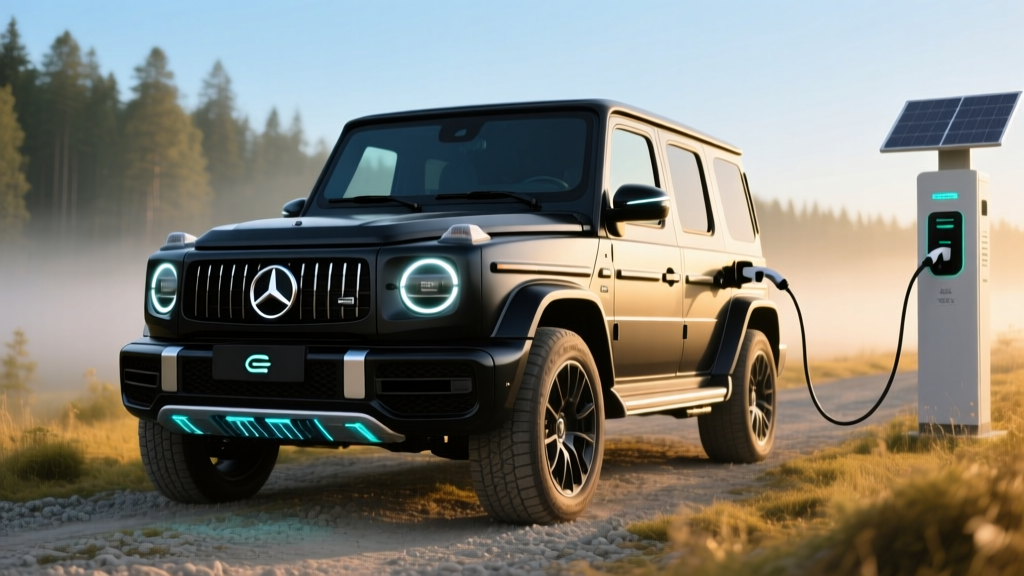
The Mercedes EQG (badged the G 580 with EQ Technology in showrooms) is the full-electric evolution of one of the most iconic off-roaders ever built. For 2026, Mercedes-Benz delivers a 116 kWh battery pack, four individually controlled electric motors, and a 0-60 mph time that defies its boxy, 6,600-pound curb weight. But the EQG was never designed to chase efficiency records — it exists to prove that an electric vehicle can match the G-Class's legendary off-road capability while adding instantaneous torque and near-silent trail crawling.
If you're cross-shopping the EQG against a Rivian R1S Quad-Motor or a Tesla Cybertruck, you're looking at a very different value proposition. The EQG starts above $150,000, carries a luxury tax burden, and prioritizes heritage and craftsmanship over range-per-dollar. Here's everything you need to know before putting down a deposit.
Range, Battery, and Real-World Efficiency
The 2026 Mercedes EQG is equipped with a 116 kWh usable lithium-ion battery using NMC (nickel-manganese-cobalt) chemistry — chosen for its high energy density, which is critical in a vehicle with the G-Wagen's aerodynamic profile. The EPA-estimated range sits at 240 miles for the standard G 580 edition.
EPA sticker: 240 miles
Real-world highway (70-80 mph): ~180–200 miles — the boxy shape creates substantial drag at speed
Cold-weather (below 30°F): ~160–180 miles — NMC chemistry loses 20–30% capacity in deep cold without consistent preconditioning
Off-road/low-speed trail use: Range extends significantly due to low speeds and heavy regen, often exceeding 260 miles equivalent
Efficiency is rated at approximately 58 MPGe combined (roughly 57 kWh/100 miles), which is low by EV standards but expected for a 6,600-lb body-on-frame SUV with the aerodynamics of a brick. For context, the Rivian R1S Quad-Motor achieves around 70 MPGe combined. If daily efficiency is your priority, the EQG is not the right tool.
| Spec | Value |
|---|---|
| EPA Range | 240 miles |
| Battery (usable) | 116 kWh, NMC chemistry |
| Efficiency | 58 MPGe / ~57 kWh/100 mi |
| Drivetrain | Quad-motor AWD (one motor per wheel) |
| Horsepower | 579 hp (432 kW) |
| 0-60 mph | 4.4 seconds |
| Top Speed | 118 mph (electronically limited) |
| Max DC Fast Charge | 200 kW |
| 10-80% DC Charge Time | ~32 minutes |
| Level 2 Charge Rate | 11 kW (~25 mi/hr) |
| Curb Weight | ~6,600 lbs |
| Towing Capacity | 7,700 lbs (estimated) |
Charging Speed: DC Fast, Level 2, and the Curve Reality
The EQG supports a peak DC fast-charge rate of 200 kW via CCS1 connector (NACS adapter available through Mercedes-Benz for Tesla Supercharger access). In optimal conditions — battery preconditioned, ambient temperature 65-80°F — the EQG can add 10-80% state of charge in approximately 32 minutes.
However, the charging curve matters more than the peak number. The EQG sustains close to 200 kW only between roughly 10-30% SoC. From 30-60%, rates taper to 150-170 kW, and above 80%, charging slows dramatically to protect the NMC cells — expect 80-100% to take an additional 25+ minutes. On a road trip, plan your stops around 10-80% cycles for the fastest turnaround.
| Charge Level | Power | Miles Added per Hour | Notes |
|---|---|---|---|
| Level 1 (120V) | 1.4 kW | ~2 mi/hr | Emergency/trickle only; full charge takes 80+ hours |
| Level 2 (240V) | 11 kW | ~25 mi/hr | Full charge in ~11 hours; ideal for overnight home charging |
| DC Fast (peak) | 200 kW | ~160 mi/hr (10-30% SoC) | Curve tapers significantly above 60%; use preconditioning |
For home charging, the 11 kW onboard charger is adequate but not class-leading. A full charge from 10% requires about 11 hours on a 48-amp Level 2 circuit. Most owners will plug in nightly and rarely need a full 0-100% cycle. Note: a 200-amp electrical panel is typically sufficient for a 48-amp Level 2 installation, but older homes may require a panel upgrade — budget $1,500-$3,000 for that contingency.
Performance: Four Motors, Tank Turns, and G-Mode
The EQG's quad-motor layout — one electric motor per wheel — produces 579 horsepower and launches the 6,600-lb SUV to 60 mph in 4.4 seconds. That's genuinely quick, though it trails the Rivian R1S Quad-Motor (3.5 seconds) and Cybertruck Cyberbeast (2.6 seconds). The EQG's advantage isn't straight-line speed; it's torque vectoring precision.
Each wheel's motor can be controlled independently, enabling features like G-Turn (a 360-degree tank turn on any surface) and G-Steering (tightening the turning radius by braking the inside wheels). The dedicated G-Mode adjusts throttle mapping, regen, and traction control for off-road crawling — and the instant torque delivery means no waiting for a transmission to find the right gear on a steep incline.
Mercedes has also engineered a simulated two-speed reduction gear for the rear motors, giving the EQG a low-range equivalent for extreme crawling. Approach, departure, and breakover angles match or slightly exceed the gas G 550, and ground clearance remains at 9.5 inches. Water fording depth is rated at 27.6 inches — slightly less than the ICE G-Class due to battery sealing considerations, but still best-in-class for electric SUVs.
Interior, Cargo, and Technology
The EQG cabin mirrors the latest G-Class interior: a 12.3-inch digital instrument cluster and a 12.3-inch central touchscreen running MBUX (Mercedes-Benz User Experience). The system supports wireless Apple CarPlay and Android Auto, over-the-air updates, and an off-road telemetry display showing pitch, roll, and individual wheel torque distribution.
Passenger space is generous for a vehicle with such a compact footprint:
- Front legroom: 41.3 inches
- Rear legroom: 38.7 inches
- Cargo volume (rear seats up): 22.6 cu ft
- Cargo volume (rear seats folded): 68.6 cu ft
The cargo area is slightly reduced compared to the ICE G-Class because the battery pack raises the floor by roughly one inch. The spare tire has been replaced by a charging cable storage compartment on the rear door — the iconic round housing remains, now repurposed.
Driver assistance includes Mercedes' Driver Assistance Package with adaptive cruise control, lane-keeping assist, active blind-spot monitoring, and evasive steering assist. This is a SAE Level 2 system — the driver must remain fully engaged at all times. It is not autonomous driving, and Mercedes does not market it as such.
Pricing, Trims, and Federal Tax Credit Eligibility
The 2026 Mercedes EQG (G 580) starts at a base MSRP of $152,900 including destination. A fully optioned Edition One launch model — with exclusive interior trim, 20-inch AMG wheels, and the MANUFAKTUR paint program — pushes the as-tested price to approximately $175,000-$185,000.
| Trim | MSRP | Federal §30D Credit | Effective Price (est.) |
|---|---|---|---|
| G 580 (base) | $152,900 | $0 — exceeds MSRP cap | $152,900 |
| G 580 Edition One | $175,000+ | $0 — exceeds MSRP cap | $175,000+ |
Federal tax credit reality: The EQG does not qualify for the IRS §30D Clean Vehicle Credit. The §30D credit caps eligible SUVs at an MSRP of $80,000. At $152,900 base, the EQG is nearly double that threshold. Additionally, buyer income caps ($300,000 joint / $150,000 single) and battery critical-mineral sourcing requirements further restrict eligibility. At this price point, buyers should consult a tax professional regarding potential state-level incentives or commercial fleet credits under §45W, but the standard consumer purchase credit is off the table.
Ownership Costs: Warranty, Insurance, and Efficiency
Mercedes-Benz provides a 4-year/50,000-mile new-vehicle limited warranty and an 8-year/100,000-mile battery warranty covering capacity retention below 70% of original. This battery warranty is standard for the luxury EV segment, though some competitors (notably Hyundai/Kia at 10 years/100,000 miles) offer longer coverage.
Insurance premiums for the EQG are significant. Expect annual costs of $4,500-$6,500 depending on your driving record, location, and coverage level — driven by the high replacement cost of the battery pack, quad-motor drivetrain, and carbon-fiber body components.
Charging costs vary by region, but at the national average of $0.16/kWh for home electricity, a full 116 kWh charge costs roughly $18.56. Public DC fast charging at $0.40-$0.50/kWh pushes that to $46-$58 per session. At 57 kWh/100 miles, the EQG costs approximately $0.09/mile on home power and $0.25/mile on public DC — comparable to a gas G 550 at current fuel prices, but without the maintenance savings of a simpler EV drivetrain (four motors mean more potential service points than a dual-motor setup).
- Unmatched off-road capability with quad-motor torque vectoring
- G-Turn and G-Steering features are genuinely useful on tight trails
- Iconic G-Class styling with premium MBUX interior
- Instant torque delivery transforms rock-crawling precision
- Quiet operation preserves the outdoor experience on trails
- 7,700-lb towing capacity (est.) exceeds most electric SUVs
- 240-mile EPA range is low; highway range drops to ~185 miles
- 58 MPGe means high electricity costs per mile
- $152,900+ MSRP — no federal tax credit eligibility
- 200 kW peak charge rate trails rivals (Rivian R1S: 220+ kW)
- Heavy curb weight (6,600 lbs) increases tire wear
- Cargo floor raised slightly vs. ICE G-Class
Who Should Buy the 2026 Mercedes EQG?
The EQG is a purpose-built vehicle for a narrow buyer profile. It's ideal if you:
- Want an electric off-roader with heritage: No other EV carries the G-Class's 45-year legacy and build quality.
- Prioritize trail capability over range: The quad-motor system and G-Mode make this the most capable electric off-roader available, even if you'll need to plan charging on longer overlanding trips.
- Have home charging and a short daily commute: The 240-mile range is perfectly adequate for daily driving if you charge at home overnight.
- Budget is flexible: At $150K+, this is a luxury purchase, not an efficiency play.
Look elsewhere if you need 300+ miles of range, want to minimize per-mile energy costs, or need a third row (the EQG seats five only). The Rivian R1S offers more range (up to 352 miles EPA with Max Pack), faster charging, three rows, and starts at $79,900 — making it the more practical electric family SUV. The EQG wins on exclusivity, craftsmanship, and off-road precision.
Frequently Asked Questions
What is the real-world range of the Mercedes EQG?
The EPA rates the EQG at 240 miles. In real-world highway driving at 70-80 mph, expect 180-200 miles. In cold weather (below 30°F), range can drop to 160-180 miles. Off-road at low speeds, range can exceed the EPA estimate due to regenerative braking.
How fast does the EQG charge at home and on the road?
On a Level 2 home charger (11 kW), the EQG adds about 25 miles per hour, fully charging in roughly 11 hours. On a DC fast charger, it peaks at 200 kW and charges 10-80% in about 32 minutes with a preconditioned battery.
Does the Mercedes EQG qualify for the $7,500 federal EV tax credit?
No. The IRS §30D credit caps eligible SUVs at $80,000 MSRP. The EQG starts at $152,900, far exceeding this limit. Consult a tax professional about state incentives or §45W commercial credits.
Is the EQG worth buying over the Rivian R1S or Tesla Cybertruck?
If your priorities are luxury, heritage, and off-road precision, the EQG is unmatched. If you need more range, lower cost, or family practicality (third row), the Rivian R1S is the stronger value. The Cybertruck offers more performance and range at a lower price but lacks the EQG's interior refinement.
Can the EQG really do tank turns?
Yes. The G-Turn feature spins the vehicle 360 degrees in place by driving the left and right wheels in opposite directions. It works on dirt, gravel, and pavement — though Mercedes recommends using it primarily on loose surfaces to minimize tire wear.