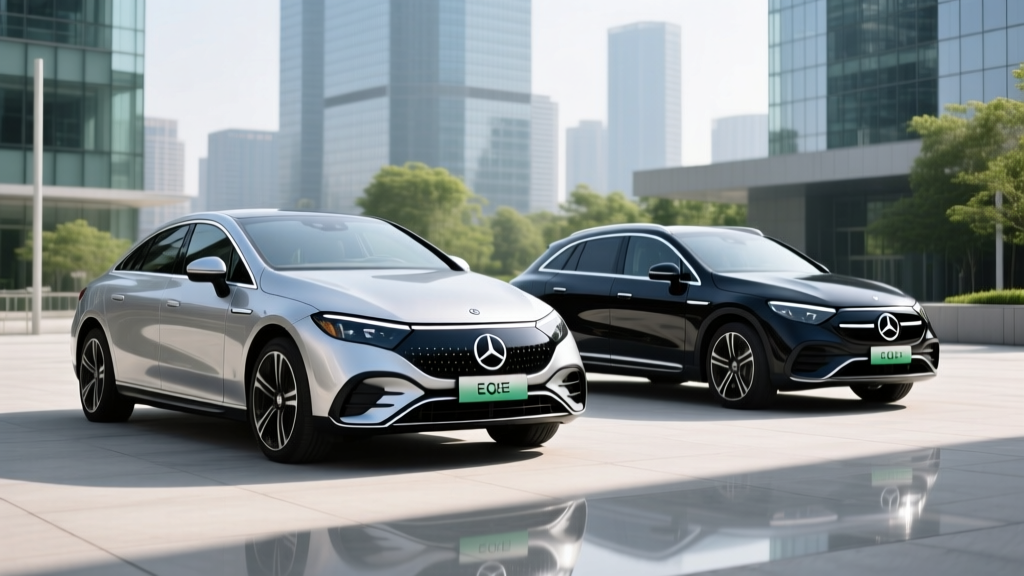
Mercedes-Benz's decision to end production of the EQE sedan and EQE SUV marks one of the most significant shakeups in the luxury electric vehicle segment. After a brief run that began with the 2023 model year, the Mercedes EQE and EQE SUV discontinuation leaves a gap in the mid-size luxury EV market that buyers and dealers are now scrambling to navigate. Whether you're considering a leftover 2025 model on a dealer lot, eyeing a certified pre-owned example, or pivoting to a competitor, this guide gives you the exact specs, real-world performance data, and ownership economics you need to make an informed decision.
Why Mercedes Discontinued the EQE and EQE SUV
Mercedes-Benz confirmed in late 2024 that it would streamline its EV lineup, consolidating its electric sedan offerings around the larger EQS and upcoming next-generation models built on the new MB.EA platform. The EQE sedan and EQE SUV, despite sharing the sophisticated EVA2 architecture with the EQS, struggled with soft sales relative to their more affordable competitors like the BMW i5, Tesla Model S, and Genesis Electrified G80. The EQE SUV faced an even tougher battle against the wildly popular BMW iX and Tesla Model X.
For buyers, this creates a unique opportunity: remaining new inventory often carries aggressive dealer discounts, and CPO examples can represent strong value — provided you understand exactly what you're getting and the long-term implications of buying a discontinued model.
EQE Sedan and EQE SUV: Complete Spec Breakdown
| Specification | EQE 350+ Sedan | EQE 350+ SUV |
|---|---|---|
| EPA Range | 305 miles | 279 miles |
| Battery (Usable) | 90.6 kWh | 90.6 kWh |
| Battery Chemistry | NMC (Nickel Manganese Cobalt) | NMC |
| Drivetrain | RWD (single motor) | RWD (single motor) |
| Horsepower | 288 hp | 288 hp |
| Torque | 417 lb-ft | 417 lb-ft |
| 0-60 mph | 6.2 seconds | 6.4 seconds |
| Max DC Fast Charge | 170 kW | 170 kW |
| 10-80% DC Charge Time | ~32 minutes | ~32 minutes |
| Level 2 Charge Rate | 9.6 kW (AC) | 9.6 kW (AC) |
| MPGe (Combined) | 94 MPGe | 84 MPGe |
| Efficiency | 36 kWh/100 mi | 40 kWh/100 mi |
| Cargo Volume | 15.0 cu ft (trunk) | 55.0 cu ft (rear seats folded) |
| Rear Legroom | 38.0 in | 39.5 in |
| Base MSRP | $76,050 | $79,050 |
| Battery/Powertrain Warranty | 8 yr / 100,000 mi | 8 yr / 100,000 mi |
The AWD variants — the EQE 350 4MATIC and EQE 500 4MATIC — offered dual-motor setups with 288 hp and 402 hp respectively, with ranges dropping to approximately 260 miles (sedan 4MATIC) and 240 miles (SUV 500 4MATIC). The AMG EQE sedan pushed 617 hp and a 3.2-second 0-60 but with a steep $106,900 starting price and range dropping to around 220 miles.
Real-World Range: What the EPA Number Doesn't Tell You
EQE 350+ Sedan: EPA 305 miles. Expect 260-280 miles on a mixed highway trip at 70-80 mph. In freezing temperatures (below 32°F), plan for 210-240 miles due to battery thermal demands and cabin heating. City driving with regenerative braking can push close to or slightly above the EPA figure.
EQE 350+ SUV: EPA 279 miles. Highway cruising yields roughly 235-255 miles. Cold weather drops this to approximately 195-220 miles. The SUV's taller, less aerodynamic profile and higher curb weight (about 5,600 lbs vs. 5,400 lbs for the sedan) account for the efficiency penalty.
According to fueleconomy.gov, the EQE 350+ sedan achieves 94 MPGe combined, which translates to 36 kWh per 100 miles. That's respectable for a luxury sedan but trails the Tesla Model S (124 MPGe) and the BMW i5 eDrive40 (105 MPGe). The EQE SUV's 84 MPGe combined reflects the aerodynamic cost of its crossover body style.
The 90.6 kWh usable battery (NMC chemistry) provides a solid energy reservoir, but the EVA2 platform's thermal management system is slightly less aggressive at preconditioning compared to Hyundai's E-GMP or Tesla's system. In our experience, preconditioning the battery via the Mercedes me app before arriving at a DC fast charger is essential to hitting peak charge rates, especially in cool weather.
Charging Performance: DC Fast and Home Level 2
Charging speed is where the EQE's age relative to newer competitors becomes apparent. The 170 kW peak DC fast-charge rate was competitive at launch but now trails vehicles like the Hyundai Ioniq 6 (peak 240 kW on 800V architecture) and the Porsche Taycan (peak 270 kW). Here's what the charging experience looks like in practice:
| Charge Level | Power | Miles Added per Hour | Full Charge Time |
|---|---|---|---|
| Level 1 (120V household) | ~1.4 kW | ~4 mi/hr | ~65 hours (0-100%) |
| Level 2 (240V, 40A circuit) | 9.6 kW | ~28 mi/hr | ~9.5 hours (0-100%) |
| DC Fast Charge (peak) | 170 kW | N/A | ~32 min (10-80%) |
| DC Fast Charge (sustained avg) | ~110-120 kW | N/A | ~50 min (10-90%) |
The charging curve matters more than the peak number. The EQE hits its 170 kW peak briefly between roughly 10-25% state of charge, then tapers progressively. Between 25-50%, expect sustained rates around 130-140 kW; from 50-80%, it drops to approximately 90-100 kW. This means the advertised 32-minute 10-80% time assumes optimal battery temperature and a capable 350 kW charger. At a 150 kW Electrify America or EVgo station, plan for 38-42 minutes for the same 10-80% session.
At home on a Level 2 Wallbox or ChargePoint Home Flex unit (240V, 48A circuit, delivering 9.6 kW to the vehicle), a depleted EQE will fully recharge overnight in about 9.5 hours. Most owners who plug in nightly with 30-50% remaining will wake up to a full battery every morning. Home Level 2 installation typically runs $1,200-$2,500 depending on panel capacity and conduit distance — factor this into your total purchase budget.
Pricing, Tax Credits, and the Discontinuation Discount
The final MSRP for the 2025 EQE 350+ sedan started at $76,050 (including destination), with the EQE 350+ SUV at $79,050. Higher trims climbed steeply: the EQE 500 4MATIC SUV started around $89,050, and the AMG EQE sedan began at $106,900.
| Model / Trim | Base MSRP | §30D Credit Eligible? | Effective Price (with credit) |
|---|---|---|---|
| EQE 350+ Sedan | $76,050 | No — MSRP exceeds $55,000 sedan cap | $76,050 |
| EQE 350+ SUV | $79,050 | Yes — qualifies under $80,000 SUV/van/truck cap* | ~$71,550 |
| EQE 350 4MATIC SUV | $82,050 | No — exceeds $80,000 SUV cap | $82,050 |
| EQE 500 4MATIC SUV | $89,050 | No — exceeds $80,000 SUV cap | $89,050 |
| AMG EQE Sedan | $106,900 | No — exceeds $55,000 sedan cap | $106,900 |
Critical tax credit caveat: Under IRS §30D rules (see irs.gov), the EQE 350+ SUV can qualify for up to $7,500 in federal tax credits because it is classified as an SUV and falls under the $80,000 MSRP cap. However, eligibility depends on meeting critical-mineral and battery-component sourcing requirements, plus buyer income limits ($300,000 joint / $150,000 single modified AGI). The point-of-sale transfer option allows qualifying buyers to apply the credit as an immediate price reduction at the dealership. Always confirm eligibility with your tax professional before relying on the credit.
The EQE sedan, classified as a passenger car, faces the $55,000 MSRP cap — meaning no EQE sedan trim qualifies. This pricing structure was a significant headwind for EQE sedan sales and one factor in the discontinuation.
Tech, Interior, and Driver Assistance
The EQE cabin showcases Mercedes at its technology-forward best. The standard MBUX infotainment system runs on a 12.8-inch OLED central touchscreen with a 12.3-inch digital instrument cluster. Optional is the striking MBUX Hyperscreen — a 56-inch curved glass panel spanning the entire dashboard width, integrating three displays under a single glass surface. It's visually impressive, though some users find the multi-layered menu system distracting while driving.
Driver assistance comes via Mercedes' Driver Assistance Package, which includes:
- Active Distance Assist DISTRONIC (adaptive cruise with stop-and-go)
- Active Steering Assist (lane centering)
- Active Lane Change Assist
- Active Emergency Stop Assist
- Pre-Safe Plus (rear collision preparation)
This is an SAE Level 2 system — it requires continuous driver attention and hands-on-wheel supervision. It is not self-driving. The system performs competently on highways, with smooth lane-keeping and natural adaptive cruise behavior, but it does not match the hands-free capability of GM's Super Cruise or Ford's BlueCruise on mapped highways.
Standout features include rear-axle steering (up to 10 degrees, dramatically shrinking the turning circle to a compact-car-like 35 feet), Energizing Comfort programs that synchronize seat massage, ambient lighting, and climate, and available Burmester 3D surround sound with Dolby Atmos. The optional DIGITAL LIGHT headlamps project navigation arrows and hazard warnings directly onto the road surface.
Notable drawbacks: The trunk opening on the sedan is relatively narrow for the class (15.0 cu ft, and the opening shape limits bulky items). The regenerative braking paddle system requires a learning curve — one-pedal driving is available but not the default. And the touch-sensitive steering wheel controls are a frequent complaint, prone to accidental inputs.
Pros and Cons: The Honest Assessment
- Exceptionally quiet, refined ride quality — among the best in the luxury EV segment
- Rear-axle steering makes it remarkably maneuverable in urban settings
- Strong build quality and premium materials throughout
- 305-mile EPA range (sedan) is competitive for the class
- Robust 8-year/100,000-mile battery and powertrain warranty
- Discontinuation may create steep dealer discounts on remaining inventory
- 170 kW peak DC charging trails newer competitors (240-350 kW)
- Sedan does not qualify for the $7,500 federal tax credit (MSRP cap)
- MBUX Hyperscreen looks great but adds complexity and potential distraction
- Discontinued status raises long-term parts availability and resale value concerns
- Efficiency (36-40 kWh/100 mi) lags behind more aerodynamic rivals
- Touch-sensitive steering wheel controls frustrate many owners
Who Should Buy the EQE — and Who Should Look Elsewhere
Buy the EQE if: You prioritize ride comfort and cabin quietness above all else, you can find a remaining new unit at a meaningful discount, you have reliable home Level 2 charging (so the slower DC rate matters less), and you value Mercedes' dealer service network and 8-year warranty backing.
Look elsewhere if: You take frequent road trips where 32-minute charge stops become a liability (consider the BMW i5 or Hyundai Ioniq 6 for faster charging), you need the federal tax credit to make the math work (the sedan doesn't qualify), or you're concerned about long-term resale value on a discontinued nameplate.
Key competitors to cross-shop:
- BMW i5 eDrive40 ($70,200, EPA 295 mi, 205 kW DC charging) — sportier handling, similar luxury, slightly less range
- Tesla Model S ($79,990, EPA 402 mi, 250 kW DC charging) — superior range and charging, less traditional luxury feel
- Genesis Electrified G80 ($79,825, EPA 282 mi, 350 kW DC charging) — fastest charging in class, strong value, limited dealer network
- BMW iX xDrive50 ($87,250, EPA 324 mi, 195 kW DC charging) — if you want the SUV form factor with better range
Warranty, Parts, and Long-Term Ownership After Discontinuation
Mercedes-Benz backs the EQE's high-voltage battery and electric powertrain with an 8-year/100,000-mile warranty that guarantees at least 70% of original capacity retention. This is industry-standard and remains fully in effect regardless of discontinuation status. The basic vehicle warranty covers 4 years/50,000 miles.
On the parts question: Mercedes is legally obligated to maintain parts supply for a minimum period after discontinuation (typically 10+ years for structural and safety components). The EVA2 platform shares significant components with the EQS, which remains in production, so many drivetrain and battery parts will continue to be available. Body panels, trim pieces, and model-specific interior components may become harder to source over time — a factor worth considering if you plan to keep the vehicle beyond the warranty period.
For resale value, discontinued luxury EVs historically take a depreciation hit in the first 2-3 years after announcement before stabilizing. If you plan to own the EQE for 5+ years, this matters less. If you trade every 3 years, expect steeper depreciation than a continuing model.
Frequently Asked Questions
What is the real-world range of the Mercedes EQE?
The EQE 350+ sedan delivers an EPA-estimated 305 miles, but real-world highway driving at 70-80 mph typically yields 260-280 miles. In cold weather (below freezing), expect 210-240 miles. The EQE 350+ SUV is rated at 279 miles EPA, with real-world highway range around 235-255 miles and cold-weather range approximately 195-220 miles.
How fast does the EQE charge at home and on the road?
At home on a Level 2 charger (240V, 9.6 kW), the EQE adds roughly 28 miles of range per hour and fully recharges in about 9.5 hours. On DC fast chargers, it peaks at 170 kW and can go from 10-80% in approximately 32 minutes under ideal conditions, though real-world sessions at 150 kW chargers typically take 38-42 minutes due to charge-curve tapering above 50% SoC.
Does the Mercedes EQE qualify for the federal EV tax credit?
Only the EQE 350+ SUV (base MSRP $79,050) can potentially qualify for up to $7,500 under the IRS §30D credit, because it is classified as an SUV under the $80,000 MSRP cap. All EQE sedan trims exceed the $55,000 sedan MSRP cap and do not qualify. Even for the SUV, eligibility depends on battery-sourcing requirements, buyer income limits ($300K joint / $150K single AGI), and the vehicle being purchased new from a dealer. Consult a tax professional and check current rules at irs.gov.
Is it worth buying a discontinued EV like the EQE?
It can be, if the price is right. Discontinued models often see aggressive dealer discounts of $5,000-$15,000 off MSRP on remaining inventory. The 8-year battery/powertrain warranty remains fully valid, and Mercedes must maintain parts availability. However, expect steeper initial depreciation and potentially longer wait times for model-specific body or trim parts down the road. If you plan to own the car 5+ years and secure a strong discount, the value proposition can be compelling.
What should I buy instead of the Mercedes EQE?
For a luxury electric sedan, the BMW i5 eDrive40 offers comparable refinement with faster 205 kW charging and a lower starting price. The Tesla Model S provides vastly superior range (402 mi EPA) and DC charging speed. For the SUV form factor, the BMW iX xDrive50 delivers more range (324 mi EPA) and continues in production. The Genesis Electrified G80 offers the fastest DC charging in the class at 350 kW, though its dealer network is smaller.
Will Mercedes replace the EQE with a new model?
Mercedes has indicated that its next-generation mid-size electric sedan will be built on the new MB.EA platform, expected to debut around 2027. Details are preliminary, but the successor is expected to feature improved efficiency, faster 800V charging architecture, and next-generation MBUX. No official name, pricing, or specs have been confirmed as of early 2026.
Sources: EPA fuel economy data via fueleconomy.gov, Mercedes-Benz USA specifications, IRS §30D clean vehicle credit rules via irs.gov. Pricing reflects final 2025 model year MSRP. Tax credit eligibility subject to change — verify current rules before purchase.