Quick Verdict: The Mercedes-AMG EQE in 2026
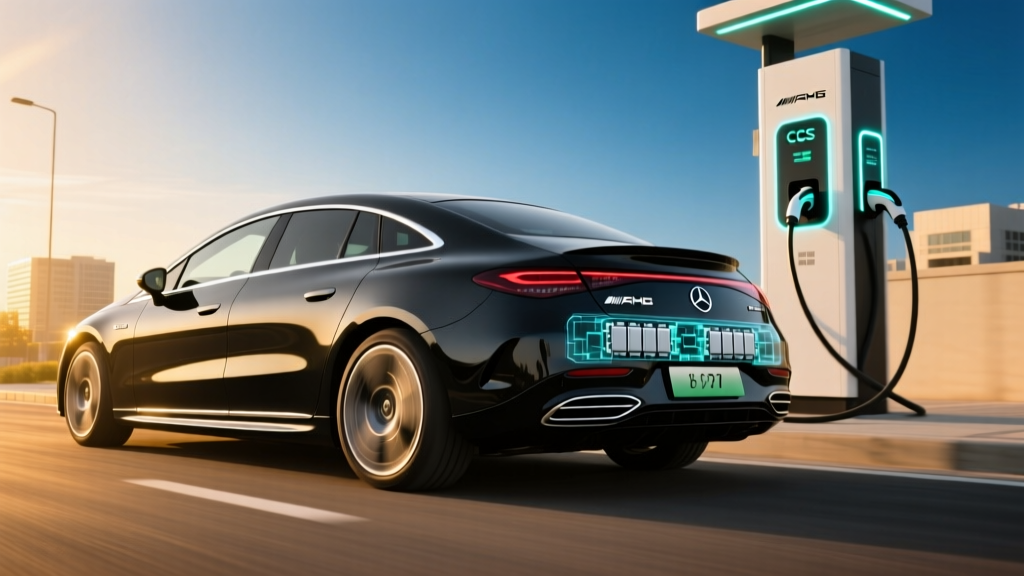
The 2026 Mercedes-AMG EQE sedan occupies a narrow but compelling lane: it's a luxury performance EV that prioritizes autobahn-bred composure over raw efficiency. With dual-motor AWD producing up to 677 horsepower (with Race Start engaged), a 90.6 kWh usable NMC battery, and a starting MSRP around $108,550, it targets buyers who want AMG dynamics without the V8 rumble. But at an EPA-estimated 230 miles of range and 79 MPGe combined, it trades efficiency for thrust — a calculation worth examining before you sign.
EPA Estimate: 230 miles (AMG EQE 53 4MATIC+)
Real-World Expectation: Plan for 195–215 miles on mixed highway driving at 70+ mph. In cold weather (below 35°F), expect 170–190 miles without aggressive preconditioning. City/regen-heavy driving can push closer to 240 miles. The AMG EQE's performance tuning and wider tires penalize efficiency compared to the standard EQE 350.
This review covers the AMG EQE 53 4MATIC+ sedan — the volume AMG variant for the US market. We'll break down exact charging speeds, real-world ownership economics, and whether this electrified AMG justifies its six-figure ask against rivals like the Porsche Taycan, BMW i5 M60, and Tesla Model S Plaid.
Spec Sheet: 2026 Mercedes-AMG EQE 53 4MATIC+
| Specification | Value |
|---|---|
| EPA Range | 230 miles |
| Battery (Usable) | 90.6 kWh, NMC (nickel manganese cobalt) |
| Drivetrain | Dual-motor AWD (4MATIC+) |
| Horsepower | 617 hp (677 hp w/ Race Start overboost) |
| Torque | 701 lb-ft (738 lb-ft w/ Race Start) |
| 0–60 mph | 3.3 seconds (manufacturer) |
| Top Speed | 149 mph (electronically limited) |
| Max DC Fast Charge | 170 kW (CCS1) |
| 10–80% DC Charge Time | ~32 minutes |
| Level 2 AC Charge Rate | 9.6 kW (adds ~28 mi/hr) |
| EPA Efficiency | 79 MPGe combined / 43 kWh/100 mi |
| Cargo Volume | 15.2 cu ft (trunk) |
| Rear Legroom | 38.2 inches |
| Curb Weight | ~5,600 lbs |
| Battery/Powertrain Warranty | 8 years / 100,000 miles |
| Base MSRP | $108,550 (before destination) |
Range and Efficiency: What You'll Actually See
The EPA's 230-mile figure for the AMG EQE 53 lands well below the standard EQE 350+ (which achieves up to 305 miles on its RWD configuration). The gap comes from three factors: the AMG's dual-motor AWD system adds weight and mechanical drag, its stickier performance tires increase rolling resistance, and its more aggressive powertrain calibration prioritizes response over conservation.
At a sustained 75 mph on flat interstate, expect the AMG EQE to consume roughly 46–49 kWh/100 miles, translating to approximately 185–200 miles of practical range before you'd want to stop. The car's thermal management system is robust — Mercedes uses a sophisticated heat pump and liquid-cooled battery loop that conditions the pack efficiently in both hot and cold climates. Still, NMC chemistry loses roughly 15–25% of capacity in sub-freezing temperatures, and highway speeds compound that loss.
The 43 kWh/100 mi combined EPA figure means the AMG EQE costs approximately $0.14–$0.18 per mile to charge at home (at $0.13–$0.17/kWh national average). On public DC fast chargers at $0.35–$0.48/kWh (common Electrify America and EVgo pricing), your cost per mile jumps to $0.15–$0.21. For comparison, a BMW M5 getting 18 mpg combined at $3.50/gallon costs about $0.19 per mile — so the AMG EQE is cheaper to fuel at home but roughly comparable on road trips.
Charging Speed: DC Fast and Level 2 Breakdown
| Charging Level | Max Power | Connector | Speed / Time |
|---|---|---|---|
| Level 1 (120V household) | ~1.4 kW | J1772 | ~4 miles per hour |
| Level 2 (240V home/public) | 9.6 kW | J1772 | ~28 miles per hour; full charge in ~10 hrs |
| DC Fast Charging | 170 kW peak | CCS1 | 10–80% in ~32 min; adds ~130 mi in 20 min |
The AMG EQE's 170 kW peak DC fast-charge rate is its most debated spec. For a $108,000+ performance sedan in 2026, it trails rivals: the Porsche Taycan peaks at 320 kW (800V architecture), the Hyundai Ioniq 5 N hits 240 kW, and the Lucid Air exceeds 300 kW. Mercedes' 400V electrical architecture limits peak charge rate, and the charging curve tapers noticeably above 60% State of Charge (SoC).
Here's what the charge curve actually looks like in practice: from 10% SoC, the AMG EQE pulls close to 170 kW for roughly the first 15–20% of the charge, then gradually steps down. Between 60–80%, you'll see 80–100 kW. Above 80%, charging drops below 50 kW — so topping off from 80–100% adds another 25+ minutes. For road-trip planning, plan 30-minute stops every 170–190 miles of highway driving.
At home on a 48-amp Level 2 charger (like a ChargePoint Home Flex or Wallbox Pulsar Plus hardwired to a 60-amp circuit), the 9.6 kW onboard charger replenishes the 90.6 kWh battery from empty in roughly 10 hours. Most owners will arrive home at 30–50% SoC and wake up fully charged — home charging is where the AMG EQE works perfectly well.
One note: the AMG EQE uses the CCS1 connector. Mercedes has confirmed NACS (Tesla-style) adoption for future models, but the 2026 AMG EQE retains CCS1. You'll need a CCS-to-NACS adapter for Tesla Supercharger access, and Mercedes does provide one with the vehicle.
Performance and Driving Dynamics
With 617 horsepower standard (677 with Race Start launch control), the AMG EQE 53 delivers the kind of effortless, surge-of-torque acceleration that defines performance EVs. The 3.3-second 0–60 time is genuinely quick — faster than the outgoing AMG E 63 S sedan — and the instant torque delivery makes it feel even quicker in rolling highway pulls.
Mercedes-AMG tunes the dual-motor system with a rear bias under normal conditions, and the torque vectoring can shift up to 100% of power to either axle. The result is neutral, composed handling that belies the car's 5,600-pound curb weight. AMG-tuned air suspension with adaptive dampers manages body roll effectively in Sport+ mode, and the standard rear-axle steering (up to 3.6 degrees) tightens the turning radius to a manageable 35.4 feet.
Regenerative braking offers three levels via steering-wheel paddles, including a one-pedal-driving mode that brings the car to a complete stop. The brake pedal feel — a common weakness in heavy EVs — is well-calibrated here, with a firm initial bite and predictable blending between regen and friction brakes.
The trade-off is ride comfort. In Sport+ the AMG EQE transmits more road imperfections than a standard EQE, and the 21-inch AMG wheels (standard on the 53) generate noticeable road noise on coarse-paved highways. This is a performance sedan that communicates road surface — for better or worse.
Interior, Tech, and Cargo
The AMG EQE cabin mirrors the standard EQE's architecture but adds AMG-specific sport seats, a flat-bottom steering wheel, AMG digital instrument themes, and available carbon-fiber or microfiber trim. The centerpiece remains the available MBUX Hyperscreen — a 56-inch curved glass panel spanning the dashboard with three zones: a 12.3-inch driver cluster, a 17.7-inch central OLED touchscreen, and a 12.3-inch passenger display.
The MBUX infotainment system runs wirelessly with Apple CarPlay and Android Auto, includes natural-language voice control ("Hey Mercedes"), and supports over-the-air updates. Navigation includes EV-specific route planning that factors in charging stops, battery preconditioning for fast charging, and real-time charger availability via Mercedes me Charge.
Driver assistance comes via Mercedes' Driver Assistance Package, which includes adaptive cruise control with stop-and-go, active lane-keeping, automated lane changes, and evasive steering assist. This is an SAE Level 2 system — the driver must remain attentive with hands on or near the wheel at all times. It is not self-driving.
Cargo space measures 15.2 cubic feet in the trunk — competitive with the BMW 5 Series but less than a Tesla Model S (28 cu ft with hatchback). There is no front trunk (frunk); the space under the hood houses drive electronics. Rear legroom of 38.2 inches accommodates adults comfortably, though the sloping roofline reduces rear headroom for passengers over 6 feet.
Pricing, Trims, and Federal Tax Credit Eligibility
The 2026 Mercedes-AMG EQE 53 4MATIC+ starts at approximately $108,550 (including destination). Key option packages include:
- AMG Night Package: ~$2,500 (blacked-out trim)
- MBUX Hyperscreen: ~$3,500 (if not standard on your configuration)
- AMG Performance Package: ~$5,000 (Race Start, AMG exhaust sound, upgraded brakes)
- Rear-Axle Steering: standard on 53
A well-equipped build with Hyperscreen, performance package, and premium leather typically lands between $118,000–$125,000 before incentives.
| Item | Amount |
|---|---|
| Base MSRP (AMG EQE 53) | $108,550 |
| Typical As-Tested | $118,000–$125,000 |
| Federal §30D Tax Credit | $0 (exceeds MSRP cap) |
| Estimated Out-of-Pocket | $108,550–$125,000 |
The IRS §30D Clean Vehicle Credit imposes an MSRP cap of $55,000 for sedans. The AMG EQE, at $108,550, far exceeds this threshold and does not qualify for the up-to-$7,500 federal credit. Additionally, buyers must meet income caps ($150,000 single / $300,000 joint MAGI) and the vehicle must meet battery critical-mineral and component sourcing requirements. Even if the MSRP cap didn't disqualify it, the AMG EQE's battery sourcing may not satisfy current-year rules. Always consult a tax professional and verify current IRS guidance before purchase.
Some states offer additional incentives that aren't bound by the federal MSRP cap — check your state's energy office or the fueleconomy.gov incentive tool for local programs.
Competitor Comparison: Is the AMG EQE Worth It?
The AMG EQE competes against a sharp field of performance EV sedans. Here's how it stacks up on the metrics that matter:
| Metric | AMG EQE 53 | Porsche Taycan GTS | BMW i5 M60 | Tesla Model S Plaid |
|---|---|---|---|---|
| EPA Range | 230 mi | 246 mi | 256 mi | 359 mi |
| 0–60 mph | 3.3 sec | 3.5 sec | 3.7 sec | 1.99 sec |
| Horsepower | 617 hp | 590 hp | 593 hp | 1,020 hp |
| Peak DC Charge | 170 kW | 320 kW | 205 kW | 250 kW |
| Base MSRP | $108,550 | $111,900 | $84,100 | $89,990 |
| Efficiency (MPGe) | 79 | 83 | 86 | 120 |
The AMG EQE wins on: Interior luxury and material quality, MBUX Hyperscreen technology, AMG brand cachet, ride composure in comfort modes.
The AMG EQE loses on: Range, charging speed, efficiency, and price-per-horsepower. The Porsche Taycan charges nearly twice as fast (800V architecture), the Tesla Model S Plaid is absurdly quicker and goes 130 miles farther, and the BMW i5 M60 undercuts on price by $24,000 while offering more range.
- You prioritize cabin luxury, quietness, and material quality over spec-sheet dominance
- You mostly drive within 150 miles of home and charge overnight on Level 2
- AMG brand identity matters to you and you want something less common than a Tesla
- You value composed ride quality in daily driving with performance available on demand
- Road-trip range and fast charging are top priorities (Taycan or Model S)
- You want the best performance-per-dollar (Model S Plaid or i5 M60)
- Federal tax credit eligibility matters to your purchase math
- You need hatchback cargo versatility (Model S or Taycan Sport Turismo)
Pros and Cons
- Refined, luxurious cabin with available Hyperscreen
- Composed ride quality with adaptive air suspension
- Strong 617–677 hp with instant electric torque
- Robust thermal management for battery longevity
- Rear-axle steering improves maneuverability
- 8-year/100,000-mile battery warranty
- 230-mile EPA range trails competitors significantly
- 170 kW peak DC charging is slow for the price class
- No federal tax credit (exceeds $55K sedan MSRP cap)
- Low efficiency (79 MPGe) raises road-trip fuel costs
- No frunk; limited cargo versatility vs hatchback rivals
- High starting price vs i5 M60 and Model S Plaid
Ownership and Warranty
Mercedes backs the AMG EQE with a 4-year/50,000-mile limited vehicle warranty and an 8-year/100,000-mile high-voltage battery warranty. The battery warranty guarantees the pack will retain at least 70% of its original capacity during the coverage period — if degradation exceeds 30%, Mercedes will repair or replace the battery at no cost. Based on NMC chemistry track records in the EQS and other Mercedes EVs, real-world degradation over 8 years is expected to be in the 10–15% range under normal use.
Insurance costs for the AMG EQE are significant — expect $3,500–$5,000 annually depending on your profile, location, and coverage level. This is in line with the Porsche Taycan but higher than the BMW i5 M60.
Maintenance is minimal compared to an AMG E 63 — no oil changes, no spark plugs, reduced brake wear from regenerative braking. Mercedes offers complimentary maintenance for the first 2 years/20,000 miles on new EVs. Expect tire replacement to be your largest recurring cost; the AMG EQE's 21-inch performance tires run $350–$500 each and typically last 20,000–30,000 miles.
Frequently Asked Questions
What is the real-world range of the Mercedes-AMG EQE?
The EPA rates the AMG EQE 53 at 230 miles, but real-world highway driving at 70–80 mph typically yields 195–215 miles. In cold weather (below 35°F), plan for 170–190 miles. City driving with regenerative braking can push closer to 240 miles. The AMG's performance tires and dual-motor AWD reduce efficiency compared to the standard EQE 350+.
How fast does the AMG EQE charge at home and on DC fast chargers?
On a Level 2 home charger (9.6 kW), the AMG EQE adds approximately 28 miles of range per hour, charging from empty to full in about 10 hours. On DC fast chargers, it peaks at 170 kW and charges from 10–80% in roughly 32 minutes. The 400V architecture limits peak speed compared to 800V competitors like the Porsche Taycan (320 kW).
Does the Mercedes-AMG EQE qualify for the federal EV tax credit?
No. The IRS §30D Clean Vehicle Credit caps eligible sedans at $55,000 MSRP. The AMG EQE starts at $108,550 and does not qualify. Additionally, buyers must meet income limits and the vehicle must satisfy battery-sourcing requirements. Check IRS.gov for current rules and consult a tax professional.
Is the AMG EQE worth buying over the Porsche Taycan or Tesla Model S?
It depends on priorities. The AMG EQE excels in cabin luxury, ride comfort, and daily composure. The Porsche Taycan charges much faster and handles more sharply on a track. The Tesla Model S Plaid offers dramatically more range (359 mi), faster acceleration (1.99 sec 0–60), and a lower starting price. If luxury and brand prestige outweigh spec-sheet performance, the AMG EQE is compelling. If range and charging speed matter more, look at the Taycan or Model S.
What's the biggest drawback of the AMG EQE?
The combination of limited range (230 mi EPA) and modest DC fast-charge speed (170 kW peak) makes road-trip planning more demanding than in competitors. You'll stop more often and wait longer at chargers than a Taycan owner. For a $108,000+ performance sedan, that's a meaningful practical compromise.
Who is the Mercedes-AMG EQE best suited for?
The AMG EQE fits a buyer who wants a luxurious daily-driver sedan with strong performance, mostly drives within 150 miles of home, has reliable Level 2 home charging, and values Mercedes-AMG brand identity. It's less suited for frequent long-distance travelers, efficiency-focused buyers, or those who need maximum cargo versatility.