Quick Verdict: The Executive EV Sedan That Prioritizes Comfort Over Curb Appeal
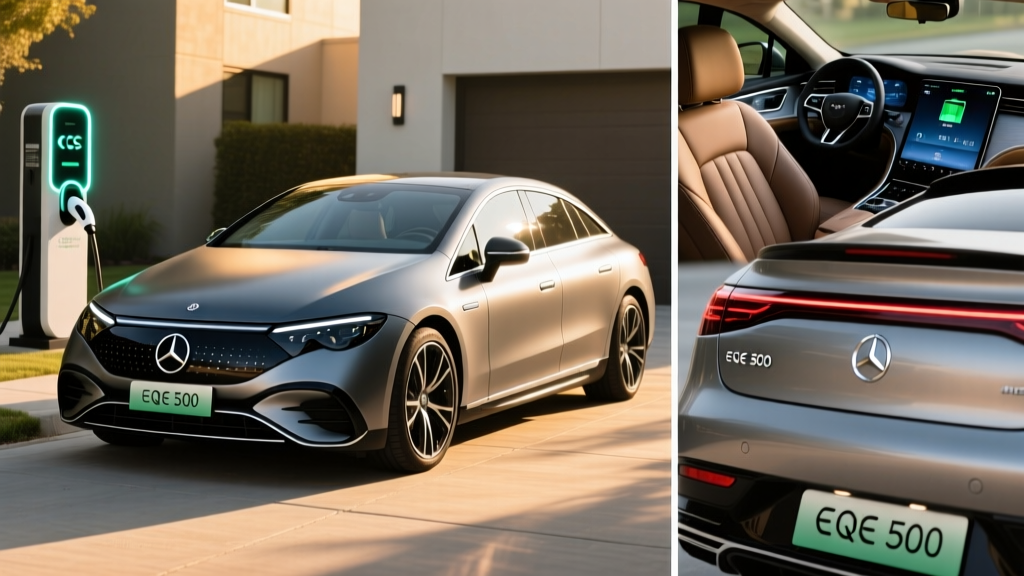
The Mercedes-Benz EQE 500 4MATIC occupies a narrow but deliberate lane in the luxury EV market: a mid-size electric sedan tuned for highway serenity, cabin isolation, and understated status rather than headline-grabbing performance. With dual motors producing 536 horsepower, a usable 90.6 kWh NMC battery, and an EPA-estimated 305 miles of range, it competes directly with the BMW i5 M60, Audi e-tron GT, and Tesla Model S — yet each rival makes fundamentally different compromises.
After spending time with the EQE 500 across highway commutes, DC fast-charging stops, and cold-weather driving, the picture is clear: this is a superb long-distance cruiser that trades maximum efficiency and cargo versatility for ride quality and cabin refinement. If your EV purchase centers on serene daily driving and occasional 300-mile road trips, the EQE 500 delivers. If you prioritize sporty dynamics, cutting-edge infotainment responsiveness, or maximum value per dollar, other options in this segment make stronger cases.
| Specification | 2026 Mercedes EQE 500 4MATIC |
|---|---|
| EPA Range | 305 miles |
| Battery (Usable) | 90.6 kWh, NMC chemistry |
| Drivetrain | Dual-motor AWD (4MATIC) |
| Horsepower / Torque | 536 hp / 564 lb-ft |
| 0–60 mph | 4.5 seconds |
| Peak DC Fast Charge | 170 kW (CCS1) |
| 10–80% DC Charge Time | ~32 minutes |
| Level 2 Charge Rate | 9.6 kW (~28 mi/hr) |
| EPA Efficiency | 84 MPGe (combined) / 40 kWh/100mi |
| Cargo Volume | 15.0 cu ft (trunk) |
| Base MSRP | $87,350 |
| Battery Warranty | 10 years / 155,000 miles |
Range, Efficiency, and Real-World Expectations
The EPA rates the 2026 EQE 500 4MATIC at 305 miles on a full charge. That figure places it slightly behind the BMW i5 xDrive50 (295 mi EPA with a smaller battery but better efficiency) and well behind the Lucid Air Pure (419 mi EPA). The EQE 500's 90.6 kWh usable battery is one of the largest in the segment, but the sedan's 5,400-pound curb weight and 0.22 Cd drag coefficient yield a combined 84 MPGe — adequate, not class-leading.
Real-World Range Reality Check
EPA Sticker: 305 miles
Expected Highway (70–80 mph, 72°F): 255–275 miles
Cold Weather (30°F, highway): 210–235 miles
Mixed Commute (city/suburban, mild weather): 280–300 miles
The EQE 500's efficiency suffers most at sustained highway speeds and in cold temperatures. The standard heat pump helps mitigate winter losses compared to resistive cabin heating, but the heavy platform and wide tires still extract a 25–30% range penalty in freezing conditions. For 300-mile road trips in summer, plan one DC fast-charge stop; in winter, budget for two.
According to fueleconomy.gov, the EQE 500 consumes approximately 40 kWh per 100 miles in combined driving. That translates to roughly $0.12–$0.16 per mile on average residential electricity ($0.17/kWh national average), or $0.08–$0.10 per mile if you charge primarily on off-peak utility rates. Compare that to a similarly quick gas sedan at 24 MPG and $3.40/gallon: $0.14 per mile. The per-mile savings exist, but they're modest at this price point — the real economic story is maintenance reduction and the federal tax credit.
Charging Speed: DC Fast Charging and Home Level 2
The EQE 500 uses a CCS1 connector for DC fast charging and a J1772 inlet for AC Level 1 and Level 2. Mercedes quotes a peak DC charge rate of 170 kW — respectable for a 400-volt architecture, but noticeably behind the 800-volt platforms in the Hyundai Ioniq 5 (240 kW peak) and Porsche Taycan (270 kW peak).
| Charging Level | Power / Voltage | Speed | Notes |
|---|---|---|---|
| Level 1 (120V household) | 1.4 kW | ~4 mi/hr | Emergency only; 75+ hours for full charge |
| Level 2 (240V home/public) | 9.6 kW | ~28 mi/hr | Full charge in ~10 hours; ideal overnight |
| DC Fast Charge | 170 kW peak (CCS1) | 10–80% in ~32 min | Sustains ~130–150 kW through 60% SoC, tapers sharply above 80% |
The charging curve matters more than the peak number. In real-world DC fast-charging sessions at Electrify America and EVgo 150–350 kW stations, the EQE 500 pulls its maximum rate only between roughly 10% and 35% state of charge. From 35% to 60%, expect 130–150 kW sustained. Above 80%, the rate drops below 50 kW as the battery management system protects the NMC cells. If you're road-tripping, the practical move is to charge from 10% to 75% (adding roughly 195 miles of range) in about 28 minutes, then move on rather than wait for a slow top-off.
For home Level 2 charging, the onboard 9.6 kW charger means a full 0–100% replenishment takes approximately 10 hours. Most owners will arrive home at 30–50% SoC and wake up fully charged. A 48-amp Level 2 wall connector on a dedicated 60-amp circuit is the recommended setup — budget $800–$1,500 for the charger unit and $1,200–$3,000 for professional electrician installation, depending on panel proximity and local permit requirements.
One note for Tesla Supercharger access: as of 2026, Mercedes-Benz EVs do not have native NACS (Tesla) connectors. An approved CCS-to-NACS adapter enables access to Tesla's V3 Supercharger network (up to 150 kW on most stalls), but charging speed will be limited by the adapter's throughput and the EQE's 400V architecture. Confirm adapter compatibility with your specific model year before purchase.
Performance, Ride Quality, and Driving Dynamics
The dual-motor 4MATIC powertrain produces 536 horsepower and 564 lb-ft of torque, launching the EQE 500 to 60 mph in 4.5 seconds. That's quick by any measure, and the instantaneous torque delivery makes highway merging and passing effortless. However, the EQE 500 isn't tuned for sport-sedan engagement — the steering is light and isolated, the air suspension prioritizes compliance over body control, and the 5,400-pound mass is always perceptible during aggressive direction changes.
Where the EQE 500 excels is highway cruising. At 80 mph, cabin noise levels are among the lowest in the segment — the acoustic-laminated glass, foam-lined tires, and sealed underbody create a near-library environment. The standard AIRMATIC air suspension absorbs expansion joints and broken pavement with composure that makes competitors like the Tesla Model S feel brittle by comparison. Rear-axle steering (standard on the 500, optional on the 350+) tightens the turning circle to 34.4 feet, making this 196-inch sedan surprisingly maneuverable in urban parking scenarios.
Regenerative braking offers three levels selectable via steering-wheel paddles (D+, D, D−) plus an adaptive D-Auto mode that uses radar and navigation data to modulate regen based on traffic and upcoming intersections. It's effective but falls short of true one-pedal driving — the EQE 500 will not come to a complete stop in most regen modes, requiring a brake-pedal application for the final few mph. Drivers accustomed to the BMW iX or Nissan Leaf's full one-pedal capability will notice the difference.
Interior, Cargo, and Technology
The EQE 500's cabin is a showcase of Mercedes material quality: standard MB-Tex/microfiber upholstery (leather optional), open-pore wood trim, and 64-color ambient lighting. The Hyperscreen — a 56-inch curved glass panel spanning the dashboard with three displays (12.3-inch instrument cluster, 17.7-inch central touchscreen, 12.3-inch passenger screen) — is standard on the 500 trim. The visual impact is dramatic, though the central screen's menu latency and voice-recognition accuracy still trail the responsiveness of BMW's iDrive 8.5 and Tesla's interface.
Front-seat comfort is excellent, with 16-way power adjustment, heating, and ventilation standard. Rear-seat legroom measures 38.2 inches — generous for the segment and noticeably more accommodating than the Porsche Taycan's cramped rear quarters. However, the sloping roofline reduces rear headroom for passengers over 6 feet tall, and the fixed rear glass creates a somewhat enclosed feeling compared to the airy greenhouse of the BMW i5.
Cargo capacity is the EQE sedan's most practical limitation: 15.0 cubic feet in a traditional trunk opening. There is no front trunk (frunk) — the space under the hood houses electronics and the cabin HVAC system. For comparison, the Tesla Model S offers 28 cu ft behind its liftgate plus a 3.1 cu ft frunk, and the Lucid Air provides 32 cu ft with its liftback design. The EQE's trunk is adequate for two large suitcases and a carry-on, but bulky items like a full-size bicycle or dog crate won't fit without folding the 40/20/40 rear seats.
Driver Assistance and ADAS
The EQE 500 comes standard with Mercedes' Driver Assistance Package, including adaptive cruise control with stop-and-go, active lane-keeping assist, blind-spot monitoring, and evasive steering assist. The available DRIVE PILOT system (a $2,500 option in eligible states) is an SAE Level 3 system — meaning it can fully manage driving tasks under specific conditions (highway traffic jams below 40 mph, clear weather, mapped roads) without driver supervision. As of 2026, DRIVE PILOT approval is limited to Nevada and California, with specific highway segments geo-fenced.
SAE Automation Level: Level 2 Standard / Level 3 Available (Conditional)
The standard Driver Assistance Package is SAE Level 2 — you must keep your hands on the wheel and eyes on the road at all times. The optional DRIVE PILOT achieves SAE Level 3 only under narrowly defined conditions (low-speed highway congestion, mapped routes, good weather). Outside those conditions, the system reverts to Level 2. This is not a "self-driving" vehicle in any general sense.
Pricing, Trim Levels, and Federal Tax Credit Eligibility
The 2026 Mercedes EQE 500 4MATIC starts at $87,350 (including $1,150 destination). A well-equipped example with the AMG Line exterior package, MBUX Hyperscreen, Premium Plus package (ventilated seats, Burmester 3D audio, head-up display), and DRIVER PILOT adds $12,000–$15,000, pushing as-tested pricing to $99,000–$103,000.
| Trim / Configuration | MSRP | Est. Federal Credit | Effective Price |
|---|---|---|---|
| EQE 500 4MATIC (base) | $87,350 | $0 (MSRP cap exceeded) | $87,350 |
| EQE 500 w/ Premium Plus | $94,850 | $0 | $94,850 |
| EQE 500 w/ DRIVE PILOT | $99,350 | $0 | $99,350 |
Here is the critical tax-credit reality: the EQE 500 does not qualify for the federal §30D new EV tax credit. Under current IRS rules, sedars must have an MSRP at or below $55,000 to be eligible. At $87,350 base, the EQE 500 exceeds this cap by over $32,000. Buyer income limits ($150,000 single / $300,000 joint MAGI) and battery critical-mineral sourcing requirements are moot — the price cap alone disqualifies the vehicle. Per IRS §30D guidelines, no point-of-sale transfer or annual tax-credit claim is available for this model.
State-level incentives may partially offset the cost. California's CVRP program, Colorado's innovative motor vehicle credit, and various utility-company rebates can reduce out-of-pocket expense by $2,000–$7,500 depending on your jurisdiction and income. Check your state's energy office and local utility for current programs — these vary widely and change frequently.
Ownership Costs, Warranty, and Long-Term Battery Outlook
Mercedes-Benz provides a 10-year / 155,000-mile battery warranty that covers capacity degradation below 70% of original state of health. This is one of the strongest battery warranties in the luxury EV segment — BMW and Audi offer 8 years/100,000 miles, and Tesla's Model S warranty is 8 years/150,000 miles with the same 70% threshold. The vehicle limited warranty covers 4 years/50,000 miles, which is typical for German luxury brands but unremarkable.
The 90.6 kWh NMC (nickel manganese cobalt) battery pack is liquid-cooled with an active thermal management system that preconditions during navigation-routed DC fast charging. NMC chemistry offers higher energy density than LFP (lithium iron phosphate), enabling the EQE's range in a compact package, but it is more sensitive to sustained high-SoC storage and frequent DC fast charging. Best practices for long-term battery health: charge to 80% for daily use (set the MBUX charge limit), reserve 100% charges for road trips, and minimize consecutive-day DC fast charging when Level 2 is available.
Insurance costs run 15–25% higher than a comparable gas-powered Mercedes E-Class, reflecting the EV's repair costs, battery replacement exposure, and higher MSRP. Expect annual premiums of $2,800–$3,600 depending on your driving record, ZIP code, and coverage levels. Get quotes before purchasing — this is a meaningful ownership cost that surprises many luxury-EV buyers.
Depreciation is the EQE sedan's most concerning economic factor. First-generation Mercedes EVs (EQC, early EQS) have experienced steeper-than-average depreciation, with 3-year retained values of 45–52% compared to 58–65% for comparable BMW and Porsche EVs. The EQE 500's combination of high MSRP, no federal tax credit, and modest efficiency relative to newer platforms suggests similar depreciation patterns. If you lease, this is the lessor's problem; if you buy outright or finance, plan for significant equity loss in years 1–3.
Competitive Comparison: EQE 500 vs. BMW i5 M60 vs. Lucid Air Pure
| Attribute | Mercedes EQE 500 4MATIC | BMW i5 M60 | Lucid Air Pure |
|---|---|---|---|
| Base MSRP | $87,350 | $84,100 | $69,900 |
| EPA Range | 305 mi | 295 mi | 419 mi |
| Battery (Usable) | 90.6 kWh | 81.2 kWh | 88 kWh |
| 0–60 mph | 4.5 sec | 3.7 sec | 5.0 sec |
| Peak DC Charge | 170 kW | 205 kW | 200+ kW |
| Efficiency (combined) | 84 MPGe | 86 MPGe | 146 MPGe |
| Cargo | 15.0 cu ft | 17.3 cu ft | 32.0 cu ft |
| Federal Tax Credit | No (MSRP cap) | No (MSRP cap) | No (MSRP cap) |
| Battery Warranty | 10 yr / 155k mi | 8 yr / 100k mi | 8 yr / 100k mi |
Best for Highway Comfort
Winner: Mercedes EQE 500 — The air suspension, acoustic isolation, and rear-axle steering create a long-distance experience no competitor matches.
Best for Driving Engagement
Winner: BMW i5 M60 — Sharper steering, quicker acceleration, and better body control make the i5 the driver's choice.
Best Value and Efficiency
Winner: Lucid Air Pure — At $69,900 with 419 miles of range and 146 MPGe, the Air Pure delivers dramatically more range per dollar.
Best Cargo Practicality
Winner: Lucid Air Pure — The liftback design and 32 cu ft of space dwarf the EQE's conventional trunk.
Pros, Cons, and Who Should Buy the EQE 500
Pros
- Class-leading highway ride quality and cabin quietness
- 10-year / 155,000-mile battery warranty (best in luxury segment)
- Standard rear-axle steering for tight urban maneuverability
- DRIVE PILOT Level 3 capability (in eligible states/conditions)
- Strong dual-motor acceleration (4.5 sec 0–60)
- Generous rear-seat legroom (38.2 inches)
Cons
- No federal tax credit eligibility (MSRP exceeds $55,000 sedan cap)
- 170 kW peak DC charging lags 800V competitors
- 15.0 cu ft trunk with no frunk limits cargo versatility
- MBUX Hyperscreen has noticeable menu latency
- Steep projected depreciation based on prior EQ models
- Heavy (5,400 lb) — efficiency suffers at highway speeds and in cold
- Regen braking doesn't enable true one-pedal driving
Choose the EQE 500 If:
- Your priority is highway ride comfort and cabin silence above all else
- You commute 40–100 miles daily and can charge at home overnight
- You value SAE Level 3 DRIVE PILOT for stop-and-go highway traffic
- You prefer understated luxury branding over sporty or tech-forward image
- You plan to lease (mitigating depreciation risk)
Look Elsewhere If:
- Maximum range per dollar is your priority (Lucid Air Pure is dramatically more efficient)
- You need cargo space for family gear, bikes, or dogs (the trunk is limiting)
- You want the fastest DC charging for frequent road trips (800V platforms charge faster)
- You expect federal tax credit savings to offset the purchase price
- You prefer engaged, sporty driving dynamics (BMW i5 or Porsche Taycan are sharper)
Frequently Asked Questions
What is the real-world range of the Mercedes EQE 500?
The EPA rates the EQE 500 4MATIC at 305 miles, but real-world highway driving at 70–80 mph in mild weather yields 255–275 miles. In freezing temperatures (30°F), expect 210–235 miles on the highway. City and suburban driving in moderate temperatures gets closest to the EPA figure at 280–300 miles.
How fast does the EQE 500 charge at home and on the road?
At home on a 240V Level 2 charger (9.6 kW), the EQE 500 adds about 28 miles of range per hour, with a full charge taking roughly 10 hours. On DC fast chargers, it peaks at 170 kW and charges from 10% to 80% in approximately 32 minutes. Above 80% SoC, charging slows significantly — plan to charge to 75% and drive on rather than wait for a full top-off.
Does the EQE 500 qualify for the federal EV tax credit?
No. Under IRS §30D rules, new EV sedans must have an MSRP at or below $55,000 to qualify. The EQE 500 starts at $87,350, exceeding the cap by more than $32,000. Buyer income limits and battery-sourcing requirements are irrelevant here — the price alone disqualifies it. State and utility incentives may still apply; check IRS guidelines and your state energy office.
How does the EQE 500 compare to the Tesla Model S?
The Model S offers more range (402 mi EPA), a frunk plus liftback cargo area, faster DC charging (250 kW peak on V3 Superchargers), and a lower starting price (~$79,990). The EQE 500 counters with superior ride comfort, lower cabin noise, a longer battery warranty (10 years vs. 8 years), and more traditional luxury materials. If you value Tesla's Supercharger network and software ecosystem, the Model S wins. If you prioritize ride quality and build refinement, the EQE 500 is the better choice.
Is the EQE 500 good for road trips?
It's capable but not optimal. The 305-mile EPA range and 170 kW charging mean you'll stop every 220–250 real-world highway miles and spend 25–30 minutes at each DC fast charger. The cabin comfort makes those miles pleasant, but the Lucid Air Pure (419 mi range) or even the BMW i5 (295 mi range with faster 205 kW charging) require fewer or shorter stops. For road trips exceeding 500 miles, the EQE 500's charging pace becomes a meaningful time cost.
What is the battery replacement cost for the EQE 500?
Mercedes-Benz has not published a flat replacement figure, but industry estimates for a 90+ kWh NMC pack in a luxury EV range from $18,000 to $28,000 for parts and labor outside of warranty coverage. The 10-year / 155,000-mile battery warranty (covering degradation below 70% SoH) significantly reduces this risk during the ownership period most buyers will experience.
Does the EQE 500 have a front trunk (frunk)?
No. The space under the hood houses power electronics, the onboard charger, and HVAC components. All cargo must go in the 15.0 cu ft rear trunk. This is a notable practicality gap compared to the Tesla Model S (3.1 cu ft frunk) and Lucid Air.