Quick Verdict: A Conservative but Dependable Electric Crossover
The 2024 Toyota bZ4X XLE occupies a specific niche in the EV market: it's the electric crossover for buyers who prioritize brand trust, warranty coverage, and everyday comfort over headline-grabbing range or blistering acceleration. With an EPA-estimated 252 miles of range in front-wheel-drive form, a 71.4 kWh lithium-ion battery, and Toyota Safety Sense 3.0 as standard equipment, the bZ4X XLE makes a rational case for itself — especially on the used-EV market in 2026, where depreciation has made it significantly more attainable than its original MSRP.
However, the bZ4X is not without compromises. Its DC fast-charging speed peaks modestly, real-world highway range falls noticeably below the EPA sticker, and the interior tech feels a generation behind rivals like the Hyundai Ioniq 5 or Tesla Model Y. This review breaks down the exact numbers you need to decide if the 2024 bZ4X XLE fits your driving pattern and budget.
Range, Battery & Real-World Efficiency
| Specification | FWD XLE | AWD XLE |
|---|---|---|
| EPA Range | 252 miles | 228 miles |
| Battery Capacity (usable) | 71.4 kWh | 71.4 kWh |
| Battery Chemistry | NMC (Nickel Manganese Cobalt) | NMC |
| MPGe (city/hwy/combined) | 131/107/119 | 114/94/104 |
| Energy Consumption | 28 kWh/100 mi | 32 kWh/100 mi |
| Drivetrain | Single motor, FWD | Dual motor, AWD |
The bZ4X uses a 71.4 kWh (usable capacity) NMC lithium-ion battery pack mounted beneath the floor. Toyota does not offer an LFP (lithium iron phosphate) option, which means the pack delivers higher energy density but requires more careful state-of-charge management for long-term longevity. Toyota recommends daily charging to 80% for routine use and reserving 100% fills for road trips — a practice that helps preserve battery health over the vehicle's lifespan.
According to fueleconomy.gov, the FWD XLE achieves 119 MPGe combined, which translates to 28 kWh per 100 miles. That's competitive with the Ford Mustang Mach-E Select RWD (105 MPGe combined) but trails the Hyundai Ioniq 5 RWD (114 MPGe combined with a larger battery and more range). The AWD variant's 104 MPGe combined reflects the efficiency penalty of dual motors and added weight.
Charging Speed: DC Fast Charge & Home Level 2
| Charging Level | Power / Rate | Time / Range Added |
|---|---|---|
| Level 1 (120V household) | ~1.2 kW | ~3-4 miles per hour |
| Level 2 (240V home/public) | 7.2 kW (onboard charger max) | ~24-26 miles per hour; 0-100% in ~9.5 hours |
| DC Fast Charge (CCS) | Up to 150 kW peak | 10-80% in ~30 minutes |
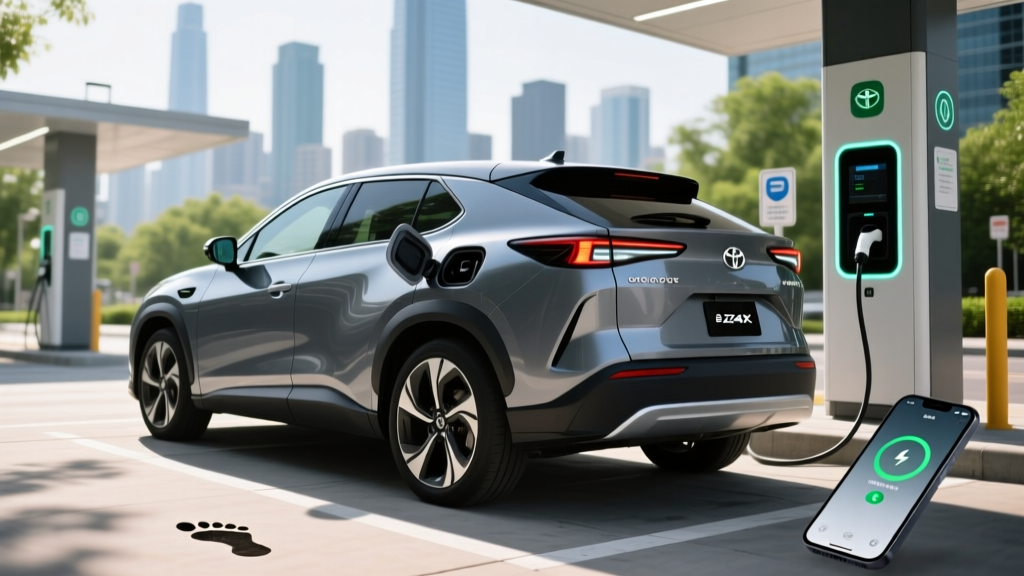
The bZ4X's charging profile is where buyers should pay close attention. Its DC fast-charging peak of 150 kW is conservative by 2024-2026 standards — the Hyundai Ioniq 5 peaks at 240 kW on an 800V architecture, and the Tesla Model Y can sustain over 250 kW on V3 Superchargers. In practice, the bZ4X reaches its 150 kW peak only briefly between roughly 10-30% state of charge, then tapers progressively. The 10-80% charge takes approximately 30 minutes at a capable CCS station, which is adequate for road-trip breaks but noticeably slower than the 18-20 minute sessions you'd experience in an Ioniq 5 or Kia EV6.
For home charging, the bZ4X's 7.2 kW onboard Level 2 charger is standard fare. On a 48-amp Level 2 home charger (the most common hardwired installation), you'll replenish roughly 25 miles of range per hour, meaning a full overnight session easily restores a depleted battery. Most bZ4X owners who charge at home report plugging in nightly and starting each morning with a full battery — effectively eliminating range concerns for daily commuting.
The bZ4X uses the CCS1 connector for DC fast charging in North America. Toyota has announced future adoption of NACS (the Tesla connector) for upcoming models, but the 2024 bZ4X requires a CCS-to-NACS adapter to access Tesla Supercharger stalls, and compatibility varies by adapter brand. Toyota's partnership with EVgo provides bZ4X buyers with a complimentary charging credit (typically $250-$500 worth) on the EVgo network, which helps offset early public-charging costs.
Performance, Drivetrain & Driving Dynamics
The FWD bZ4X XLE uses a single front-mounted electric motor producing 201 horsepower and 196 lb-ft of torque. Toyota rates its 0-60 mph time at approximately 7.1 seconds — adequate for merging and passing but not thrilling. The AWD variant adds a rear motor for a combined 214 hp and 248 lb-ft, dropping the 0-60 time to roughly 6.5 seconds.
Neither version is a performance EV, and that's by design. The bZ4X prioritizes ride comfort over sporty handling. The suspension absorbs road imperfections well, cabin noise is low at highway speeds, and the steering is light and predictable. Regenerative braking offers adjustable levels via paddle shifters behind the steering wheel, though it doesn't quite achieve true one-pedal driving at lower regen settings — you'll still need the brake pedal for complete stops unless you're in the strongest regen mode on downhill grades.
The AWD system uses an X-MODE function (borrowed from Subaru, Toyota's bZ4X development partner) that adjusts torque distribution for light off-road or slippery conditions. It's not a rock-crawler, but it handles snow-covered roads and gravel with confidence. Ground clearance sits at 8.1 inches, which is generous for an electric crossover and aids in winter driving.
Interior, Cargo & Technology
The bZ4X cabin is spacious for its class. Front-seat passengers enjoy 41.4 inches of legroom, while rear-seat legroom measures 35.6 inches — enough for adults on longer trips, though it trails the Hyundai Ioniq 5's 39.4 inches of rear legroom. The seats in the XLE trim are SofTex (synthetic leather) and heated in the front, with a heated steering wheel included.
Cargo volume behind the rear seats is 27.7 cubic feet, expanding to approximately 56.9 cubic feet with the rear seats folded. That's competitive with the RAV4 and adequate for family gear, groceries, or a weekend's worth of luggage. Notably, the bZ4X does not have a front trunk (frunk) — the space under the hood houses power electronics, which is a missed opportunity for additional storage that rivals like the Ford Mustang Mach-E and Hyundai Ioniq 5 provide.
The infotainment system runs on a 12.3-inch touchscreen with wireless Apple CarPlay and Android Auto, Amazon Alexa integration, and Toyota's cloud-based navigation. The interface is functional but not class-leading: response times can lag slightly, and the menu structure requires more taps than rivals for common functions like climate adjustments. A 7-inch digital instrument cluster sits behind the steering wheel, positioned unusually far forward (nearly at the base of the windshield) to mimic a head-up display — some drivers find this intuitive, others find it takes adjustment.
Standard driver-assistance features under Toyota Safety Sense 3.0 include:
- Pre-Collision System with Pedestrian Detection
- Lane Departure Alert with Steering Assist
- Lane Tracing Assist (lane centering)
- Full-Speed Range Dynamic Radar Cruise Control (adaptive cruise)
- Road Sign Assist
- Automatic High Beams
- Proactive Driving Assist (gentle braking/steering in certain scenarios)
This is a Level 2 driver-assist system (per SAE classification), meaning the driver must remain fully engaged with hands on the wheel and eyes on the road at all times. It is not autonomous or self-driving.
Pricing, Trim Levels & Federal Tax Credit
| Trim | Original MSRP (2024) | Drivetrain | Est. Used Price (2026) |
|---|---|---|---|
| XLE FWD | $43,070 | Single motor | $28,000–$33,000 |
| XLE AWD | $45,150 | Dual motor | $30,000–$35,000 |
| Limited FWD | $46,780 | Single motor | $31,000–$36,000 |
| Limited AWD | $48,860 | Dual motor | $33,000–$38,000 |
The 2024 bZ4X XLE FWD launched at $43,070 (including destination charge). By 2026, depreciation has been significant — a positive for used-EV buyers. Well-maintained XLE FWD examples typically list between $28,000 and $33,000 depending on mileage and condition.
Federal Tax Credit Eligibility: If purchasing the 2024 bZ4X as a used EV in 2026, you may qualify for the IRS §25E Used Clean Vehicle Credit, which provides up to $4,000 (30% of the sale price, capped at $4,000) for vehicles with an MSRP under $25,000 at the time of the used sale. Key requirements include:
- Buyer adjusted gross income: ≤$75,000 (single), $112,500 (head of household), $150,000 (joint)
- Vehicle must be at least 2 model years old (2024 qualifies in 2026)
- Sale price must not exceed $25,000
- Must purchase from a licensed dealer (private-party sales do not qualify)
- Vehicle must have a battery capacity of at least 7 kWh (the bZ4X's 71.4 kWh easily clears this)
If the bZ4X XLE you find is priced at or below $25,000 from a dealer and your income falls within the caps, the $4,000 credit can bring your effective cost down to $21,000-$24,000 — a compelling entry point into a modern electric crossover. Note that the original $7,500 §30D new-vehicle credit is no longer applicable for a 2024 model purchased in 2026. Always verify current credit rules with a tax professional or directly on irs.gov.
Warranty Coverage & Battery Longevity
Toyota backs the bZ4X with one of the strongest EV warranties in the industry:
- Basic Vehicle Warranty: 3 years / 36,000 miles
- Powertrain Warranty: 5 years / 60,000 miles
- EV Battery Warranty: 8 years / 100,000 miles (retains ≥70% of original capacity)
- Roadside Assistance: 2 years / 25,000 miles
The 8-year/100,000-mile battery warranty with a 70% capacity retention threshold is competitive with industry norms (Hyundai, Kia, and Ford offer similar terms). Toyota's NMC battery chemistry, combined with active thermal management (liquid cooling and heating), is designed to minimize degradation over time. Early data from 2023-2024 bZ4X owners suggests degradation is tracking within expected parameters — approximately 3-5% capacity loss after the first year, with the rate slowing in subsequent years.
For buyers considering a used 2024 bZ4X in 2026, most examples will still carry significant battery warranty coverage (typically 6+ years remaining), which provides peace of mind against premature degradation or cell failure.
Pros, Cons & Who Should Buy the bZ4X XLE
- Strong 8-year/100,000-mile battery warranty
- Comfortable, quiet ride quality
- Standard Toyota Safety Sense 3.0 (comprehensive ADAS)
- Good ground clearance (8.1 in) for winter/snow driving
- Wireless Apple CarPlay and Android Auto
- Significant used-market depreciation = strong value in 2026
- Eligible for up to $4,000 used-EV tax credit
- Modest 150 kW DC fast-charge peak; 10-80% in ~30 min trails rivals
- Real-world highway range notably below 252-mile EPA sticker
- No front trunk (frunk)
- Infotainment interface lags behind competitors in responsiveness
- AWD model's range drops to 228 miles EPA
- CCS connector requires adapter for Tesla Supercharger access
- No one-pedal driving in all regen settings
Best for: Daily commuters with home charging access who drive under 150 miles round-trip, value Toyota's reliability reputation and warranty coverage, and want a comfortable, easy-to-drive electric crossover without paying a premium. The bZ4X XLE is also a strong pick for buyers in snowy climates who want AWD with decent ground clearance.
Look elsewhere if: You take frequent road trips over 250 miles and need the fastest possible DC charging, you prioritize cutting-edge infotainment tech, or you need maximum cargo space and a frunk for gear. The Hyundai Ioniq 5, Kia EV6, or Tesla Model Y serve those use cases better.
Frequently Asked Questions
What is the real-world range of the 2024 Toyota bZ4X XLE?
The EPA rates the FWD XLE at 252 miles, but expect roughly 210-225 miles in highway driving at moderate temperatures, and 175-195 miles in cold weather (below 32°F). City driving with regen braking recovers closer to or slightly above the EPA figure. The AWD model delivers approximately 190-200 miles on the highway.
How fast does the bZ4X charge at home and on the road?
At home on a Level 2 (240V) charger, the bZ4X charges at up to 7.2 kW, adding roughly 25 miles of range per hour — a full charge takes about 9.5 hours. On a DC fast charger, it peaks at 150 kW and charges from 10-80% in approximately 30 minutes. This is slower than rivals like the Ioniq 5 (18 min) but adequate for planned road-trip stops.
How much does a used 2024 bZ4X XLE cost in 2026?
Used 2024 bZ4X XLE FWD models typically list between $28,000 and $33,000 depending on mileage and condition. If you find one priced at or below $25,000 from a licensed dealer and meet the income requirements, the federal used-EV tax credit (§25E) can provide up to $4,000, bringing effective cost to $21,000-$24,000.
Does the 2024 bZ4X qualify for the federal EV tax credit?
As a new vehicle in 2024, the bZ4X was potentially eligible for the §30D new-vehicle credit (up to $7,500) depending on battery-sourcing requirements and buyer income. In 2026, purchasing a used 2024 bZ4X may qualify for the §25E used-EV credit (up to $4,000) if the sale price is ≤$25,000, the vehicle is purchased from a dealer, and buyer income is within caps ($75K single / $150K joint). Always verify with a tax professional.
Is the bZ4X worth buying over the Hyundai Ioniq 5 or Tesla Model Y?
It depends on your priorities. The bZ4X wins on warranty confidence, ride comfort, and 2026 used-market value. The Ioniq 5 wins on charging speed (240 kW, 800V), interior space, and tech. The Model Y wins on range (320+ miles), Supercharger network access, and performance. If you charge at home, commute daily, and want Toyota reliability, the bZ4X is a strong pick. If road-trip charging speed is critical, the Ioniq 5 or EV6 are better choices.
What are the biggest drawbacks of the bZ4X?
The most common owner complaints center on the 150 kW DC fast-charging speed (slow vs. rivals), real-world range falling short of the EPA estimate on highways, the lack of a frunk, and an infotainment system that feels less polished than competitors. The CCS connector also limits Tesla Supercharger access without an adapter.
How long will the bZ4X battery last?
Toyota warrants the battery for 8 years or 100,000 miles against dropping below 70% of original capacity. Based on early owner data and Toyota's thermal management system, the NMC battery is expected to retain 80-85% capacity after 100,000 miles under normal use. Avoiding frequent 100% charges and DC fast-charging in extreme heat can help maximize longevity.