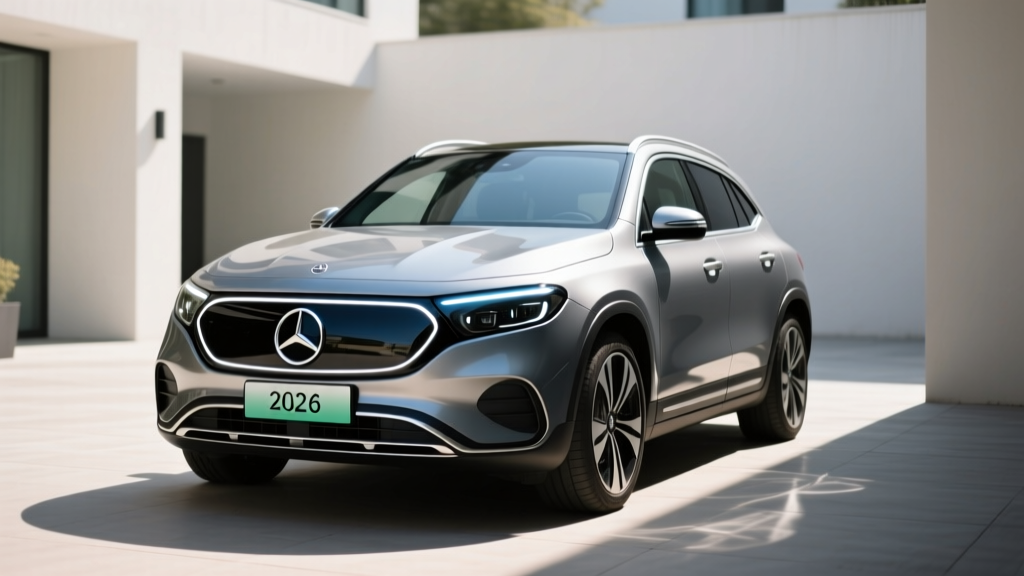
Quick Verdict: Is the 2026 Mercedes EQA Worth It?
The 2026 Mercedes EQA 250+ is the brand's entry-level electric crossover, starting around $48,000. With an EPA-estimated range of 265 miles from its 66.5 kWh (usable) NMC battery, a peak DC fast-charge rate of 100 kW (10–80% in ~30 minutes), and a 0–60 mph time of 7.7 seconds, it trades outright performance for luxury refinement. It qualifies for up to $3,750 in federal EV tax credits under current §30D rules, depending on your income, MSRP, and battery-sourcing compliance. If you want a premium compact electric SUV with real-world range near 220 miles and home charging convenience, the EQA delivers. If you need 300+ miles, 200+ kW charging, or a lower entry price, look to the Tesla Model Y or Hyundai Ioniq 5 instead.
2026 Mercedes EQA Electric Car: Full Specifications
| Specification | 2026 EQA 250+ |
|---|---|
| EPA Range (est.) | 265 miles |
| Real-World Range (highway/cold) | ~210–230 miles |
| Battery (usable) | 66.5 kWh, NMC chemistry |
| Peak DC Fast Charge | 100 kW |
| 10–80% DC Charge Time | ~30 minutes |
| Level 2 AC Charge Rate | 11 kW (~37 mi/hr) |
| Level 1 (120V) Charge Rate | ~1.4 kW (~5 mi/hr) |
| Connector | CCS (NACS adapter available) |
| 0–60 mph | 7.7 seconds |
| Horsepower | 188 hp |
| Torque | 273 lb-ft |
| Drivetrain | FWD single motor |
| MPGe (combined, est.) | 108 MPGe |
| Base MSRP | ~$48,000 |
| Federal Tax Credit (§30D) | Up to $3,750* |
| Battery Warranty | 8 years / 100,000 miles (70% capacity) |
*Tax credit eligibility depends on buyer AGI, MSRP caps, and critical-mineral/battery-sourcing requirements. See IRS §30D guidelines for current-year rules.
Real-World Range vs. EPA Sticker: What to Expect
EPA Estimate: 265 miles | Real-World Expectation: 210–230 miles highway; 190–210 miles in freezing weather
The EPA range sticker is a blended cycle that includes low-speed city driving, where EVs are most efficient. On sustained 70–75 mph highway runs, expect the EQA 250+ to consume roughly 3.2–3.5 miles per kWh, yielding around 210–230 miles before hitting the low-SoC buffer. In sub-32°F conditions without preconditioning, range can drop 20–30% due to cabin heating loads and increased battery internal resistance. The EQA includes a heat pump (standard on most trims for 2026), which recovers waste heat from the powertrain and cuts winter energy consumption by roughly 10–15% compared to resistive heating.
Practical tip: Use the Mercedes me app to precondition the cabin and battery while plugged in at home. This warms the NMC cells to optimal operating temperature before departure, preserving range and enabling faster DC charging at your first stop.
Charging Speed: The 100 kW Reality
The EQA 250+ peaks at 100 kW on DC fast chargers — a figure that sits at the lower end of the 2026 compact EV segment. For context, the Hyundai Ioniq 5 peaks at 240 kW (10–80% in ~18 minutes), and the Tesla Model Y peaks at 250 kW (~15 minutes on V3 Superchargers). The EQA's charge curve holds near 95–100 kW from roughly 10–50% SoC, then tapers to 60 kW by 70%, and drops further to ~30 kW above 85%.
On a road trip, this means your typical 10–80% stop takes about 30 minutes — long enough for a meal break but noticeably slower than the 15–20-minute stops you'd make in a Hyundai, Kia, or Tesla. For daily driving, however, DC speed matters far less. At home on a Level 2 (240V, 48A) wallbox delivering 11 kW, the EQA adds roughly 37 miles of range per hour, fully recharging the 66.5 kWh battery in about 6.5 hours — easily overnight.
Charging Levels at a Glance
| Level | Power | Miles Added per Hour | Typical Use |
|---|---|---|---|
| Level 1 (120V) | ~1.4 kW | ~5 mi/hr | Emergency / trickle top-off |
| Level 2 (240V, 48A) | 11 kW | ~37 mi/hr | Home overnight charging |
| DC Fast (CCS/NACS) | 100 kW peak | ~130 mi in 30 min | Road-trip stops |
Cost of Ownership: EQA vs. Gas Mercedes GLA
The closest gas-powered sibling to the EQA is the Mercedes-Benz GLA 250, starting around $42,000 with a 2.0L turbo producing 221 hp and an EPA-estimated 28 MPG combined. Here's how five years of ownership stacks up at 15,000 miles per year.
| Cost Category | 2026 EQA 250+ | 2026 GLA 250 (Gas) |
|---|---|---|
| Base MSRP | $48,000 | $42,000 |
| Federal Tax Credit (§30D) | –$3,750 | $0 |
| Effective Purchase Price | $44,250 | $42,000 |
| Fuel/Energy (5 yrs, 75k mi) | ~$4,700* | ~$10,400** |
| Maintenance (5 yrs) | ~$1,200 | ~$3,500 |
| Insurance (5 yrs, est. avg) | ~$12,500 | ~$10,800 |
| 5-Year Total (excl. depreciation) | ~$62,650 | ~$66,700 |
*Based on $0.15/kWh home charging (national average). **Based on $3.60/gal premium at 28 MPG. Your actual costs vary by state electricity rates and local fuel prices. Source: fueleconomy.gov.
The EQA saves roughly $4,000 over five years on fuel and maintenance alone, largely offsetting its higher purchase price even before accounting for the tax credit. EV maintenance eliminates oil changes, transmission fluid, spark plugs, and exhaust system repairs. Brake pad life extends significantly thanks to regenerative braking, which handles most deceleration without friction brakes.
However, EV insurance premiums run 10–20% higher on average, driven by higher repair costs for battery-adjacent collision damage and specialized technician requirements. Get quotes from your insurer before committing.
Federal Tax Credit: What You Actually Qualify For
Under current IRS §30D rules, the EQA may qualify for up to $3,750 in federal tax credits (not the full $7,500). The credit splits into two $3,750 halves — one for critical-mineral sourcing and one for battery-component manufacturing — and the EQA's supply chain currently satisfies one of the two prongs for the 2026 model year.
§30D Eligibility Checklist:
- Buyer AGI: ≤ $150,000 (single) / ≤ $300,000 (joint)
- Vehicle MSRP: ≤ $80,000 (SUVs/crossovers)
- Battery critical-mineral and component sourcing thresholds (varies by model year)
- Vehicle must be new, assembled in North America (verify VIN)
- Point-of-sale transfer available — apply credit at purchase, not at tax filing
Key caveat: Battery-sourcing rules tighten annually. A vehicle that qualifies in 2025 may not in 2026 or beyond. Always verify current eligibility on the IRS website or with a tax professional before relying on the credit in your purchase budget.
Mercedes EQA vs. Gas and Hybrid Alternatives
| Metric | EQA 250+ (BEV) | GLA 250 (Gas) | GLA 250e (PHEV, est.) |
|---|---|---|---|
| Powertrain | Single motor, FWD | 2.0L turbo I-4 | 1.3L turbo + electric motor |
| EPA Range / MPG | 265 mi / 108 MPGe | 28 MPG combined | ~25 mi EV + 30 MPG |
| 0–60 mph | 7.7 sec | 6.8 sec | ~7.0 sec |
| Base MSRP | ~$48,000 | ~$42,000 | ~$46,000 |
| Fuel/Energy Cost per Mile | ~$0.06 | ~$0.14 | ~$0.09 blended |
| Home Charging Needed? | Yes (critical) | No | Recommended for EV miles |
| Maintenance Burden | Low | Moderate | Moderate–High (two systems) |
The PHEV GLA 250e offers a middle ground: roughly 25 miles of electric-only commuting before the gas engine kicks in. If your daily commute is under 25 miles and you lack reliable home charging for a full BEV, the PHEV eliminates range anxiety while still reducing fuel consumption. But if you can charge at home, the BEV's lower per-mile cost and simpler maintenance make it the better long-term play.
Common Misconceptions About the EQA
| Myth | Fact |
|---|---|
| "100 kW charging is too slow for road trips." | 30-minute stops every 2–2.5 hours align with normal rest breaks. Slower than rivals, but workable for most trips. |
| "The battery will need expensive replacement in 5 years." | NMC batteries in liquid-cooled systems like the EQA's typically lose 10–15% capacity over 8 years/100k miles. The warranty guarantees 70% retention. |
| "I can't drive an EV without a garage." | Public Level 2 chargers (workplace, grocery, gym) and DC fast stations can substitute, but daily convenience drops significantly without home charging. |
| "The EQA gets the full $7,500 tax credit." | As of 2026, the EQA qualifies for up to $3,750 based on current battery-sourcing compliance. Always verify on IRS.gov. |
| "EVs are worse in winter." | Range drops 20–30% in extreme cold, but the EQA's heat pump, preconditioning, and regenerative braking on slippery roads keep it practical with planning. |
Decision Framework: Should You Buy the 2026 EQA?
Buy the Mercedes EQA 250+ if:
- You want a luxury-compact EV with Mercedes build quality, MBUX infotainment, and a refined ride
- You can charge at home (Level 2 recommended) and your daily driving is under 150 miles
- You primarily drive in urban/suburban environments where the 265-mile EPA range is ample
- You value a quiet, torque-rich commute and lower maintenance costs over outright performance
Look elsewhere if:
- You road-trip frequently and need sub-20-minute DC fast-charge stops (consider Hyundai Ioniq 5 or Tesla Model Y)
- You need 300+ miles of real-world range (Tesla Model Y Long Range, Chevrolet Equinox EV)
- You lack any access to home or workplace charging
- You need AWD — the EQA 250+ is FWD only in the US market
- You want maximum federal tax credit — some competitors qualify for the full $7,500
First-Time EV Buyer Checklist
- Confirm home charging access. A 240V Level 2 circuit (NEMA 14-50 or hardwired wallbox) is the single biggest ownership convenience factor. Budget $500–$2,000 for equipment plus $500–$2,500 for electrician installation, depending on panel capacity and run length. A 200-amp electrical panel is usually sufficient; older homes with 100-amp service may need a panel upgrade ($1,500–$3,000).
- Check your utility's EV rate plan. Many utilities offer time-of-use (TOU) rates that drop electricity to $0.08–$0.10/kWh overnight, cutting your fueling cost to $5–$7 for a full EQA charge.
- Verify §30D tax credit eligibility. Use your VIN on the IRS portal and confirm with your tax advisor. Point-of-sale transfer lets you apply the credit as a down-payment reduction at the dealer.
- Plan for winter. If you live where temperatures regularly drop below freezing, budget 25% of your EPA range for cold-weather loss and precondition whenever possible.
- Download the Mercedes me app and charging-network apps. PlugShare, Electrify America, and EVgo cover most public charging. The EQA's built-in navigation routes through Mercedes' partnered networks with real-time charger availability.
- Get insurance quotes before purchase. EV premiums average 10–20% higher. Some insurers offer EV-specific discounts — shop around.
Frequently Asked Questions
Does the 2026 Mercedes EQA qualify for any state incentives?
State incentives vary widely and change frequently. California's CVRP, Colorado's state credit, and various utility rebates may apply depending on your location. Check your state's energy office or fueleconomy.gov for current state-level programs.
What is the EQA's towing capacity?
The 2026 EQA 250+ is not rated for towing in the US market. If you need towing capability in a Mercedes EV, look at the EQB (up to 2,000 lbs) or the larger EQE/EQS SUV platforms.
Can I use Tesla Superchargers with the EQA?
Mercedes offers a NACS adapter for CCS-equipped models, enabling access to Tesla's Supercharger network. Availability and adapter pricing vary — confirm with your dealer at purchase. The EQA will also continue to support the Electrify America, EVgo, and ChargePoint networks natively via CCS.
How does the EQA compare to the Mercedes EQB?
The EQB is the EQA's longer, available three-row sibling with a slightly larger battery (~66.5 kWh usable, similar architecture) and optional AWD. The EQB sacrifices ~15 miles of range for extra cargo space and seating. If you need a third row (tight, best for children), the EQB is the better pick. For a strict two-row compact, the EQA is lighter and slightly more efficient.
What happens if the battery degrades past the warranty threshold?
Mercedes' battery warranty covers capacity loss below 70% within 8 years or 100,000 miles. If your battery falls below that threshold under warranty, Mercedes will repair or replace modules to restore capacity above 70%. Out-of-warranty replacement for the full pack runs $12,000–$18,000 depending on labor, though individual module replacement is often possible at lower cost. Real-world data from liquid-cooled NMC packs suggests most owners will never reach the warranty threshold under normal use.