The Short Answer: Stainless Steel, Composites, and a Massive Battery
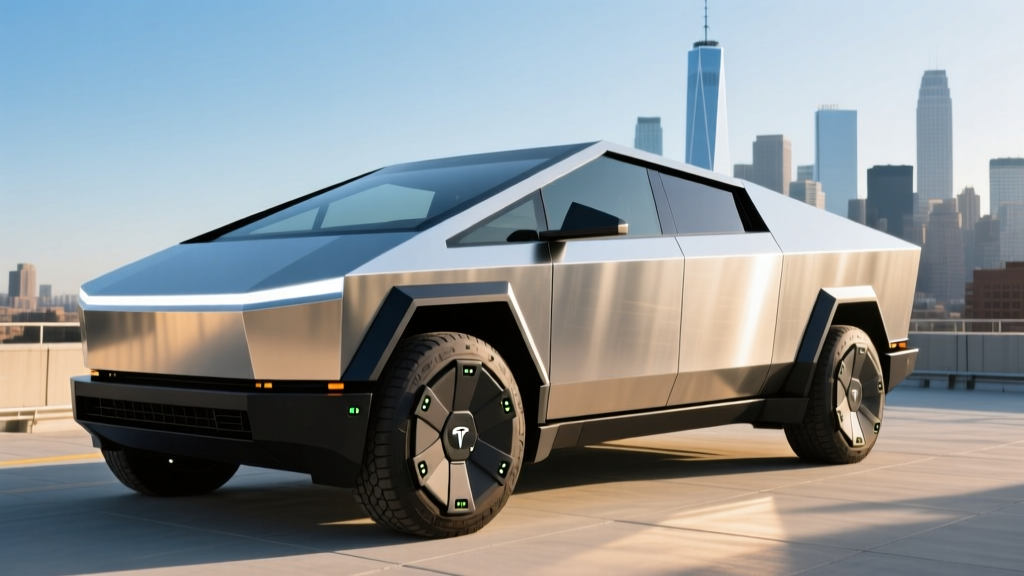
If you've ever looked at Tesla's angular pickup and wondered what is Cybertruck made of, the answer starts with a proprietary stainless steel alloy Tesla calls "Ultra-Hard 30X Cold-Rolled." Unlike conventional trucks that use stamped aluminum or mild-steel body panels over a frame, Cybertruck's exterior panels are part of a structural exoskeleton — the skin itself bears load. Beneath that skin sits a cast aluminum underbody, composite bed liner, and one of the largest battery packs in any consumer EV.
But materials only tell part of the story. This review covers everything a buyer actually needs: real-world range, charging speed, pricing after tax credits, and whether Cybertruck makes sense against the Ford F-150 Lightning, Rivian R1T, and Chevy Silverado EV in 2026.
Cybertruck Materials Deep Dive
30X Cold-Rolled Stainless Steel Exoskeleton
Tesla's 30X alloy is a variant of 300-series austenitic stainless steel, cold-rolled to roughly three times the yield strength of conventional automotive steel. This eliminates the need for traditional paint — the panels are brushed bare metal. The trade-off: stainless steel is denser than aluminum, contributing to Cybertruck's substantial curb weight (approximately 6,600–6,850 lbs depending on trim). Panel gaps and surface finish remain polarizing among owners, and minor dents require specialist repair since the steel resists conventional paintless dent removal.
Armor Glass and Composite Panels
The windshield and windows use a multi-layer laminated "armor glass" designed for impact resistance, though early-production units drew complaints for optical distortion that Tesla has since addressed through manufacturing revisions. The truck bed (Tesla calls it the "Vault") uses a molded composite liner rather than a traditional drop-in bed liner — it's integrated and textured for grip, but scratches are permanent.
Cast Aluminum Underbody and Structural Pack
Beneath the exoskeleton, Cybertruck uses Tesla's mega-cast aluminum front and rear subframes, reducing part count and improving torsional rigidity. The battery pack is structural — it's bonded between the underbody and floor, contributing to chassis stiffness. This architecture is similar to Model Y but scaled for truck duty cycles.
Spec Table: Cybertruck Trims at a Glance
| Spec | AWD (Dual Motor) | Cyberbeast (Tri-Motor) |
|---|---|---|
| EPA Range | 340 miles | 320 miles |
| Battery (usable) | ~123 kWh, NMC | ~123 kWh, NMC |
| Horsepower | 600 hp | 845 hp |
| 0-60 mph | 3.9 sec | 2.6 sec |
| Drivetrain | Dual-motor AWD | Tri-motor AWD |
| Max Tow Capacity | 11,000 lbs | 11,000 lbs |
| Payload | 2,500 lbs | 2,500 lbs |
| MPGe (combined) | 72 MPGe | 69 MPGe |
| Efficiency | 47 kWh/100mi | 49 kWh/100mi |
| Base MSRP (2026) | $79,990 | $99,990 |
| Battery/Drive Warranty | 8 yr / 120,000 mi | 8 yr / 120,000 mi |
Source: fueleconomy.gov and Tesla's official specs. The previously announced Rear-Wheel-Drive Cybertruck ($60,990 target) has not materialized for retail sale as of 2026.
Real-World Range: What the EPA Number Doesn't Tell You
EPA Sticker: 340 mi (AWD) / 320 mi (Cyberbeast)
Real-World Expectation: Highway cruising at 70-75 mph yields roughly 260–290 miles. Cold weather (below freezing) cuts that to ~220–250 miles. Towing a 7,000-lb trailer can halve range to 150–180 miles.
Cybertruck's slab-sided, angular design gives it a drag coefficient around 0.39 — poor by EV standards and a major reason highway range falls well short of the EPA combined figure. Efficiency at 75 mph drops noticeably compared to 65 mph, so road-trip planning should assume ~260 miles between stops in fair conditions. The 123 kWh NMC pack provides a large buffer, but the physics of a 6,800-lb brick-shaped truck are inescapable.
Charging Speed: DC Fast and Home Level 2
Cybertruck uses the North American Charging Standard (NACS) connector natively — no adapter needed for Tesla Superchargers. It supports an 800-volt architecture, enabling strong DC fast-charge performance.
| Charging Level | Power | Speed / Time |
|---|---|---|
| Level 1 (120V outlet) | ~1.4 kW | ~3-4 miles per hour |
| Level 2 (240V, 48A Wall Connector) | 11.5 kW | ~34 miles per hour |
| DC Fast Charge (peak) | 250 kW | 10-80% in ~30 minutes |
| DC Sustained (real-world avg) | ~160-180 kW avg | Expect taper above 50% SoC |
The 250 kW peak rate is strong, but the massive 123 kWh battery means a 10-80% session still takes around 30 minutes — longer than lighter EVs with smaller packs. Charge curve taper becomes noticeable above 50% state of charge. On a road trip, plan for roughly 25-35 minute stops. Preconditioning the battery (automatic when navigating to a Supercharger) is essential for hitting peak rates, especially in cold weather.
At home, a 48-amp Tesla Wall Connector on a 60-amp circuit adds roughly 34 miles per hour of charging — enough to fully replenish overnight. A 200-amp electrical panel is typically required; homes with older 100-amp service may need a panel upgrade ($1,500–$3,000) before installation.
Pricing, Trims, and Federal Tax Credit Eligibility
Cybertruck pricing has climbed since the original 2019 announcement. As of 2026, Tesla offers two retail trims:
| Trim | MSRP | Federal Credit (§30D) | Effective Price |
|---|---|---|---|
| AWD (Dual Motor) | $79,990 | $0 (exceeds MSRP cap) | $79,990 |
| Cyberbeast (Tri-Motor) | $99,990 | $0 (exceeds MSRP cap) | $99,990 |
Tax credit reality: Under IRS §30D rules, the new clean vehicle credit caps eligible pickup trucks at an $80,000 MSRP. The AWD trim at $79,990 sits just under that cap, but buyers must also meet income limits ($300,000 joint / $150,000 single modified AGI) AND the vehicle must satisfy critical-mineral and battery-component sourcing requirements that shift annually. As of 2026, Cybertruck's battery sourcing compliance has been inconsistent across production batches — verify current eligibility on the IRS qualified vehicles list before purchase. Point-of-sale transfer is available if all criteria are met. Cyberbeast at $99,990 exceeds the MSRP cap entirely and does not qualify.
Interior, Cargo, and Technology
Cybertruck's cabin follows Tesla's minimalist approach: a single 18.5-inch center touchscreen handles virtually all vehicle functions, with no traditional instrument cluster. Rear passengers get a 9.4-inch touchscreen. The steering yoke remains divisive — it offers unobstructed screen visibility but requires adaptation for low-speed maneuvering and three-point turns.
Cargo Dimensions
- Bed length: 6 feet (72 inches) with tailgate closed; extends to ~8 feet with tailgate down
- Bed width (between wheel wells): ~48 inches
- Frunk (front trunk): ~7.1 cu ft — useful for groceries or charging cables, not large items
- Rear legroom: ~41.6 inches — competitive with full-size crew cabs
- Seating: 6 passengers (3-across bench front and rear)
The motorized tonneau cover ("sail pillars" integrated) is a standout feature — it seals the bed, improves aero slightly, and is lockable. However, it limits vertical cargo clearance to roughly 30 inches with the cover closed. Oversized items require the cover fully retracted.
Driver Assistance and Software
All Cybertrucks ship with Tesla's Autopilot suite (Traffic-Aware Cruise Control and Autosteer). Full Self-Driving (Supervised) is available as a paid add-on. Important: FSD is an SAE Level 2 system — the driver must remain fully attentive with hands on the yoke at all times. It is not autonomous driving. Autopark, Smart Summon, and intersection assistance are included, but real-world reliability in construction zones and unmapped areas remains a known limitation.
Pros and Cons
Pros
- Stainless exoskeleton eliminates paint chips and corrosion concerns
- Massive 123 kWh pack provides genuine 250+ real-world highway miles
- 11,000-lb tow rating and 2,500-lb payload match half-ton truck benchmarks
- NACS native — full Supercharger network access without adapters
- 800V architecture with 250 kW peak DC charging
- Unique utility: 120V/240V bed outlets (up to 9.6 kW V2L for job-site tools)
Cons
- Highway efficiency is poor (~47-49 kWh/100mi) due to aerodynamics and weight
- Real-world range significantly below EPA, especially towing or in cold weather
- No federal tax credit for Cyberbeast; AWD credit eligibility uncertain
- Steep price: $80K–$100K with no budget-friendly trim available
- Stainless panels are difficult and expensive to repair if damaged
- Garage height compatibility — at ~70.5 inches tall, some low-clearance garages won't fit
Who Should Buy Cybertruck in 2026?
Choose Cybertruck if: You need a work-capable electric truck with V2L power for job-site tools, value the corrosion-proof stainless body, tow occasionally (but not daily), and want access to the Supercharger network for road trips. It suits tech-forward buyers who prioritize novelty and on-site power over traditional truck refinement.
Consider competitors if: You prioritize highway range efficiency (Rivian R1T Dual-Motor gets ~352 mi EPA), need a more conventional truck interior (Ford F-150 Lightning), or want a sub-$60K price point (Silverado EV Work Truck). If daily towing is your use case, expect range to drop below 180 miles — a diesel or PHEV may serve better.
Frequently Asked Questions
Is Cybertruck's stainless steel body really bullet-resistant?
Tesla has demonstrated the 30X steel resisting 9mm handgun rounds in controlled tests. However, this is a marketing demonstration, not a ballistic certification. The armor glass shattered in Tesla's own public demo — subsequent revisions improved it, but no independent NIJ rating has been published. Treat "bullet-resistant" claims with skepticism.
Does Cybertruck qualify for the $7,500 federal EV tax credit?
It depends on the trim and your tax situation. The AWD trim at $79,990 is under the $80,000 truck MSRP cap, but you must also meet IRS income limits and the vehicle must satisfy critical-mineral and battery-component sourcing rules that change yearly. Cyberbeast at $99,990 does not qualify. Always check the current IRS qualified vehicle list and consult a tax professional before relying on the credit.
How does Cybertruck's range compare to F-150 Lightning and Rivian R1T?
Cybertruck AWD's 340-mile EPA rating edges the F-150 Lightning Extended Range (320 mi) and Rivian R1T Dual-Motor Max Pack (~352 mi). However, Cybertruck's real-world highway efficiency is worse than the Rivian due to its boxier aero profile. In cold weather and towing, all three lose 30-50% of rated range — plan accordingly.
What is the battery warranty on Cybertruck?
Tesla covers the battery and drive unit for 8 years or 120,000 miles, whichever comes first, with a minimum 70% capacity retention threshold during that period. This is slightly better mileage coverage than the industry standard 100,000 miles, reflecting the truck's intended higher-mileage use case.
Can I charge Cybertruck at non-Tesla DC fast chargers?
Yes. Cybertruck has a native NACS port. Most major networks (Electrify America, EVgo, ChargePoint) now offer NACS connectors or CCS-to-NACS adapters. Tesla's open Supercharger network also supports NACS-equipped non-Tesla EVs, so the connector ecosystem has converged in Cybertruck's favor as of 2026.