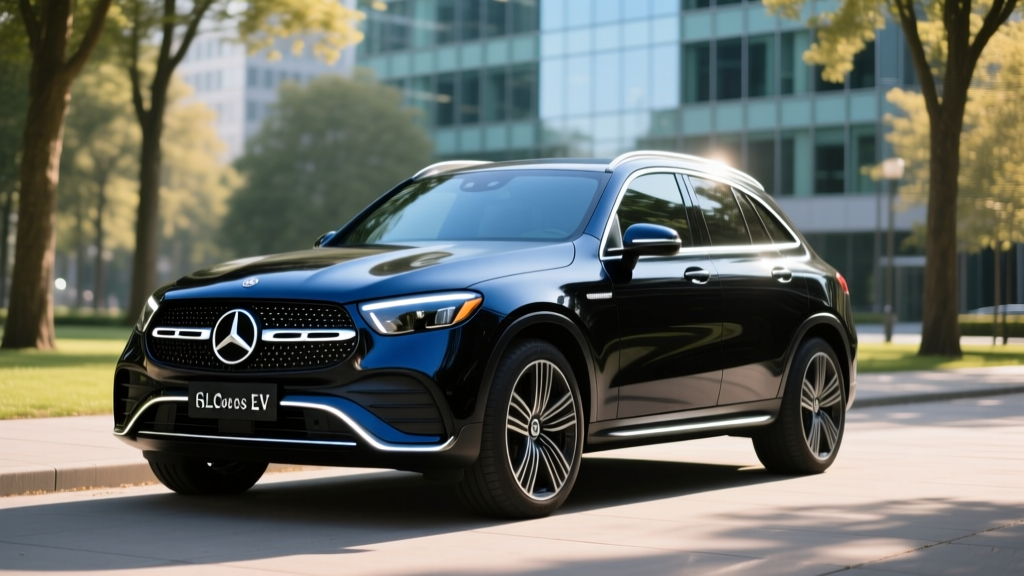
If you're searching for the electric GLC, you're looking at the Mercedes-Benz GLC EV — the battery-electric successor to one of the brand's best-selling luxury SUVs. Built on Mercedes' dedicated MB.EA (Mercedes-Benz Electric Architecture) platform and launching for the 2026 model year, the electric GLC targets buyers who want GLC-class space and refinement without the gas engine. Expect an EPA-estimated range near 300 miles, DC fast charging up to roughly 200 kW, and a starting MSRP in the mid-$60,000s. This guide breaks down every number that matters for a purchase decision — range, charging, pricing, tax credits, and total ownership cost — with real-world context you won't find on a spec sheet.
Quick Verdict: Who Is the Electric GLC For?
The 2026 electric GLC fits luxury-SUV shoppers who want premium build quality, a quiet cabin, and solid fast-charging capability in a midsize package — and who have reliable access to Level 2 home charging. It competes directly with the BMW iX3, Audi Q6 e-tron, and Tesla Model Y, trading outright performance for refinement. If you need three rows or a sub-$50K price, look elsewhere. If you want a refined daily driver that charges quickly on road trips and qualifies for some federal incentives, it's a strong contender.
Range and Efficiency: EPA Sticker vs. Real-World Expectations
The 2026 electric GLC is expected to use a battery pack in the range of 85–95 kWh (usable capacity), likely employing NMC (nickel manganese cobalt) chemistry for its balance of energy density and longevity. Mercedes has targeted an EPA-estimated range of approximately 300 miles for the base rear-wheel-drive configuration, with all-wheel-drive (4MATIC) variants coming in somewhat lower, likely around 275–285 miles.
Real-World Range Reality Check
EPA estimate: ~300 miles (RWD) / ~280 miles (AWD)
Expect in practice:
- Mixed driving (suburban/city): 280–300 miles — close to sticker
- Sustained highway (70–80 mph): 240–260 miles — EVs are less efficient at speed
- Cold weather (below 30°F): 210–240 miles — expect 15–25% range loss without preconditioning
- Cold + highway combined: 190–220 miles — plan road-trip charging accordingly
The GLC EV's heat pump (expected standard) helps mitigate cold-weather losses, but no EV matches its EPA sticker in winter highway driving. Preconditioning the battery while plugged in is essential for preserving range and enabling peak DC charge rates in cold weather.
Efficiency should land in the neighborhood of 85–95 MPGe combined, competitive with the segment. For reference, the Audi Q6 e-tron achieves roughly 91 MPGe combined per fueleconomy.gov.
Charging Speeds and Connector Compatibility
Charging speed is where the MB.EA platform shows its engineering. The electric GLC supports an 800-volt electrical architecture (similar to the Porsche Taycan and Hyundai Ioniq 5), enabling peak DC fast-charge rates up to approximately 200 kW. Mercedes has stated the vehicle can add roughly 185 miles of range in about 15 minutes at a compatible DC fast charger under ideal conditions.
| Level | Power (kW) | Connector | Charge Time / Rate |
|---|---|---|---|
| Level 1 (120V household) | ~1.4 kW | J1772 / NACS | ~3–4 miles per hour |
| Level 2 (240V home/public) | Up to 11 kW | J1772 / NACS | ~30–35 miles per hour; full charge in ~9–10 hours |
| DC Fast Charging | Up to ~200 kW | CCS1 / NACS | 10–80% in approximately 22–25 minutes |
Charging curve reality: Peak 200 kW is a maximum, not a sustained rate. Expect the GLC EV to hold peak power roughly from 10–40% state of charge, then taper progressively. The 10–80% time of 22–25 minutes reflects this curve. Above 80%, charging slows dramatically to protect battery health — plan to charge to 80% on road trips and move on rather than waiting for a full top-off.
Connector note: Mercedes-Benz has committed to the North American Charging Standard (NACS) for its US-market EVs. The 2026 electric GLC is expected to ship with a native NACS charge port, granting direct access to Tesla's Supercharger network — the largest and most reliable DC network in the US. This is a significant ownership advantage over CCS-only vehicles, which rely on Electrify America and other networks with more variable uptime.
Performance and Powertrain
The base electric GLC will likely feature a single rear-mounted motor producing approximately 268–295 horsepower, with a 0–60 mph time in the mid-6-second range. A dual-motor 4MATIC variant should deliver in the neighborhood of 380–410 horsepower and a 0–60 time around 5.0–5.5 seconds. An AMG-tuned variant is possible later in the production cycle.
| Specification | RWD (Base) | AWD (4MATIC) |
|---|---|---|
| Battery (usable) | ~85–95 kWh (NMC) | ~85–95 kWh (NMC) |
| EPA Range | ~300 miles | ~275–285 miles |
| Horsepower | ~268–295 hp | ~380–410 hp |
| 0–60 mph | ~6.5 sec | ~5.0–5.5 sec |
| Peak DC Charge Rate | ~200 kW | ~200 kW |
| 10–80% DC Charge | ~22–25 min | ~22–25 min |
| Level 2 Rate | 11 kW | 11 kW |
Mercedes' regenerative braking system offers multiple levels, including a one-pedal driving mode. The GLC EV should also feature a coasting mode that disengages regen for maximum highway efficiency — a feature many EV owners find valuable for extending range on flat, open roads.
Pricing, Tax Credits, and Purchase Incentives
The 2026 electric GLC is expected to start at an MSRP of approximately $62,000–$65,000 for the base RWD trim, with 4MATIC and higher-optioned trims reaching into the $70,000–$75,000 range. Fully loaded examples with the AMG Line package and premium options could approach $80,000.
Federal EV Tax Credit (§30D) Eligibility — 2026 Rules
The IRS §30D Clean Vehicle Credit offers up to $7,500 for qualifying new EVs. Eligibility depends on multiple factors that change frequently:
- MSRP cap: SUVs must have a base MSRP at or below $80,000
- Buyer income cap: Modified AGI must not exceed $300,000 (joint), $225,000 (head of household), or $150,000 (individual)
- Battery sourcing: Critical minerals and battery components must meet phased-in domestic/free-trade-partner sourcing requirements that tighten each year through 2030
- FEOC restriction: Vehicles with battery components from a "foreign entity of concern" (e.g., certain Chinese suppliers) are disqualified
- Point-of-sale transfer: Eligible buyers can transfer the credit to the dealer at purchase, reducing the out-of-pocket price immediately
Bottom line: The base electric GLC is likely to fall under the $80K MSRP cap, but battery-sourcing compliance for 2026 will determine whether the full $7,500, a partial credit, or no credit applies. Mercedes has not published final sourcing data for the GLC EV at time of writing. Always verify current eligibility on fueleconomy.gov and consult a tax professional before relying on credit estimates.
Total Cost of Ownership: Electric GLC vs. Gas GLC
The strongest argument for the electric GLC isn't the driving experience — it's the long-term cost equation. Here's a five-year comparison against the gasoline GLC 300 4MATIC (MSRP ~$48,000, EPA 27 MPG combined).
| Category | Electric GLC (AWD) | Gas GLC 300 4MATIC |
|---|---|---|
| Base MSRP (est.) | $67,000 | $48,000 |
| Federal Tax Credit | –$3,750 to –$7,500* | $0 |
| Effective Purchase Price | ~$59,500–$63,250 | $48,000 |
| Fuel / Energy (5 yrs, 60K mi) | ~$3,600–$4,800** | ~$8,900*** |
| Maintenance (5 yrs) | ~$1,500–$2,000 | ~$3,500–$4,500 |
| Insurance (5 yrs, est.) | ~$12,000–$14,000 | ~$10,000–$12,000 |
| Estimated Depreciation | ~$28,000–$32,000 | ~$22,000–$26,000 |
| 5-Year Total (approx.) | ~$101,000–$112,000 | ~$92,000–$100,000 |
*Tax credit amount depends on battery sourcing compliance and buyer income. **Assumes $0.13–$0.17/kWh average (mix of home and public charging). ***Assumes $3.50/gal, 27 MPG combined. All figures are estimates; actual costs vary by region, driving pattern, and electricity rates.
The gas GLC still wins on total five-year cost in most scenarios, primarily because of its lower purchase price and slower depreciation. However, the gap narrows significantly if the full $7,500 credit applies and if you charge primarily at home on off-peak electricity rates. Beyond five years, the EV's maintenance advantage widens — no oil changes, fewer brake replacements (regen saves pads), and no transmission fluid.
Real-World Ownership Considerations
Home Charging Access
The electric GLC's 11 kW onboard charger means a full Level 2 home charge takes roughly 9–10 hours — ideal for overnight replenishment. A Level 2 home charger (such as a ChargePoint Home Flex or Tesla Wall Connector) costs $500–$700 for the unit, with professional installation typically running $800–$2,000 depending on your electrical panel. If your home has a 200-amp panel with spare capacity, expect the lower end. A panel upgrade to 200A or 400A can add $2,000–$5,000.
If you cannot install home charging (apartment, condo, street parking), the electric GLC becomes significantly less practical. Public Level 2 charging is slow (hours), and relying exclusively on DC fast charging accelerates battery wear and costs 2–3x more per kWh than home electricity.
Climate and Driving Patterns
If you live in a cold-weather region (sustained sub-30°F winters), plan for 15–25% range reduction. The GLC EV's heat pump helps, but preconditioning while plugged in is essential. In mild climates (Pacific Coast, Southeast), you'll see range much closer to the EPA sticker year-round.
For frequent road trippers: the NACS connector and Supercharger access make the electric GLC one of the more road-trip-friendly luxury EVs. Plan for a 20–25 minute charge stop every 200–240 highway miles.
Battery Longevity and Warranty
Mercedes typically provides an 8-year/100,000-mile high-voltage battery warranty, covering defects and capacity loss below a specified threshold (typically 70% state of health). NMC chemistry has demonstrated acceptable long-term degradation — expect roughly 8–12% capacity loss over the first 100,000 miles based on industry averages for liquid-cooled packs. Avoid routinely charging to 100% for daily use; setting a daily limit of 80–90% extends battery life.
Common Misconceptions About the Electric GLC
| Myth | Fact |
|---|---|
| "The electric GLC qualifies for the full $7,500 tax credit automatically." | Eligibility depends on battery sourcing, buyer income, and MSRP — all subject to annual rule changes. Verify on fueleconomy.gov before purchase. |
| "300 miles of range means I can drive 300 miles before charging." | The EPA estimate assumes mixed driving. Highway-only driving at 75+ mph yields ~240–260 miles. Cold weather reduces this further. |
| "DC fast charging takes the same time as filling a gas tank." | A 10–80% DC charge takes 22–25 minutes — longer than gas, but sufficient for a rest stop. You'll never "fill up" in 5 minutes. |
| "I don't need a home charger if there are public stations nearby." | Public DC charging costs 2–3x more than home electricity and frequent DC charging can accelerate battery degradation. Home Level 2 is strongly recommended. |
| "The electric GLC is self-driving." | Mercedes' DRIVE PILOT is a Level 2/conditional Level 3 system. The driver must remain attentive and is legally responsible for the vehicle at all times in most US jurisdictions. |
Decision Framework: Should You Buy the Electric GLC?
Choose the Electric GLC If:
- You have (or can install) Level 2 home charging
- Your daily commute is under 80 miles round-trip
- You value cabin quietness, smooth acceleration, and premium build quality
- You road-trip 2–4 times per year and want Supercharger network access
- You're in a state with high gas prices ($4+/gallon), amplifying fuel savings
- You qualify for the federal tax credit and/or state EV incentives
Consider a Gas or Plug-In Hybrid Instead If:
- You lack reliable access to home or workplace charging
- You regularly drive 300+ miles in a single day in cold weather
- Your budget is firmly under $50,000
- You live in a rural area with limited DC fast-charging infrastructure
- You plan to keep the vehicle beyond 10 years and worry about out-of-warranty battery replacement costs ($15,000–$25,000 estimated)
Consider a Competitor If:
- Tesla Model Y: Lower price, more range, best-in-class Supercharger access, but less premium interior
- Audi Q6 e-tron: Similar luxury positioning, comparable range and charging, different styling and infotainment approach
- BMW iX3: Direct competitor; compare range, charging speed, and local dealer support
- Genesis GV70 Electrified: Strong luxury value but shorter range and slower DC charging
Frequently Asked Questions
When will the electric GLC be available to buy?
The 2026 Mercedes-Benz GLC EV is expected to begin US deliveries in late 2025 or early 2026. Mercedes has confirmed the MB.EA-based midsize SUV for global markets, with US specifications and pricing to be finalized closer to launch. Monitor Mercedes-Benz's official press site for confirmed specs.
Will the electric GLC use NACS or CCS?
Mercedes-Benz has committed to the NACS (Tesla-style) connector for its US EV lineup. The electric GLC is expected to feature a native NACS charge port, providing direct access to the Tesla Supercharger network without an adapter.
How much does it cost to charge the electric GLC at home?
With a ~90 kWh battery and a national average electricity rate of $0.16/kWh, a full home charge costs approximately $14.40. At 280 miles of real-world range, that works out to roughly $0.05 per mile — compared to about $0.13 per mile for the gas GLC 300 at $3.50/gallon and 27 MPG.
Is the electric GLC eligible for the $7,500 federal tax credit?
Possibly, but it depends on 2026 battery-sourcing requirements, your income, and the vehicle's final MSRP. The MSRP cap for SUVs is $80,000, which the base electric GLC should clear. However, critical-mineral and battery-component sourcing rules tighten each year. Check fueleconomy.gov for the latest eligibility data and consult a tax professional.
What happens if the battery needs replacement out of warranty?
Out-of-warranty high-voltage battery replacement for luxury EVs currently ranges from $15,000 to $25,000+ depending on pack size and labor. However, industry data suggests most liquid-cooled NMC packs retain 80%+ capacity at 150,000 miles. Complete failure is rare; gradual capacity loss is the more common scenario, and many owners find 80% capacity still acceptable for daily use.
How does the electric GLC compare to a plug-in hybrid GLC?
Mercedes also offers the GLC as a plug-in hybrid (PHEV) in some markets. A PHEV provides ~30–40 miles of electric-only range before the gas engine engages. If you can charge daily and most trips are under 40 miles, a PHEV offers EV-like commuting with gas-car road-trip flexibility — but with more mechanical complexity (two powertrains to maintain). The full EV is simpler, cheaper to fuel, and has lower maintenance costs if you have reliable charging access.