Quick Answer: Is a Mercedes Electric Vehicle Worth It in 2026?
Mercedes-Benz currently sells four battery-electric models in the US — the EQB, EQE Sedan, EQE SUV, and EQS Sedan — with EPA ranges from 245 to 390 miles and base MSRPs spanning $54,000 to $105,550. None qualify for the full $7,500 federal §30D tax credit in 2026 due to battery-sourcing and MSRP-cap rules, making the real purchase price higher than competitors like Tesla or Hyundai. However, if you prioritize cabin refinement, advanced driver-assist tech, and dealer service infrastructure, a Mercedes electric vehicle delivers measurable ownership savings over its gas counterparts — roughly $1,200 to $1,800 annually in fuel and maintenance — provided you can install a Level 2 home charger.
The 2026 Mercedes Electric Lineup: Specs at a Glance
Mercedes consolidated its EQ branding for 2026, but the core architecture remains the EVA2 platform (EQE, EQS) and MFA2 platform (EQB). Here is every battery-electric model you can order today, with exact figures from fueleconomy.gov and Mercedes-Benz USA press materials.
| Model | Battery (kWh usable) | Chemistry | EPA Range (mi) | Peak DC Charge (kW) | 10–80% Time | 0–60 mph (sec) | HP | Base MSRP |
|---|---|---|---|---|---|---|---|---|
| EQB 350 4MATIC | 66.5 | NMC | 245 | 100 | ~32 min | 5.8 | 288 | $54,000 |
| EQE 350+ Sedan | 90.6 | NMC | 305 | 170 | ~28 min | 6.2 | 288 | $76,050 |
| EQE 350 4MATIC SUV | 90.6 | NMC | 279 | 170 | ~28 min | 6.4 | 288 | $78,050 |
| EQS 450+ Sedan | 118.0 | NMC | 390 | 200 | ~31 min | 5.9 | 355 | $105,550 |
Real-world range caveat: Expect 10–15% range reduction at sustained highway speeds (70–80 mph) and 20–30% loss in sub-freezing temperatures. The EQS 450+ with its 390-mile EPA sticker will realistically deliver 310–340 miles on a warm-weather highway run, but closer to 270–290 miles in winter conditions. The smaller EQB is the most range-sensitive — plan for 190–210 real-world miles on a cold winter day.
Mercedes Electric vs. Gas: The Ownership Cost Reality
The most common question from luxury-car shoppers is whether switching from a gas Mercedes (GLE, E-Class, S-Class) to an EQ model actually saves money. The answer depends heavily on your electricity rate, annual mileage, and how long you keep the car.
5-Year Ownership Cost: EQE 350+ vs. E350 Sedan (15,000 mi/yr)
| Category | EQE 350+ (Electric) | E350 (Gas) | Difference |
|---|---|---|---|
| Purchase Price (MSRP) | $76,050 | $58,900 | +$17,150 EV |
| Federal Tax Credit (§30D) | $0* | $0 | — |
| Fuel/Energy (5 yrs, home L2 @ $0.14/kWh) | $5,510 | $11,250 (premium @ $4.10/gal, 26 MPG) | –$5,740 EV |
| Maintenance (5 yrs) | $2,200 | $4,800 | –$2,600 EV |
| Insurance (5 yrs, avg) | $12,500 | $10,800 | +$1,700 EV |
| Estimated Depreciation (5 yrs) | $34,200 | $26,500 | +$7,700 EV |
| Total 5-Year Cost | $130,460 | $112,250 | +$18,210 EV |
*The EQE exceeds the §30D MSRP cap of $55,000 for sedans and does not meet critical-mineral sourcing thresholds for 2026. Always verify current rules at irs.gov.
The numbers show that a Mercedes electric vehicle costs more to own over five years primarily because of the higher purchase price and steeper depreciation — EV luxury sedans lose value faster than their gas counterparts in the current market. However, the fuel and maintenance savings are real and compound over time. If you keep the EQE for eight years, the energy and maintenance gap narrows the total-cost deficit to roughly $8,000–$10,000. For buyers who lease (which absorbs depreciation risk), the monthly fuel savings become more immediately meaningful.
Charging a Mercedes Electric Vehicle: What You Actually Need
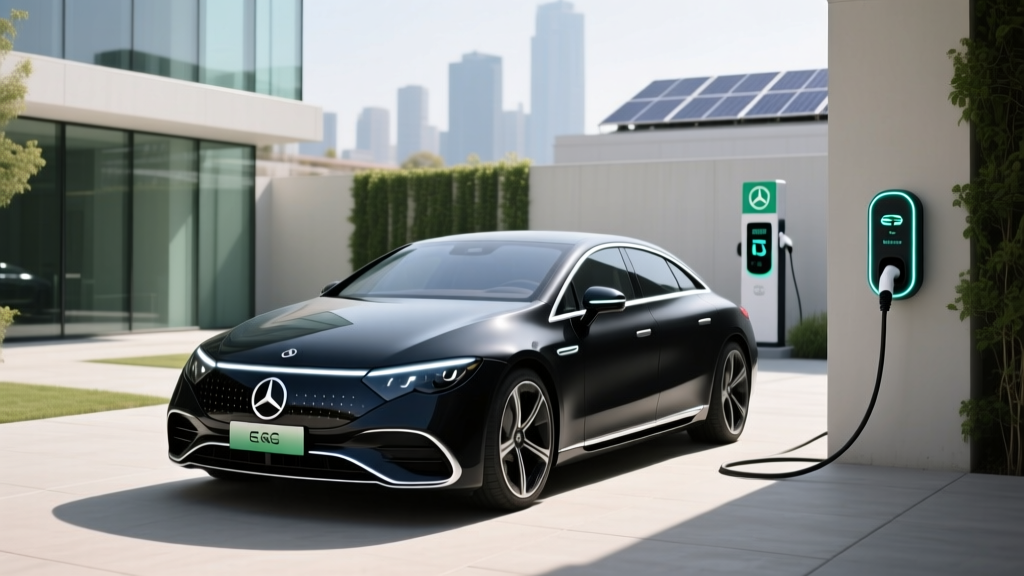
Mercedes uses the CCS1 connector on all current US-market EQ models, with NACS (Tesla-style) adapters available through Mercedes dealerships for Supercharger access. Here is what charging looks like in practice.
| Charging Level | Power (kW) | Miles Added per Hour | Typical Use Case |
|---|---|---|---|
| Level 1 (120V household) | 1.4 kW | ~3–4 mi/hr | Emergency / overnight top-up only |
| Level 2 (240V, 48A home charger) | 11.5 kW | ~28–35 mi/hr | Daily home charging (full overnight) |
| DC Fast Charge (CCS) | 100–200 kW peak | ~180–350 mi/hr (peak) | Road trips; 10–80% in 28–32 min |
Charging-curve reality: The EQS peaks at 200 kW but only sustains that rate from roughly 10–35% State of Charge (SoC). Above 50%, the curve tapers to ~100 kW, and above 80%, it drops below 50 kW. This is why Mercedes quotes 10–80% times rather than 0–100%. If you arrive at a DC fast charger at 20% SoC, expect roughly 15 minutes of high-speed charging followed by a slower taper. Preconditioning the battery (via the Mercedes me app navigation-to-charger feature) is essential in cold weather to achieve advertised charge speeds.
Home Charging Installation Costs
Most Mercedes electric owners will want a Level 2 home charger. Budget for the following:
- Level 2 charger hardware: $400–$700 (Mercedes Wallbox or ChargePoint Home Flex)
- Electrician labor (240V/50A circuit): $800–$2,500 depending on panel proximity
- Electrical panel upgrade (if needed): $1,500–$3,500 for older homes with 100A service
- Permit: $50–$200 depending on municipality
Total home install: $1,250–$6,900. Homes with a 200A panel and a garage adjacent to the breaker box sit at the low end. Always get a licensed electrician's assessment before purchasing equipment.
Federal Tax Credit: Why Most Mercedes Electric Models Don't Qualify
Under current IRS §30D rules, the federal clean vehicle credit offers up to $7,500, but eligibility requires meeting all of these criteria simultaneously:
- MSRP cap: Sedans must be under $55,000; SUVs/pickups under $80,000. The EQB (SUV classification) at $54,000 base technically clears the cap, but higher trims exceed it.
- Buyer income cap: AGI must not exceed $150,000 (single) / $300,000 (joint).
- Battery sourcing: Critical minerals and battery components must meet phased-in percentage thresholds from US free-trade partners. Mercedes sources cells from CATL (China) and Farasis, which do not satisfy 2026 critical-mineral requirements.
- Final assembly: Must occur in North America. The EQS and EQE are built in Sindelfingen, Germany; the EQB is built in Kecskemét, Hungary — neither qualifies.
The bottom line: no current Mercedes electric model qualifies for the $7,500 federal credit as of 2026. This is a significant competitive disadvantage against vehicles like the Tesla Model Y, Ford Mustang Mach-E, or Cadillac Lyriq, which meet at least partial credit thresholds. Always confirm current eligibility on fueleconomy.gov's tax credit page before purchasing.
EV vs. Gas Mercedes: Head-to-Head Comparison
| Factor | EQE 350+ (Electric) | E350 Sedan (Gas) |
|---|---|---|
| 0–60 mph | 6.2 sec | 6.1 sec |
| Combined Efficiency | 91 MPGe (33 kWh/100mi) | 26 MPG combined |
| "Fuel" Cost per Mile | $0.047 (home L2) | $0.158 (premium gas) |
| Annual Maintenance | ~$440 (cabin filter, wipers, tires) | ~$960 (oil, filters, brakes, spark plugs) |
| Cargo Volume | 15.0 cu ft (trunk) | 13.1 cu ft (trunk) |
| Powertrain Warranty | 8 yr / 100,000 mi (battery) | 4 yr / 50,000 mi |
| Real-World Highway Range | ~260–280 mi (summer), ~220 mi (winter) | ~400 mi |
| Refueling/Recharge Time | 28 min (10–80% DC fast) or 8+ hr (home L2) | 5 min (gas station) |
The performance and efficiency numbers favor the EQE, but the gas E350 retains a decisive advantage in refueling speed and total range — critical for frequent long-distance drivers. If you regularly drive 300+ miles in a single day, the EQE's charging stops (even at 28 minutes each) add meaningful trip time.
Common Mercedes Electric Misconceptions, Corrected
| Myth | Fact |
|---|---|
| "The battery will need expensive replacement within a few years." | Mercedes warrants the high-voltage battery for 10 years or 155,000 miles, guaranteeing it will retain at least 70% of original capacity. NMC degradation data from similar platforms shows ~8–12% capacity loss over 100,000 miles under normal use. |
| "I can charge on any Tesla Supercharger." | Mercedes offers a NACS adapter, but Supercharger access depends on Tesla opening specific stalls to non-Tesla vehicles. Check the Mercedes me app for compatible stations — not all Supercharger locations support CCS/NACS-adapter vehicles. |
| "Regenerative braking means I never need to replace brake pads." | Regen significantly reduces brake wear, but pads and rotors still require periodic inspection. Expect brake service at 80,000–120,000 miles vs. 30,000–50,000 on a gas car. |
| "The EQS is just an electric S-Class." | The EQS rides on a dedicated EVA2 skateboard platform with a lower roofline, different interior proportions (MBUX Hyperscreen), and different crash structure. It is not a converted S-Class. |
| "Electric Mercedes are self-driving." | Mercedes DRIVE PILOT is SAE Level 3 in limited conditions (specific highways, under 40 mph, in approved regions) and Level 2 everywhere else. You must remain attentive and ready to take over at all times outside those narrow parameters. |
Decision Framework: Which Mercedes Electric Model Is Right for You?
Choose the EQB 350 4MATIC if: You need a compact luxury crossover with a third row (seats up to 7), your daily commute is under 50 miles, you want the lowest entry price, and you have reliable home charging. Accept that real-world range tops out around 210 miles in ideal conditions.
Choose the EQE 350+ Sedan if: You want the best balance of range, luxury, and daily usability in a midsize executive sedan. You drive 30–80 miles daily and can charge at home overnight. You value the 305-mile EPA range as a buffer for occasional longer trips.
Choose the EQE 350 4MATIC SUV if: You prefer a higher seating position and need more cargo versatility than the sedan offers, and you're willing to trade ~26 miles of range for AWD traction and SUV practicality. Best for families in four-season climates.
Choose the EQS 450+ Sedan if: You want maximum range (390 miles EPA — the longest of any Mercedes electric model), flagship luxury, and the MBUX Hyperscreen. You're upgrading from an S-Class and want the quietest, most refined EV experience Mercedes offers, and the six-figure price is within budget.
Do NOT buy a Mercedes electric vehicle if: You lack access to home or workplace Level 2 charging, you regularly drive 300+ miles in a single day through rural areas with sparse DC fast-charging infrastructure, or you expected to claim the $7,500 federal tax credit to offset the purchase price. In these cases, consider a plug-in hybrid like the Mercedes S 580e (PHEV with ~35 miles electric-only range) as a bridge solution.
First-Time EV Buyer Checklist for Mercedes
- Verify home charging feasibility: Confirm your electrical panel can support a 240V/50A circuit. Get an electrician quote before ordering the car.
- Map your typical week: If your weekly driving is under 250 miles, any Mercedes electric model covers it with a single overnight charge. Above that, plan mid-week DC fast-charge stops.
- Download the Mercedes me app: Use it to precondition the battery before fast charging, schedule off-peak charging, and monitor battery State of Health (SoH).
- Research your state incentives: While the federal credit doesn't apply, some states (California, Colorado, New York) offer rebates of $1,000–$4,000 for EVs. Check your state energy office.
- Get insurance quotes early: EV insurance premiums run 10–20% higher than equivalent gas models. Shop quotes from EV-friendly insurers before committing.
- Understand the warranty: The battery is covered for 10 years/155,000 miles at 70% capacity retention. The basic vehicle warranty is 4 years/50,000 miles. Mercedes also includes 2 years of complimentary maintenance on new EVs.
Frequently Asked Questions
What is the longest-range Mercedes electric car available in 2026?
The EQS 450+ Sedan leads the lineup at 390 miles EPA with its 118 kWh (usable) NMC battery. Real-world highway range in warm conditions is approximately 330–350 miles; expect 270–290 miles in cold weather.
Does Mercedes still make the EQC or EQA?
No. The EQC was discontinued after 2023 and never officially sold in the US. The EQA is not offered in the US market. The current US battery-electric lineup consists of the EQB, EQE Sedan, EQE SUV, and EQS Sedan.
How much does it cost to charge a Mercedes EQE at home?
At the US average residential rate of $0.14/kWh, fully replenishing the EQE's 90.6 kWh battery from 10% to 100% costs approximately $11.40 — adding roughly 270 real-world miles. That works out to about $0.042 per mile, compared to $0.16 per mile for a gas E350 on premium fuel.
Is the Mercedes DRIVE PILOT system self-driving?
No. DRIVE PILOT is certified at SAE Level 3 only under very specific conditions: approved divided highways, speeds under 40 mph, clear weather, and in regions where Mercedes has received regulatory approval (currently limited in the US). Outside those conditions, the system operates at Level 2, requiring continuous driver supervision.
What happens if the battery degrades significantly?
Mercedes warrants the high-voltage battery for 10 years or 155,000 miles with a 70% capacity-retention threshold. If measured State of Health drops below 70% within that period, Mercedes will repair or replace modules to restore capacity above the threshold. Out-of-warranty full battery replacement for an EQS is estimated at $25,000–$32,000 based on current parts pricing, though individual module replacement is less expensive.
Can I tow with a Mercedes electric vehicle?
The EQE SUV and EQS are rated for up to 1,650 lbs of towing capacity. The EQB is rated for up to 3,500 lbs when properly equipped. Note that towing reduces range by 30–50% depending on trailer weight and aerodynamics.