Quick Answer: Which Mercedes EQ Is Right for You?
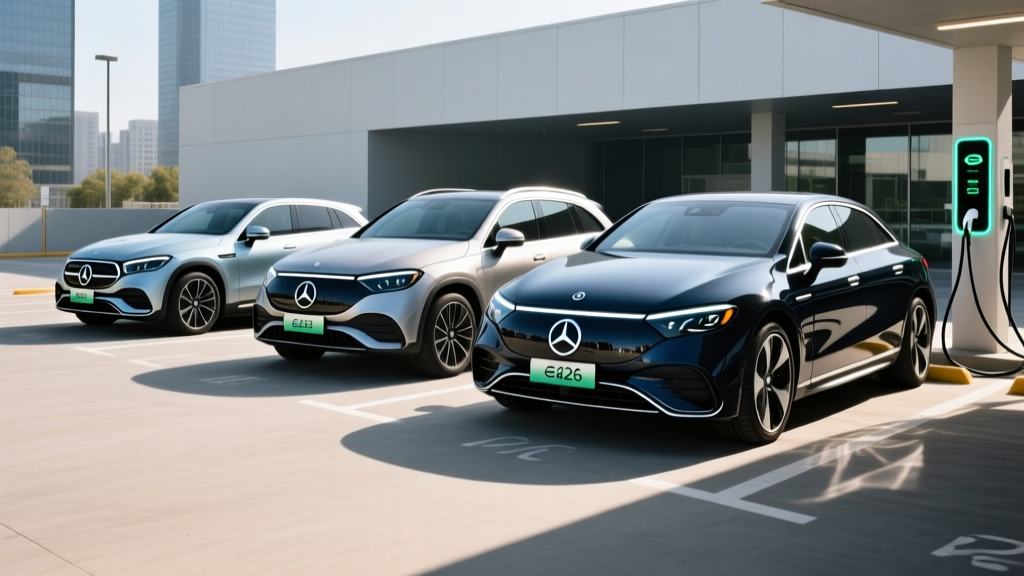
The Mercedes-Benz electric EQ lineup spans three core models for 2026: the EQB (compact SUV, ~245 mi EPA, starting ~$54,000), the EQE Sedan/SUV (mid-size, ~280 mi EPA, starting ~$72,000), and the EQS Sedan/SUV (flagship, ~350 mi EPA, starting ~$105,000). If you need three-row seating on a budget, the EQB is your entry point. If you want a balance of range and daily usability, the EQE is the sweet spot. If maximum range and luxury matter most, the EQS delivers — but at a steep premium. None of these models currently qualify for the full §30D federal tax credit due to battery-sourcing requirements, so plan your budget accordingly.
The 2026 Mercedes Electric EQ Lineup at a Glance
Mercedes-Benz consolidated its EV naming under the EQ banner, and for the 2026 model year the lineup is leaner after the discontinuation of the EQA (never sold in the U.S.) and the EQC. Here is what you can actually buy, with the numbers that matter.
| Spec | 2026 EQB 350 4MATIC | 2026 EQE 350+ Sedan | 2026 EQS 450+ Sedan |
|---|---|---|---|
| EPA Range | ~245 mi | ~280 mi | ~350 mi |
| Battery (usable) | 66.5 kWh (NMC) | 90.6 kWh (NMC) | 108.4 kWh (NMC) |
| Peak DC Fast Charge | 100 kW | 170 kW | 200 kW |
| 10–80% DC Time | ~32 min | ~31 min | ~31 min |
| Level 2 Rate | 9.6 kW | 9.6 kW | 9.6 kW |
| Horsepower | 288 hp | 288 hp | 355 hp |
| 0–60 mph | 5.8 sec | 6.2 sec | 5.3 sec |
| MPGe (combined) | ~89 MPGe | ~94 MPGe | ~97 MPGe |
| Base MSRP | $54,150 | $72,900 | $105,550 |
| Battery Warranty | 8 yr / 100,000 mi | 8 yr / 100,000 mi | 8 yr / 100,000 mi |
| Seating | 5 (optional 7) | 5 | 5 |
Sources: fueleconomy.gov, Mercedes-Benz USA spec sheets. Real-world range will vary — expect 10–20% reduction in sustained highway driving at 75+ mph and up to 30% loss in sub-freezing temperatures.
Real-World Range Reality Check
EPA sticker vs. what you'll actually see: The EQS 450+ posts an impressive 350-mile EPA figure, but on a 75-mph highway loop in moderate temperatures, plan for roughly 290–310 miles before you need a charger. In winter conditions (below 32°F), that drops to approximately 245–270 miles. The EQB, with its smaller battery and boxier shape, will realistically deliver 200–220 highway miles in fair weather and as little as 170 in cold climates. These aren't flaws — they're physics. Cold batteries resist charge and discharge, and cabin heating draws significant energy without a heat pump on the EQB (the EQE and EQS include a standard heat pump).
Charging Speeds and What They Mean for Your Routine
The electric EQ lineup uses CCS1 connectors for DC fast charging, though Mercedes has committed to transitioning to NACS (Tesla's connector) on future models. For 2026, you'll charge on Electrify America, EVgo, and ChargePoint networks without an adapter.
| Charging Level | Power (kW) | Approx. Miles Added per Hour | Best For |
|---|---|---|---|
| Level 1 (120V household) | ~1.4 kW | ~4–5 mi/hr | Overnight top-ups, emergencies |
| Level 2 (240V home/public) | 9.6 kW | ~28–35 mi/hr | Daily home charging |
| DC Fast Charge | 100–200 kW (peak) | ~180–350 mi/hr (at peak) | Road trips |
Charging-curve reality: The EQS peaks at 200 kW, but that rate only holds between roughly 10–40% state of charge. From 40–60%, it tapers to ~150 kW, and above 80%, it drops sharply to under 50 kW to protect battery health. This is why manufacturers quote 10–80% times rather than 0–100%. If you're road-tripping, plan to charge from 10% to 80% and then drive on — charging the final 20% takes nearly as long as the first 70%.
The EQB's 100 kW peak is the weakest link in the lineup. On a road trip, you'll spend roughly 5–8 minutes longer at each stop compared to the EQE or EQS. For daily driving with home Level 2 charging, this is irrelevant — all three models charge fully overnight on a 9.6 kW Level 2 unit in 7–12 hours depending on battery size.
EQ vs. Gas vs. Hybrid: Cost Comparison That Matters
Let's compare the EQE 350+ against its closest internal-combustion sibling, the Mercedes-Benz E 350 sedan, and the E 350 plug-in hybrid (if available in your market). We'll use a 5-year, 60,000-mile ownership horizon.
| Cost Category | EQE 350+ (EV) | E 350 Sedan (Gas) | E 350 PHEV |
|---|---|---|---|
| Base MSRP | $72,900 | $62,500 | $68,000 |
| Fed. Tax Credit (§30D) | $0–$3,750* | $0 | $0–$3,750* |
| 5-Yr Fuel/Energy Cost** | $4,800 | $10,500 | $6,200 |
| 5-Yr Maintenance Est. | $1,800 | $4,200 | $3,500 |
| 5-Yr Insurance Est. | $9,500 | $7,800 | $8,400 |
| Estimated Depreciation (5yr) | $32,000 | $22,000 | $26,000 |
| 5-Yr Total Cost of Ownership | ~$56,000 | ~$57,000 | ~$59,700 |
*Tax credit eligibility for Mercedes EQ models is limited by battery critical-mineral and component sourcing rules under IRS §30D. Consult a tax professional — rules change and income/MSRP caps apply. **Energy costs assume $0.16/kWh home charging and $3.50/gal gas, 15,000 mi/yr.
The numbers reveal a familiar EV pattern: higher purchase price and insurance, lower operating costs. The EQE roughly breaks even with the gas E 350 over five years, but the gap narrows further if your utility offers off-peak charging rates below $0.10/kWh. Where the EV wins decisively is maintenance — no oil changes, no transmission fluid, regenerative braking saves pad life (expect 80,000+ miles on original brake pads).
The depreciation column is the wildcard. Mercedes EQ models have experienced steeper resale-value drops than their gas counterparts, partly due to rapid EV tech iteration and Tesla-driven price competition. If you plan to keep the car 8+ years, depreciation matters less. If you trade every 3 years, the gas E-Class may cost you less overall.
Real-World Ownership: What First-Time EQ Buyers Must Know
Before you sign, work through these practical realities that spec sheets don't cover:
Home Charging Access Is Non-Negotiable for Most Owners
Public DC fast charging costs $0.35–$0.55/kWh on most networks — essentially erasing the fuel-cost advantage over gas. The economics of EV ownership only work if you charge at home most of the time. A Level 2 home installation (240V, 48-amp circuit) typically costs $800–$2,500 for the charger and electrician, but can jump to $4,000–$8,000 if your electrical panel needs a 200-amp upgrade. Get an electrician quote before you buy.
Insurance Premiums Run 15–25% Higher
EV repair costs — especially battery-adjacent collision damage — push insurance premiums above comparable gas models. Expect to pay $1,800–$2,200/year for an EQE where a gas E 350 might run $1,400–$1,700. Shop quotes from multiple carriers; some insurers now offer EV-specific discounts.
Cold-Weather Range Loss Is Real and Measurable
If you live in the upper Midwest, Northeast, or Mountain West, plan for 20–30% range reduction in sustained sub-freezing driving. The EQE and EQS mitigate this with a standard heat pump (which moves heat rather than generating it electrically), but the EQB lacks one. Preconditioning the battery while plugged in — a feature available through the Mercedes me app — recovers some of that lost range by warming the battery before you depart.
The Mercedes me Connect App: Your Charging Command Center
Mercedes' app lets you schedule charging during off-peak utility hours, set charge limits (80% daily is optimal for NMC battery longevity), precondition the cabin and battery, and locate compatible chargers. It's functional but not class-leading — the interface lags behind Tesla's and Hyundai's in responsiveness. Plan for occasional connectivity quirks.
Common Misconceptions About the Mercedes EQ Lineup
| Myth | Fact |
|---|---|
| "The EQS gets 350 miles, so I'll always see 350." | EPA testing uses a mixed city/highway cycle at moderate speeds. Sustained 75–80 mph highway driving yields ~290–310 mi. Cold weather drops that to ~245–270 mi. |
| "All EQ models get the $7,500 federal tax credit." | Most 2026 Mercedes EQ models do NOT qualify for the full credit due to battery-sourcing requirements under §30D. Some may qualify for $3,750 (critical minerals portion only). Always verify on the fueleconomy.gov credit tracker. |
| "DC fast charging damages the battery." | Occasional DC fast charging is fine. The BMS (battery management system) actively manages temperature and charge rate. Daily use of DC fast charging may accelerate degradation slightly, but Mercedes warranties 70% capacity retention at 8 years/100,000 miles. |
| "I can't take an EQ on a road trip." | With the CCS1 network spanning Electrify America, EVgo, and others, road-tripping is entirely feasible. Plan stops around 10–80% charges (31 min for EQE/EQS) every 200–250 miles in the EQE, or every 280–310 miles in the EQS. |
| "EVs need no maintenance at all." | Tires wear 15–20% faster on EVs due to instant torque and heavier curb weight. Cabin air filters, brake fluid checks, coolant top-offs, and wiper blades still apply. Budget ~$350–$450/year in maintenance. |
Decision Framework: Which Electric EQ Should You Choose?
Choose the EQB If:
- You need a compact luxury SUV with optional third-row seating for occasional use
- Your daily commute is under 60 miles round-trip and you charge at home
- Your budget caps around $55,000–$60,000 before options
- You rarely take road trips exceeding 200 miles between stops
Choose the EQE If:
- You want the best balance of range (~280 mi EPA), performance, and price
- You commute 40–80 miles daily and want a heat pump for cold-climate efficiency
- You value a quiet, refined ride over outright sportiness
- Your budget is $72,000–$85,000 depending on trim and options
Choose the EQS If:
- Maximum range (350 mi EPA) is your top priority — few luxury sedans match it
- You want flagship technology: the Hyperscreen dashboard, rear-axle steering, advanced ADAS
- You regularly drive 300+ miles between charges on road trips
- Your budget comfortably exceeds $105,000 and depreciation is a secondary concern
Look Outside the EQ Lineup If:
- You need the fastest DC charging available — Hyundai/Kia's E-GMP platform (Ioniq 5, EV6) charges at up to 350 kW and does 10–80% in ~18 minutes
- You want full §30D tax credit eligibility — several domestic and Korean models currently qualify for the full $7,500
- You need a truck bed or serious towing capacity (the EQ lineup has no truck option)
2026 Tax Credit and Incentive Reality for Mercedes EQ Buyers
The federal EV tax credit under IRS §30D has become increasingly complex. For the 2026 tax year, the full $7,500 credit requires:
- MSRP caps: $55,000 for sedans, $80,000 for SUVs/trucks/vans — this eliminates the EQS sedan and most EQE trims from eligibility
- Buyer income limits: $150,000 single / $225,000 head of household / $300,000 joint MAGI
- Battery sourcing: Critical minerals and battery components must meet escalating domestic/free-trade-agreement percentages — most Mercedes EQ batteries currently fail the component requirement
- Point-of-sale transfer: If eligible, you can transfer the credit to the dealer for an immediate price reduction rather than waiting for tax filing
The practical result: most Mercedes EQ buyers should not count on the federal credit when budgeting. Some state and utility incentives remain available — check AFDC's incentive database for your zip code — but these vary widely and may have their own caps.
Frequently Asked Questions
How long will a Mercedes EQ battery last?
Mercedes warranties the high-voltage battery for 8 years or 100,000 miles, whichever comes first, guaranteeing at least 70% of original capacity. Based on current NMC degradation data from similar platforms, expect roughly 8–12% capacity loss over 100,000 miles under normal use (mix of Level 2 and occasional DC fast charging). That means a 350-mile EQS would still deliver roughly 308–322 miles of range at the 100,000-mile mark. Full battery replacement, if needed out of warranty, currently runs $18,000–$30,000 depending on the model — though prices are trending downward.
Does the Mercedes EQ support Tesla Superchargers?
Not natively in 2026. The EQ lineup uses CCS1 connectors. Mercedes has announced a transition to NACS for future models, and a CCS-to-NACS adapter may become available, but as of the current model year, you'll rely on Electrify America, EVgo, ChargePoint, and other CCS-compatible networks. Tesla Supercharger access requires a compatible adapter, which Mercedes has not officially certified for EQ models.
Is the EQS worth the premium over the EQE?
Strictly on range, the EQS delivers 70 additional EPA miles for roughly $32,000 more — that's about $457 per extra mile of range. The real justification is the flagship experience: the Hyperscreen, superior sound insulation, rear-axle steering for tighter turning, and the prestige factor. If range is your sole priority, the EQE delivers 80% of the capability at 70% of the price. If you're cross-shopping the S-Class, the EQS makes sense as the electric equivalent.
What's the cheapest way to own a Mercedes EQ?
Lease. Mercedes frequently offers aggressive lease deals on EQ models (sometimes $500–$700/month on the EQE with $5,000 down), and leasing sidesteps the depreciation risk that hits EQ models harder than gas Mercedes. Additionally, some leases pass through a commercial clean vehicle credit (§45W) that the lessee may benefit from indirectly through reduced lease payments — ask the dealer about this. If you drive under 12,000 miles/year and want to upgrade every 3 years, leasing is the financially rational path.
How does EQ compare to BMW i and Audi e-tron?
The BMW i5 and i7 are the EQE and EQS's most direct rivals. The i5 offers similar range (~280 mi EPA) at a comparable price but with slightly faster DC charging (up to 205 kW) and more engaging driving dynamics. The Audi e-tron GT targets the performance end. Where Mercedes wins is ride comfort, cabin quietness, and the MBUX infotainment system. Where it loses is charging speed and tax-credit eligibility — BMW's U.S.-built EVs have had better luck meeting §30D sourcing requirements.