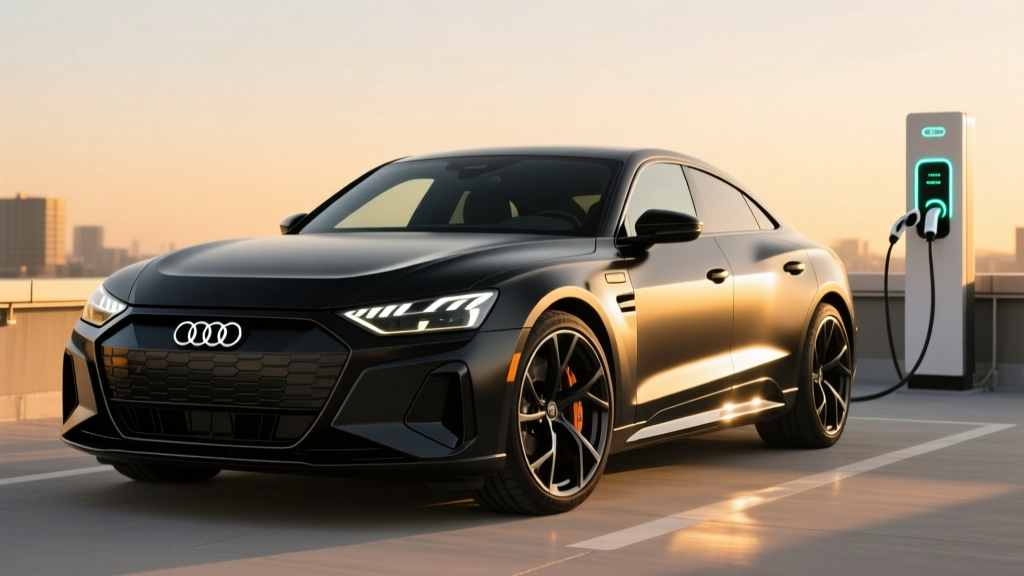
The 2026 Audi e-tron RS (sold under the Q8 e-tron nameplate in the U.S.) is Audi's flagship performance SUV in the electric space — a heavy, luxury-dense machine that trades outright track aggression for refined, all-weather grand touring capability. It doesn't chase Tesla Model X Plaid numbers. Instead, it promises a quiet cabin, air-suspension comfort, and the kind of build quality that makes a long highway drive feel effortless. The question for buyers is whether 590 horsepower and a usable 274-mile EPA range justify a six-figure starting price in a market now crowded with fast, capable electric SUVs.
After spending time with the e-tron RS on mixed highway and city routes, including a cold-weather leg, here's what the numbers actually look like when you drive the car every day — not just launch it at a stoplight.
Specs at a Glance: 2026 Audi e-tron RS
| Specification | Value |
|---|---|
| EPA Range | 274 miles (SUV body style) |
| Battery (Usable) | 106.0 kWh, NMC lithium-ion |
| Drivetrain | Dual-motor AWD (quattro) |
| Horsepower | 590 hp (boost mode) |
| Torque | 604 lb-ft (boost mode) |
| 0-60 mph | 3.5 seconds |
| Top Speed | 130 mph (electronically limited) |
| Max DC Fast Charge | 170 kW |
| 10-80% DC Charge Time | ~31 minutes |
| Level 2 Charge Rate | 11.5 kW (~25 mi/hr) |
| MPGe (Combined) | 78 MPGe |
| Efficiency | 43 kWh/100 mi |
| Cargo (Behind 2nd Row) | 28.5 cu ft |
| Cargo (Seats Folded) | 57.0 cu ft |
| Base MSRP | $113,100 (Premium Plus) |
| Battery/Powertrain Warranty | 8 years / 100,000 miles |
Real-World Range: What the EPA Number Doesn't Tell You
The EPA rates the 2026 Audi e-tron RS SUV at 274 miles of combined range. The Sportback variant drops to approximately 268 miles due to its larger wheel option and subtle aerodynamic trade-offs. On paper, 274 miles is adequate for most commutes and moderate road trips. In practice, several factors compress that number.
- Mild-weather city/suburban: ~260-275 mi (close to EPA sticker)
- Highway cruising at 75 mph: ~225-245 mi (aerodynamic drag dominates at speed)
- Cold weather (below 32°F): ~200-225 mi (cabin heating + battery thermal losses)
- Worst-case (cold + highway + mountain): ~185-200 mi
The e-tron RS is a 5,900-lb vehicle with a frontal area that works against it at sustained highway speeds. If your typical drive is 70+ mph on flat interstates in moderate weather, expect to plan charging stops around the 230-mile mark to maintain a safety buffer.
One positive: the e-tron platform uses a generous battery buffer. Of the 114.0 kWh total capacity, 106.0 kWh is usable. That large top and bottom buffer protects long-term battery health but means you're carrying weight you never access. According to fueleconomy.gov, the combined efficiency is 43 kWh per 100 miles — not class-leading, but typical for a heavy luxury performance SUV.
Charging Speed: 170 kW Peak, Honest Curve
The e-tron RS supports a maximum DC fast-charge rate of 170 kW via its CCS1 connector. Audi was an early leader in charge-curve transparency, and the e-tron platform sustains near-peak charging rates longer than many competitors — holding close to 150 kW well past 50% state of charge before tapering.
| Charging Level | Power | Speed (Approx.) | Use Case |
|---|---|---|---|
| Level 1 (120V) | 1.4 kW | ~3 mi/hr | Emergency / overnight trickle |
| Level 2 (240V, 48A) | 11.5 kW | ~25 mi/hr | Home / workplace daily charging |
| DC Fast Charge | 170 kW peak | 10-80% in ~31 min | Road trips, public stations |
On a 150+ kW Electrify America or EVgo station, expect the 10-80% session to take roughly 31 minutes. That's competitive but not best-in-class — the Hyundai Ioniq 5 and Porsche Macan Electric, both on 800V architectures, can achieve 10-80% in 18-21 minutes at peak. The e-tron RS uses a 400V electrical architecture, which caps its peak charge rate.
For home charging, the 11.5 kW onboard charger is excellent. A full overnight session on a Level 2 wallbox (like a ChargePoint Home Flex or Wallbox Pulsar Plus, both requiring a 60A circuit) replenishes the entire usable battery in about 9.5 hours. That means a full charge every morning if you install a proper Level 2 setup.
Preconditioning note: The e-tron RS will automatically precondition the battery for fast charging when a DC station is entered into the navigation system. This warms the pack to optimal temperature and is essential for achieving the advertised 170 kW peak, especially in cold weather. Always navigate to the charger — don't just drive there.
Performance and Driving Impressions
In boost mode, the e-tron RS produces 590 horsepower and 604 lb-ft of torque, launching to 60 mph in 3.5 seconds. That's genuinely quick for a vehicle this heavy, and the quattro AWD system delivers torque to all four wheels with minimal drama. The dual-motor setup provides precise torque vectoring, and the rear motor bias in Dynamic mode gives the RS a more neutral feel than the standard e-tron.
The adaptive air suspension is the real story. In Comfort mode, it soaks up highway expansion joints and broken pavement with the kind of isolation that defines Audi's luxury positioning. Drop it into Dynamic, and the ride firms up meaningfully, though the 5,900-lb curb weight is always present through direction changes. This is a grand tourer, not a canyon carver.
Regenerative braking offers three levels selectable via steering-wheel paddles, plus an auto mode that uses the front radar to adjust regen based on traffic ahead. The auto mode is well-tuned and makes one-pedal-style driving viable in stop-and-go traffic, though the e-tron RS does not come to a complete hold without brake application — it creeps at low speed.
Interior, Tech, and Cargo Practicality
The e-tron RS cabin uses Audi's dual-touchscreen MMI setup: a 10.1-inch upper display for navigation and media, and an 8.6-inch lower screen for climate and handwriting input. The 12.3-inch Virtual Cockit Plus digital instrument cluster is standard and well-integrated. Wireless Apple CarPlay and Android Auto are included.
The RS-specific interior adds sport seats with Nappa leather, a flat-bottom steering wheel, and RS-specific displays in the Virtual Cockpit for power flow and battery temperature. Build quality is exceptional — panel gaps are tight, materials are premium, and cabin noise at 80 mph is among the lowest in the EV SUV segment.
Cargo space is practical but not class-leading:
- Behind second row: 28.5 cu ft
- Seats folded: 57.0 cu ft
- Front trunk (frunk): Not available — the space houses electronics
Rear-seat legroom is 39.1 inches, which is generous for adults on longer trips. The center tunnel hump is minimal thanks to the EV platform. However, the absence of a frunk is a missed opportunity for storing charging cables or a small bag.
Driver assistance: The e-tron RS comes with Audi's adaptive cruise assist with lane guidance — a SAE Level 2 system that requires hands on the wheel at all times. It's competent for highway use but does not offer hands-free driving like GM's Super Cruise or Ford's BlueCruise. The available night vision assistant and traffic sign recognition are worthwhile add-ons.
Pricing, Trims, and Federal Tax Credit Eligibility
The 2026 Audi e-tron RS is offered in a single Premium Plus trim, with the Prestige package available as an option:
| Trim / Config | MSRP | Est. After §30D Credit |
|---|---|---|
| RS Premium Plus (SUV) | $113,100 | $105,600 (if eligible) |
| RS Prestige (SUV) | $121,400 | $113,900 (if eligible) |
| RS Sportback Premium Plus | $116,900 | $109,400 (if eligible) |
Federal tax credit (§30D) eligibility is not guaranteed. Under current IRS rules, several conditions must be met for the full $7,500 credit:
- MSRP cap: SUVs must be at or below $80,000 — the e-tron RS exceeds this cap, meaning it does not qualify for the new-vehicle §30D credit based on MSRP alone.
- Buyer income limits: AGI must not exceed $300,000 (joint), $225,000 (head of household), or $150,000 (single).
- Battery sourcing: Critical minerals and battery components must meet phased-in domestic/Fta-sourcing thresholds.
- Point-of-sale transfer: Eligible buyers can apply the credit at purchase, reducing out-of-pocket cost at the dealer.
Because the e-tron RS MSRP is well above the $80,000 SUV cap, most buyers will not qualify for the federal new-vehicle credit. Consult a tax professional and the latest guidance at IRS.gov before making a purchase decision based on incentives. Some state and local incentives may still apply — check your state's energy office for details.
A well-equipped Prestige model with optional 22-inch wheels, the towing package, and Audi's Black Optic package can push the as-tested price past $130,000.
Warranty and Long-Term Battery Outlook
Audi provides the following warranty coverage for the e-tron RS:
- Basic vehicle: 4 years / 50,000 miles
- Powertrain: 4 years / 50,000 miles
- High-voltage battery: 8 years / 100,000 miles (with a 70% capacity retention threshold)
- Corrosion perforation: 12 years, unlimited miles
The 70% battery retention threshold is standard for the industry. If the usable capacity drops below 70% within 8 years or 100,000 miles, Audi will repair or replace the battery. Real-world data from earlier e-tron models (2019-2023) suggests degradation has been modest — most vehicles report 90-94% state of health after 60,000 miles, aided by the large buffer and liquid thermal management.
A full battery replacement out of warranty is estimated at $20,000-$28,000 based on current parts pricing — a significant long-term ownership cost to factor in for second owners or those planning to keep the vehicle past the warranty period.
Pros, Cons, and the Verdict
Pros
- Exceptional cabin quietness and build quality
- Air suspension delivers genuine luxury ride comfort
- Sustained fast-charge curve holds strong past 50% SoC
- 11.5 kW Level 2 charging enables full overnight replenishment
- 3.5-second 0-60 with composed AWD launches
- Generous battery buffer supports long-term health
Cons
- MSRP exceeds $80K cap — no federal new-vehicle tax credit
- Efficiency (43 kWh/100 mi) is poor vs. rivals
- No frunk — charging cable storage is awkward
- 400V architecture limits peak DC charge rate vs. 800V rivals
- Real-world highway range drops to ~230 mi at 75 mph
- Hands-free Level 2 driver assist not available
Is the Audi e-tron RS Worth It vs. the Competition?
The e-tron RS competes against a growing list of performance electric SUVs. Here's how it stacks up on key metrics:
| Vehicle | EPA Range | 0-60 mph | Max DC kW | Base MSRP |
|---|---|---|---|---|
| Audi e-tron RS | 274 mi | 3.5s | 170 kW | $113,100 |
| BMW iX M60 | 274 mi | 3.6s | 195 kW | $111,500 |
| Tesla Model X Plaid | 326 mi | 2.5s | 250 kW | $94,990 |
| Mercedes EQE SUV AMG | 235 mi | 3.4s | 170 kW | $108,550 |
| Porsche Macan Electric Turbo | 288 mi | 3.3s | 270 kW | $105,300 |
- Cabin refinement, ride comfort, and build quality are your top priorities
- You value sustained charge-curve performance over absolute peak kW
- You want a luxury badge with understated styling and premium materials
- Maximum range and efficiency are critical (Tesla Model X, Porsche Macan)
- You want hands-free highway driving (BMW iX with Highway Assistant, GM Super Cruise vehicles)
- Federal tax credit eligibility is a deal-breaker — the RS exceeds the MSRP cap
Frequently Asked Questions
What is the real-world range of the Audi e-tron RS?
The EPA rates it at 274 miles combined. In real-world highway driving at 75 mph, expect roughly 225-245 miles. In cold weather below freezing, that drops to approximately 200-225 miles depending on terrain and speed.
How fast does the e-tron RS charge at home and on the road?
At a 170 kW DC fast charger, 10-80% takes about 31 minutes. On a Level 2 home charger (11.5 kW), a full charge takes approximately 9.5 hours, delivering about 25 miles of range per hour of charging.
Does the Audi e-tron RS qualify for the $7,500 federal tax credit?
Likely not. The e-tron RS MSRP exceeds the $80,000 SUV cap set by IRS §30D rules, which disqualifies it from the new clean vehicle credit regardless of buyer income or battery sourcing. Always verify current rules at IRS.gov.
How does the e-tron RS compare to the BMW iX M60?
Both offer similar EPA range (~274 mi) and 0-60 times (~3.5s). The BMW iX M60 has a slightly faster peak charge rate (195 kW), offers an available hands-free Highway Assistant feature, and sits at a comparable price point. The Audi wins on ride comfort and cabin quietness; the BMW edges ahead on tech and charging speed.
What battery chemistry does the e-tron RS use?
The e-tron RS uses an NMC (nickel manganese cobalt) lithium-ion battery with a 106.0 kWh usable capacity. NMC offers higher energy density than LFP chemistry, which is necessary for a performance-oriented luxury SUV of this weight.
Is it worth buying in 2026?
If cabin luxury, ride quality, and Audi's build standards matter more to you than outright efficiency or tax-credit savings, the e-tron RS delivers a compelling package. However, the Porsche Macan Electric Turbo offers faster charging (800V architecture), better range, and a lower starting price — making it the more pragmatic performance-EV-SUV pick for most buyers.