Quick Answer: Are Mercedes Electric Cars Worth It in 2026?
Mercedes-Benz currently sells four battery-electric models in the U.S.: the EQB (compact SUV, ~250 mi EPA), EQE Sedan (~305 mi EPA), EQE SUV (~279 mi EPA), and EQS Sedan (~390 mi EPA). Base prices run from roughly $54,000 to $105,000 before incentives. They offer premium interiors, strong DC fast-charging (up to 200 kW on the EQS), and Mercedes' Level 2 Drive Pilot system. However, none currently qualify for the full $7,500 federal §30D tax credit due to battery-sourcing requirements. If you want a luxury EV with top-tier cabin quality and don't need maximum range-per-dollar, they're compelling. If you're chasing the longest range or lowest cost of ownership, rivals like the Lucid Air or Tesla Model S may serve you better.
The 2026 Mercedes EV Lineup at a Glance
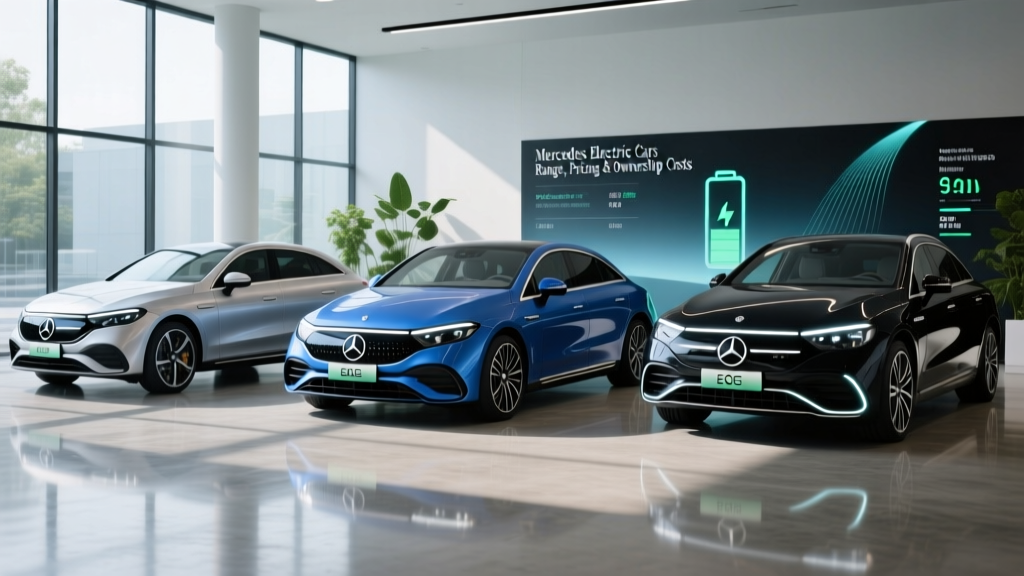
Mercedes consolidated its electric naming around the "EQ" sub-brand. Here's what's on sale for the 2026 model year, with official EPA figures and manufacturer data:
| Model | EPA Range | Battery (usable kWh) | Peak DC Charge | 10–80% Time | 0–60 mph | Base MSRP |
|---|---|---|---|---|---|---|
| EQB 300 4MATIC | 251 mi | 66.5 kWh (NMC) | 100 kW | ~32 min | 7.7 sec | $54,150 |
| EQE 350+ Sedan | 305 mi | 90.6 kWh (NMC) | 170 kW | ~31 min | 6.2 sec | $75,050 |
| EQE 350 4MATIC SUV | 279 mi | 90.6 kWh (NMC) | 170 kW | ~32 min | 6.4 sec | $78,100 |
| EQS 450+ Sedan | 390 mi | 108.4 kWh (NMC) | 200 kW | ~31 min | 5.9 sec | $105,550 |
| EQS 580 4MATIC SUV | 330 mi | 108.4 kWh (NMC) | 200 kW | ~31 min | 4.4 sec | $110,000 |
Sources: fueleconomy.gov, Mercedes-Benz USA press specifications. Real-world highway range is typically 10–15% lower than EPA; cold-weather (below 32°F) can reduce range by 20–30%.
Real-World Range Reality Check
The EQS 450+ posts an impressive 390-mile EPA rating, but on a 75-mph highway loop in moderate temperatures, expect roughly 330–350 miles. In sub-freezing conditions with cabin heat running, that drops to 275–310 miles. The EQE Sedan's 305-mile EPA figure translates to about 260–280 miles highway. All Mercedes EQ models use a heat pump (standard), which helps mitigate cold-weather losses compared to resistive heating, but physics still applies.
Charging Speeds: What You'll Actually Experience
Mercedes EQ models use the CCS1 connector for DC fast charging and J1772 for Level 2 AC. (Mercedes has not yet adopted NACS on 2026 models, though a NACS adapter is available for Tesla Supercharger access.) Here's what charging looks like in practice:
| Level | Power | Miles Added per Hour | Typical Use Case |
|---|---|---|---|
| Level 1 (120V) | ~1.4 kW | 3–5 mi/hr | Emergency / overnight trickle |
| Level 2 (240V, 48A) | ~11.5 kW | 28–38 mi/hr | Home overnight, workplace |
| DC Fast (EQB) | 100 kW peak | ~150 mi in 30 min | Road trips, public stations |
| DC Fast (EQE/EQS) | 170–200 kW peak | ~180–220 mi in 30 min | Road trips, public stations |
Charging-curve reality: The EQS peaks at 200 kW only between roughly 10–40% state of charge (SoC). Above 60%, the rate tapers significantly — to around 80–100 kW. This means the advertised 10–80% time of ~31 minutes is accurate, but charging from 80–100% can take an additional 25–30 minutes. Plan road-trip stops to charge to 80% and move on; the MBUX navigation's route planner handles this automatically.
Home charging cost: A Level 2 home charger installation (48A hardwired unit, 60A circuit) typically costs $1,200–$2,800 depending on panel proximity and local permitting. If your home has a 200A panel with spare capacity, you're on the lower end. A panel upgrade to 200A or 400A can add $2,000–$5,000. Always get a quote from a licensed electrician before purchasing.
Mercedes EVs vs. Gas Equivalents: The Cost Breakdown
Let's compare the EQE 350+ Sedan against its closest internal-combustion sibling, the E 350 Sedan, over 5 years / 75,000 miles:
| Cost Category | EQE 350+ (EV) | E 350 Sedan (Gas) |
|---|---|---|
| Base MSRP | $75,050 | $59,950 |
| Federal Tax Credit (§30D) | $0 (sourcing rules)* | $0 |
| Fuel/Energy (5 yr) | $4,800 (home L2 @ $0.14/kWh) | $10,500 (@ $3.50/gal, 26 MPG comb.) |
| Maintenance (5 yr) | $2,100 | $4,800 |
| Insurance (5 yr avg.) | $12,500 | $9,800 |
| Est. Depreciation (5 yr) | $32,000 | $22,000 |
| 5-Year Total Cost | ~$126,450 | ~$107,050 |
*As of 2026, Mercedes EQ models do not meet the §30D critical-mineral and battery-component sourcing thresholds. Check the latest eligibility at irs.gov. State incentives may apply separately.
The takeaway: The EQE saves roughly $8,400 in fuel and maintenance over five years, but the higher purchase price, steeper depreciation, and elevated insurance premiums erase those savings and then some. The gas E 350 wins on pure economics. The EQE wins on refinement, silence, instant torque, and zero tailpipe emissions — intangibles that matter to luxury buyers.
What First-Time Mercedes EV Buyers Must Know
Home Charging Is Almost Mandatory
Public DC fast charging costs $0.35–$0.55/kWh on networks like Electrify America and EVgo — making it more expensive per mile than gasoline in many states. The economic case for an EQ vehicle depends on home Level 2 charging at residential electricity rates ($0.10–$0.20/kWh in most markets). If you live in an apartment without charging access or street-park consistently, a Mercedes PHEV (like the S 580e) may be a more practical bridge.
The §30D Federal Tax Credit Likely Won't Apply
Federal rules under IRS §30D require that a percentage of battery critical minerals and components be sourced from the U.S. or free-trade-agreement partners. Mercedes' battery supply chain (primarily CATL and other non-qualifying suppliers for EQ models) does not currently meet these thresholds. This means the full $7,500 credit is unavailable at point of sale. Some states offer separate rebates — check AFDC's state incentive database for specifics in your jurisdiction.
Insurance Costs 15–30% More
Luxury EVs carry higher insurance premiums due to expensive battery replacement costs ($20,000–$35,000 for a full pack), specialized repair requirements, and higher vehicle values. Expect annual premiums of $2,200–$3,000 depending on your profile, versus $1,600–$2,200 for an equivalent gas Mercedes. Get quotes before committing.
MBUX and Drive Pilot: What You're Getting
All 2026 EQ models feature the MBUX infotainment system with the hyperscreen option (56-inch glass panel spanning the dash). The Drive Pilot system is SAE Level 2 — meaning you must keep your hands on or near the wheel and remain attentive. It is not self-driving. Mercedes has conditionally approved Level 3 Drive Pilot in limited jurisdictions (Nevada, California) for speeds up to 40 mph in traffic jams, but availability is restricted and requires specific road and weather conditions.
⚠️ Drive Pilot Is Not Autonomous
Mercedes Drive Pilot (Level 2) requires continuous driver supervision. You are legally responsible for the vehicle at all times. Level 3 capability (where the car assumes liability in approved conditions) is limited to specific highways, under 40 mph, in clear weather, in Nevada and California only. Do not confuse marketing terms with SAE automation levels.
Mercedes EVs vs. the Competition
| Spec | EQS 450+ Sedan | Tesla Model S LR | Lucid Air Pure | BMW i7 xDrive50 |
|---|---|---|---|---|
| EPA Range | 390 mi | 402 mi | 419 mi | 318 mi |
| Battery | 108.4 kWh | ~100 kWh | 88 kWh | 101.7 kWh |
| Peak DC Charge | 200 kW | 250 kW | 220 kW | 195 kW |
| 0–60 mph | 5.9 sec | 3.1 sec | 3.4 sec | 4.5 sec |
| Base MSRP | $105,550 | $79,990 | $69,900 | $120,295 |
| Federal Credit | $0 | $0 | $0 | $0 |
The EQS offers the most opulent interior and the smoothest ride quality in this group, but it trails the Model S and Lucid Air on range, performance, and price. The BMW i7 is the closest rival in luxury terms but sacrifices range. If cabin craftsmanship and brand prestige are your top priorities, the EQS delivers. If range-per-dollar or outright acceleration matters more, look elsewhere.
Decision Framework: Which Mercedes EV Is Right for You?
Choose Based on Your Situation
- Choose the EQB if you need a compact luxury EV with a third row (small children only), have a shorter commute (<50 mi/day), and want the lowest entry price into Mercedes electric ownership.
- Choose the EQE Sedan if you want a mid-size luxury electric daily driver with ~260 miles of real-world highway range, excellent cabin isolation, and don't mind paying a premium over the Tesla Model S.
- Choose the EQE SUV if you need the cargo space and ride height of an SUV and your daily driving stays within 240 miles.
- Choose the EQS Sedan if budget is flexible, you want the longest range in the lineup (~330+ miles real-world), and flagship-level luxury is a must.
- Choose a Mercedes PHEV instead if you lack home charging, regularly drive 300+ miles between stops, or live in a region with sparse DC fast-charging infrastructure.
- Look at Tesla, Lucid, or Hyundai/Kia if range-per-dollar, fastest charging speeds, or federal tax credit eligibility are your top priorities.
Common Misconceptions About Mercedes EVs
| Myth | Fact |
|---|---|
| "Mercedes EVs get the $7,500 tax credit." | As of 2026, none qualify under §30D due to battery-sourcing rules. Verify at irs.gov. |
| "The EQS goes 390 miles in real driving." | EPA is a lab estimate. Expect 330–350 mi highway, 275–310 mi in freezing weather. |
| "DC fast charging is cheaper than gas." | Only home Level 2 is cheaper. Public DCFC at $0.40+/kWh often costs more per mile than a 30-MPG gas car. |
| "Drive Pilot means the car drives itself." | Drive Pilot is SAE Level 2 (supervised). Level 3 is available only in narrow, approved conditions in NV/CA. |
| "EV batteries need replacing every 5 years." | Mercedes warranties its EV batteries for 10 years/155,000 miles against degradation below 70% capacity. Most NMC packs retain 85–90% after 100,000 miles based on industry fleet data. |
Battery Longevity and Warranty
All 2026 Mercedes EQ models use NMC (nickel manganese cobalt) battery chemistry, which prioritizes energy density over cycle life compared to LFP. Mercedes provides a 10-year / 155,000-mile battery warranty guaranteeing at least 70% capacity retention. Real-world degradation data from European EQS fleets suggests roughly 5–8% loss over the first 100,000 miles with typical charging habits (avoiding frequent 100% charges and DC fast charging).
Care tips for maximum longevity:
- Set daily charge limit to 80% (configurable in MBUX)
- Use DC fast charging sparingly — rely on Level 2 for daily needs
- Precondition the battery before fast charging (MBUX does this automatically when a DCFC is set as a nav destination)
- Avoid leaving the car at 100% SoC for extended periods, especially in hot climates
A full battery replacement out of warranty runs $22,000–$35,000 depending on the model — a significant cost to factor into long-term ownership projections.
Frequently Asked Questions
Do any Mercedes electric cars qualify for the federal tax credit?
As of 2026, no Mercedes EQ models qualify for the full $7,500 §30D federal tax credit due to battery critical-mineral and component sourcing requirements. Some state-level incentives may still apply. Always verify current eligibility on irs.gov and consult a tax professional.
What's the cheapest Mercedes electric car?
The EQB 300 4MATIC starts at approximately $54,150. It offers 251 miles of EPA range, a compact SUV form factor with an optional third row, and 100 kW DC fast charging. It's the most accessible entry point into the Mercedes EV lineup.
Can I charge a Mercedes EV at a Tesla Supercharger?
Yes, with a CCS-to-NACS adapter (sold separately by Mercedes, ~$200–$250). Mercedes EQ models use CCS1 natively. The adapter unlocks access to Tesla's Supercharger network, significantly expanding your road-trip charging options.
How long does it take to charge a Mercedes EQS at home?
With a 48A Level 2 home charger (11.5 kW), a fully depleted EQS 108.4 kWh battery charges in roughly 9.5 hours. In practice, you'll rarely arrive home at 0% — a typical daily top-up from 40–80% takes about 3.5 hours overnight.
Are Mercedes EVs reliable?
Mercedes EQ models have average reliability ratings for the luxury EV segment. The most commonly reported issues involve MBUX software glitches and 12V auxiliary battery drain — not traction battery failures. The high-voltage battery is well-protected by the 10-year/155,000-mile warranty. Check NHTSA for current recall information.
Should I buy a Mercedes EV or a plug-in hybrid?
If you have reliable home charging and your daily commute is under 80 miles, an EQ model delivers lower running costs and a smoother driving experience. If you frequently take 300+ mile trips through areas with sparse charging infrastructure, or you can't install a home charger, a Mercedes PHEV (like the GLC 350e or S 580e) offers 30–40 miles of electric-only range for daily driving with a gas engine for longer trips — no range anxiety.