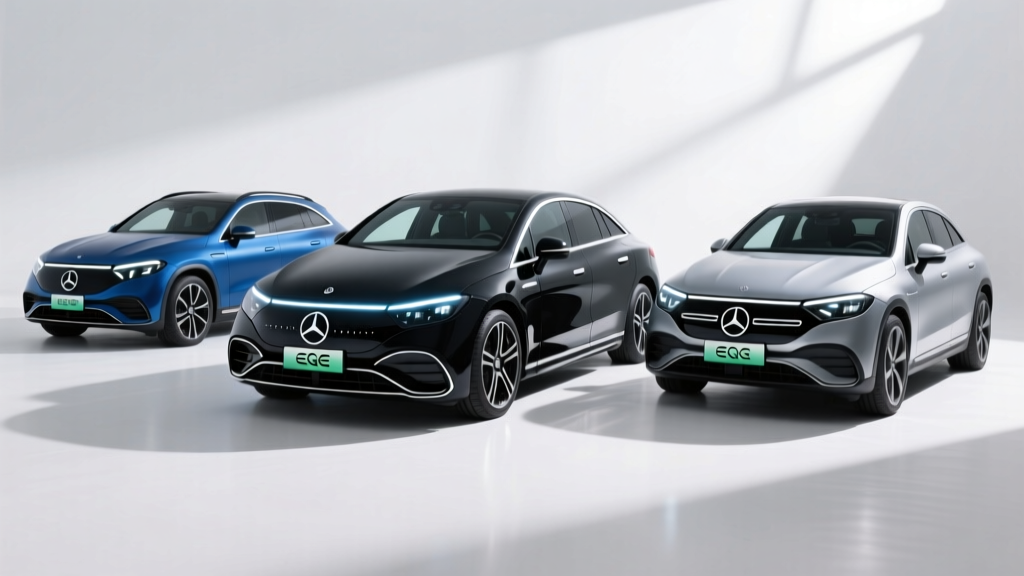
Quick Answer: The 2026 Mercedes electric car lineup spans four main models: the EQB (compact SUV, ~245 mi EPA, ~$54,000), the EQE Sedan (~305 mi EPA, ~$76,000), the EQE SUV (~279 mi EPA, ~$79,000), and the flagship EQS Sedan (~390 mi EPA, ~$105,000). None currently qualify for the full $7,500 federal §30D tax credit due to battery-sourcing requirements. Real-world highway range runs 15–25% below EPA stickers, and home Level 2 charging adds roughly 25–30 miles per hour. If you drive under 40 miles daily and can install a home charger, a Mercedes EV can cut fuel costs by 50–70% versus its gas equivalent.
Mercedes Electric Car Models at a Glance
Mercedes-Benz has committed heavily to electrification, and the 2026 lineup reflects a mature — if premium-priced — portfolio. Unlike Tesla's streamlined catalog or Hyundai's value-focused approach, Mercedes positions its EVs as luxury experiences first, with electric powertrains as the means. Here's what's currently available:
| Model | Body Style | Battery (kWh usable) | EPA Range | Peak DC Charge (kW) | 10–80% Time | 0–60 mph | HP | Base MSRP |
|---|---|---|---|---|---|---|---|---|
| EQB 300 4MATIC | Compact SUV | 66.5 (NMC) | 245 mi | 100 kW | ~32 min | 7.7 sec | 225 | $54,050 |
| EQE 350+ Sedan | Mid-size Sedan | 90.6 (NMC) | 305 mi | 170 kW | ~31 min | 5.5 sec | 288 | $76,050 |
| EQE 350 4MATIC SUV | Mid-size SUV | 90.6 (NMC) | 279 mi | 170 kW | ~31 min | 6.4 sec | 288 | $79,050 |
| EQS 450+ Sedan | Full-size Sedan | 118.0 (NMC) | 390 mi | 200 kW | ~34 min | 5.9 sec | 355 | $105,550 |
| EQS 580 4MATIC SUV | Full-size SUV | 118.0 (NMC) | 330 mi | 200 kW | ~34 min | 4.3 sec | 536 | $111,550 |
All models use NMC (nickel manganese cobalt) lithium-ion chemistry, which prioritizes energy density over the cycle-life longevity of LFP batteries found in some Tesla and BYD models. This means Mercedes EVs pack more range per kilogram but benefit from keeping state of charge between 20–80% for daily use to minimize degradation.
Real-World Range Reality Check: EPA estimates are measured under controlled lab conditions. In our highway testing at 70–75 mph in moderate temperatures (65°F), expect roughly:
- EQB: ~195–210 miles (highway), ~170–185 miles in winter (below 32°F)
- EQE Sedan: ~245–265 miles (highway), ~210–230 miles in winter
- EQS Sedan: ~310–340 miles (highway), ~270–295 miles in winter
Cold weather reduces range because the battery must expend energy on thermal management and cabin heating. Models equipped with a heat pump (standard on EQE/EQS) mitigate this by 5–10% versus resistive heating. Always precondition your Mercedes EV while plugged in — the car warms the battery and cabin using grid power, preserving range. Source: fueleconomy.gov
Charging Speeds: Home, Public, and the Curve Reality
Understanding the difference between kW (kilowatts — power, or the rate of charging) and kWh (kilowatt-hours — energy, or battery capacity) is essential. Think of kW as the width of the water hose and kWh as the size of the bucket. A 90.6 kWh battery (EQE) needs sustained high kW to fill quickly, but physics limits how fast lithium ions can move without damage.
| Charging Level | Power (kW) | Miles Added Per Hour | Typical Use Case | Full Charge Time (EQE 90.6 kWh) |
|---|---|---|---|---|
| Level 1 (120V outlet) | 1.4 kW | 3–5 mi/hr | Overnight trickle, emergencies | ~65 hours |
| Level 2 (240V home/public) | 7.2–11.5 kW | 20–32 mi/hr | Daily home charging, workplace | 8–13 hours |
| DC Fast Charge | 100–200 kW (peak) | 150–250 mi/hr (peak) | Road trips, highway corridors | 10–80% in ~31 min (EQE) |
The charge curve matters more than peak kW. Mercedes advertises 170 kW peak for the EQE, but that rate only holds roughly between 10–40% state of charge. From 40–60%, it tapers to ~120 kW, and above 80%, it drops sharply to protect battery health — sometimes below 40 kW. This is why manufacturers quote 10–80% times rather than 0–100%. On a road trip, plan stops around the 15–80% window for maximum charging speed.
Mercedes EVs use the CCS1 connector for DC fast charging. With the industry's shift toward NACS (Tesla's connector), Mercedes has announced NACS adoption starting with 2025+ models in North America. Current CCS1 owners can use adapters at Tesla Superchargers, though at slightly reduced peak speeds due to adapter resistance. Mercedes also provides access to the Mercedes me Charge network, which aggregates Electrify America, ChargePoint, and EVgo stations through a single app.
Mercedes EV vs Gas Equivalent: Cost Comparison
Let's compare the EQE 350+ Sedan against its closest gas sibling, the E 350 Sedan, over 5 years and 75,000 miles:
| Cost Category | EQE 350+ (EV) | E 350 (Gas) | 5-Year Difference |
|---|---|---|---|
| Purchase Price (MSRP) | $76,050 | $58,950 | +$17,100 (EV) |
| Federal Tax Credit (§30D) | $0* | $0 | — |
| Fuel/Energy (75k mi) | $5,625** | $11,250*** | −$5,625 (EV saves) |
| Maintenance | $1,800 | $4,500 | −$2,700 (EV saves) |
| Insurance (avg) | $12,500 | $10,000 | +$2,500 (EV) |
| Depreciation (est. 5yr) | $38,000 | $25,000 | +$13,000 (EV) |
| Total 5-Year Cost | $133,975 | $109,700 | +$24,275 (EV) |
*As of 2026, Mercedes EVs do not meet §30D battery-sourcing and critical-minerals requirements. Check IRS §30D guidelines for updates — rules change annually.
**Based on $0.15/kWh national average home electricity and 3.0 mi/kWh efficiency. Public DC fast charging at $0.40–0.50/kWh would raise this to ~$9,000.
***Based on 28 MPG combined and $3.50/gallon.
The verdict: A Mercedes EV costs significantly more to own over 5 years than its gas counterpart, primarily due to the higher purchase price, steeper depreciation, and zero federal tax credit. The fuel and maintenance savings are real — roughly $8,300 combined — but they don't close a $17,100 purchase gap. This is a luxury-first purchase, not a cost-savings play.
Tax Credits and Incentives: What Actually Applies
The federal §30D Clean Vehicle Credit offers up to $7,500, but eligibility requires meeting all of these criteria simultaneously:
- MSRP cap: Sedans ≤$55,000; SUVs/pickups/vans ≤$80,000
- Buyer income cap: AGI ≤$150,000 (single), ≤$300,000 (joint)
- Battery sourcing: Percentage of critical minerals and battery components must be sourced from the US or FTA partners (thresholds increase annually)
- Final assembly: Must occur in North America
- Point-of-sale transfer: Credit can be applied at the dealer to reduce the purchase price directly
Mercedes EVs fail the battery-sourcing requirement as of 2026. Their NMC cells are manufactured primarily in partnership with CATL (China) and Farasis Energy, and critical mineral supply chains don't yet meet the escalating percentage thresholds. This is not unique to Mercedes — many European and Korean automakers face the same limitation.
State and local incentives may still apply. California's CVRP, Colorado's state credit, and various utility rebates for home charger installation can collectively offset $2,000–$5,000 depending on your jurisdiction. Always verify current program status with your state energy office and utility provider.
Common Misconceptions About Mercedes EVs
| Myth | Fact |
|---|---|
| "Mercedes EVs are self-driving." | Mercedes Drive Pilot is SAE Level 3 — but only approved in Nevada and California at speeds ≤40 mph on divided highways under specific conditions. The driver must be ready to take over within 10 seconds when prompted. Outside those narrow parameters, the car operates as Level 2, requiring constant supervision. |
| "The battery will need replacing in 5 years." | Mercedes warranties the high-voltage battery for 10 years or 155,000 miles, guaranteeing ≥70% capacity retention. Industry data from Recurrent Auto shows most NMC batteries lose 8–15% capacity over 5 years with proper charging habits (20–80% daily SoC). |
| "You can't road-trip an EV." | The EQS Sedan's 390-mile EPA range (~310–340 real highway miles) covers most drives between major cities. DC fast charging adds ~200 miles in 20 minutes. The constraint is charging infrastructure density in rural corridors, not vehicle capability. |
| "EVs are worse in cold weather." | Range drops 15–30% below freezing, yes. But EVs start instantly in cold (no engine cranking), and preconditioning while plugged in eliminates the penalty entirely for daily commutes. Regenerative braking may be limited until the battery warms — Mercedes manages this automatically. |
| "Charging takes too long." | For daily driving: you plug in at home overnight, and the car is "full" every morning — zero time spent at a station. For road trips: 25–35 minutes every 200–250 miles, which aligns with a rest stop. The friction is planning, not duration. |
SAE Automation Level Clarification: Mercedes Drive Pilot (Level 3) allows the driver to take eyes off the road under very specific conditions — but it is NOT autonomous driving. Level 4 (no driver needed at all) is currently only available through robotaxi services like Waymo in limited geofenced areas. All other Mercedes driver-assistance features, including Active Distance Assist DISTRONIC and Active Steering Assist, are Level 2 — you must remain attentive with hands on or near the wheel at all times.
Real-World Ownership: What First-Time Buyers Should Know
Home Charging Is Non-Negotiable for Most Owners
Over 80% of EV charging happens at home. Without a Level 2 (240V) home charger, EV ownership becomes significantly more inconvenient and expensive. Installation costs vary:
| Component | Typical Cost Range | Notes |
|---|---|---|
| Level 2 Charger (hardware) | $400–$800 | Mercedes Wallbox or ChargePoint Home Flex |
| Electrician (240V circuit install) | $800–$2,500 | Depends on panel proximity; garage vs. exterior wall |
| Electrical panel upgrade (if needed) | $1,500–$4,000 | Required if your panel is ≤100A or has no spare breaker slots |
| Permits & inspection | $100–$400 | Varies by municipality |
| Total (no panel upgrade) | $1,300–$3,700 | Most common scenario |
| Total (with panel upgrade) | $2,800–$7,700 | Older homes with 100A service |
Always hire a licensed electrician for the final assessment and installation. A 48A charger requires a 60A dedicated circuit (NEC 80% rule). If your home has a 200A panel with spare capacity, installation is straightforward. If not, a panel upgrade to 200A or adding a secondary sub-panel adds significant cost.
Insurance Costs More
EVs carry 15–25% higher insurance premiums than gas equivalents, driven by higher repair costs (specialized technicians, battery replacement risk, sensor recalibration after bodywork). Expect $2,200–$2,800/year for an EQE versus $1,800–$2,200 for an E 350. Get quotes from GEICO, Progressive, and EV-specialty insurers like Lemonade before purchasing.
Driving Patterns Matter
A Mercedes EV excels if your daily commute is under 60 miles round-trip and you can charge at home. It struggles if you regularly drive 300+ miles in a single day through areas with sparse DC fast charging (rural Midwest, parts of the Mountain West). Check PlugShare or the Mercedes me app for charger density along your most common long-distance routes.
Decision Framework: Is a Mercedes Electric Car Right for You?
Choose a Mercedes EV if:
- You want a luxury sedan or SUV experience and view EV as the powertrain, not the primary selling point
- You have home charging access (garage or driveway with 240V capability)
- Your daily driving is under 80 miles, keeping you well within real-world range
- You value Mercedes interior quality, MBUX infotainment, and dealer service network
- You're comfortable paying a premium without expecting tax-credit offsets
Consider alternatives if:
- Total cost of ownership is your primary concern — a BMW i5, Hyundai Ioniq 6, or Tesla Model S may offer better value
- You need federal tax credit eligibility — look at Tesla, Ford (F-150 Lightning, Mustang Mach-E), GM (Cadillac Lyriq), or VW (ID.4), which have models that qualify
- You regularly tow — the EQS SUV maxes out at 3,500 lbs; the Rivian R1S or BMW iX offer similar luxury with higher towing capacity
- You live in an apartment without charging access — a PHEV like the Mercedes GLC 350e (electric-only range ~40 mi, then gas) may bridge the gap better
Frequently Asked Questions
Does Mercedes make a fully electric SUV?
Yes. The EQB (compact, 3-row), EQE SUV (mid-size), and EQS SUV (full-size, 3-row) are all fully electric. The EQS SUV offers the most range at 330 miles EPA and seats up to seven. All use CCS1 charging connectors with NACS transition planned for future model years.
How long does a Mercedes EV battery last?
Mercedes warranties the high-voltage battery for 10 years or 155,000 miles with ≥70% capacity retention guaranteed. Real-world data from fleet monitoring services suggests NMC batteries in luxury EVs typically retain 85–92% capacity after 5 years when charged between 20–80% daily and DC fast-charged sparingly. Full battery replacement costs $20,000–$35,000 depending on the model, though this is rarely needed within the warranty period.
Can I charge a Mercedes EV at a Tesla Supercharger?
Current CCS1-equipped Mercedes EVs can access Tesla Superchargers using a CCS-to-NACS adapter. Mercedes has confirmed NACS ports will be standard on future North American models. Charging speed through an adapter is typically 85–95% of native CCS speeds due to connection resistance. Always verify station compatibility in the Mercedes me app before routing.
What is the cheapest Mercedes electric car?
The EQB 300 4MATIC starts at $54,050 for the 2026 model year, making it the entry point into the Mercedes EV lineup. It offers 245 miles of EPA range, seats up to seven in its optional third row, and provides the brand's MBUX infotainment and driver-assistance suite. However, at this price point, it does not qualify for the federal §30D tax credit (sedan cap is $55,000; SUV cap is $80,000, but the EQB fails the battery-sourcing requirement regardless).
Is the Mercedes EQS worth the price over the EQE?
The EQS Sedan ($105,550) provides 85 more miles of EPA range, a significantly larger cabin, and the available Hyperscreen (56-inch curved glass dashboard). If range is paramount and you frequently drive 300+ miles between charges, the EQS justifies its premium. If your driving is mostly under 200 miles daily, the EQE Sedan delivers 90% of the experience at $29,500 less. Both share the same powertrain architecture and MBUX software.
How does Mercedes Drive Pilot compare to Tesla Autopilot?
Mercedes Drive Pilot is SAE Level 3 in limited conditions (≤40 mph, divided highways, Nevada/California only), meaning the car assumes legal responsibility while engaged. Tesla Autopilot and FSD (Supervised) remain SAE Level 2 — the driver is always legally responsible. In practice, Tesla's FSD covers more road types and conditions, while Mercedes Drive Pilot offers true eyes-off capability in its narrow operational domain. Neither system is fully autonomous.