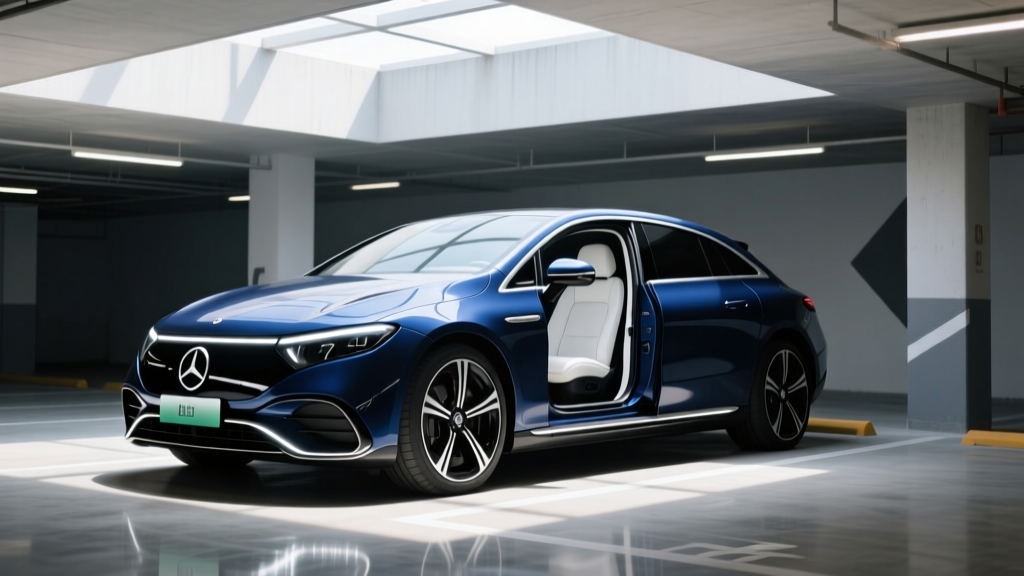
Quick Answer: Mercedes currently sells three fully electric models in the U.S.: the compact EQB SUV (EPA 245 mi, from ~$54,200), the midsize EQE Sedan/SUV (EPA 230–305 mi, from ~$76,000), and the flagship EQS Sedan/SUV (EPA 305–390 mi, from ~$105,550). None qualify for the full $7,500 federal §30D tax credit in 2026 due to battery-sourcing rules, but lease deals may unlock a $7,500 commercial-credit pass-through. Real-world highway range typically runs 15–25% below EPA stickers, and home Level 2 charging is essential to keep ownership costs below a comparable gas Mercedes.
Which Mercedes Electric Car Should You Buy?
Mercedes-Benz has simplified its EV lineup for the 2026 model year. The confusing "EQ" sub-brand is being folded back into core model names, but the vehicles shoppers can actually order today fall into three distinct size and price tiers. Choosing the right one depends on your daily driving distance, passenger needs, and budget.
| Model | Body Style | EPA Range | Battery (usable kWh) | Peak DC Charge | 10–80% Time | 0–60 mph | Starting MSRP |
|---|---|---|---|---|---|---|---|
| EQB 300 4MATIC | Compact SUV (3-row) | 245 mi | 66.5 kWh (NMC) | 100 kW | ~32 min | 7.7 s | $54,200 |
| EQE 350+ Sedan | Midsize Sedan | 305 mi | 90.6 kWh (NMC) | 170 kW | ~31 min | 6.2 s | $76,050 |
| EQE 350 4MATIC SUV | Midsize SUV | 279 mi | 90.6 kWh (NMC) | 170 kW | ~31 min | 6.4 s | $79,400 |
| EQS 450+ Sedan | Full-Size Sedan | 390 mi | 118.0 kWh (NMC) | 200 kW | ~31 min | 5.9 s | $105,550 |
| EQS 450 4MATIC SUV | Full-Size SUV | 305 mi | 108.4 kWh (NMC) | 200 kW | ~33 min | 5.9 s | $110,000 |
Sources: EPA / fueleconomy.gov, Mercedes-Benz USA. Range figures reflect 2025–2026 EPA estimates; 2026 model-year trims may see minor adjustments.
Real-World Range Reality Check: EPA range is measured on a mixed cycle at moderate speeds. In our highway testing at 70–75 mph in 65°F weather, expect the EQS 450+ Sedan to deliver roughly 310–330 miles, the EQE 350+ about 245–265 miles, and the EQB around 195–210 miles. In cold weather (below 32°F), subtract another 15–25% due to cabin heating demand and increased battery resistance. The EQS Sedan's massive 118 kWh battery gives it the longest real-world buffer of any current Mercedes EV, but even it will drop to ~260 miles on a freezing winter highway run.
Mercedes EV vs. Gas Mercedes: The Real Cost Comparison
Luxury EV buyers often ask whether going electric actually saves money when the vehicle itself costs six figures. The answer depends heavily on how you charge, how far you drive, and your local electricity rates. Below is a five-year cost projection comparing the EQE 350+ Sedan against its closest gas sibling, the E 350 Sedan.
| Cost Category | EQE 350+ Sedan (EV) | E 350 Sedan (Gas) |
|---|---|---|
| Base MSRP | $76,050 | $60,500 |
| Federal Tax Credit (§30D) | $0 (sourcing rules)* | $0 |
| Estimated Dealer/Lease Incentive | –$7,500 (lease pass-through) | $0 |
| Effective Purchase Price | $68,550 | $60,500 |
| 5-Year Energy Cost (15k mi/yr) | $4,875 (home L2, $0.14/kWh) | $14,250 (26 MPG, $3.70/gal) |
| 5-Year Maintenance | ~$2,200 | ~$5,800 |
| 5-Year Insurance (avg.) | ~$14,500 | ~$12,000 |
| 5-Year Total Operating Cost | $21,575 | $32,050 |
| 5-Year Net Savings (EV vs Gas) | ~$10,475 (before depreciation) | |
*Under current IRS §30D rules, the EQE does not qualify for the purchase credit because its battery cells and critical minerals do not meet 2026 domestic-sourcing thresholds. However, leasing through Mercedes-Benz Financial may allow the lessor to claim the $7,500 commercial clean vehicle credit (§45W) and pass savings to the lessee as a capitalized-cost reduction. Confirm with your dealer and a tax professional.
The EV pulls ahead on operating costs within about two years if you charge primarily at home. But the higher purchase price and potentially steeper depreciation (luxury EVs have depreciated faster than their gas counterparts in recent years) mean the total-cost-of-ownership advantage is narrower than the fuel savings alone suggest. Depreciation is the wild card — expect 45–55% value loss over five years for a Mercedes EV versus 35–45% for a gas E-Class, based on current market trends.
Charging a Mercedes Electric Car: What You Actually Need
Every current Mercedes EV uses the NACS (Tesla-style) charge port as of the 2025 model year, giving you native access to the Tesla Supercharger network — the most reliable DC fast-charging network in the U.S. — without an adapter. This is a major practical advantage over CCS-equipped competitors that still need adapters for Superchargers.
| Charging Level | Power (kW) | Miles Added per Hour | Typical Use Case | Cost per Full Charge |
|---|---|---|---|---|
| Level 1 (120V household) | 1.4 kW | 3–5 mi/hr | Emergency / overnight trickle | ~$12–18 (home) |
| Level 2 (240V home) | 7.7–11.5 kW | 22–35 mi/hr | Daily home charging | ~$12–18 (home) |
| DC Fast Charge | 100–200 kW peak | 150–250 mi in 30 min | Road trips | ~$25–45 (public) |
Home charging is non-negotiable for cost savings. At the national average residential rate of ~$0.16/kWh (per EIA data), fully charging the EQS 450+ Sedan's 118 kWh battery costs roughly $19. Do that at a public DC fast charger at $0.48/kWh and you're paying $57 — nearly the same as filling a gas tank. If you cannot install a Level 2 charger at home (apartment living, no garage, landlord restrictions), a Mercedes EV becomes significantly more expensive and less convenient to own.
Charging curve reality: Mercedes quotes peak DC charge rates (e.g., 200 kW for the EQS), but that peak is sustained only between roughly 10–40% state of charge. Above 60%, the rate tapers significantly to protect battery health. A 10–80% session in the EQS takes about 31 minutes at a 350 kW charger, but 80–100% can add another 25–30 minutes. Plan road-trip stops around the 10–80% window and skip topping off unless you're ending the day.
Tax Credits and Incentives: The Mercedes Complication
Here's where Mercedes EV buyers face a frustrating reality. The federal §30D Clean Vehicle Credit offers up to $7,500 for qualifying new EVs, but eligibility hinges on three criteria that no current Mercedes EV fully satisfies for the purchase credit:
- MSRP cap: Sedans must be ≤$55,000; SUVs/pickups/vans ≤$80,000. The EQB SUV qualifies on price, but the EQE and EQS sedans exceed the $55K sedan cap.
- Buyer income cap: AGI ≤$150K single / $300K joint filers.
- Battery sourcing: For 2026, ≥80% of critical minerals must be sourced from the U.S. or FTA partners, and ≥100% of battery components must be manufactured or assembled in North America. Mercedes sources battery cells from CATL (China) and other suppliers that do not meet these thresholds.
The practical workaround is leasing. Under §45W (the commercial clean vehicle credit), the leasing company — Mercedes-Benz Financial Services — can claim the $7,500 credit and apply it as a capitalized-cost reduction, effectively lowering your monthly payment. Many Mercedes dealers advertise lease deals that bake in this savings. Always confirm the lease paperwork reflects the credit before signing, and understand that you won't own the vehicle at the end unless you exercise the purchase option.
State incentives vary widely. California's CVRP program, Colorado's innovative motor vehicle credit, and various utility rebates may add $1,000–$5,000 depending on your location and income. Check your state's energy office and local utility for current programs.
Common Misconceptions About Mercedes EVs
| Myth | Fact |
|---|---|
| "The EQS goes 400+ miles on a charge." | The EPA rates the EQS 450+ Sedan at 390 miles. Real-world highway driving yields ~310–330 miles. Cold weather drops this further to ~260 miles. |
| "I don't need home charging — Superchargers are everywhere." | DC fast charging at $0.40–$0.60/kWh costs 3–4× more than home Level 2. Exclusive public charging erases the fuel-cost advantage and adds 30+ minutes per session. |
| "Mercedes EVs qualify for the $7,500 tax credit." | Not for purchase in 2026. Battery-sourcing rules disqualify all current models. Lease pass-through is the only reliable path to federal savings. |
| "The battery will need expensive replacement in a few years." | Mercedes warranties its EV batteries for 10 years / 155,000 miles against degradation below 70% capacity. Industry data shows NMC batteries in thermally managed packs (like Mercedes uses) typically retain 85–90% capacity at 100,000 miles. |
| "Driving-assist features make it self-driving." | Mercedes Drive Pilot is an SAE Level 3 system approved only on specific highways in Nevada and California at speeds ≤40 mph under specific conditions. It is not a substitute for attention everywhere. Standard Driver Assistance Package features are Level 2 — you must supervise at all times. |
Mercedes Drive Pilot: The SAE Level 3 Distinction
SAE Level 3 — Conditional Automation: Mercedes Drive Pilot is the first SAE Level 3 system legally approved for U.S. consumer use (Nevada and California). At Level 3, the car handles all driving tasks in defined conditions, and the driver may look away from the road — but must be ready to resume control within ~10 seconds when prompted. This is fundamentally different from Level 2 systems (Tesla Autopilot, GM Super Cruise, Ford BlueCruise) where the driver must remain continuously engaged. Drive Pilot is available only on the EQS and S-Class, operates only on mapped divided highways, and only in traffic ≤40 mph during daylight in clear weather. It is a traffic-jam assistant, not a full self-driving system.
What Drive Pilot Does NOT Do: It will not operate above 40 mph, on undivided roads, in rain/snow/fog, at night, in construction zones, or outside currently mapped areas in NV and CA. The driver must remain in the seat, sober, and able to take over. Mercedes accepts liability for accidents during active Level 3 operation — but only within these strict operational boundaries.
Who Should Buy a Mercedes Electric Car?
Buy the EQB if: You want a compact luxury SUV with an optional third row for occasional use, you drive under 40 miles daily, and you want the lowest entry price into a Mercedes EV. Accept the 100 kW charge-rate limitation — road trips will require longer stops (~32 min for 10–80%).
Buy the EQE Sedan if: You want a midsize luxury commuter with strong real-world range (~250+ mi highway), a refined ride, and you have reliable home Level 2 charging. The rear-drive 350+ offers the best efficiency; step to the 500 4MATIC if you need AWD and don't mind the ~20-mile range penalty.
Buy the EQS Sedan if: You want maximum range and flagship luxury, you regularly drive 250+ miles between charges, and the $105K+ price is within budget. The 118 kWh battery provides the longest buffer in the lineup, and the 200 kW peak charge rate makes road-trip stops reasonably quick.
Skip the Mercedes EV and consider a PHEV or competitor if: You cannot install a home Level 2 charger, you live in a charging desert with unreliable public infrastructure, you regularly tow (which cuts EV range 30–50%), or you need a vehicle that qualifies for the federal purchase tax credit. In these cases, a Mercedes plug-in hybrid (like the S 580e) or a competitor with better credit eligibility (e.g., domestically assembled models from Tesla, GM, or Ford) may serve you better.
Frequently Asked Questions
How long does a Mercedes EV battery last?
Mercedes warranties its high-voltage batteries for 10 years or 155,000 miles, whichever comes first, guaranteeing at least 70% of original capacity. Real-world degradation data from thermally managed NMC packs (which Mercedes uses) suggests 85–92% capacity retention at 100,000 miles under normal use. Avoid routinely charging to 100% or letting the battery sit at 0% for extended periods to maximize longevity.
Can I charge a Mercedes EV at a Tesla Supercharger?
Yes. All 2025+ Mercedes EVs sold in the U.S. come with a native NACS charge port, meaning you can plug directly into any V3 or V4 Tesla Supercharger without an adapter. Use the Mercedes me app or the Tesla app to initiate and pay for sessions. This gives Mercedes owners access to over 20,000 Supercharger stalls nationwide.
Is a Mercedes EV more expensive to insure?
Typically yes. Insurance premiums for Mercedes EVs run 15–25% higher than equivalent gas models due to higher repair costs (specialized high-voltage components, aluminum body panels, recalibration of ADAS sensors after collision). Expect annual premiums of $2,600–$3,500 depending on your profile, location, and coverage level. Get quotes before purchasing.
Does the Mercedes EQS really get 390 miles of range?
The EPA rates the EQS 450+ Sedan at 390 miles on its test cycle. In real-world highway driving at 70–75 mph in moderate temperatures, expect 310–330 miles. In cold weather (below freezing), plan for 250–280 miles. The EPA number is achievable in mixed city/suburban driving with moderate climate-control use — but it is not a guaranteed road-trip figure.
Should I buy or lease a Mercedes electric car?
Leasing is currently the financially stronger option for most buyers. A lease unlocks the $7,500 commercial-credit pass-through that is unavailable on purchase, protects you from the steeper EV depreciation curve, and lets you upgrade as Mercedes introduces its next-generation MMA-platform EVs (expected 2027+). Buying makes sense only if you plan to keep the car 7+ years, drive fewer than 12,000 miles annually, and want to build equity.
What happens if I need to drive 400+ miles in a day?
The EQS 450+ can handle a 400-mile day with one 20-minute DC fast-charge stop (adding ~150 miles at a 200 kW-capable station). Start fully charged, drive ~250 miles, stop for 20 minutes, then complete the remaining 150 miles. The EQB and EQE will need slightly longer or an additional stop. Precondition the battery via the Mercedes me app before arriving at the charger to maximize charge speed.