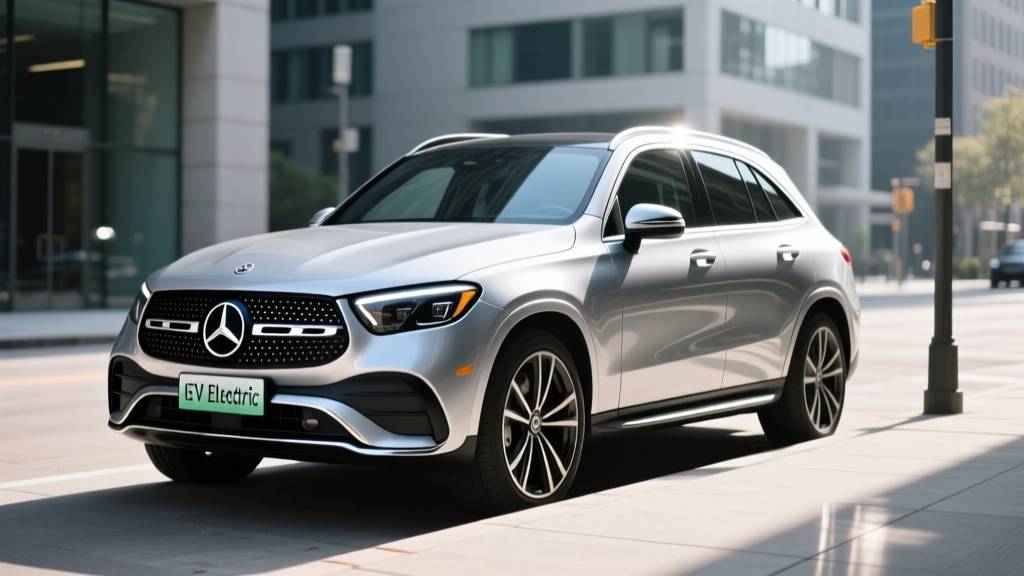
The short answer: The 2026 Mercedes-Benz GLC 350e 4MATIC is a plug-in hybrid (PHEV), not a fully electric SUV. If you want a battery-electric Mercedes in the GLC size class, the GLC EV (built on the new MMA platform) is expected for the 2027 model year with an estimated EPA range of 300+ miles. For now, the GLC 350e offers roughly 45 miles of electric-only driving before the gas engine kicks in — a strong bridge option if you can charge at home but aren't ready to go fully electric.
What the Mercedes-Benz GLC Electric SUV Lineup Actually Looks Like
There's significant confusion around the term "Mercedes-Benz GLC electric SUV" because the GLC nameplate currently spans multiple powertrains. Let's separate what's available from what's coming:
- GLC 350e 4MATIC (PHEV): Currently on sale. Plug-in hybrid with a 23.0 kWh battery (usable ~20 kWh), offering an EPA-estimated 45 miles of electric-only range and a combined 315 hp from its 2.0L turbocharged engine and electric motor.
- GLC EV (BEV): Announced for the 2027 model year, riding on Mercedes' Modular Mercedes Architecture (MMA). Preliminary specs suggest an 800-volt architecture, NMC battery options up to ~85 kWh, and targeting 300+ miles of EPA range. Not yet available for purchase.
- EQC (discontinued): Mercedes' earlier all-electric compact SUV was pulled from the U.S. market after the 2022 model year and is not a current option.
This guide focuses on what you can actually buy or lease today — the GLC 350e PHEV — while flagging the upcoming GLC EV for buyers who can wait.
Range, Efficiency, and Powertrain Specs
The 2026 GLC 350e 4MATIC pairs a 2.0-liter turbocharged four-cylinder engine with a permanently excited synchronous electric motor integrated into its nine-speed automatic transmission. Combined output is 315 horsepower and 406 lb-ft of torque.
| Specification | 2026 GLC 350e 4MATIC |
|---|---|
| Powertrain | 2.0L Turbo I4 + Electric Motor (PHEV) |
| Combined Output | 315 hp / 406 lb-ft |
| Battery Capacity | 23.0 kWh total (~20 kWh usable), NMC |
| EPA Electric-Only Range | 45 miles |
| EPA MPGe (Charge-Sustaining) | 56 MPGe combined |
| EPA MPG (Gas Only) | 28 MPG combined |
| Level 2 AC Charge Rate | 7.4 kW (0–100% in ~2.75 hours) |
| DC Fast Charging | Not available (AC only) |
| 0–60 mph | 6.2 seconds |
| Base MSRP | ~$59,800 (before destination) |
| Federal Tax Credit (§30D) | Up to $3,750 (PHEV battery sourcing dependent) |
| Drivetrain Warranty | 4 years / 50,000 miles |
| Hybrid Battery Warranty | 6 years / 62,000 miles |
Real-world electric range reality: The EPA's 45-mile electric estimate assumes moderate temperatures and mixed driving. Expect 35–40 miles in cold weather (below 40°F) due to battery resistance and cabin heating demands. Highway driving at 70+ mph will also trim electric range to roughly 38 miles. In summer with moderate speeds, you may hit or slightly exceed 45 miles. This range is sufficient for most daily commutes — the FHWA reports the average American drives roughly 37 miles per day.
GLC 350e PHEV vs. Gas GLC 300 vs. Fully Electric Competitors
The GLC 350e doesn't exist in a vacuum. Here's how it stacks up against the gas-powered GLC 300 4MATIC and a fully electric competitor in the luxury compact SUV segment:
| Metric | GLC 350e (PHEV) | GLC 300 4MATIC (Gas) | BMW iX xDrive50 (BEV) |
|---|---|---|---|
| Base MSRP | ~$59,800 | ~$48,250 | ~$87,250 |
| EPA Combined Efficiency | 56 MPGe / 28 MPG | 27 MPG | 86 MPGe |
| Electric-Only Range | 45 miles | 0 miles | 324 miles (EPA) |
| Total Range (Elec + Gas) | ~440 miles | ~430 miles | 324 miles |
| Home Charging Needed? | Recommended | No | Strongly recommended |
| 0–60 mph | 6.2 sec | 6.3 sec | 4.4 sec |
| Federal Tax Credit | Up to $3,750* | $0 | $0 (MSRP cap) |
*Tax credit amount depends on battery component and critical-mineral sourcing requirements under IRS §30D rules. PHEVs must have a battery of at least 7 kWh to qualify — the GLC 350e clears this threshold. However, income caps ($150K single / $300K joint AGI) and MSRP caps ($80K for SUVs) apply. Consult a tax professional.
Real Cost of Ownership: 5-Year Breakdown
Sticker price is only the beginning. Here's a realistic 5-year / 60,000-mile ownership cost comparison, assuming you charge the GLC 350e at home for 80% of your daily driving and use gas for longer trips:
| Cost Category | GLC 350e (PHEV) | GLC 300 (Gas) |
|---|---|---|
| Purchase Price (base + destination) | $61,150 | $49,600 |
| Estimated Tax Credit | –$3,750 | $0 |
| Effective Purchase Price | $57,400 | $49,600 |
| Home Charger Install (Level 2) | $800–$1,500 | $0 |
| Fuel/Energy (5 yrs, 60K mi) | ~$4,200 | ~$8,100 |
| Maintenance (5 yrs) | ~$2,800 | ~$3,600 |
| Insurance (5 yrs, avg) | ~$11,500 | ~$10,200 |
| Estimated Depreciation | ~$24,000 | ~$20,500 |
| 5-Year Total Cost | ~$99,900–$100,600 | ~$92,000 |
Key takeaways: The GLC 350e saves roughly $3,900 in fuel over five years and about $800 in maintenance (fewer oil changes, reduced brake wear from regenerative braking). However, the higher purchase price, slightly higher insurance premiums, and steeper projected depreciation eat into those savings. The PHEV makes financial sense if you value the electric driving experience and qualify for the tax credit, but it does not pay for itself purely on fuel savings versus the gas GLC 300.
First-Time PHEV Buyer: What You Need to Know
If this is your first electrified vehicle, the GLC 350e has a learning curve. Here are the practical realities that brochures won't emphasize:
Home Charging Is the Whole Point
Without home charging, you're essentially driving a heavy, less-efficient gas GLC. The 23 kWh battery charges at 7.4 kW on a Level 2 (240V) home charger, taking about 2 hours and 45 minutes from empty. On a standard 120V outlet (Level 1), a full charge takes roughly 8 hours — workable only if you park for long overnight stretches. Do not buy this vehicle without a plan for daily home or workplace charging.
The Gas Engine Will Start Unexpectedly
Even in electric-only mode, the engine may fire up in cold weather to heat the cabin, during hard acceleration, or if the system determines the battery needs conditioning. This is normal PHEV behavior, not a malfunction.
Regenerative Braking Is Mild
Unlike a full EV with strong one-pedal driving, the GLC 350e's regen is relatively gentle. You'll still use the brake pedal regularly. Mercedes offers adjustable regen via paddle shifters, but it doesn't approach the aggressive deceleration of a Tesla or Hyundai Ioniq 5.
DC Fast Charging Is Not Available
The GLC 350e charges only via AC (Level 1 or Level 2). There's no DC fast-charging port. On road trips, you'll rely entirely on the gas engine — which is fine, but understand that you cannot "quick charge" at Electrify America or Tesla Supercharger stations.
Common Misconceptions, Corrected
| Myth | Fact |
|---|---|
| "The GLC electric SUV is a full EV." | The current GLC 350e is a plug-in hybrid. A fully electric GLC EV is expected for the 2027 model year. |
| "PHEVs qualify for the full $7,500 tax credit." | PHEVs qualify for up to $7,500 under §30D, but the actual amount depends on battery sourcing. The GLC 350e currently qualifies for up to $3,750 based on partial critical-mineral compliance. Check fueleconomy.gov for current credit amounts. |
| "45 miles of electric range isn't enough." | The average U.S. commute is ~37 miles round trip. For daily driving, 45 miles covers most needs. The gas engine handles longer trips. |
| "I don't need a home charger." | Without regular charging, the PHEV operates as a heavy hybrid at 28 MPG — worse than the gas GLC 300's 27 MPG. Charging access is essential to justify the premium. |
| "The battery will need expensive replacement." | Mercedes warranties the hybrid battery for 6 years / 62,000 miles. PHEV batteries are smaller and less stressed than full EV packs. Replacement (if ever needed out of warranty) is estimated at $5,000–$8,000 — significant but less than full EV battery swaps. |
Decision Framework: Is the GLC 350e Right for You?
Choose the GLC 350e PHEV if:
- You have reliable home or workplace Level 2 charging access
- Your daily commute is under 40 miles and you want electric-only driving for it
- You regularly take longer road trips and don't want to plan around DC charging infrastructure
- You want the GLC's interior quality and ride comfort with a meaningful efficiency boost over the gas model
- You qualify for the §30D tax credit (income under $300K joint / $150K single)
Choose the gas GLC 300 instead if:
- You cannot install a home charger (apartment, street parking, no garage)
- Your budget is firm below $50,000 and you don't want to wait for tax credit payback
- You drive mostly long highway miles where the PHEV's electric advantage disappears
Wait for the GLC EV (2027 model year) if:
- You want a true battery-electric vehicle with 300+ miles of range
- You already have a gas car for backup or are a two-car household
- You want DC fast-charging capability for road trips
- You're interested in Mercedes' 800V MMA platform with potentially faster charging and newer tech
Charging Setup and Infrastructure Costs
For the GLC 350e, you'll want a Level 2 home charger to make daily electric driving practical. Here's what to budget:
- Level 2 charger hardware: $300–$600 (ChargePoint Home Flex, Emporia Vue, or Mercedes Wallbox)
- Electrician installation: $500–$1,500 depending on panel proximity and conduit run length
- Electrical panel upgrade (if needed): $1,500–$3,000 for older homes with 100-amp service upgrading to 200-amp
- Permit fees: $50–$200 depending on municipality
The GLC 350e's 7.4 kW onboard charger means you don't need a 48-amp circuit — a 32-amp circuit (NEMA 14-50 or hardwired) is sufficient. A licensed electrician should make the final determination based on your panel's available capacity.
For the upcoming GLC EV with its expected 800V architecture, you'll want to plan for a higher-capacity Level 2 charger (48-amp, 11.5 kW) and potentially a panel upgrade if your home doesn't have headroom.
Frequently Asked Questions
Does the Mercedes-Benz GLC come in a fully electric version?
Not yet. The current GLC 350e is a plug-in hybrid with 45 miles of electric range. A fully electric GLC EV, built on Mercedes' MMA platform, is announced for the 2027 model year with preliminary estimates of 300+ miles of EPA range and 800V fast-charging capability.
How much does it cost to charge the GLC 350e at home?
The usable battery capacity is approximately 20 kWh. At the U.S. average residential electricity rate of ~$0.17/kWh, a full charge costs roughly $3.40. That's about $0.076 per mile on electricity — compared to $0.14–$0.18 per mile on gasoline at $3.50/gallon and 28 MPG.
Does the GLC 350e qualify for the federal EV tax credit?
It qualifies for a partial credit. Under current IRS §30D rules, the GLC 350e is eligible for up to $3,750 (based on battery critical-mineral and component sourcing). You must also meet income caps ($150K single / $300K joint modified AGI), and the vehicle must be under the $80,000 MSRP cap for SUVs. The credit can now be transferred to the dealer at point of sale as a purchase-price reduction. Always verify current eligibility with your tax advisor.
What happens when the battery runs out on the GLC 350e?
The 2.0L turbocharged gas engine seamlessly takes over. You drive normally with a combined EPA rating of 28 MPG. There is no "stranding" risk — the 15.8-gallon fuel tank gives you roughly 440 total miles of combined range. The transition between electric and gas driving is generally smooth, though you may notice a slight vibration when the engine fires up.
Is the GLC 350e good in cold weather?
Expect electric range to drop to 35–40 miles in freezing temperatures. The PHEV system will also automatically start the gas engine to provide cabin heat in very cold conditions, further reducing electric-only driving. The gas engine eliminates the cold-weather range anxiety that full EV owners experience, since total range remains strong.
Can I use a Tesla Supercharger with the GLC 350e?
No. The GLC 350e does not have DC fast-charging capability at all. It charges only via AC Level 1 (120V) or Level 2 (240V). The upcoming GLC EV is expected to adopt the NACS connector, which would eventually grant access to Tesla's Supercharger network, but this applies to the future BEV model, not the current PHEV.