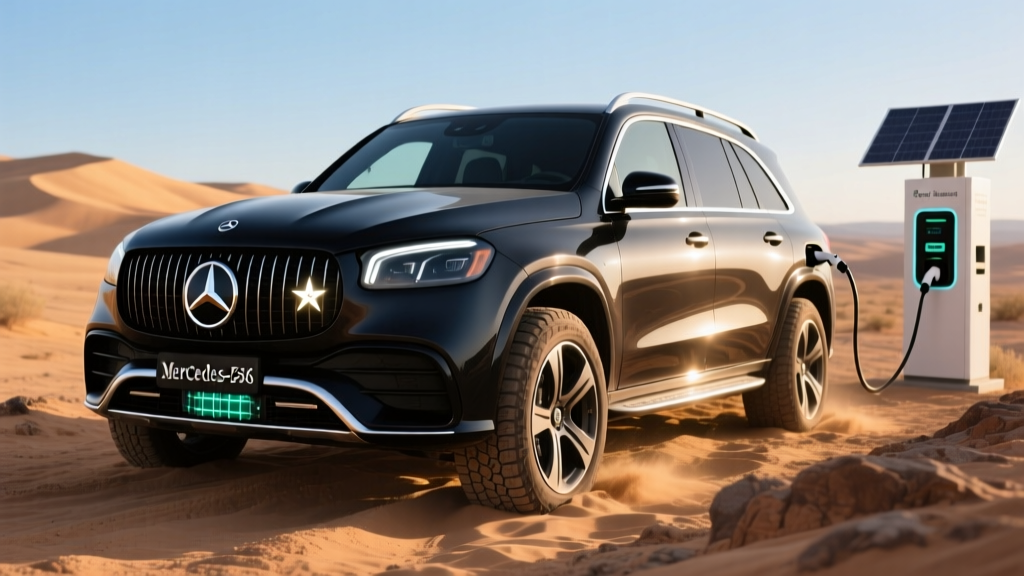
The Mercedes-Benz G 580 with EQ Technology — colloquially the "EQG" — is the most improbable electric vehicle on the road: a boxy, 6,600-pound off-road legend re-engineered around a 116 kWh battery and four independent motors. For 2026, Mercedes has fully committed to the electric G-Class, retiring the V8-powered G 550 in the U.S. market and positioning the G 580 as the sole new G-Wagen available. The question isn't whether it can climb a 45-degree grade — it absolutely can — but whether a luxury icon with an EPA range under 250 miles and a price north of $160,000 makes sense as a daily-drivable EV.
We spent time with the 2026 G 580 to evaluate its real-world range, charging behavior, tech suite, and ownership economics. Here's the data-driven verdict.
Quick Verdict: Who the G 580 EQ Is For
Choose the G 580 EQ if: You want unmatched off-road capability wrapped in iconic styling, need a luxury daily driver that can handle trails and valet lanes equally well, and have reliable home Level 2 charging.
Look elsewhere if: You prioritize maximum highway range, want the lowest cost-per-mile EV ownership, or frequently drive 300+ miles between charging stops.
The G 580 EQ is not an efficiency play. It's a statement vehicle that happens to be electric — and it's surprisingly competent as one, provided your expectations align with what a 6,600-lb aerodynamic brick can deliver.
Range & Efficiency: EPA Numbers vs. Real-World Reality
The 2026 Mercedes-Benz G 580 EQ carries an EPA-estimated range of 240 miles on a full charge, with a combined efficiency rating of approximately 52 MPGe (roughly 65 kWh per 100 miles). That efficiency figure is among the worst in the EV market — a direct consequence of the G-Wagen's flat windshield, upright stance, and substantial curb weight.
Real-World Range Expectations
EPA sticker: 240 miles
Highway driving (70-75 mph): Expect 180–200 miles. The boxy aero profile punishes you at speed far more than a sleeker SUV like the BMW iX or Rivian R1S.
City/suburban mixed: 210–230 miles, closer to the EPA estimate thanks to regenerative braking recapturing energy.
Cold weather (below 32°F): 155–180 miles. The large battery helps buffer losses, but cabin heating and battery warming draw significant power.
Off-road use: Highly variable. Low-speed technical crawling uses less energy per mile but sustained use of the four motors under load can drain the pack quickly.
For context, the EPA's fueleconomy.gov listing confirms the 240-mile combined figure. If your daily commute is under 60 miles round-trip and you charge at home nightly, the range is perfectly adequate. Road trips require planning: you'll be stopping every 160–180 miles to maintain a comfort buffer.
Battery Specs: Chemistry, Capacity, and Packaging
| Specification | Detail |
|---|---|
| Battery capacity (gross) | 116 kWh |
| Battery capacity (usable) | ~110 kWh (estimated) |
| Chemistry | NMC (Nickel Manganese Cobalt) |
| Cell format | Prismatic |
| Battery location | Skateboard platform, integrated into ladder frame |
| Thermal management | Active liquid cooling and heating |
| Structural protection | Carbon-fiber underbody shield for off-road protection |
Mercedes uses NMC chemistry rather than LFP (lithium iron phosphate), prioritizing energy density to fit maximum capacity into the G-Wagen's ladder-frame architecture. The trade-off is that NMC cells degrade slightly faster than LFP over many charge cycles and prefer not to be held at 100% state of charge for extended periods. For daily driving, Mercedes recommends setting the charge limit to 80% — yielding roughly 192 real-world miles for commuting.
The battery is housed within a reinforced section of the ladder frame, protected underneath by a carbon-fiber skid plate. This is one of the few EVs where you can reasonably take it rock-crawling without fear of puncturing the pack.
Charging Speed: DC Fast Charging and Home Level 2
| Charging Level | Power | Time / Rate |
|---|---|---|
| DC Fast Charge (peak) | 200 kW | |
| 10–80% DC fast charge | ~32 minutes | |
| DC charge curve note | Peak 200 kW sustained to ~30% SoC, then tapers to ~150 kW through 50%, dropping further above 80% | |
| Level 2 (home/public AC) | 11 kW (48A at 240V) | |
| Level 2 full charge time | ~10.5 hours (0–100%) | |
| Level 2 rate | ~22 miles of range per hour | |
| Level 1 (120V household) | ~1.4 kW (~3 miles/hr) — not practical for this battery size |
The 200 kW peak DC fast-charge rate is adequate but not class-leading. Competitors on 800V architectures — the Hyundai Ioniq 5 (peak 240 kW, 10–80% in ~18 minutes) or the Porsche Macan EV (peak 270 kW) — recharge noticeably faster. The G 580's large 116 kWh battery means even at 200 kW, you're adding roughly 3 miles of range per minute at peak.
The charging curve matters in practice: on a road trip, you'll typically charge from 10–80% in about 32 minutes at a capable station (Electrify America 350 kW stall, for example). Above 80%, charging slows dramatically — plan to unplug at 80% and drive rather than wait for a full top-off.
At home, the 11 kW onboard charger is solid. A full overnight charge on a Level 2 wall connector (48A circuit) replenishes the entire pack in roughly 10.5 hours. Most owners will arrive home at 30–40% SoC and wake up fully charged. Installation of a home Level 2 charger typically runs $800–$2,000 depending on your electrical panel's capacity and the distance from panel to charger location.
Performance: Four Motors, 579 HP, and G-Turns
| Performance Spec | Detail |
|---|---|
| Drivetrain | Quad-motor AWD (one motor per wheel) |
| Total horsepower | 579 hp |
| Total torque | 859 lb-ft |
| 0–60 mph | 4.6 seconds |
| Top speed | 118 mph (electronically limited) |
| Curb weight | ~6,614 lbs |
| Towing capacity | Not officially rated (est. ~4,500 lbs based on ICE G-Class) |
The quad-motor layout is the G 580's engineering headline. Each wheel gets its own independently controlled motor, enabling torque vectoring that no mechanical differential can match. The result is a 0–60 mph time of 4.6 seconds — remarkable for a vehicle shaped like a filing cabinet and weighing as much as two Mazda Miatas.
The standout party trick is the G-Turn: by spinning the left-side and right-side wheels in opposite directions, the G 580 can perform a 360-degree tank turn on dirt, gravel, or other low-traction surfaces. Mercedes limits this feature to off-road conditions (it will not activate on pavement). It's genuinely useful for tight trail reversals, not merely a stunt.
Also notable: G-Steering, which brakes the inside rear wheel during tight turns to dramatically reduce the turning circle — helpful given the G-Wagen's traditionally truck-like maneuverability. And G-Roar, an artificial sound profile that pulses through the cabin speakers to simulate the visceral feedback of the departed V8. You can toggle it off, and most drivers will after the novelty wears thin.
Interior, Tech, and Cargo Space
The 2026 G 580 EQ retains the iconic upright interior but gains Mercedes' latest MBUX infotainment system with a 12.3-inch digital instrument cluster and a 12.3-inch central touchscreen. Wireless Apple CarPlay and Android Auto are standard, along with a Burmester 3D surround sound system, 64-color ambient lighting, and Nappa leather upholstery.
Driver-assistance tech includes:
- Active Distance Assist DISTRONIC (adaptive cruise control)
- Active Steering Assist (lane centering)
- Active Lane Keeping Assist
- Active Blind Spot Assist
- 360-degree camera with off-road views
- PRE-SAFE predictive occupant protection
These are SAE Level 2 driver-assistance features — the driver must remain engaged and hands on the wheel at all times. Mercedes does not currently offer a Level 3 or Level 4 system in the U.S. market G-Class.
ADAS reminder: Despite the advanced feature set, the G 580's driver-assistance systems require continuous driver supervision. Active Steering Assist is not autonomous driving. You are responsible for the vehicle at all times.
Cargo and passenger dimensions remain similar to the conventional G-Class:
- Cargo volume (behind rear seats): ~17.2 cu ft
- Cargo volume (rear seats folded): ~68.6 cu ft
- Rear legroom: ~38.5 inches
- Front legroom: ~40.9 inches
- Seating capacity: 5 passengers
The cargo area is notably compact for a vehicle of this exterior size — a consequence of the upright rear glass and the ladder-frame architecture. The battery pack sits below the floor, so there's no frunk (front trunk); the hood houses electronics and the HVAC system. For a $160,000+ vehicle, the 17.2 cu ft of rear cargo space is modest. A Rivian R1S offers significantly more utility.
Pricing, Tax Credits, and Ownership Economics
| Item | Amount |
|---|---|
| 2026 G 580 EQ base MSRP | $161,500 (incl. $1,500 destination) |
| As-tested (with typical options) | $175,000–$190,000+ |
| Federal §30D tax credit | NOT eligible — exceeds MSRP cap |
| Estimated annual charging cost | ~$1,800–$2,400 (at $0.16/kWh avg, 12,000 mi/yr) |
| Estimated annual insurance | $4,500–$6,000 (luxury EV premium) |
The 2026 Mercedes-Benz G 580 EQ starts at approximately $161,500. Well-optioned examples with the AMG Line package, MANUFAKTUR paint, and premium interior packages can push past $190,000.
Regarding the federal EV tax credit: the G 580 EQ does NOT qualify for the §30D clean vehicle credit. The IRS imposes an MSRP cap of $80,000 for SUVs (per IRS.gov guidance on new clean vehicle credits). At $161,500 base, the G 580 far exceeds this threshold. Additionally, the buyer income cap ($300,000 joint / $150,000 single) would exclude some buyers regardless. There is no pathway to the $7,500 federal credit for this vehicle.
Some states offer their own EV incentives that may apply — check your state's energy office or DMV for current programs. These vary widely by jurisdiction and change frequently.
Battery and Powertrain Warranty
| Warranty Coverage | Terms |
|---|---|
| New vehicle limited | 4 years / 50,000 miles |
| Battery pack | 8 years / 100,000 miles (minimum 70% capacity retention) |
| Powertrain (motors) | 8 years / 100,000 miles |
| Roadside assistance | 4 years / 50,000 miles |
The 8-year/100,000-mile battery warranty with a 70% capacity retention threshold is industry-standard for luxury EVs. Mercedes has not published projected battery replacement costs, but based on comparable large NMC packs, expect $20,000–$35,000 if out-of-warranty replacement is ever needed.
Competitor Comparison: G 580 EQ vs. the Alternatives
| Spec | Mercedes G 580 EQ | Rivian R1S Tri-Motor | BMW iX M60 | Cadillac Escalade IQ |
|---|---|---|---|---|
| EPA Range | 240 mi | ~330 mi (est.) | ~296 mi | ~300 mi (est.) |
| Battery | 116 kWh NMC | ~149 kWh NMC | 105.2 kWh NMC | ~200 kWh NMC |
| Peak DC Charge | 200 kW | ~200 kW | 200 kW | ~350 kW |
| 10–80% DC | ~32 min | ~35 min | ~31 min | ~25 min (est.) |
| 0–60 mph | 4.6 sec | ~3.5 sec | 3.6 sec | ~3.5 sec |
| Horsepower | 579 hp | 850 hp | 610 hp | ~680 hp |
| Base MSRP | ~$161,500 | ~$106,000 | ~$111,500 | ~$130,000 |
| Federal Tax Credit | No (MSRP cap) | Eligible (verify sourcing) | No (MSRP cap) | No (MSRP cap) |
| Off-Road Capability | Exceptional | Excellent | Moderate | Limited |
The G 580 EQ's closest philosophical rival is the Rivian R1S, which offers more range, more horsepower, more cargo space, more seats (available 7-passenger), and a price advantage of roughly $55,000. The R1S also qualifies for the federal tax credit in eligible configurations. Where the G 580 wins is brand prestige, interior material quality, and genuine hardcore off-road engineering (locking differentials, ladder frame, G-Turn).
The BMW iX M60 is a more efficient, more comfortable highway cruiser but can't approach the G-Wagen off-road. The Cadillac Escalade IQ offers three rows and American luxury but similarly lacks off-road chops.
Pros, Cons, and the Bottom Line
Pros
- Unmatched off-road capability among EVs — G-Turn, G-Steering, and true low-range crawling
- Iconic styling that turns heads everywhere
- Quad-motor torque vectoring delivers surprising on-road agility for its size
- Large 116 kWh battery provides adequate daily range for most owners
- Carbon-fiber underbody protection is genuine engineering, not marketing
- Luxury interior with latest MBUX tech and premium materials
- Strong brand cachet and projected resale value
Cons
- EPA range of 240 miles is low for 2026 — highway and cold weather reduce it significantly
- Efficiency of ~65 kWh/100mi means expensive "fuel" costs relative to most EVs
- $161,500+ starting price with no federal tax credit eligibility
- 200 kW peak charge rate is outpaced by 800V competitors
- Cargo space (17.2 cu ft) is surprisingly small for the vehicle's footprint
- G-Roar artificial engine sound is polarizing and adds no performance value
- No frunk — missed opportunity given the battery's skateboard layout
- Insurance costs are steep ($4,500–$6,000/year estimated)
The 2026 Mercedes-Benz G 580 EQ is not the rational EV purchase. If you want maximum range per dollar, a Rivian R1S or even a Tesla Model X delivers more practical electrification. But the G-Wagen was never rational. It's an aspirational object — and as an EV, it retains the character that made the G-Class legendary while adding torque-vectoring magic that the old V8 could never deliver.
If you have home charging, a commute under 80 miles, and the budget to absorb the premium, the G 580 EQ is a surprisingly livable electric luxury SUV. Just don't expect to match the EPA range on a winter road trip.
Frequently Asked Questions
What is the real-world range of the Mercedes-Benz G 580 EQ?
The EPA rates the G 580 EQ at 240 miles combined. In real-world highway driving at 70+ mph, expect 180–200 miles. Around town with regenerative braking, you'll see 210–230 miles. In freezing weather, plan for 155–180 miles. Always maintain a 20% buffer for unexpected detours.
How fast does the G 580 EQ charge?
On a DC fast charger, the G 580 peaks at 200 kW and charges from 10–80% in approximately 32 minutes. At home on a Level 2 (240V, 48A) charger, it adds about 22 miles of range per hour, with a full 0–100% charge taking roughly 10.5 hours. Level 1 (120V) charging is impractical for a battery this large.
Does the Mercedes-Benz G 580 EQ qualify for the federal EV tax credit?
No. Under current IRS §30D rules, the federal clean vehicle credit has an MSRP cap of $80,000 for SUVs. The G 580 EQ starts at $161,500, far exceeding this limit. Some state-level incentives may apply — check your state's energy office for details. Always consult a tax professional for your specific situation.
Is the G 580 EQ worth buying vs. the Rivian R1S?
It depends on priorities. The R1S offers more range (~330 mi vs. 240 mi), more cargo space, available 7-passenger seating, faster acceleration, and a ~$55,000 lower starting price — plus potential federal tax credit eligibility. The G 580 wins on brand prestige, interior luxury materials, hardcore off-road engineering (ladder frame, locking differentials, G-Turn), and resale value. If you want the most capable off-road EV with Mercedes cachet, the G 580 is unique. If you want the best value luxury electric SUV, the R1S is the stronger buy.
What is the G-Turn feature and when can you use it?
G-Turn spins the left-side and right-side wheels in opposite directions, rotating the vehicle 360 degrees in place. Mercedes restricts this feature to off-road, low-traction surfaces (dirt, gravel, sand) — it will not activate on paved roads. It's useful for reversing direction on narrow trails where a multi-point turn isn't possible.
How much does it cost to charge the G 580 EQ at home?
At the U.S. average residential electricity rate of ~$0.16/kWh, a full 116 kWh charge costs approximately $18.56. Driving 12,000 miles per year at 65 kWh/100mi consumes about 7,800 kWh, costing roughly $1,250–$1,500 annually in electricity — significantly less than the V8 G 550's fuel costs, though the G 580 is far less efficient than most EVs.
What battery chemistry does the G 580 EQ use?
The G 580 uses NMC (Nickel Manganese Cobalt) lithium-ion cells, chosen for their high energy density. NMC offers more range per kilogram than LFP (lithium iron phosphate) but prefers not to sit at 100% state of charge for extended periods. For daily use, set your charge limit to 80% to maximize long-term battery health.