Should You Buy a Mercedes-Benz EV in 2026?
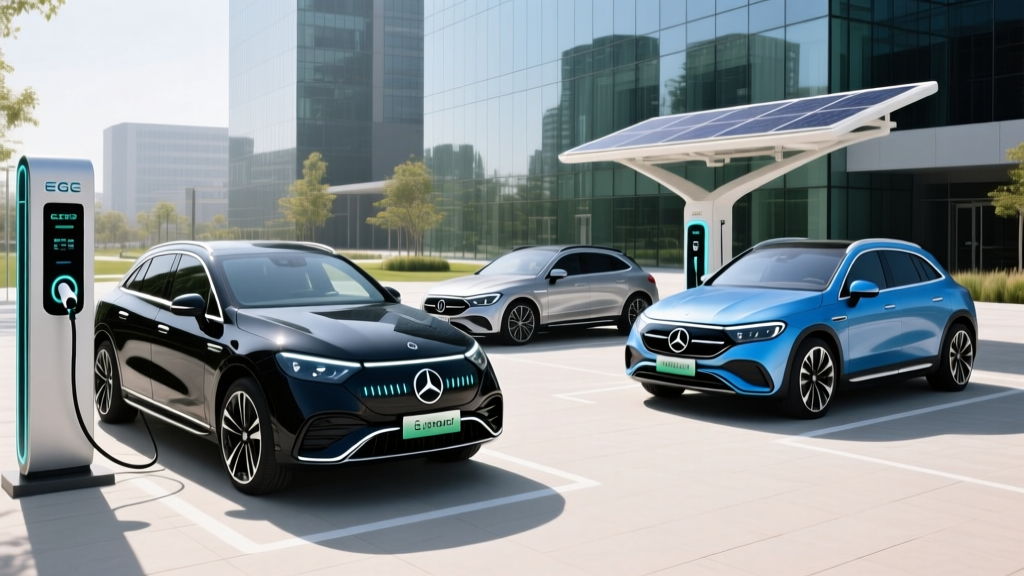
Mercedes-Benz currently sells four battery-electric models in the U.S.: the EQB (compact SUV, 245 mi EPA), EQE Sedan (midsize luxury, 305 mi EPA), EQE SUV (midsize luxury SUV, 279 mi EPA), and EQS Sedan (flagship, 390 mi EPA). Prices range from roughly $54,000 to $120,000+ before incentives. The biggest ownership advantage is home Level 2 charging at ~$0.13/kWh (about $0.04/mile), while the biggest hurdles are higher insurance premiums (typically 15–25% above gas equivalents) and DC fast-charge speeds that lag behind Hyundai/Kia's 800V architectures. Most 2026 models now ship with the NACS (Tesla-style) charge port, granting native Supercharger access.
The 2026 Mercedes-Benz EV Lineup at a Glance
Mercedes has consolidated its EQ branding, but the core models remain familiar. Below is the complete spec matrix for the current U.S. lineup. All figures are manufacturer-confirmed or EPA-published for the 2026 model year.
| Model | EPA Range | Battery (usable kWh) | Chemistry | Peak DC Charge kW | 10–80% Time | L2 Rate (kW) | 0–60 mph | HP | Base MSRP |
|---|---|---|---|---|---|---|---|---|---|
| EQB 300 4MATIC | 245 mi | 66.5 kWh | NMC | 100 kW | ~32 min | 7.2 kW | 6.2 sec | 225 | $54,200 |
| EQE 350 4MATIC Sedan | 305 mi | 90.6 kWh | NMC | 170 kW | ~31 min | 11 kW | 5.1 sec | 288 | $75,050 |
| EQE 350+ SUV | 279 mi | 90.6 kWh | NMC | 170 kW | ~31 min | 11 kW | 6.4 sec | 288 | $78,100 |
| EQS 450+ Sedan | 390 mi | 118 kWh | NMC | 200 kW | ~31 min | 11 kW | 5.9 sec | 355 | $105,550 |
| EQS 580 4MATIC Sedan | 371 mi | 118 kWh | NMC | 200 kW | ~31 min | 11 kW | 4.1 sec | 536 | $120,050 |
Sources: EPA fueleconomy.gov, Mercedes-Benz USA. Real-world highway range is typically 10–15% below EPA; cold-weather (below 32°F) can reduce range 20–30%.
Real-World Range vs. EPA Stickers: What to Expect
EPA range estimates are a useful baseline, but they represent a mix of city and highway driving under moderate temperatures. In practice, your mileage will vary based on speed, climate, and terrain.
Real-World Range Expectations
EQS 450+ Sedan: EPA 390 mi → Expect ~330–350 mi on mixed highway trips at 70 mph; ~275–300 mi in sustained sub-freezing weather.
EQE 350 4MATIC Sedan: EPA 305 mi → Expect ~260–275 mi highway; ~215–240 mi in cold conditions.
EQB 300: EPA 245 mi → Expect ~210–220 mi highway; ~170–195 mi in cold. The EQB's smaller battery makes it most susceptible to winter range loss.
All models include a standard heat pump on 2026 trims, which reduces cold-weather HVAC energy draw by roughly 30% compared to resistive heating.
Charging Speeds and the NACS Advantage
One of the most significant changes for 2026 is Mercedes-Benz's adoption of the North American Charging Standard (NACS) port on all new EQ models. This means native access to Tesla's Supercharger network — over 25,000 stalls in North America — without an adapter.
| Charging Level | Power (kW) | Miles Added per Hour | Typical Use Case |
|---|---|---|---|
| Level 1 (120V household) | ~1.4 kW | 3–5 mi/hr | Emergency / overnight top-up |
| Level 2 (240V home) | 7.2–11 kW | 20–35 mi/hr | Daily home charging |
| DC Fast (public) | 100–200 kW peak | 150–250 mi in 20 min | Road trips |
The Charge Curve Reality
Mercedes-Benz quotes peak DC fast-charge rates (100–200 kW depending on model), but peak is not sustained. Like all NMC batteries, the EQ lineup tapers charge speed significantly above 80% State of Charge (SoC) to protect battery longevity. A typical session from 10–80% takes roughly 31 minutes across the lineup, but pushing from 80–100% can add another 25–35 minutes. For road trips, plan stops around the 10–80% window for the fastest turnaround.
Compared to the Hyundai Ioniq 5 or Kia EV6, which use 800V architectures allowing 10–80% in ~18 minutes at 240+ kW, Mercedes's 400V platform is noticeably slower on DC fast chargers. This matters if you road-trip frequently.
Mercedes-Benz EV vs. Gas Equivalent: 5-Year Cost Breakdown
Luxury EV buyers often weigh an EQ model against a conventional Mercedes like the E-Class or GLC. Here's a five-year total-cost-of-ownership comparison for the EQE 350 4MATIC Sedan vs. the E 350 4MATIC (gas), assuming 12,000 miles/year, $0.13/kWh home electricity, $3.60/gallon premium fuel, and 80% home / 20% public charging.
| Cost Category | EQE 350 4MATIC (EV) | E 350 4MATIC (Gas) |
|---|---|---|
| Purchase Price (MSRP) | $75,050 | $62,550 |
| Federal Tax Credit (§30D) | $0 (see eligibility note) | $0 |
| Fuel/Energy (5 years) | $3,900 | $11,880 |
| Maintenance (5 years) | $1,800 | $4,200 |
| Insurance (5 years, avg) | $14,400 | $11,500 |
| Estimated Depreciation (5 yr) | $37,500 | $28,100 |
| Total 5-Year Cost | $132,650 | $118,230 |
Key takeaways: The EQE saves roughly $7,980 in fuel and $2,400 in maintenance over five years. However, higher insurance premiums (~$2,900 more) and steeper depreciation (~$9,400 more) erase those savings and then some. The EV wins on operating costs but loses on total cost unless you drive significantly more than 12,000 miles/year or benefit from state-level incentives.
Federal Tax Credit: The §30D Reality for Mercedes EVs
As of 2026, no Mercedes-Benz EV qualifies for the full $7,500 federal tax credit under IRS §30D rules. The reason: battery component and critical-mineral sourcing requirements that most European-assembled EVs do not meet. Some buyers may qualify for partial credits depending on specific model-year sourcing certifications — always verify with a tax professional and the IRS's official eligible-vehicle list before purchasing.
- MSRP cap: Sedans must be ≤$55,000; SUVs/trucks ≤$80,000 (most Mercedes EVs exceed these caps)
- Buyer income cap: AGI ≤$150K single / $300K joint
- Battery sourcing: Critical minerals and components must meet phased-in domestic/free-trade thresholds
- Point-of-sale transfer: Eligible credits can be applied at the dealer, reducing out-of-pocket cost
Common Mercedes-Benz EV Misconceptions
| Myth | Fact |
|---|---|
| "Mercedes EVs are self-driving." | Mercedes offers SAE Level 2 driver-assist (Active Distance Assist DISTRONIC, Active Steering Assist). The driver must remain fully engaged. Mercedes's Level 3 DRIVE PILOT is available only in California and Nevada on select EQS models, limited to 40 mph in heavy traffic on approved highways, and requires specific conditions (dry roads, clear lane markings). It is not a general-purpose autonomous system. |
| "The battery will need replacing in 5 years." | Mercedes warranties the high-voltage battery for 10 years / 155,000 miles against degradation below 70% of original capacity. Real-world NMC degradation data from similar platforms shows ~8–12% capacity loss at 100,000 miles under normal use. Full battery replacement costs range from $18,000–$32,000 depending on model, but is rarely needed within the warranty period. |
| "You can't road-trip an EV." | With NACS Supercharger access and 170–200 kW DC charging, an EQS can add ~200 miles of range in a 20-minute stop. The real limitation is the EQB's smaller battery and 100 kW peak rate, which makes longer trips require more planning. |
| "Home charging is too expensive to install." | A Level 2 home charger (240V, 48A) typically costs $1,200–$2,800 installed if your electrical panel has capacity. A panel upgrade (100A to 200A) adds $1,500–$3,000. Most EQ owners charge at home 80–90% of the time. |
SAE Automation Levels: Where Mercedes Stands
Level 2 (standard on all EQ models): Adaptive cruise + lane centering. Driver must monitor the road at all times. Hands on or near the wheel. Examples: Active Distance Assist DISTRONIC, Active Steering Assist.
Level 3 (DRIVE PILOT, EQS only, CA/NV): Conditional automation under 40 mph on mapped highways. The car handles steering, braking, and acceleration; the driver may look away but must be ready to resume control within seconds. Currently approved only in specific jurisdictions.
Level 4 (not available on consumer Mercedes): Full driverless in defined areas — this is Waymo/Zoox territory, not a personal vehicle feature.
Who Should Buy a Mercedes-Benz EV? Decision Framework
Choose a Mercedes-Benz EV If:
- You have reliable Level 2 home charging (garage or driveway with 240V access) and drive mostly within 150 miles/day.
- You value cabin refinement, MBUX infotainment, and brand prestige over maximum charging speed.
- You're considering the EQS for its class-leading 390-mile EPA range and want a luxury sedan that can handle 300-mile highway trips with one charge stop.
- You live in a region with robust Electrify America or Supercharger coverage for road trips.
Look Elsewhere If:
- You frequently drive 400+ miles in a day — Hyundai/Kia's 800V platform charges significantly faster (10–80% in ~18 min vs. ~31 min).
- You need a third row — the EQB's optional third row fits only small children; consider the Tesla Model X or Rivian R1S.
- You're counting on the federal tax credit to make the math work — most Mercedes EVs don't qualify due to MSRP caps and sourcing rules.
- You live in an apartment without charging access and your area has sparse public DC infrastructure. Relying solely on public charging adds cost ($0.30–$0.50/kWh) and inconvenience.
Home Charging Setup: What First-Time Buyers Must Know
Before taking delivery, confirm your home charging plan. Here's a realistic cost breakdown for a Level 2 installation:
| Item | Cost Range |
|---|---|
| Level 2 charger (Wallbox, ChargePoint, Emporia) | $400–$750 |
| Electrician labor (240V/48A circuit, NEMA 14-50 or hardwired) | $600–$1,800 |
| Electrical permit | $50–$200 |
| Panel upgrade (if needed, 100A → 200A) | $1,500–$3,000 |
| Total (no panel upgrade) | $1,050–$2,750 |
| Total (with panel upgrade) | $2,550–$5,750 |
Mercedes's EQE and EQS models support 11 kW Level 2 charging, which requires a 48A circuit to maximize. A standard 40A circuit (like many older homes) will limit you to ~9.6 kW — still plenty for overnight charging, but slightly slower. Always hire a licensed electrician and confirm your panel's spare capacity before purchasing equipment.
Frequently Asked Questions
What is the longest-range Mercedes-Benz EV?
The EQS 450+ Sedan leads the lineup at 390 miles EPA. In real-world highway driving at 70 mph, expect ~330–350 miles. It uses a 118 kWh NMC battery pack — one of the largest in any production EV.
Does Mercedes-Benz use LFP or NMC batteries?
All current U.S. Mercedes-Benz EVs use NMC (nickel manganese cobalt) chemistry. NMC offers higher energy density than LFP, enabling longer range in a given pack size, but it's generally recommended to charge to 80% for daily use to prolong battery life (unlike LFP, which tolerates regular 100% charges). Mercedes's battery management system includes a top-end buffer to help mitigate this.
How much does it cost to charge a Mercedes EV at home?
At the U.S. average residential rate of ~$0.16/kWh (per EIA), fully charging an EQS 450+ (118 kWh) costs roughly $18.90 for 390 miles of range — about $0.049/mile. A comparable gas S-Class at 23 MPG combined on premium ($4.00/gal) costs $0.174/mile. That's a ~72% per-mile energy savings with home charging.
Are Mercedes EVs reliable?
Long-term reliability data for the EQ lineup is still maturing. The battery and electric drivetrain have fewer moving parts than ICE vehicles, reducing mechanical failure risk. However, early EQ models have seen software-related complaints (MBUX glitches, charging communication errors) addressed through OTA updates. Mercedes's 10-year/155,000-mile battery warranty provides strong coverage. Check NHTSA for any active recalls on specific model years.
Can I use Tesla Superchargers with a Mercedes EV?
Yes — 2026 model-year Mercedes-Benz EVs ship with the native NACS charge port, granting direct access to Tesla's Supercharger network without an adapter. For older CCS-equipped models (2022–2025), Mercedes offers an official CCS-to-NACS adapter.