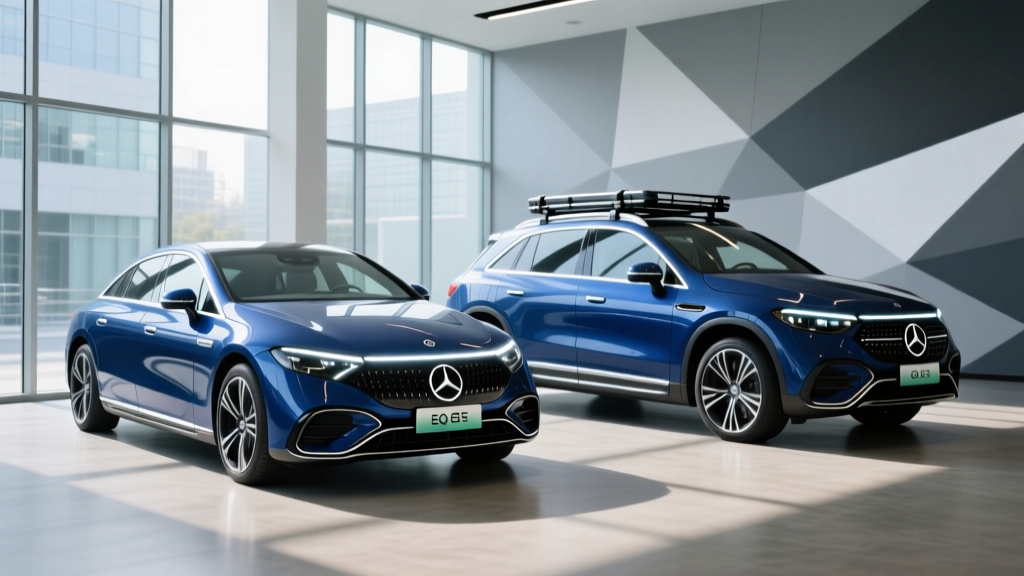
The Mercedes-Benz EQS remains the brand's flagship electric statement — a full-size luxury platform that stretches across both a sleek sedan and a three-row SUV. For 2026, the EQS lineup receives subtle but meaningful refinements to battery management, thermal efficiency, and driver-assistance calibration. But at six-figure pricing in a market now crowded with well-equipped electric luxury alternatives from BMW, Lucid, and Tesla, the EQS must justify its premium with more than a star on the grille.
We've driven both the EQS Sedan and EQS SUV across highway corridors, in winter conditions, and at DC fast chargers to deliver a numbers-first breakdown of what you actually get for the money — and what the spec sheet doesn't tell you.
Quick Verdict: Which EQS Should You Consider?
The EQS Sedan is the efficiency champion of the two, offering class-leading aerodynamics and up to an EPA-estimated 390 miles of range in the EQS 450+ rear-wheel-drive configuration. The EQS SUV trades roughly 50-60 miles of range for three-row seating, a commanding ride height, and more practical cargo access. Both share the same modular EVA2 platform, battery architecture, and MBUX Hyperscreen dashboard.
If your priority is maximum range and a whisper-quiet highway cruiser, the sedan wins. If you need family hauling with electric refinement, the SUV fills a niche few rivals can match — though at a measurable efficiency penalty.
Range and Efficiency: EPA Sticker vs. Real World
EPA estimates represent mixed city/highway driving at moderate temperatures. On the EQS 450+ Sedan, expect approximately 330–350 miles at sustained 75 mph highway speeds in fair weather. In cold conditions (below 32°F), plan for a 15–25% reduction, dropping effective range to roughly 290–330 miles depending on cabin heat usage and whether the heat pump is engaged. The EQS SUV 450+ sees a similar percentage loss, yielding approximately 260–290 real-world highway miles in winter.
| Model / Trim | EPA Range (mi) | MPGe (Combined) | kWh/100 mi |
|---|---|---|---|
| EQS 450+ Sedan (RWD) | 390 | 97 MPGe | 35 |
| EQS 450 4MATIC Sedan (AWD) | 365 | 91 MPGe | 37 |
| EQS 580 4MATIC Sedan (AWD) | 345 | 87 MPGe | 39 |
| EQS 450+ SUV (RWD) | 330 | 84 MPGe | 40 |
| EQS 450 4MATIC SUV (AWD) | 305 | 79 MPGe | 43 |
| EQS 580 4MATIC SUV (AWD) | 285 | 74 MPGe | 46 |
Source: fueleconomy.gov
The sedan's 0.20 drag coefficient is among the lowest of any production car, and that aerodynamic advantage shows up directly on the highway. The SUV's taller, bluff-body profile works against it at speed — a physics trade-off that no software update can erase. Both vehicles use a heat pump as standard equipment for 2026, which mitigates cold-weather range loss compared to resistance-heater-only EVs, but the SUV's larger cabin volume still demands more energy to condition.
Battery Architecture: Capacity, Chemistry, and Longevity
Both the EQS Sedan and EQS SUV draw from a 108.4 kWh usable lithium-ion battery pack (118 kWh gross). Mercedes-Benz uses NMC (nickel manganese cobalt) cell chemistry supplied primarily by CATL and LG Energy Solution, depending on production batch. NMC offers higher energy density than LFP, which is necessary to achieve the EQS's range targets in a package that fits the EVA2 skateboard — but it comes with trade-offs.
NMC cells are more sensitive to sustained high states of charge and extreme temperatures. Mercedes recommends daily charging to 80–90% for routine use and reserving 100% sessions for road trips. The battery management system (BMS) includes active liquid cooling and heating, which precondition the pack during navigation-routed charging — a critical feature for preserving charge speed and cell health.
Battery Warranty: Mercedes-Benz covers the high-voltage battery for 10 years or 155,000 miles, whichever comes first, against capacity falling below 70% of original. This exceeds the federal minimum of 8 years/100,000 miles and matches the best in the luxury segment.
Charging Speed: DC Fast, Level 2, and Real-World Expectations
| Charging Level | Max Rate | Speed / Time | Connector |
|---|---|---|---|
| Level 1 (120V household) | 1.4 kW | ~4 mi/hr added | J1772 / NACS (with adapter) |
| Level 2 (240V home/public) | 9.6 kW (onboard charger) | ~28 mi/hr; full charge in ~11.5 hr | J1772 / NACS (with adapter) |
| DC Fast Charge | 200 kW peak | 10–80% in ~31 minutes | CCS1 (NACS via adapter on newer builds) |
The EQS peaks at 200 kW on DC fast chargers, but — as with all EVs — that peak is not sustained across the entire charging session. The charge curve is strong from 10–50% SoC, holding above 170 kW. From 50–80%, the rate tapers progressively, dropping to roughly 90–110 kW near 80%. This taper protects cell longevity but means the published 10–80% time of approximately 31 minutes is realistic only at chargers capable of delivering a sustained 200+ kW (such as Electrify America's 350 kW stalls or Tesla Superchargers with the Magic Dock adapter).
For 2026, Mercedes-Benz has begun transitioning US-spec EQS models to the NACS (North American Charging Standard) port, granting native access to Tesla's Supercharger network. Earlier builds and some inventory models still carry CCS1, requiring a NACS adapter. Confirm the connector type on any specific vehicle before purchase — it varies by production date.
Preconditioning matters. When you route to a DC fast charger via the MBUX navigation system, the BMS automatically warms or cools the battery to optimal temperature. Arriving without preconditioning — especially in cold weather — can add 5–10 minutes to your 10–80% session as the pack thermally equalizes on the charger's dime.
Performance: Powertrain, 0–60, and Drivetrain
| Trim | Drivetrain | Horsepower | Torque (lb-ft) | 0–60 mph (sec) |
|---|---|---|---|---|
| EQS 450+ (Sedan & SUV) | RWD (single motor) | 355 hp | 419 | 5.9 (Sedan) / 6.4 (SUV) |
| EQS 450 4MATIC | AWD (dual motor) | 355 hp | 590 | 5.3 (Sedan) / 5.8 (SUV) |
| EQS 580 4MATIC | AWD (dual motor) | 536 hp | 633 | 4.1 (Sedan) / 4.4 (SUV) |
The 580 4MATIC Sedan's 4.1-second 0–60 time puts it in sports-car territory, and the instant torque delivery makes it feel even quicker in real-world passing situations. The RWD 450+ trades acceleration for maximum efficiency and is the trim we'd recommend for buyers who prioritize range over urgency.
All trims feature adaptive air suspension (AIRMATIC) with automatic ride-height adjustment, rear-axle steering (up to 10 degrees on 580 trims, 4.5 degrees standard), and regenerative braking with steering-wheel paddle selectors for three regen levels plus a coasting mode. The EQS does not offer true one-pedal driving to a full stop in the strongest regen setting — it will decelerate aggressively but still requires the brake pedal for a complete stop. This is a deliberate Mercedes calibration choice that some EV converts find frustrating.
Interior, Cargo, and the MBUX Hyperscreen
The EQS cabin is dominated by the MBUX Hyperscreen — a 56-inch curved glass panel spanning the full dashboard width, integrating a 12.3-inch instrument cluster, 17.7-inch central OLED touchscreen, and 12.3-inch passenger display. The system runs Mercedes' latest MBUX generation with over-the-air update capability, wireless Apple CarPlay/Android Auto, and an AI-driven voice assistant that handles navigation, climate, and media competently.
EQS Sedan Cargo: 22.0 cu ft (trunk, with hatchback-style liftback opening) — expandable to approximately 63 cu ft with rear seats folded. The sedan's liftback design is more practical than a traditional trunk lid, though the sloping roofline limits vertical space for tall items.
EQS SUV Cargo: 23.0 cu ft behind the third row, 44.0 cu ft behind the second row, and up to 88.0 cu ft with both rear rows folded. The SUV also offers a small front trunk (frunk) of approximately 3.0 cu ft — enough for a charging cable bag but not a full grocery run.
Passenger Space: The sedan provides 42.0 inches of front legroom and 41.2 inches rear. The SUV offers similar front space but a more upright rear seating position and optional third-row seats best suited for children or short-trip adults (approximately 28 inches of third-row legroom).
Pricing, Trims, and Federal Tax Credit Eligibility
| Model / Trim | Base MSRP | As-Tested (Typical) | §30D Credit Eligible? |
|---|---|---|---|
| EQS 450+ Sedan | $105,550 | $112,000–$118,000 | See eligibility notes |
| EQS 450 4MATIC Sedan | $108,550 | $115,000–$122,000 | See eligibility notes |
| EQS 580 4MATIC Sedan | $127,350 | $135,000–$148,000 | See eligibility notes |
| EQS 450+ SUV | $106,050 | $113,000–$120,000 | See eligibility notes |
| EQS 450 4MATIC SUV | $109,050 | $116,000–$124,000 | See eligibility notes |
| EQS 580 4MATIC SUV | $128,550 | $137,000–$152,000 | See eligibility notes |
- MSRP Cap: Sedans must be ≤ $55,000 MSRP; SUVs/vans/trucks ≤ $80,000 MSRP to qualify. All 2026 EQS models exceed these caps and are NOT eligible for the $7,500 federal credit.
- Buyer Income Cap: Even if a vehicle qualifies, modified AGI must not exceed $300,000 (joint), $225,000 (head of household), or $150,000 (single).
- Battery Sourcing: Critical-mineral and battery-component requirements apply, but the MSRP cap renders this moot for the EQS.
- Point-of-Sale Transfer: Not applicable here since the vehicle does not qualify.
Source: IRS.gov — Clean Vehicle Credits
The EQS's pricing places it firmly above the §30D threshold. Buyers seeking tax-credit assistance should explore state and local incentives, which vary widely — California's CVRP, Colorado's innovative vehicle credit, and various utility rebates may still apply. Consult your tax professional and check afdc.energy.gov for your jurisdiction's programs.
Driver Assistance and Autonomous Capability
The EQS comes standard with Mercedes-Benz Driver Assistance Package, which includes adaptive cruise control with stop-and-go, active lane-keeping assist, evasive steering assist, and Pre-Safe collision preparation.
The available Drive Pilot system — Mercedes' conditional Level 3 automated driving feature — is approved in Nevada and California for speeds up to 40 mph on suitable divided highways in daylight and clear weather. When engaged, Drive Pilot allows the driver to disengage from active steering and braking (a genuine step above Level 2 systems), but it is heavily geofenced and condition-dependent. Outside those parameters, the EQS operates as a SAE Level 2 vehicle requiring continuous driver supervision.
Standard EQS driver-assist features are SAE Level 2: you must remain attentive, hands near the wheel, and ready to take over at any moment. Drive Pilot is SAE Level 3 under specific conditions only. Neither system is "self-driving" in the Waymo Level 4 sense. You remain legally responsible for the vehicle at all times outside approved Level 3 operational design domains.
Pros and Cons
- Class-leading sedan range (390 mi EPA on 450+)
- Exceptional ride quality with AIRMATIC air suspension
- MBUX Hyperscreen is visually stunning and increasingly responsive
- 10-year/155,000-mile battery warranty exceeds industry standard
- Drive Pilot Level 3 capability (where approved) is a genuine differentiator
- Strong DC fast-charge curve from 10–50% SoC
- No federal tax credit eligibility — all trims exceed MSRP caps
- SUV range drops significantly vs. sedan (50–100 mi penalty depending on trim)
- Regenerative braking does not offer true one-pedal driving to a stop
- Base pricing above $105K before options pushes most builds past $120K
- NACS vs. CCS1 port varies by production date — verify before purchase
- Competitors like Lucid Air and BMW i7 offer comparable luxury at lower entry prices
Who Is the EQS For?
The EQS Sedan is best for luxury commuters and frequent highway travelers who want maximum electric range, a vault-quiet cabin, and don't need a third row. If you regularly drive 200+ mile corridors and want to minimize charging stops, the 450+ RWD sedan is the efficiency pick.
The EQS SUV suits families who want electric propulsion with three-row flexibility and are willing to accept a range trade-off. It competes directly with the Rivian R1S, Tesla Model X, and the BMW iX (though the iX lacks a third row). If you need towing, the EQS SUV is rated at up to 3,500 lbs — adequate for a small trailer but not a boat or large camper.
If tax credit eligibility is a priority, the EQS will not qualify, and you should consider vehicles under the MSRP cap — such as the Tesla Model S (sedan cap), Hyundai Ioniq 5, or Ford Mustang Mach-E — or explore the pre-owned EV credit pathway.
Frequently Asked Questions
What is the real-world range of the 2026 Mercedes-Benz EQS?
The EQS 450+ Sedan achieves an EPA-estimated 390 miles, but expect approximately 330–350 miles at sustained highway speeds in fair weather, and 290–330 miles in cold conditions. The EQS SUV 450+ delivers an EPA 330 miles, with real-world highway figures closer to 275–300 miles in moderate temperatures.
How fast does the EQS charge at home and on the road?
On a Level 2 home charger at 9.6 kW, the EQS adds approximately 28 miles of range per hour, fully charging in about 11.5 hours. On a DC fast charger, it peaks at 200 kW and achieves 10–80% in roughly 31 minutes under optimal conditions (preconditioned battery, 350 kW-capable charger).
Does the Mercedes-Benz EQS qualify for the federal EV tax credit?
No. All 2026 EQS trims exceed the §30D MSRP cap ($55,000 for sedans, $80,000 for SUVs). The federal $7,500 credit is not available. State incentives may still apply — check your local program details.
Is the EQS worth buying over the BMW i7 or Lucid Air?
The EQS sedan leads the BMW i7 in EPA range (390 vs. ~318 miles for the i7 xDrive60) but the i7 starts lower and offers a more traditional luxury sedan aesthetic. The Lucid Air Grand Touring exceeds the EQS in range (516 mi EPA) and charges faster, but has a smaller service network. The EQS wins on ride isolation and available Level 3 driving; the Lucid wins on raw efficiency and range.
What are the biggest drawbacks of the EQS?
Price is the primary barrier — with no federal tax credit and as-tested pricing routinely exceeding $120,000, the EQS demands a significant premium. The SUV's range penalty vs. the sedan, the lack of one-pedal driving, and inconsistent NACS/CCS port availability on current inventory are additional friction points.
How long will the EQS battery last?
Mercedes-Benz warranties the battery for 10 years or 155,000 miles against degradation below 70% capacity. With proper charging habits (80–90% daily max, preconditioning before DC fast charging), NMC packs in thermally managed systems like the EQS typically retain 85–90% capacity at 100,000 miles based on industry fleet data.