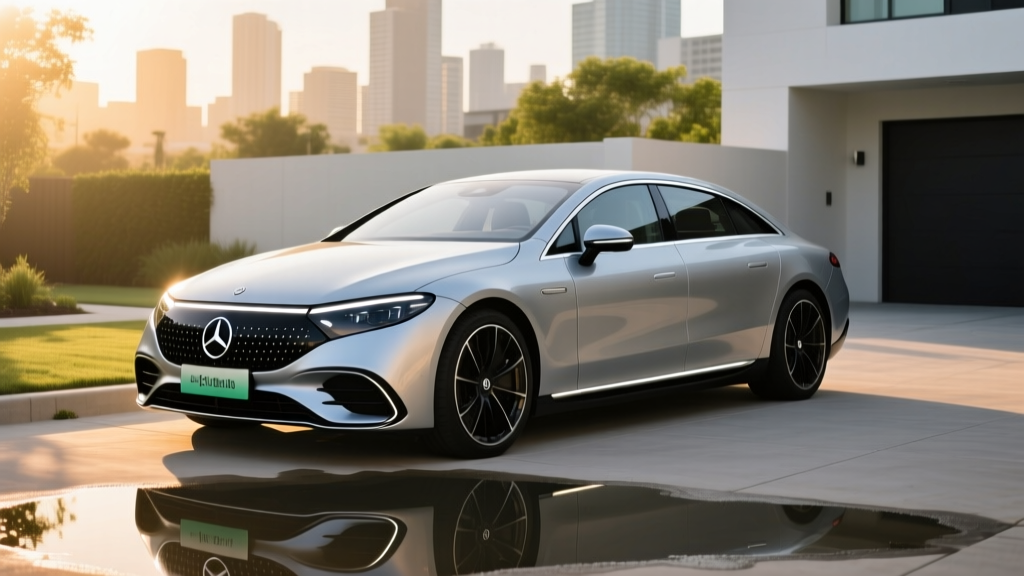
Quick Verdict: The Mercedes-Benz EQS 580 Sedan in 2026
The 2026 Mercedes-Benz EQS 580 sedan occupies a rare position in the EV market: a full-size luxury flagship that pairs genuine long-range capability with the refinement buyers expect from a six-figure Mercedes. With 536 horsepower, standard 4MATIC all-wheel drive, and an EPA-estimated 371 miles of range, the EQS 580 is engineered for executives who commute in silence and road-trip in comfort. But at a starting MSRP of $104,400, it must justify its premium against the Tesla Model S, Lucid Air, and BMW i7 — each of which brings distinct strengths to the table.
This review breaks down the real numbers that matter: what range you'll actually see on the highway in January, how fast the EQS 580 charges when the battery is cold versus preconditioned, whether the §30D federal tax credit applies, and where this sedan fits in a rapidly evolving luxury EV landscape.
Range, Efficiency, and the Real-World Reality Check
The EQS 580 4MATIC sedan carries a usable battery capacity of 108.4 kWh using NMC (nickel manganese cobalt) lithium-ion chemistry. Mercedes quotes an EPA-estimated range of 371 miles for the EQS 580 with its standard 20-inch wheels. Step up to the optional 21-inch AMG wheels, and the EPA figure drops to approximately 340–350 miles due to increased rolling resistance and aero drag.
| Condition | Estimated Range |
|---|---|
| EPA Combined (sticker) | 371 mi |
| Highway (70–80 mph, 68°F) | ~310–330 mi |
| City / stop-and-go (68°F) | ~360–380 mi |
| Highway, cold weather (25°F) | ~250–280 mi |
| Mixed driving, cold weather | ~290–310 mi |
The EQS 580's slippery 0.20 Cd drag coefficient helps it overperform on the highway relative to boxier EVs, but cold weather still exacts a 20–30% toll. The standard heat pump mitigates cabin energy draw, but battery chemistry inherently loses efficiency below freezing.
Efficiency lands at an EPA-rated 97 MPGe combined, translating to roughly 35 kWh per 100 miles. That's respectable for a 5,800-pound sedan, though the lighter Lucid Air Grand Touring achieves a higher MPGe figure. Source: fueleconomy.gov.
Charging Speed: DC Fast, Level 2, and the Curve
Charging capability is where luxury EV buyers often discover compromises. The EQS 580 supports a peak DC fast-charge rate of 200 kW via its CCS1 connector (NACS adapter available for Tesla Supercharger access). On a 350 kW Electrify America or EVgo station with a preconditioned battery, Mercedes claims a 10–80% charge in approximately 31 minutes.
| Level | Power / Rate | Speed |
|---|---|---|
| Level 1 (120V) | 1.4 kW | ~3 mi/hr |
| Level 2 (240V, 48A) | 11 kW (onboard max) | ~30 mi/hr / 10–100% in ~11 hr |
| DC Fast Charge | 200 kW peak | 10–80% in ~31 min |
The real-world charging curve tells a more nuanced story. The EQS 580 sustains close to 200 kW from roughly 10% to 40% state of charge, then progressively tapers. From 60–80%, expect the rate to drop to 90–120 kW. This taper is typical of NMC chemistry protecting cell longevity, but it means the last 20% takes nearly as long as the first 50%. Always precondition the battery via the Mercedes me app before arriving at a DC fast charger — skipping this step in cold weather can cut peak charge rates by 40% or more.
For home charging, the onboard 11 kW AC charger is adequate for overnight replenishment. A full charge from near-empty takes about 11 hours on a 48-amp Level 2 wall connector — perfectly suited to overnight top-ups. Most owners will rarely charge from 0%, so typical nightly sessions of 20–40% will complete in 3–5 hours.
Performance and Drivetrain
The EQS 580 4MATIC runs a dual-motor all-wheel-drive powertrain producing 536 horsepower and 631 lb-ft of torque. Mercedes quotes a 0–60 mph time of 4.1 seconds. That's quick by any measure, though the Tesla Model S Plaid and Lucid Air Sapphire exist in an entirely different performance stratosphere. The EQS 580's acceleration delivery is tuned for smoothness rather than violence — a surge rather than a snap — which suits its grand-tourer character.
Rear-axle steering (standard on the EQS 580, up to 10 degrees) makes this 17-foot sedan surprisingly maneuverable in parking garages and tight urban streets. The turning circle shrinks to roughly 35 feet, comparable to a compact hatchback. Air suspension with adaptive damping is standard, offering a Comfort, Sport, and Eco mode that meaningfully change the sedan's ride character.
Interior, Tech, and Cargo Practicality
The cabin is dominated by the available MBUX Hyperscreen — a 56-inch curved glass panel spanning the full dashboard width, combining a 12.3-inch instrument cluster, 17.7-inch central OLED touchscreen, and 12.3-inch passenger display. The Hyperscreen is visually stunning, though some drivers find the touch-capacitive climate controls less intuitive than physical buttons. A more conventional floating-screen layout is standard on lower trims.
Passenger space is generous, as expected from a full-size sedan:
- Front legroom: 41.7 inches
- Rear legroom: 41.4 inches
- Rear headroom: 37.8 inches (slightly reduced by the coupe-like roofline)
- Trunk cargo volume: 22.0 cu ft (with rear seats up), expandable via 40/20/40 split folding
There is no front trunk (frunk) — the space is occupied by the HEPA filtration system and power electronics. The 22 cu ft trunk is competitive with the BMW i7 but trails the Tesla Model S's combined frunk + trunk volume.
On the driver-assistance front, the EQS 580 comes equipped with Mercedes-Benz Driver Assistance Package, including adaptive cruise control, active lane-keeping, automated lane changes, and the available Drive Pilot system. Drive Pilot is a SAE Level 3 system — meaning the car can handle all driving tasks under specific conditions (pre-mapped highways, under 40 mph, clear weather) without driver supervision. This is a significant distinction from Level 2 systems like Tesla Autopilot or GM Super Cruise, which require continuous driver attention. However, Drive Pilot's operational design domain is currently limited to approved highway sections in select states.
Pricing, Trims, and Federal Tax Credit Eligibility
The 2026 EQS 580 4MATIC sedan starts at a base MSRP of $104,400 (including destination). A well-equipped example with the Hyperscreen, Executive Rear Seat package, AMG Line exterior, and Advanced Driver Assistance Package typically lands between $115,000 and $128,000.
| Trim | Base MSRP | Tax Credit Eligible? |
|---|---|---|
| EQS 450+ (RWD) | $87,350 | No — exceeds $55,000 sedan cap |
| EQS 450 4MATIC | $90,350 | No — exceeds $55,000 sedan cap |
| EQS 580 4MATIC | $104,400 | No — exceeds $55,000 sedan cap |
| AMG EQS (performance) | $149,900+ | No — exceeds $55,000 sedan cap |
Does the Mercedes-Benz EQS 580 sedan qualify for the §30D federal EV tax credit? No. Under current IRS rules, the §30D clean vehicle credit is capped at $55,000 MSRP for sedans (the limit is $80,000 for SUVs, vans, and trucks). The EQS 580 — at $104,400 base — far exceeds this threshold. Additionally, buyer income caps ($300,000 joint / $150,000 individual) and critical-mineral battery-sourcing requirements apply to qualifying vehicles. For the full rule set, see IRS §30D guidance.
The EQS 580's price places it firmly in the "no-compromise luxury" segment where tax incentives matter less to the typical buyer. Still, some states offer separate EV rebates or HOV-lane access that may apply — check your local DMV and energy office for current programs.
Ownership Costs, Warranty, and Longevity
Mercedes-Benz backs the EQS 580 with a 4-year/50,000-mile new-vehicle limited warranty and an 8-year/100,000-mile high-voltage battery warranty. The battery warranty guarantees that the pack will retain at least 70% of its original capacity during the coverage period. If degradation exceeds that threshold, Mercedes will repair or replace the battery at no cost.
Maintenance costs are lower than a comparable S-Class with a combustion engine — no oil changes, no transmission fluid, no spark plugs. Expect brake pad life to extend well beyond 80,000 miles thanks to regenerative braking handling most deceleration. However, tire costs are real: the EQS 580's weight (approximately 5,800 lbs) and instant torque wear through tires faster than a gasoline equivalent. Budget $1,200–$1,800 for a set of premium EV-rated tires every 25,000–35,000 miles.
Insurance premiums for the EQS 580 run 15–25% higher than a gasoline S-Class, reflecting the vehicle's repair costs, sensor density, and replacement value. Get quotes before purchase — annual premiums of $3,500–$5,000 are common depending on your profile and state.
For home charging economics: at a national average electricity rate of $0.16/kWh, fully charging the 108.4 kWh battery costs roughly $17.35, yielding a cost per mile of about $0.05. Compare this to a gasoline S-Class at 25 MPG combined and $3.50/gallon fuel: $0.14 per mile. Over 15,000 annual miles, the EQS 580 saves approximately $1,350 per year in energy costs — meaningful, though not enough to offset the purchase premium over an S 500 for most buyers.
Competitor Comparison: EQS 580 vs. the Field
| Spec | Mercedes EQS 580 | Tesla Model S LR | Lucid Air Grand Touring | BMW i7 xDrive60 |
|---|---|---|---|---|
| EPA Range | 371 mi | 402 mi | 516 mi | 318 mi |
| Battery (usable) | 108.4 kWh | ~95 kWh | 112 kWh | 101.7 kWh |
| HP | 536 | 670 | 819 | 536 |
| 0–60 mph | 4.1s | 3.1s | 3.0s | 4.5s |
| Peak DC Charge | 200 kW | 250 kW | 300 kW | 195 kW |
| Base MSRP | $104,400 | $79,990 | $127,400 | $106,700 |
| §30D Credit | No (MSRP cap) | Check eligibility | No (MSRP cap) | No (MSRP cap) |
The EQS 580 doesn't win on raw range (Lucid dominates), performance (Tesla and Lucid), or price (Tesla undercuts significantly). Where it wins is cabin serenity, ride quality, and brand cachet. The EQS 580 is the quietest EV sedan on the market at highway speed, the air suspension soaks up imperfections with genuine S-Class authority, and the interior materials quality exceeds anything Tesla offers. If your priority is being cosseted in silence over 400-mile road trips, the EQS 580 delivers. If you want the most range per dollar, look at the Lucid Air or Tesla Model S.
Pros, Cons, and Who Should Buy
- Class-leading cabin quietness and ride refinement
- 371-mile EPA range sufficient for most road trips without excessive stops
- Rear-axle steering gives compact-car maneuverability
- Drive Pilot Level 3 capability (where approved)
- Strong regenerative braking with one-pedal driving option
- Hyperscreen is genuinely impressive for passengers
- No federal §30D tax credit (MSRP exceeds sedan cap)
- 200 kW peak DC charging trails Tesla, Lucid, Hyundai/Kia 800V platforms
- Touch-capacitive controls can frustrate while driving
- No frunk — missed cargo opportunity
- High insurance and tire costs relative to sedan average
- Depreciation steeper than S-Class gasoline equivalent (early data)
- Choose the EQS 580 if: You prioritize ride comfort and cabin silence above all else, commute 30–80 miles daily with home Level 2 charging, take 2–4 road trips per year under 400 miles, and value Mercedes brand prestige and dealer service.
- Look elsewhere if: You want maximum range per dollar (Lucid Air Grand Touring), the fastest charging and Supercharger network (Tesla Model S), or need a vehicle that qualifies for the federal tax credit (consider the EQS SUV, which qualifies at different MSRP caps if structured correctly — consult a tax professional).
Frequently Asked Questions
What is the real-world range of the Mercedes-Benz EQS 580 sedan?
The EPA rates the EQS 580 at 371 miles. In real-world mixed driving at moderate temperatures, expect 320–350 miles. Highway driving at 75–80 mph reduces this to roughly 310–330 miles. In cold weather (below 30°F), plan for 250–290 miles on the highway. Always keep a 10–15% buffer for unplanned detours and charging-station availability.
How fast does the EQS 580 charge at home and on the road?
At home on a 48-amp Level 2 charger (240V), the EQS 580 adds approximately 30 miles of range per hour, fully replenishing in about 11 hours. On a DC fast charger, it peaks at 200 kW and charges from 10–80% in roughly 31 minutes with a preconditioned battery. Cold, unpreconditioned batteries may see peak rates cut to 100–130 kW initially.
Does the EQS 580 qualify for the $7,500 federal EV tax credit?
No. The IRS §30D clean vehicle credit has an MSRP cap of $55,000 for sedans. The EQS 580 starts at $104,400, making it ineligible regardless of buyer income or battery sourcing. Some state-level incentives or utility rebates may still apply. Always verify current rules at irs.gov and consult a tax professional before making purchase decisions based on credits.
Is the EQS 580 worth buying over the Tesla Model S or Lucid Air?
It depends on your priorities. The EQS 580 offers the quietest, most refined cabin in the segment with excellent ride quality and strong brand backing. The Tesla Model S costs $25,000 less, charges faster, and has longer range. The Lucid Air Grand Touring delivers over 500 miles of range and more power but at a higher price. If cabin luxury and daily comfort matter more than spec-sheet dominance, the EQS 580 is the right choice.
How long will the EQS 580 battery last?
Mercedes warranties the high-voltage battery for 8 years or 100,000 miles against degradation below 70% capacity. NMC chemistry in a thermally managed pack typically sees 10–15% degradation over the first 100,000 miles based on industry data. To maximize longevity, avoid routinely charging to 100% (set daily limits to 80–90%) and minimize repeated DC fast charging in extreme heat. A full battery replacement outside warranty, if ever needed, is estimated at $20,000–$30,000 based on current Mercedes EV service pricing.
Can the EQS 580 use Tesla Superchargers?
Yes. Mercedes-Benz provides a NACS adapter (or has transitioned to the NACS port on newer model-year builds) allowing access to Tesla's Supercharger network. This significantly expands the available DC fast-charging infrastructure, particularly on rural highway corridors where Electrify America and EVgo coverage is thinner. Confirm adapter inclusion with your dealer at purchase.