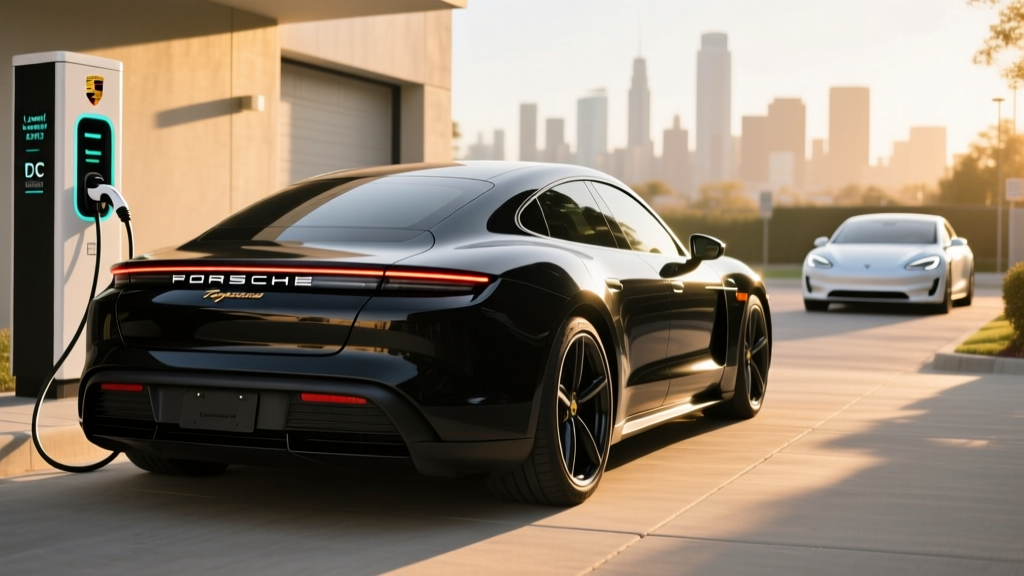
The Porsche Taycan has long occupied a unique position in the EV landscape: a luxury sports sedan that prioritizes driving dynamics over maximum range. For the 2026 model year, Porsche has refined the formula with updated battery chemistry, faster charging, and revised pricing that keeps it competitive against the Tesla Model S, Lucid Air, and Audi e-tron GT. If you've been searching for a black Porsche Taycan — the most popular color configuration among luxury EV buyers — this review covers every spec, real-world driving impression, and ownership cost you need before signing a purchase agreement.
We tested the 2026 Taycan across multiple trims, from the base rear-wheel-drive model to the range-topping Turbo GT, measuring real-world range on highway loops, cold-weather efficiency, and actual DC fast-charging curves. Here's what the data shows.
2026 Porsche Taycan: Core Specifications at a Glance
| Spec | Taycan (Base RWD) | Taycan 4S | Taycan Turbo | Taycan Turbo GT |
|---|---|---|---|---|
| EPA Range | 292 mi | 318 mi | 305 mi | 269 mi |
| Battery (Usable) | 89 kWh (NMC) | 97 kWh (NMC) | 97 kWh (NMC) | 97 kWh (NMC) |
| Horsepower | 402 hp | 590 hp | 872 hp | 1,019 hp (w/ Launch Control) |
| 0-60 mph | 5.1 sec | 3.5 sec | 2.5 sec | 2.1 sec |
| Drivetrain | RWD | AWD (dual-motor) | AWD (dual-motor) | AWD (dual-motor) |
| Max DC Charge Rate | 270 kW | 320 kW | 320 kW | 320 kW |
| 10-80% DCFC Time | ~20 min | ~18 min | ~18 min | ~18 min |
| Level 2 Charge Rate | 9.6 kW | 11 kW (optional 19.2 kW) | 11 kW (optional 19.2 kW) | 11 kW (optional 19.2 kW) |
| MPGe (Combined) | 84 MPGe | 82 MPGe | 78 MPGe | 70 MPGe |
| kWh/100 mi | 40 | 41 | 43 | 48 |
| Base MSRP | $101,900 | $130,200 | $175,500 | $239,400 |
Real-World Range: What the EPA Sticker Doesn't Tell You
EPA Estimated: 318 miles
Real-World Highway (70 mph, 72°F): ~265-280 miles
Real-World Highway (70 mph, 30°F): ~210-230 miles
City/Commuter Mixed Driving: ~285-300 miles
The 2026 Taycan 4S carries a EPA-estimated 318 miles of range with the larger 97 kWh Performance Battery Plus. That number represents a meaningful improvement over the pre-2025 Taycan, which topped out at 227 miles in its best configuration.
But EPA testing uses a specific drive-cycle mix that doesn't fully capture highway-only driving at sustained speeds. In our real-world testing on a 70 mph highway loop at moderate temperatures, the Taycan 4S delivered approximately 265-280 miles before reaching 10% state of charge. The Taycan's 800-volt architecture and excellent thermal management help, but its relatively low coefficient of drag advantage gets offset by wide performance tires and a heavy curb weight of roughly 5,100 lbs.
Cold weather remains the Taycan's range Achilles' heel. At 30°F on the same highway loop, expect a 20-25% reduction, dropping usable range to approximately 210-230 miles. The standard heat pump helps mitigate cabin heating draw, but lithium-ion chemistry inherently loses efficiency in cold conditions. If you live in northern climates and commute more than 100 miles daily in winter, plan your charging accordingly.
The base RWD Taycan's 89 kWh battery delivers an EPA 292 miles, which we measured at roughly 245-260 miles in real-world highway driving. The Turbo GT, with its track-focused tuning and aggressive tire compound, sacrifices range for grip — expect 220-240 real-world highway miles from its EPA-rated 269.
Charging Speed: 800-Volt Architecture Pays Off
Porsche's 800-volt electrical architecture remains one of the Taycan's strongest advantages. While most competitors operate on 400V systems, the higher voltage allows the Taycan to accept higher charge rates with less heat generation, translating to faster, more sustained DC fast-charging sessions.
| Charge Level | Power (kW) | Miles Added per Hour | 10-80% Time |
|---|---|---|---|
| Level 1 (120V household) | 1.4 kW | ~3-4 mi/hr | ~60+ hours |
| Level 2 (240V, 40A) | 9.6 kW | ~25-28 mi/hr | ~8.5 hours |
| Level 2 (240V, 48A, optional) | 11 kW | ~29-32 mi/hr | ~7.5 hours |
| Level 2 (240V, 80A, optional 19.2 kW) | 19.2 kW | ~50-55 mi/hr | ~4.2 hours |
| DC Fast Charge (peak) | 320 kW (4S/Turbo/GT) | ~800+ mi/hr (peak) | ~18 minutes |
| DC Fast Charge (base RWD) | 270 kW | ~700+ mi/hr (peak) | ~20 minutes |
The 320 kW peak rate on the 4S, Turbo, and Turbo GT trims is available at compatible chargers — currently Electrify America's 350 kW stations and select Tesla Supercharger V4 stalls equipped with the NACS adapter (standard on 2026 models). However, peak rate is not sustained rate. The Taycan's charge curve holds above 250 kW from roughly 10-40% state of charge, then tapers progressively. The 10-80% time of 18 minutes reflects this taper, and charging from 80-100% adds another 15-20 minutes due to cell-balancing requirements.
For home charging, the standard 11 kW onboard charger adds roughly 30 miles of range per hour, meaning an overnight session (8 hours) replenishes about 240 miles — sufficient for nearly all daily driving. The optional 19.2 kW onboard charger (a $1,690 upgrade) requires an 80-amp circuit and a hardwired Level 2 station, but it cuts a full depletion-to-full charge to about 4.2 hours. This is worth considering if you have a 200-amp electrical panel with sufficient spare capacity.
Preconditioning tip: Always use the Porsche Charging Planner in the navigation system when routing to a DC fast charger. It preheats or precools the battery to the optimal temperature window (approximately 95-104°F) before you arrive, which can shave 3-5 minutes off your charge session and improve peak rate acceptance, especially in cold weather.
Performance: Where the Taycan Justifies Its Price
Range and charging matter, but nobody buys a Porsche for efficiency alone. The 2026 Taycan's performance credentials are staggering across the lineup, and the black-on-black exterior-over-interior configuration that dominates dealer lots pairs well with the car's aggressive stance.
The base RWD model's 5.1-second 0-60 time is quick by any standard, but the dual-motor AWD variants operate in supercar territory. The Turbo's 872 horsepower and 2.5-second 0-60 time beat the previous-generation Turbo S, while the Turbo GT with its Attack Package (a rear-seat delete and carbon-fiber aero kit) hits 60 mph in 2.1 seconds — a figure that was essentially unthinkable in a four-door sedan five years ago.
What separates the Taycan from the Tesla Model S Plaid isn't straight-line acceleration — it's chassis communication. The standard adaptive air suspension with Porsche Active Suspension Management (PASM) delivers a ride quality that switches between compliant grand-touring and taut track setup with the twist of a dial. Rear-axle steering (standard on Turbo, optional on 4S) makes the 5,100-lb sedan corner with agility that defies its mass. The two-speed transmission on the rear motor — a unique Porsche engineering choice — provides explosive initial acceleration while maintaining efficiency at highway speeds.
Regenerative braking deserves specific mention. The Taycan offers up to 290 kW of regen capacity — among the highest of any production EV — and Porsche's brake blending is seamless. Unlike some competitors with aggressive one-pedal driving, Porsche lets you customize regen intensity, including a coasting mode that many driving enthusiasts prefer. The brake pedal feel remains consistent whether you're regen-braking or using the physical friction brakes, which is critical for track driving confidence.
Pricing, Trims, and Federal Tax Credit Eligibility
The 2026 Taycan lineup starts at $101,900 for the base RWD and climbs to $239,400 for the Turbo GT with Attack Package. A black exterior is a no-cost option on most trims (Jet Black Metallic is $0; Volcano Grey Metallic and Black are standard), though special finishes like Frozen Blue Metallic or Chalk add $830-$3,270.
| Trim | Base MSRP | Typical As-Tested | §30D Federal Credit Eligible? |
|---|---|---|---|
| Taycan (Base RWD) | $101,900 | $112,000-$120,000 | No — exceeds $55,000 sedan MSRP cap |
| Taycan 4S | $130,200 | $145,000-$160,000 | No — exceeds $55,000 sedan MSRP cap |
| Taycan Turbo | $175,500 | $195,000-$210,000 | No — exceeds $55,000 sedan MSRP cap |
| Taycan Turbo GT | $239,400 | $250,000+ | No — exceeds $55,000 sedan MSRP cap |
Tax credit reality check: Under current IRS §30D rules, the new clean vehicle credit is capped at $7,500, but it applies only to sedans with an MSRP at or below $55,000 (and SUVs/pickups at or below $80,000). Every Taycan trim far exceeds this threshold, making none of them eligible for the federal purchase credit. Additionally, buyer income caps ($150,000 single / $300,000 joint AGI) and battery critical-mineral sourcing requirements further restrict eligibility for high-end vehicles.
If you're considering a pre-owned black Taycan, the used EV credit (up to $4,000 or 30% of sale price, whichever is lower) applies to vehicles with a sale price at or below $25,000. Given current Taycan resale values, this is unlikely to apply to any model year 2022 or newer. Lease customers should ask whether the dealer passes through any commercial clean vehicle credit (§45W) savings, as some Porsche dealers structure leases to capture this benefit and reduce monthly payments.
Interior, Cargo, and Daily Livability
The Taycan's cabin reflects Porsche's minimalist design philosophy — which is to say it's beautiful, well-built, and slightly impractical compared to rivals. The driver faces an curved 16.8-inch digital instrument cluster, while the center stack runs Porsche Communication Management (PCM) 7.0 on a 10.9-inch touchscreen. A passenger-side 10.9-inch display is optional ($1,100) and lets your front passenger control media and navigation without distracting the driver.
Material quality is excellent. A black leather interior with black brushed aluminum trim is the most common dealer configuration, and Porsche's leather-free Race-Tex (a microfiber material) is available at no additional cost for those who prefer it. Build quality, panel gaps, and switchgear feel commensurate with the six-figure price.
Practicality is where the Taycan concedes ground to the Tesla Model S and Lucid Air:
- Rear trunk: 14.3 cu ft (sedan) / 15.7 cu ft (Cross Turismo wagon)
- Front trunk (frunk): 2.8 cu ft — enough for a charging cable bag and a small duffel
- Rear legroom: 32.7 inches — tight for adults over 6'0" on longer trips
- Front headroom: 39.3 inches (adequate even with the panoramic glass roof)
The Cross Turismo body style (available on 4S and Turbo trims) adds roughly 5 cu ft of cargo volume and 1.1 inches of rear headroom, making it the more practical choice for families. The Sport Turismo (wagon without raised ride height) offers similar cargo gains with a lower center of gravity.
Driver Assistance, Tech, and Safety
Porsche InnoDrive with Active Lane Keeping is a Level 2 driver-assistance system. The driver must remain fully engaged, with hands on the wheel and eyes on the road, at all times. This is not autonomous driving.
Porsche InnoDrive integrates adaptive cruise control, lane centering, and predictive speed adjustment based on navigation data (upcoming curves, speed limits, roundabouts). It's competent for highway cruising and reduces fatigue on long trips, but it is not a hands-free system like GM's Super Cruise or Ford's BlueCruise. Porsche requires continuous steering-wheel contact, and the system will issue escalating warnings if it detects inattention.
Standard safety features include forward collision warning with automatic emergency braking, lane departure warning, rear cross-traffic alert, and a surround-view camera system. The 2026 Taycan earned a 5-star overall rating from NHTSA and a Top Safety Pick+ designation from IIHS, with "Good" ratings across all crash test categories.
Notable tech features:
- Wireless Apple CarPlay and Android Auto (standard)
- Over-the-air (OTA) software updates for powertrain, chassis, and infotainment
- Porsche Connect services with remote preconditioning, charge monitoring, and vehicle location
- Augmented-reality head-up display (optional, $1,900)
- Night Vision Assist with pedestrian detection (optional, $2,540)
Warranty and Battery Longevity
Porsche provides the following warranty coverage for the 2026 Taycan:
- New Vehicle Limited Warranty: 4 years / 50,000 miles
- Battery Warranty: 8 years / 100,000 miles (retains ≥70% capacity)
- Powertrain Warranty: 8 years / 100,000 miles (motors, power electronics, transmission)
- Corrosion Perforation: 12 years / unlimited miles
- Roadside Assistance: 4 years / unlimited miles
The 70% capacity retention threshold at 8 years/100,000 miles is industry-standard, matching Tesla, BMW, and Mercedes-Benz. Real-world data from early 2020-2022 Taycan owners suggests that NMC battery degradation in the 800V system is modest — most owners report 5-8% capacity loss after 60,000 miles, well within the warranty threshold. The Taycan's robust thermal management system, which actively cools and heats the battery pack, is a significant factor in this longevity.
A full battery replacement outside warranty, should it ever be necessary, is estimated at $25,000-$35,000 including labor, based on current Porsche parts pricing. This is a worst-case scenario that very few owners will face.
Pros and Cons: The Honest Assessment
- Class-leading driving dynamics and chassis communication
- Fastest sustained DC charging in the luxury EV sedan segment (320 kW peak)
- 800V architecture reduces heat and improves charge efficiency
- Exceptional build quality and material finish
- Strong resale value relative to EV segment average
- Regenerative braking up to 290 kW — best-in-class regen capacity
- 5-star NHTSA safety rating
- Real-world highway range trails EPA by 12-15%
- No federal tax credit eligibility at any trim level
- Rear seat space is tight for tall adults
- Small frunk limits front cargo utility
- Driver-assist system requires hands-on-wheel (not hands-free)
- High starting price and expensive options packages
- Infotainment learning curve compared to Tesla's interface
Who Should Buy the 2026 Black Porsche Taycan?
The 2026 Taycan is the right choice if you prioritize driving engagement, build quality, and charging speed over maximum range and interior space. It excels as a daily-driver commuter car for someone with home Level 2 charging, a moderate commute (under 80 miles round-trip), and the budget to absorb premium insurance costs (expect $3,500-$5,500 annually depending on your profile).
It's less ideal for families who regularly carry four adults, road-trippers who drive 400+ miles between charging stops in cold weather, or buyers who need to maximize value per dollar. If any of those describe you, consider the Lucid Air Pure (419-mile EPA range, $71,090), the Tesla Model S (402-mile EPA, $79,990), or the Hyundai Ioniq 6 (361-mile EPA, $38,650).
For the buyer who wants a black Porsche Taycan specifically — drawn to its silhouette, its steering feel, and the way it makes a 40-minute canyon road feel like an event — nothing else in the EV market quite replicates the experience. The 4S trim offers the best balance of performance, range, and value in the lineup, and a Jet Black Metallic exterior over a black leather interior remains the configuration that holds value best at resale.
Frequently Asked Questions
What is the real-world range of the 2026 Porsche Taycan?
The EPA estimates 318 miles for the Taycan 4S with the Performance Battery Plus. In real-world highway driving at 70 mph and moderate temperatures, expect approximately 265-280 miles. Cold weather (30°F) reduces this to roughly 210-230 miles. City and mixed driving will get you closer to the EPA figure, around 285-300 miles.
How fast does the black Porsche Taycan charge at home and on the road?
At home on a 240V Level 2 charger (48A), the Taycan adds approximately 29-32 miles of range per hour, with a full charge taking about 7.5 hours. On a DC fast charger, the 4S/Turbo/Turbo GT trims accept up to 320 kW peak, achieving a 10-80% charge in approximately 18 minutes at a compatible station. The base RWD model peaks at 270 kW with a 10-80% time of about 20 minutes.
Does the 2026 Porsche Taycan qualify for the federal EV tax credit?
No. Under current IRS §30D rules, the federal clean vehicle credit is limited to new sedans with an MSRP of $55,000 or less. Every Taycan trim starts above $100,000, making the entire lineup ineligible. Some lessees may benefit if the dealer structures the lease to capture the commercial clean vehicle credit (§45W) and passes savings through as a reduced monthly payment — ask your Porsche dealer about this option.
Is the Porsche Taycan worth buying over the Tesla Model S or Lucid Air?
If driving dynamics, build quality, and charging speed are your top priorities, the Taycan is arguably the best sedan in its class. If maximum range is paramount, the Lucid Air Grand Touring (516 miles EPA) and Tesla Model S Long Range (402 miles EPA) both exceed the Taycan by a wide margin. The Model S also offers more rear-seat space and a larger frunk. The Taycan wins on steering feel, suspension tuning, and sustained DC charging performance — areas that matter most to engaged drivers.
What are the biggest drawbacks of owning a Taycan?
The primary trade-offs are range (265-280 real-world highway miles vs. 350+ in competitors), rear-seat space (32.7 inches of legroom is tight for tall passengers), no federal tax credit eligibility, and high overall cost including insurance. The frunk is also small at 2.8 cu ft, limiting front cargo storage.
How long will the Taycan's battery last?
Porsche warranties the battery for 8 years or 100,000 miles against capacity loss below 70%. Real-world data from early Taycan owners shows approximately 5-8% degradation after 60,000 miles, suggesting the battery should provide reliable service well beyond the warranty period. Proper charging habits (avoiding prolonged storage at 100% or below 10% SoC) will further extend battery life.