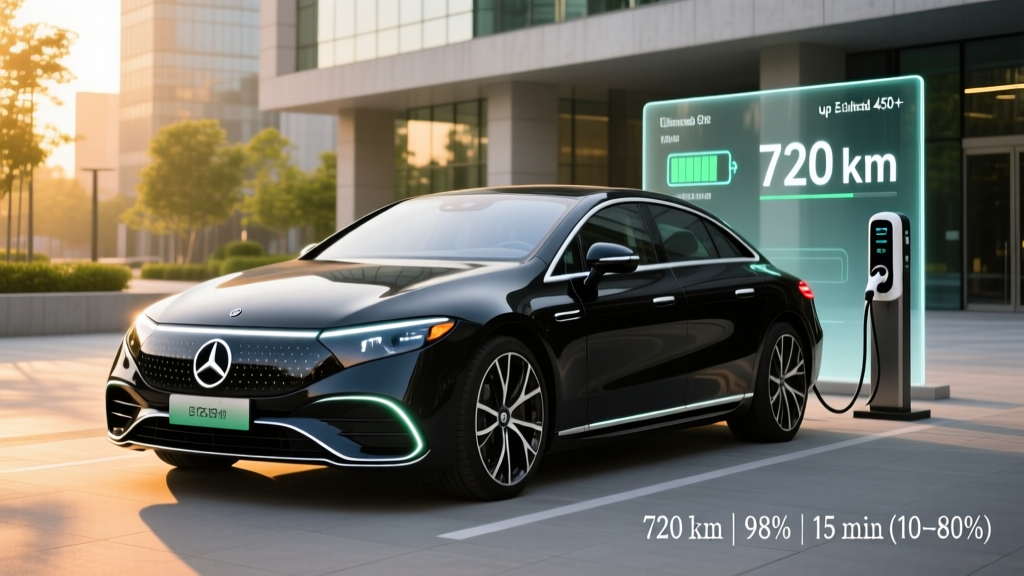
The Mercedes-Benz EQS 450+ occupies a strange corner of the luxury EV market. It's an electric sedan that prioritizes ride comfort and aerodynamic efficiency over outright performance, packing one of the largest battery packs available in any production EV. But with a starting price north of $100,000 and a sedan body style in an SUV-obsessed market, the EQS 450+ demands scrutiny beyond its impressive spec sheet. This review breaks down exactly what you get, what it costs to own, and where the real-world numbers diverge from the EPA sticker.
2026 EQS 450+ At a Glance: Key Specs
| Specification | Value |
|---|---|
| EPA Estimated Range | 390 miles |
| Battery (Usable / Gross) | 118 kWh usable / ~120 kWh gross (NMC) |
| Drivetrain | Rear-Wheel Drive (single motor) |
| Horsepower / Torque | 355 hp / 419 lb-ft |
| 0–60 mph | 5.9 seconds |
| Max DC Fast Charge Rate | 200 kW (CCS/NACS via adapter) |
| 10–80% DC Charge Time | ~31 minutes |
| Level 2 Home Charge Rate | 9.6 kW (~30 miles/hr) |
| EPA Efficiency | 97 MPGe combined / 35 kWh/100 mi |
| Cargo Volume (Trunk) | 22.0 cu ft |
| Base MSRP (EQS 450+ Sedan) | $105,550 (incl. $1,150 destination) |
| Battery/Powertrain Warranty | 10 years / 155,000 miles |
Range Reality: EPA Sticker vs. Real-World Driving
The EQS 450+ carries an EPA-estimated 390 miles of range, placing it among the longest-range EVs on the market. That figure is enabled by two factors: the massive 118 kWh usable battery pack and a remarkably low drag coefficient of 0.20 — still one of the most aerodynamic production cars ever built. But as with any EV, the sticker number requires context.
EPA Estimate: 390 miles
Highway (70–80 mph, moderate temps): ~320–345 miles
Cold Weather (below 32°F, highway): ~260–295 miles
City / Mixed Commute: ~360–385 miles
The EQS 450+ recovers energy exceptionally well in stop-and-go driving thanks to strong regenerative braking (up to 0.3g of deceleration in D Auto mode). Highway driving at sustained speeds above 75 mph erodes range more noticeably, and cold weather compounds this with battery heating demands. The EQS includes a standard heat pump, which helps mitigate winter losses compared to resistive heating systems, but expect a 25–35% range reduction in deep-freeze conditions.
The 118 kWh usable capacity uses NMC (nickel manganese cobalt) chemistry, which provides high energy density — critical for fitting this much energy into a sedan floor. NMC cells trade some cycle-life longevity versus LFP chemistry, but Mercedes' generous 10-year/155,000-mile battery warranty (covering degradation below 70% state of health) offsets that concern substantially.
Charging Speed: DC Fast Charging and Home Setup
Charging a 118 kWh battery is a test of patience and infrastructure. The EQS 450+ supports a peak DC fast-charge rate of 200 kW via its CCS port (or NACS with the included Tesla Supercharger adapter, as Mercedes-Benz has transitioned to NACS compatibility for the 2026 model year). At a 350 kW Electrify America or Tesla Supercharger V4 station, the EQS can accept its full 200 kW peak — but only briefly.
| Charge Level | Power (kW) | Speed (mi/hr added) | Notes |
|---|---|---|---|
| Level 1 (120V household) | ~1.4 kW | ~4 mi/hr | Emergency only; full charge in ~85 hours |
| Level 2 (240V, 40A circuit) | 9.6 kW | ~30 mi/hr | Full charge in ~12.5 hours; ideal for overnight |
| DC Fast Charge (peak) | 200 kW | ~550 mi/hr (peak) | 10–80% in ~31 min; tapers significantly above 80% |
The charging curve is the critical detail here. The EQS 450+ will sustain close to 200 kW from roughly 10% to 35% state of charge, then gradually taper. Between 35% and 65%, expect roughly 140–160 kW. Above 80%, the rate drops below 50 kW to protect the NMC cells. This is why the 10–80% metric matters more than peak kW — and 31 minutes for that window is competitive, though not class-leading against 800V architectures like the Hyundai Ioniq 5 or Porsche Taycan.
For home charging, a Level 2 wallbox at 9.6 kW (40 amps on a 50-amp circuit) will fully replenish the battery overnight in about 12.5 hours. Most owners who charge nightly from 30% to 80% will see roughly 6 hours of charge time. Mercedes includes a portable Level 2 charger with the vehicle, though many buyers opt for a hardwired ChargePoint Home Flex or Tesla Wall Connector for reliability.
Performance and Driving Dynamics
The EQS 450+ sends 355 horsepower and 419 lb-ft of torque to the rear wheels through a single permanent-magnet synchronous motor. The 0–60 mph time of 5.9 seconds is relaxed by luxury-EV standards — the dual-motor EQS 580 4MATIC cuts that to 4.1 seconds — but the 450+ was never designed for drag races.
Where the 450+ excels is in effortless, silent acceleration from a stop and a ride quality that ranks among the best in any vehicle, electric or otherwise. Standard AIRMATIC air suspension with adaptive damping absorbs road imperfections with a composure that makes rough highway expansion joints nearly imperceptible. Rear-axle steering (standard, up to 4.5 degrees; optional 10 degrees) shrinks the car's turning circle to that of a compact sedan, making parking maneuvers surprisingly easy for a vehicle over 207 inches long.
The trade-off for the RWD layout and comfort-first tuning is a lack of engagement on winding roads. Steering is light and numb by design, body roll is well-controlled but present, and the 5,600-pound curb weight is felt during aggressive direction changes. This is a grand tourer, not a sports sedan, and buyers comparing it to a Porsche Taycan or BMW i5 should adjust expectations accordingly.
Interior, Tech, and the MBUX Hyperscreen
The cabin of the EQS 450+ is where Mercedes justifies its six-figure price. The available MBUX Hyperscreen stretches 56 inches across the entire dashboard, combining a 12.3-inch instrument cluster, a 17.7-inch central OLED touchscreen, and a 12.3-inch passenger display under a single curved glass panel. The system runs Mercedes' latest MBUX software with over-the-air updates, wireless Apple CarPlay and Android Auto, and an AI-driven "zero layer" interface that surfaces frequently used functions without menu diving.
Passenger space is generous for a sedan. Front legroom measures 41.7 inches, and rear legroom is 41.5 inches — limousine-like for a vehicle without an extended wheelbase. The trunk offers 22.0 cubic feet, larger than most midsize sedans and accessible via a practical liftback-style opening. However, there is no front trunk (frunk); the space under the hood houses electronics and the HVAC system.
On the driver-assistance front, the EQS comes equipped with Mercedes' latest Driver Assistance Package, which includes adaptive cruise control with stop-and-go, active lane-keeping, automated lane changes, and evasive steering assist. This is an SAE Level 2 system — the driver must remain fully attentive with hands on or near the wheel at all times. It is not autonomous driving. The optional DRIVE PILOT system (available in select states like Nevada and California) can achieve conditional SAE Level 3 operation, but only below 40 mph on mapped highways in heavy traffic, with strict operational constraints.
Pricing, Trims, and Federal Tax Credit Eligibility
The 2026 EQS 450+ Sedan starts at $105,550 including destination. Key options that move the price significantly include the Pinnacle Trim package (Nappa leather, massage seats, rear-seat entertainment — approximately $8,000), the MBUX Hyperscreen (standard on higher trims, part of packages on the base), and the Executive Rear Seat Package. A well-equipped EQS 450+ typically lands between $115,000 and $125,000 before incentives.
| Configuration | MSRP |
|---|---|
| EQS 450+ Sedan (Premium Trim) | $105,550 |
| EQS 450+ Sedan (Exclusive Trim) | $108,750 |
| EQS 450+ Sedan (Pinnacle Trim) | $115,350 |
| EQS 450 4MATIC (Dual-Motor AWD) | $108,550 |
| EQS 580 4MATIC (Dual-Motor, 536 hp) | $127,350 |
Does the EQS 450+ Qualify for the Federal EV Tax Credit?
This is where the math gets complicated — and mostly unfavorable for the EQS. Under current IRS §30D rules, the new clean vehicle credit of up to $7,500 is subject to multiple constraints:
- MSRP Cap: Sedans must have an MSRP at or below $55,000. The EQS 450+ at $105,550 far exceeds this threshold, making it ineligible for the new-vehicle §30D credit.
- Buyer Income Cap: Even if it qualified on price, adjusted gross income limits apply ($150,000 single / $300,000 joint). Most EQS buyers would be within range, but the MSRP cap is the binding constraint.
- Battery Sourcing: The EQS battery is manufactured in partnership with Farasis Energy, with cell production in Germany and China. Critical-mineral and battery-component sourcing requirements add further uncertainty, though this is moot given the MSRP disqualification.
The EQS 450+ does not qualify for the $7,500 federal purchase credit. Buyers should not factor this incentive into their budget. Some states offer their own EV rebates or luxury-EV exemptions — check your state's energy office or the Alternative Fuels Data Center for local programs. Consult a tax professional for your specific situation.
Efficiency and Ownership Costs
The EPA rates the EQS 450+ at 97 MPGe combined, which translates to approximately 35 kWh per 100 miles. For a 5,600-pound luxury sedan, this is an excellent efficiency figure — and it's largely a product of that record-breaking 0.20 drag coefficient. Compared to the BMW i7 xDrive60 (83 MPGe combined), the EQS extracts meaningfully more miles per kilowatt-hour.
At the national average residential electricity rate of roughly $0.17/kWh (per EIA data), charging the EQS 450+ at home costs approximately $5.95 per 100 miles. The equivalent gasoline sedan achieving 25 MPG at $3.40/gallon would cost $13.60 per 100 miles. Over 15,000 miles annually, that's a fuel savings of roughly $1,148 per year — meaningful, though it takes years to offset the EQS's premium over a conventional S-Class.
Insurance costs are substantial. Expect annual premiums in the $3,200–$4,500 range depending on state, driving history, and coverage levels, based on industry averages for luxury EVs above $100,000. Maintenance costs are lower than a gasoline S-Class (no oil changes, fewer brake replacements due to regen), but tire replacement on the 21-inch AMG wheels can run $1,600–$2,400 per set.
Pros, Cons, and Who Should Buy the EQS 450+
Strengths
- Class-leading 390-mile EPA range
- Exceptional ride comfort and cabin isolation
- Massive 118 kWh battery with heat pump standard
- Generous 10-year/155,000-mile battery warranty
- Spacious rear seat and 22 cu ft trunk
- Excellent 0.20 Cd aerodynamics boost real-world efficiency
- MBUX Hyperscreen is genuinely impressive tech
Drawbacks
- Over $105k base; no federal tax credit eligibility
- Sedan body style limits cargo versatility vs. SUVs
- 200 kW peak DC charging trails 800V competitors
- No front trunk (frunk)
- RWD 450+ feels heavy and unengaging on back roads
- Hyperscreen can be distracting; steep learning curve
- Depreciation on six-figure luxury EVs is steep (expect ~50% over 3 years)
This is the EV for the executive commuter who values silence, ride quality, and range over performance or practicality. If your daily drive is a 60-mile highway commute and you want to charge once every four or five days at home, the EQS 450+ delivers. It's also compelling for road-trippers who can plan around DC fast-charging stops every 250–300 highway miles. It is not the right choice for buyers who need SUV cargo space, want engaging driving dynamics, or are maximizing value per dollar.
How the EQS 450+ Compares to Key Rivals
The EQS 450+'s most direct competitors are the BMW i7 xDrive60 (starting ~$120,300, EPA 318 miles, 536 hp AWD), the Porsche Taycan 4S (starting ~$108,500, EPA ~246–282 miles depending on battery, 800V architecture with 270 kW charging), and the Lucid Air Pure (starting ~$74,900 after incentives, EPA 419 miles, significantly lighter). Each makes different trade-offs:
- vs. BMW i7: The EQS offers more range (390 vs. 318 miles) and a lower starting price, but the i7's AWD, more powerful engine, and traditional sedan styling appeal to different tastes.
- vs. Porsche Taycan: The Taycan charges far faster (800V, 270 kW peak, 10–80% in ~21 minutes) and drives with genuine sports-sedan engagement, but sacrifices roughly 100–140 miles of range.
- vs. Lucid Air Pure: The Air undercuts the EQS by over $30,000, offers more EPA range (419 miles), and qualifies for the federal credit. But Mercedes' build quality, dealer network, and cabin materials remain a step above Lucid's newer operation.
Frequently Asked Questions
What is the real-world range of the Mercedes-Benz EQS 450+?
The EPA rates it at 390 miles. In real-world highway driving at 70–80 mph in moderate temperatures, expect 320–345 miles. In cold weather below 32°F, highway range drops to approximately 260–295 miles. City driving with regenerative braking recovers more energy, yielding 360–385 miles.
How fast does the EQS 450+ charge at home and on the road?
At a DC fast charger, it peaks at 200 kW and charges from 10% to 80% in about 31 minutes. On a Level 2 home charger at 9.6 kW, it adds roughly 30 miles per hour, fully charging overnight in about 12.5 hours. Level 1 (120V) adds only about 4 miles per hour and is suitable only for emergencies or topping off.
Does the EQS 450+ qualify for the $7,500 federal EV tax credit?
No. Under current IRS §30D rules, new sedans must have an MSRP at or below $55,000 to qualify. The EQS 450+ starts at $105,550, well above this cap. State-level incentives may still apply — check local programs.
Is the EQS 450+ worth buying over the Lucid Air or BMW i7?
It depends on priorities. The EQS 450+ wins on range vs. the BMW i7 and on cabin luxury vs. the Lucid Air. But the Lucid Air Pure offers more range at a dramatically lower price, and the BMW i7 provides AWD and a more traditional luxury-sedan feel. If range, ride comfort, and Mercedes brand prestige are paramount, the EQS 450+ holds its ground. If value or driving engagement matters more, look at the Air or Taycan.
How long will the EQS battery last?
Mercedes warranties the high-voltage battery for 10 years or 155,000 miles against degradation below 70% state of health. NMC chemistry typically retains 85–90% capacity after 100,000 miles based on industry data. With the large 118 kWh pack, even 15% degradation still leaves roughly 330 miles of EPA-equivalent range — a comfortable margin.
What is the biggest drawback of the EQS 450+?
The combination of a six-figure price with no federal tax credit eligibility is the primary financial concern. Beyond cost, the 200 kW charging speed falls behind 800V competitors, the sedan body limits versatility, and depreciation on luxury EVs above $100k is historically steep. The car itself is excellent; the ownership economics require a buyer who prioritizes the experience over financial optimization.