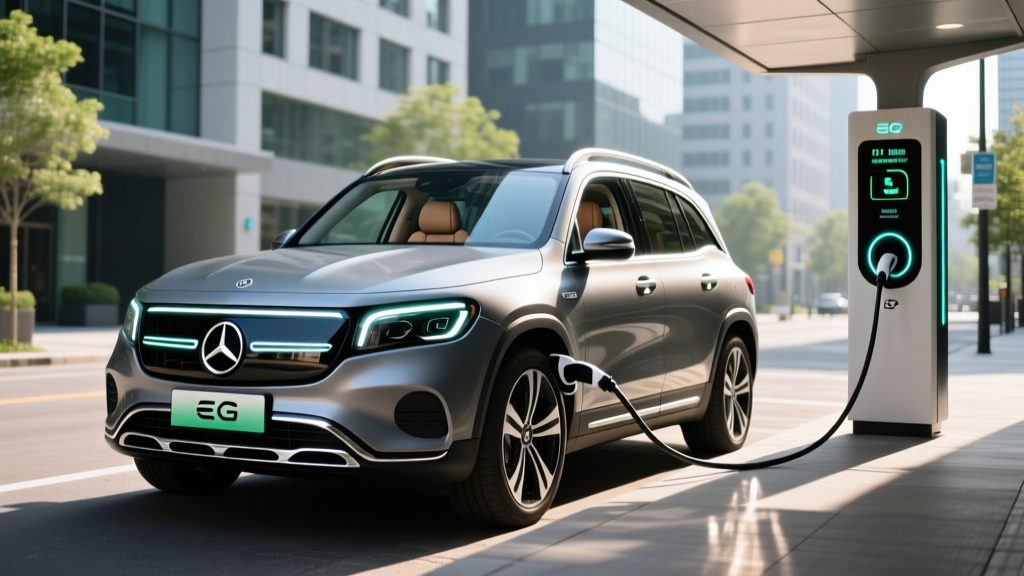
The Mercedes-Benz EQB occupies a rare niche in the luxury EV market: a compact, three-row electric crossover that prioritizes practicality and cabin refinement over headline-grabbing range or sub-four-second acceleration. For 2026, the EQB 300 4MATIC and EQB 350 4MATIC carry forward with Mercedes' familiar MBUX infotainment, standard all-wheel drive, and an optional third row that technically seats seven — a configuration no other luxury EV in this price band offers.
But practicality comes with trade-offs. The EQB's 66.5 kWh usable battery delivers an EPA-estimated 245 miles of range, which is adequate for commuting and metro-area errands but falls short of rivals like the Genesis GV60 (248–264 mi depending on trim) and the Tesla Model Y Long Range (320+ mi). DC fast charging peaks at a conservative 100 kW, meaning road-trip stops take longer than at competitors built on 800-volt architectures. If you need a premium badge, a usable third row for small children, and mostly drive under 200 miles a day, the EQB makes a compelling case. If range and charging speed top your checklist, keep reading — we'll show you exactly where it stands.
Mercedes-Benz EQB Specs at a Glance
| Specification | EQB 300 4MATIC | EQB 350 4MATIC |
|---|---|---|
| EPA Range | 245 miles | 227 miles |
| Battery (usable) | 66.5 kWh, NMC | 66.5 kWh, NMC |
| Horsepower | 225 hp | 288 hp |
| Torque | 288 lb-ft | 383 lb-ft |
| 0–60 mph | 7.7 sec | 5.8 sec |
| Drivetrain | Dual-motor AWD | Dual-motor AWD |
| DC Fast Charge (peak) | 100 kW (CCS1) | 100 kW (CCS1) |
| 10–80% DC Time | ~32 minutes | ~32 minutes |
| Level 2 Charge Rate | 9.6 kW (~30 mi/hr) | 9.6 kW (~30 mi/hr) |
| MPGe (combined) | 98 MPGe | 89 MPGe |
| Efficiency | 34 kWh/100 mi | 38 kWh/100 mi |
| Cargo (behind 3rd row) | 13.0 cu ft | 13.0 cu ft |
| Cargo (3rd row folded) | 32.1 cu ft | 32.1 cu ft |
| Cargo (all rows folded) | 61.9 cu ft | 61.9 cu ft |
| Base MSRP (2026) | $54,200 | $58,550 |
| Battery Warranty | 8 yr / 100,000 mi | 8 yr / 100,000 mi |
Range and Efficiency: The 245-Mile Reality Check
Real-World Expectation: ~200–220 miles highway at 70 mph; ~170–195 miles in freezing temperatures with cabin heat
The EQB 300's 245-mile EPA rating is derived from the standardized multi-cycle test published on fueleconomy.gov. In practice, the EQB's boxy SUV shape and 4,600-pound curb weight work against it at highway speeds. On a flat, 70-mph cruise at moderate temperatures (65–75°F), expect to see roughly 200–220 miles before the battery buffer warning kicks in. Push above 80 mph or encounter sustained elevation gains, and that number compresses further.
Cold weather is the larger concern for buyers in northern climates. Lithium-ion NMC batteries lose efficiency in freezing temperatures, and the EQB's resistance-heater-based thermal management (rather than a more efficient heat pump, which Mercedes reserves for its EVA2-platform vehicles like the EQS) means cabin heating draws significantly from the traction battery. In sustained sub-30°F driving, plan for 170–195 miles of usable range. Preconditioning the battery while plugged in — a feature accessible through the Mercedes me app — mitigates some of this loss and is essential if you're heading to a DC fast charger in cold weather.
At 34 kWh per 100 miles (EQB 300), the EQB is less efficient than the Tesla Model Y Long Range (28 kWh/100 mi) and the BMW iX xDrive50 (35 kWh/100 mi but with substantially more power and range). It's competitive with the Audi Q4 e-tron (32–36 kWh/100 mi depending on trim) and the Volvo XC40 Recharge (37 kWh/100 mi).
Charging Speed: 100 kW DC and What That Means on the Road
| Charging Level | Power / Voltage | Speed | Time to Full / 10–80% |
|---|---|---|---|
| Level 1 (120V household) | ~1.4 kW | ~4 mi/hr | ~48 hours (0–100%) |
| Level 2 (240V home) | 9.6 kW | ~30 mi/hr | ~7.5 hours (0–100%) |
| DC Fast Charge | 100 kW peak (CCS1) | ~170 mi/hr at peak | ~32 min (10–80%) |
The EQB's 100 kW DC fast-charge ceiling is its most debated spec. On a 400-volt architecture, 100 kW is a reasonable charge rate for a 66.5 kWh battery — it represents roughly a 1.5C charge rate, which is gentle on long-term cell health. But compared to 800-volt competitors like the Hyundai Ioniq 5 (240 kW peak) or the Porsche Macan Electric (270 kW peak), a 32-minute 10–80% session feels dated on multi-state road trips.
Here's what the charge curve actually looks like: the EQB sustains close to its 100 kW peak from roughly 10% to 40% state of charge, then tapers to approximately 70 kW through 60%, and further drops to 40–50 kW as it approaches 80%. This taper is normal for NMC chemistry at this charge rate, but it means the advertised 32-minute 10–80% time assumes optimal battery temperature. If you arrive at a charger with a cold battery and haven't preconditioned, add 10–15 minutes to that estimate while the battery warms.
At home on a Level 2 wallbox (240V, 40-amp circuit), the EQB's 9.6 kW onboard charger replenishes the battery at roughly 30 miles of range per hour. A full charge from near-empty takes about 7.5 hours, making overnight charging straightforward for virtually any daily commute. Most EQB owners will rarely, if ever, need public charging for daily use — the home-charging convenience equation is where this vehicle makes the most sense.
Performance and Driving Impressions
Both EQB variants use a dual-motor all-wheel-drive layout with an asynchronous induction motor up front and a permanent-magnet synchronous motor on the rear axle. The EQB 300 produces 225 horsepower and 288 lb-ft of torque, reaching 60 mph in 7.7 seconds — adequate for merging and passing but not exhilarating. The EQB 350 bumps output to 288 hp and 383 lb-ft, cutting the 0–60 time to 5.8 seconds, which gives it genuinely quick off-the-line response in city driving.
Ride quality is where the EQB earns its Mercedes badge. The suspension is tuned for comfort over sportiness, absorbing potholes and expansion joints with a composure that the stiffer-riding Tesla Model Y cannot match. Steering is light and precise, though not communicative — this is a cruiser, not a canyon carver. Regenerative braking offers multiple levels selectable via steering-wheel paddles, including a D Auto mode that uses radar and navigation data to modulate regen based on traffic and upcoming intersections. It works well in practice, though it doesn't quite achieve the one-pedal-driving seamlessness of Nissan's e-Pedal or BMW's adaptive regen.
Towing capacity is limited to 2,000 pounds when properly equipped — enough for a small utility trailer or a pair of dirt bikes, but not a boat or camper. If you need serious towing, the Rivian R1S or even the Ford Mustang Mach-E (which doesn't tow) aren't the answer either; look to the Rivian R1T or F-150 Lightning in the electric truck segment.
Interior, Cargo, and the Third-Row Question
The EQB's interior is a strong point. Mercedes' MBUX infotainment system runs on a 10.25-inch digital instrument cluster and a 10.25-inch central touchscreen (upgradable to dual 12.3-inch displays on higher trims). The system supports wireless Apple CarPlay and Android Auto, over-the-air updates, and the "Hey Mercedes" natural-language voice assistant. Build quality is exemplary — soft-touch materials, precise switchgear, and ambient lighting that reinforces the premium atmosphere.
The optional third row is the EQB's party trick and its biggest compromise. With all three rows in use, cargo space behind the third row shrinks to just 13.0 cubic feet — enough for a few grocery bags or a stroller frame, but not much else. The third-row seats themselves are best suited for children under about 5'4"; adults will find the knee room and seat cushion height inadequate for anything beyond a short trip around town. Fold the third row flat, and you get 32.1 cubic feet — competitive with the Audi Q4 e-tron (24.8 cu ft) and the Genesis GV60 (22.3 cu ft) in two-row cargo capacity. Fold everything and the EQB opens up to 61.9 cubic feet.
Second-row passengers enjoy 37.8 inches of legroom, which is generous for the segment. Front-seat headroom and legroom are excellent at 40.7 and 41.1 inches respectively. The cabin is notably quiet at highway speeds, with well-managed wind and road noise.
Pricing, Trims, and Federal Tax Credit Eligibility
| Trim | Base MSRP | As-Tested (typical) | §30D Credit Eligible? |
|---|---|---|---|
| EQB 300 4MATIC | $54,200 | $58,000–$62,000 | See eligibility notes below |
| EQB 350 4MATIC | $58,550 | $63,000–$67,500 | See eligibility notes below |
The 2026 EQB starts at $54,200 for the EQB 300 4MATIC and $58,550 for the EQB 350 4MATIC, including destination. Popular option packages — the AMG Line exterior, Premium package (panoramic roof, 360° camera, Burmester audio), and the third-row seat package — can push a well-equipped EQB 350 past $67,000.
Federal §30D EV Tax Credit — Key Requirements (2026 rules per IRS.gov):
- MSRP Cap: SUVs, vans, and pickups must have an MSRP at or below $80,000. The EQB qualifies on MSRP.
- Buyer Income Cap: Modified AGI must not exceed $150,000 (single), $225,000 (head of household), or $300,000 (joint filers).
- Battery Component Sourcing: A percentage of battery components must be manufactured or assembled in North America, with escalating thresholds each year. Critical minerals must meet sourcing requirements from the U.S. or FTA partners.
- Point-of-Sale Transfer: Eligible buyers can transfer the credit to the dealer at purchase, reducing the purchase price directly rather than waiting for a tax refund.
- Credit Amount: Up to $7,500, split between a $3,750 battery-component requirement and a $3,750 critical-minerals requirement. The EQB's partial credit eligibility varies — consult the IRS qualified vehicle list and your tax professional.
The EQB's eligibility for the full $7,500 credit is uncertain for 2026 because Mercedes sources battery cells from suppliers whose critical-mineral and component supply chains may not meet the escalating North American content thresholds. Some model years have qualified for the $3,750 partial credit. Buyers should verify current eligibility on the IRS qualified-vehicle list at the time of purchase and consult a tax professional — credit rules are subject to change and individual tax situations vary.
Competitor Comparison: EQB vs. the Luxury Compact EV Field
The EQB doesn't exist in a vacuum. Here's how it stacks up against the luxury compact electric SUVs most buyers cross-shop:
| Attribute | Mercedes EQB 300 | Audi Q4 e-tron | Genesis GV60 | Tesla Model Y LR |
|---|---|---|---|---|
| EPA Range | 245 mi | 242–265 mi | 248–264 mi | 320+ mi |
| Battery | 66.5 kWh NMC | 77 kWh NMC | 77.4 kWh NMC | ~75 kWh NMC |
| DC Fast Charge | 100 kW | 175 kW | 233 kW (800V) | 250 kW |
| 10–80% Time | ~32 min | ~28 min | ~18 min | ~25 min |
| Third Row? | Yes (optional) | No | No | Yes (optional) |
| Base MSRP | $54,200 | $49,800 | $52,000 | $47,990 |
| 0–60 mph | 7.7 sec | 7.4 sec (AWD) | 7.3 sec (AWD) | 4.8 sec |
The EQB's third row is its most defensible differentiator in the luxury segment — the only competitor offering one is the Tesla Model Y, which provides a far less refined interior experience. If third-row seating for small children is non-negotiable and you want a premium cabin, the EQB is essentially the only luxury option. If you can live with two rows, the Genesis GV60 offers dramatically faster charging (233 kW on its 800V architecture), a more distinctive interior, and similar range at a lower starting price. The Audi Q4 e-tron undercuts the EQB on price and offers faster DC charging, while the Tesla Model Y dominates on range, charging speed, Supercharger network access, and value — though its interior materials and ride quality are a tier below the Mercedes.
Warranty, Safety, and Driver Assistance
Mercedes covers the EQB's high-voltage battery for 8 years or 100,000 miles, whichever comes first, against defects and capacity loss below 70% of original capacity. The basic vehicle warranty is 4 years / 50,000 miles. This battery warranty is standard for the segment — matching Tesla, BMW, Audi, and Genesis — though some competitors like Hyundai/Kia offer 10 years / 100,000 miles on their battery packs.
The EQB comes standard with Mercedes' Driver Assistance Package, which includes adaptive cruise control with stop-and-go, active lane-keeping assist, blind-spot monitoring with rear cross-traffic alert, and automated emergency braking with pedestrian detection. This is a SAE Level 2 driver-assistance system — it does not drive the vehicle autonomously. The driver must keep hands on the wheel and eyes on the road at all times. Optional Active Lane Change Assist can initiate lane changes when the driver activates the turn signal, but the system remains supervisory.
NHTSA has awarded the EQB a 5-star overall safety rating, and the IIHS has rated it a Top Safety Pick+ in prior model years when equipped with specific headlight configurations. Confirm current-year ratings at NHTSA.gov and IIHS.org before purchasing.
Pros
- Only luxury compact EV with an optional third row
- Quiet, refined cabin with excellent ride quality
- Standard AWD on all trims
- MBUX infotainment with wireless CarPlay/Android Auto
- Comprehensive standard driver-assistance suite
- Strong build quality and materials
Cons
- 100 kW DC fast charging is slow for the class
- 245-mile range trails key competitors
- No heat pump — cold-weather range loss is significant
- Third row is cramped even for children on longer trips
- Partial or no federal tax credit eligibility depending on sourcing year
- Higher starting price than Q4 e-tron, GV60, and Model Y
Who Should Buy the Mercedes-Benz EQB?
Choose the EQB if:
- You need an occasional third row for children and refuse to drive a minivan or a Tesla
- Your daily driving is under 150 miles and you charge at home overnight
- Ride comfort and cabin quietness matter more than acceleration or range
- You value the Mercedes dealership experience and brand cachet
Look elsewhere if:
- You take frequent road trips over 250 miles and need fast DC charging
- You live in a cold climate where the lack of a heat pump will compound range loss
- You want maximum range per dollar — the Model Y Long Range wins decisively
- You need a usable third row for teenagers or adults
Frequently Asked Questions
What is the real-world range of the Mercedes-Benz EQB?
The EPA rates the EQB 300 at 245 miles and the EQB 350 at 227 miles. In real-world highway driving at 70 mph, expect roughly 200–220 miles. In freezing temperatures, that drops to approximately 170–195 miles due to battery chemistry limitations and the absence of a heat pump.
How fast does the EQB charge at home and on DC fast chargers?
On a Level 2 home charger (240V, 9.6 kW), the EQB adds about 30 miles of range per hour, fully charging in roughly 7.5 hours. On a DC fast charger, it peaks at 100 kW and reaches 10–80% in approximately 32 minutes under optimal conditions — slower than most competitors in this class.
Does the EQB qualify for the federal EV tax credit?
The EQB meets the MSRP cap (under $80,000 for SUVs), but eligibility for the full $7,500 §30D credit depends on battery-component and critical-mineral sourcing requirements that change annually. Buyers may qualify for a partial $3,750 credit or none at all depending on the production batch. Always verify on the IRS qualified vehicle list and consult a tax professional.
Is the Mercedes-Benz EQB worth buying over the Tesla Model Y or Audi Q4 e-tron?
If you prioritize cabin refinement, ride comfort, and an occasional third row in a luxury package, the EQB has no direct rival. If range, charging speed, and value are your top priorities, the Tesla Model Y Long Range is objectively superior on paper. The Audi Q4 e-tron offers a middle ground with a lower price and faster charging but no third row.
What are the biggest drawbacks of the EQB?
The 100 kW DC fast-charging speed is the EQB's most significant limitation for road-trip use. The lack of a heat pump exacerbates cold-weather range loss. The third row is very tight even for children on longer drives. And the starting price is higher than several competitors that offer more range and faster charging.
How long will the EQB battery last?
Mercedes warranties the high-voltage battery for 8 years or 100,000 miles against capacity loss below 70%. NMC batteries in similar Mercedes EVs have shown degradation of approximately 8–12% over the first 100,000 miles based on fleet data. With proper care — avoiding frequent 100% charges and minimizing DC fast charging in extreme heat — the battery should outlast the vehicle's typical ownership cycle.