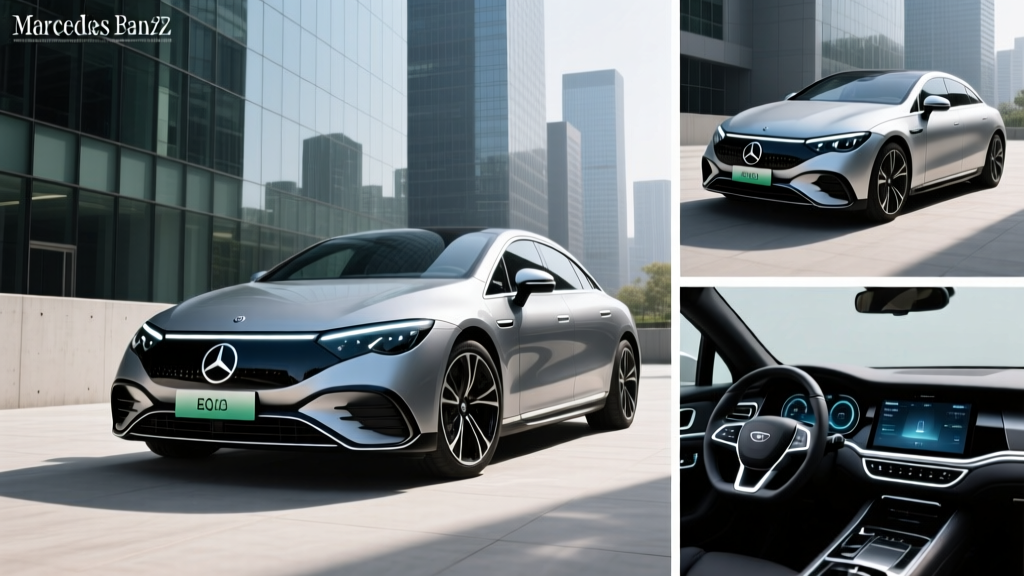
Quick Answer: Mercedes-Benz currently sells two core electric vehicle lines in the US: the EQE sedan (EPA range up to 305 miles, starting ~$76,050) and the EQS sedan (EPA range up to 390 miles, starting ~$105,550). Both use 90.6 kWh usable NMC battery packs, support up to 170 kW DC fast charging (10–80% in ~31 minutes), and qualify for no federal §30D tax credit due to battery-sourcing and MSRP-cap rules. For buyers cross-shopping a gas E-Class or S-Class, the EVs cost $8,000–$20,000 more upfront but save roughly $1,200–$1,800/year in fuel and maintenance if you can charge at home.
The 2026 Mercedes-Benz EV Lineup at a Glance
Mercedes-Benz has consolidated its US electric vehicle offerings around two sedan platforms. The EQE targets the mid-size luxury segment (comparable to the gas E-Class), while the EQS serves as the flagship electric sedan (parallel to the S-Class). The EQB compact SUV and EQS SUV remain available in limited configurations, but the sedan duo represents the core of the Mercedes-Benz electric vehicle strategy for American buyers.
| Spec | 2026 EQE 350+ | 2026 EQE 350 4MATIC | 2026 EQS 450+ | 2026 EQS 580 4MATIC |
|---|---|---|---|---|
| EPA Range | 305 mi | 277 mi | 390 mi | 345 mi |
| Battery (usable) | 90.6 kWh NMC | 90.6 kWh NMC | 107.8 kWh NMC | 107.8 kWh NMC |
| Horsepower | 288 hp | 288 hp | 355 hp | 536 hp |
| 0–60 mph | 6.2 sec | 5.8 sec | 5.9 sec | 4.1 sec |
| Max DC Charge Rate | 170 kW | 170 kW | 200 kW | 200 kW |
| 10–80% DC Time | ~32 min | ~32 min | ~31 min | ~31 min |
| Level 2 Rate (kW) | 9.6 kW | 9.6 kW | 11.5 kW | 11.5 kW |
| Efficiency (MPGe) | 94 MPGe | 86 MPGe | 97 MPGe | 87 MPGe |
| Base MSRP | $76,050 | $79,050 | $105,550 | $121,550 |
| Battery Warranty | 10 yr / 155,000 mi | 10 yr / 155,000 mi | 10 yr / 155,000 mi | 10 yr / 155,000 mi |
Sources: EPA fueleconomy.gov, Mercedes-Benz USA press specifications.
Real-World Range: What the EPA Sticker Doesn't Tell You
EPA vs. Reality: The EQS 450+ posts an impressive 390-mile EPA estimate, but real-world highway driving at 70–80 mph typically yields 310–340 miles. In cold weather (below 32°F), expect a further 15–25% reduction, bringing usable range to roughly 250–290 miles for the EQS 450+. The EQE 350+ drops to approximately 230–260 miles on the highway, and 190–220 miles in freezing conditions.
This range reduction isn't unique to Mercedes-Benz — it's physics. NMC lithium-ion cells experience increased internal resistance in cold temperatures, and cabin heating draws heavily from the traction battery. The EQS and EQE both use a heat pump (standard), which recovers waste heat from the drivetrain to warm the cabin more efficiently than resistive heating, but it can't fully eliminate cold-weather losses.
For context, the gas-powered 2026 E-Class 350 achieves roughly 420 miles of real-world highway range on its 17.4-gallon tank. The EQE 350+ falls short on raw range but delivers its miles with zero tailpipe emissions and far lower per-mile energy cost — provided you have reliable charging access.
Charging at Home and on the Road
Understanding the difference between kW (power, or how fast energy flows) and kWh (energy, or how much the battery holds) is critical. The EQE's 90.6 kWh battery is the tank size; the 170 kW DC charge rate is how quickly you can refill it.
| Charging Level | Power (kW) | Miles Added per Hour | Full Charge Time (EQE) | Where You'll Use It |
|---|---|---|---|---|
| Level 1 (120V) | 1.4 kW | ~4 mi/hr | ~65 hours | Emergency top-ups, standard outlet |
| Level 2 (240V) | 9.6 kW | ~28 mi/hr | ~9.5 hours | Home garage, workplace, hotels |
| DC Fast Charge | Up to 170 kW | ~180 mi in 15 min (peak) | 10–80% in ~32 min | Highway road trips, public stations |
Home charging setup: Most Mercedes-Benz EV owners install a Level 2 wallbox on a 240V/50A circuit, delivering the full 9.6 kW the EQE can accept. Expect $800–$2,500 for a quality Level 2 unit (ChargePoint Home Flex, Emporia Level 2, or Mercedes-Benz Wallbox Home) plus $500–$2,000 for electrician labor, depending on panel proximity and local permit costs. If your home has a 100A electrical panel, a panel upgrade to 200A may add $1,500–$3,000.
Charging curve reality: The 170 kW peak rate on the EQE only holds between roughly 10–40% state of charge. Above 60%, the rate tapers significantly — often dropping below 70 kW by 80%. This is normal for NMC chemistry and protects the battery from thermal stress, but it means the last 20% takes almost as long as the first 60%. On road trips, plan to charge to 80% and go.
The EQS, with its larger 107.8 kWh pack and 200 kW peak rate, follows a similar curve but adds miles slightly faster at peak. Both models use the CCS1 connector, though Mercedes-Benz has committed to adopting the NACS (Tesla-style) connector on future models. For 2026, CCS remains the standard, and adapters are available for Tesla Supercharger access at NACS-equipped stations.
Cost of Ownership: Mercedes-Benz EV vs. Gas Equivalent
The most common question from luxury sedan buyers: does the electric vehicle save money over the gas version? Here's a five-year comparison for the EQE 350+ versus the gas E-Class 350, assuming 12,000 miles/year and home charging at $0.14/kWh (national average).
| Cost Category (5 Years) | 2026 EQE 350+ | 2026 E-Class 350 (Gas) |
|---|---|---|
| Purchase Price (MSRP) | $76,050 | $60,500 |
| Federal Tax Credit (§30D) | $0 (sourcing rules) | $0 |
| Fuel / Electricity | $3,530 (7,200 miles ÷ 3.0 mi/kWh × $0.14) | $10,080 (60,000 mi ÷ 28 mpg × $4.70/gal) |
| Maintenance | ~$1,800 (cabin filter, fluid checks, tires) | ~$4,500 (oil, brakes, filters, transmission) |
| Insurance (avg) | ~$12,600 ($2,520/yr) | ~$10,500 ($2,100/yr) |
| Estimated Depreciation | ~$33,000 (55%) | ~$27,000 (45%) |
| 5-Year Total Cost | ~$90,980 | ~$85,580 |
Key takeaway: The EQE costs roughly $5,400 more over five years than the gas E-Class, driven primarily by the higher purchase price and steeper depreciation. Fuel and maintenance savings of ~$9,250 partially offset the ~$15,550 price gap. The math improves if electricity rates are lower (solar-charged homes), gas prices rise, or you keep the vehicle past year five when maintenance on the gas car accelerates.
Insurance is typically 15–25% higher on the EV due to higher repair costs for battery-adjacent damage and specialized parts. Get quotes from your provider before committing.
Federal Tax Credit: Why Most Mercedes-Benz EVs Don't Qualify
§30D Federal EV Tax Credit Requirements (2026):
- MSRP Cap: Sedans must be under $55,000. Both EQE ($76,050+) and EQS ($105,550+) exceed this limit.
- Buyer Income Cap: AGI must be below $150K (single) / $300K (joint).
- Battery Sourcing: Critical minerals and battery components must meet escalating domestic/free-trade-partner thresholds.
- Assembly: Final assembly must occur in North America (both EQE and EQS are assembled in Germany).
- Point-of-Sale Transfer: Eligible credits can be applied at purchase as a down-payment reduction.
The Mercedes-Benz EQE and EQS fail the §30D credit on two counts: MSRP exceeds the $55,000 sedan cap, and final assembly occurs in Bremen (EQE) and Sindelfingen (EQS), Germany — not North America. No federal purchase incentive applies. Some states offer additional credits (California's CVRP, for example), but these vary by jurisdiction and often have their own income and price caps. Check your state's energy office or the IRS §30D page for current rules.
Common Misconceptions About Mercedes-Benz EVs
| Myth | Fact |
|---|---|
| "The battery will need replacing in 5 years." | Mercedes-Benz warranties the battery for 10 years / 155,000 miles against dropping below 70% capacity. Real-world NMC degradation data from similar platforms shows ~8–12% loss over 150,000 miles with normal charging habits. |
| "Charging takes too long for road trips." | A 10–80% DC fast charge takes ~31 minutes — about the time for a rest stop and meal. Plan charging stops at 200-mile intervals and you'll barely notice. |
| "EVs are worse in winter." | Range drops 15–25% in freezing temps (true), but EVs start instantly in cold weather, have no cold-start engine wear, and the heat pump provides cabin warmth without idling a gas engine. Preconditioning while plugged in preserves range. |
| "I need a special home charger from Mercedes." | Any quality J1772/CCS Level 2 wallbox works. The Mercedes-branded wallbox is functionally identical to third-party units (ChargePoint, Emporia, Wallbox Pulsar) at similar or higher cost. |
| "The EQS is just an electric S-Class." | The EQS uses a dedicated EVA2 skateboard platform with a flat floor, not a converted S-Class chassis. Interior packaging, ride quality, and MBUX Hyperscreen are EV-specific designs. |
Who Should Buy a Mercedes-Benz Electric Vehicle?
Choose the EQE 350+ if:
- You have Level 2 home charging (or can install it)
- Your daily driving is under 100 miles round-trip
- You want a mid-size luxury sedan with EV smoothness and low running costs
- You don't need the federal tax credit to make the math work
Choose the EQS 450+ if:
- You want flagship luxury with 390-mile EPA range for longer road trips
- You prioritize cabin technology (MBUX Hyperscreen) and rear-seat comfort
- You're cross-shopping the S-Class and want instant torque with silent operation
Stick with a gas E-Class or S-Class if:
- You lack home charging access and your area has sparse public DC infrastructure
- You regularly drive 400+ miles in a single day in cold climates
- The $15,000–$20,000 upfront premium for the EV doesn't fit your budget
- You plan to sell within 3 years (depreciation hits harder on luxury EVs currently)
Consider a plug-in hybrid (PHEV) Mercedes-Benz instead if:
- You want electric-only commuting (~30–40 miles on the S 580e PHEV) with gas-engine range security
- Your household has one car that must handle both daily commutes and 500-mile holiday road trips
What First-Time Mercedes-Benz EV Buyers Need to Know
Preconditioning is essential. Use the Mercedes me app to precondition the battery before arriving at a DC fast charger. Cold batteries charge much slower — preconditioning warms the pack to optimal temperature, enabling the full 170–200 kW peak rate. Skip this step in winter and you may see charge rates cut in half.
Regenerative braking is customizable. The EQE and EQS offer steering-wheel paddle shifters to toggle regen intensity from coasting (D Auto) to strong one-pedal-style deceleration (D–). Unlike some competitors, Mercedes does not offer true one-pedal driving to a full stop in all modes — D Auto uses navigation and radar data to modulate regen based on traffic ahead.
MBUX navigation plans charging stops. When you enter a destination beyond your current range, the system automatically routes through compatible CCS chargers, preconditions the battery for each stop, and estimates arrival state of charge. It's functional but not as seamless as Tesla's integrated Supercharger routing — verify station availability with a backup app like PlugShare.
Tire costs are higher. Both models use EV-specific low-rolling-resistance tires (often Michelin Pilot Sport EV or Continental EcoContact), which cost $300–$450 per corner and may wear faster than standard touring tires due to the vehicle's 5,000+ lb curb weight and instant torque delivery. Budget $1,200–$1,800 for a tire replacement every 25,000–35,000 miles.
Frequently Asked Questions
Does Mercedes-Benz make an electric SUV available in the US?
Yes, the EQS SUV (3-row, up to 305 miles EPA) and EQB (compact, up to 251 miles EPA) are available in limited configurations for 2026. The EQS SUV starts around $105,550 and faces the same §30D tax credit ineligibility as the sedans due to MSRP and assembly location.
Can I charge a Mercedes-Benz EV at a Tesla Supercharger?
As of 2026, many Tesla Supercharger stations have been retrofitted with NACS connectors or offer CCS adapters. Mercedes-Benz EVs use CCS1 natively. Check the Tesla app or PlugShare for stations with "Magic Dock" CCS adapters or NACS-to-CCS adapter compatibility before relying on Supercharger access.
What happens if the battery degrades past the warranty threshold?
Mercedes-Benz's 10-year/155,000-mile battery warranty covers replacement or repair if capacity drops below 70% of original. Out-of-warranty battery replacement for the EQE/EQS platform is estimated at $20,000–$30,000 based on current module pricing, though module-level repair (replacing only degraded cells) can reduce this to $5,000–$10,000 at a qualified EV shop.
Is the Mercedes-Benz EQE cheaper to own than the Tesla Model S?
The EQE 350+ starts at $76,050 vs. the Model S at ~$79,990 (2026). The Model S qualifies for no federal credit either (MSRP cap + assembly in Fremont qualifies, but price exceeds the $55K sedan cap). The Tesla charges faster (250 kW peak, 10–80% in ~25 min) and has access to the full Supercharger network natively. The Mercedes offers a more traditional luxury interior and dealership service experience. Total cost of ownership is comparable within ~$2,000 over five years.
Do Mercedes-Benz EVs hold their resale value?
Luxury EVs currently depreciate faster than their gas counterparts. Industry data (Kelley Blue Book, Edmunds) shows 3-year residual values of ~45–50% for the EQE/EQS vs. ~55–60% for the gas E-Class/S-Class. This gap may narrow as EV adoption matures and battery longevity data accumulates, but as of 2026, plan for steeper depreciation.
For the latest IRS incentive rules, visit irs.gov. For official EPA range and efficiency data, see fueleconomy.gov. Pricing and specifications reflect 2026 model-year data from Mercedes-Benz USA and are subject to change.