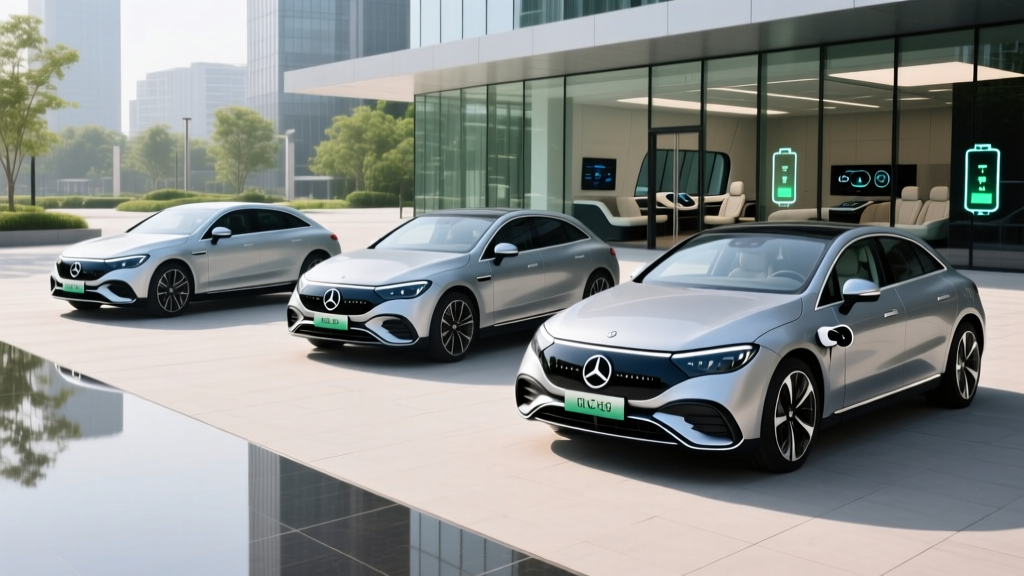
If you're researching a Mercedes-Benz electric car, the core decision comes down to three current models: the midsize EQE sedan (EPA 305 miles, starting ~$75,000), the flagship EQS sedan (EPA 390 miles, starting ~$105,000), and the compact SUV EQB (EPA 243 miles, starting ~$54,000). None currently qualify for the full $7,500 federal §30D tax credit due to battery-sourcing and MSRP-cap rules, though state incentives and dealer point-of-sale adjustments may apply. Expect real-world highway range 15–20% below EPA stickers and plan for a home Level 2 charger to make ownership practical.
Current Mercedes-Benz EV Lineup at a Glance
Mercedes-Benz has consolidated its electric offerings around the EQ brand. For 2026, three models dominate US showrooms. The discontinued EQA has been phased out, and the G-Class EV (G 580 with EQ Technology) remains a niche, limited-availability product starting above $160,000.
| Spec | EQB 300 4MATIC | EQE 350+ | EQS 450+ |
|---|---|---|---|
| EPA Range | 243 mi | 305 mi | 390 mi |
| Battery (usable kWh) | 66.5 kWh (NMC) | 90.6 kWh (NMC) | 108.4 kWh (NMC) |
| Peak DC Fast Charge | 100 kW | 170 kW | 200 kW |
| 10–80% DCFC Time | ~32 min | ~32 min | ~31 min |
| Level 2 Onboard Charger | 9.6 kW | 9.6 kW | 9.6 kW |
| Horsepower | 225 hp | 288 hp | 355 hp |
| 0–60 mph | 7.7 sec | 6.2 sec | 5.9 sec |
| MPGe (combined) | 89 MPGe | 94 MPGe | 97 MPGe |
| Starting MSRP | ~$54,200 | ~$75,050 | ~$105,550 |
| Battery Warranty | 8 yr / 100,000 mi | 8 yr / 100,000 mi | 8 yr / 100,000 mi |
Sources: EPA / fueleconomy.gov, Mercedes-Benz USA
Real-World Range: What the EPA Sticker Doesn't Tell You
EPA range estimates are tested under controlled conditions. In real-world ownership, several factors pull range below the sticker number — and Mercedes-Benz EVs are no exception.
- EQB 300: EPA 243 mi → expect ~195–210 mi highway, ~170 mi in freezing weather
- EQE 350+: EPA 305 mi → expect ~250–270 mi highway, ~220 mi in freezing weather
- EQS 450+: EPA 390 mi → expect ~320–340 mi highway, ~280 mi in freezing weather
Mercedes uses NMC (nickel manganese cobalt) battery chemistry across the lineup, which delivers high energy density but is more sensitive to cold-weather capacity loss than LFP (lithium iron phosphate). At 20°F, expect 20–30% range reduction due to increased cabin heating demand and slower electrochemical reaction rates. All three models include a heat pump as standard equipment, which mitigates some of this loss compared to resistive heating.
Highway driving at 75+ mph also reduces range significantly. Aerodynamic drag increases with the square of velocity, and while the EQS has a class-leading 0.20 drag coefficient, sustained 80 mph cruising still cuts range roughly 15% versus the EPA combined cycle.
Charging at Home and on the Road
Every Mercedes-Benz electric car uses the CCS1 connector for DC fast charging and the J1772 connector for Level 2 AC charging. (Mercedes has announced a transition to the NACS connector for future models, but 2026 models retain CCS1.)
| Level | Power (kW) | Miles Added per Hour | Use Case |
|---|---|---|---|
| Level 1 (120V) | 1.4 kW | ~3–5 mi/hr | Emergency / overnight trickle |
| Level 2 (240V) | 9.6 kW | ~25–35 mi/hr | Daily home charging |
| DC Fast Charge | 100–200 kW | ~180–400+ mi/hr (peak) | Road trips, public stations |
Charging curve reality: Peak DC fast-charge rates are not sustained. A 200 kW peak on the EQS may hold for only 10–15 minutes before tapering to 80–100 kW above 60% state of charge. This is why 10–80% times are the most meaningful metric — and why all three models cluster around 30–32 minutes despite different peak rates.
Home charging setup: A Level 2 home charger on a 240V/50A circuit delivers roughly 9.6 kW, fully replenishing an EQE overnight (about 9–10 hours from near-empty). Installation costs typically run $800–$2,500 depending on panel proximity and whether a 200A service upgrade is needed. Always have a licensed electrician assess your panel before purchasing equipment.
For public charging, Mercedes-Benz is part of a joint venture with other automakers to build a North American high-power charging network. Additionally, Mercedes owners have access to Electrify America, EVgo, and ChargePoint networks through the Mercedes me Charge app.
Mercedes-Benz EV vs Gas: The Cost Comparison
The most common question from luxury car shoppers: does a Mercedes-Benz electric car save money compared to its gas equivalent? The answer depends heavily on your driving volume, local electricity rates, and whether you can charge at home.
| Cost Category | EQE 350+ (EV) | E 350 (Gas) |
|---|---|---|
| Base MSRP | $75,050 | $58,750 |
| Federal Tax Credit | $0 (MSRP/sourcing rules)* | N/A |
| Fuel/Energy (60K mi) | ~$3,900 (home L2)** | ~$9,000 (premium gas) |
| Maintenance (5 yr) | ~$1,800 | ~$3,500 |
| Insurance (5 yr avg) | ~$14,500 | ~$12,000 |
| Estimated 5-Yr Total | ~$95,250 | ~$83,250 |
* Federal §30D credit eligibility depends on MSRP caps ($55K sedans), buyer income limits, and battery critical-mineral sourcing. Most Mercedes EVs exceed the sedan MSRP cap. Check current rules at IRS.gov.
** Based on $0.15/kWh average home electricity. Public DCFC at $0.35–0.50/kWh would raise EV energy costs to ~$6,500.
The takeaway: the EQE costs roughly $12,000 more over five years due to higher purchase price and insurance, even after fuel and maintenance savings. The break-even point for the EQE vs. E 350 typically requires 8+ years of ownership or significantly lower electricity rates. However, if you prioritize driving refinement, instant torque, and zero tailpipe emissions, the EV offers intangible benefits the gas car cannot match.
Tax Credit and Incentive Reality
This is where many Mercedes-Benz EV shoppers face disappointment. Under current IRS §30D rules, the federal clean vehicle credit has three major hurdles:
- MSRP cap: $55,000 for sedans; $80,000 for SUVs/vans/pickups. The EQE sedan ($75K+) and EQS ($105K+) exceed this cap. The EQB ($54K+) technically qualifies on MSRP as an SUV.
- Income cap: Modified AGI ≤ $150K (single), ≤ $300K (joint).
- Battery sourcing: Critical minerals and battery components must meet escalating North American/free-trade-partner thresholds. Most Mercedes-Benz EVs use battery cells sourced from Asian suppliers that do not yet meet 2026 thresholds.
The EQB may qualify for a partial or full credit depending on your income and the specific battery batch. Always verify with your dealer and a tax professional before assuming credit eligibility. Some states offer additional rebates — check your state energy office or Alternative Fuels Data Center for local incentives.
First-Time EV Buyer: What You Must Know
If this is your first Mercedes-Benz electric car — or your first EV period — these practical realities separate informed buyers from frustrated ones:
- Confirm home charging access. Do you own your home or have landlord approval for a Level 2 install? Apartment/condo charging remains the biggest ownership barrier.
- Check your electrical panel. A 200A service panel with spare breaker slots is ideal. A panel upgrade adds $1,500–$3,000 to installation costs.
- Map your common road trips. Use PlugShare or A Better Routeplanner to confirm DC fast-charger availability along routes you drive 2–3 times per year.
- Understand preconditioning. Mercedes EVs can precondition the battery before fast charging (via navigation to a charger), which significantly improves charge speed in cold weather.
- Budget for insurance. EV insurance premiums run 15–25% higher than equivalent gas models due to repair costs and battery replacement values.
| Myth | Fact |
|---|---|
| "The battery will need replacing in 5 years" | NMC batteries in Mercedes EVs are warrantied for 8 years/100K miles at ≥70% capacity. Real-world data shows ~10–12% degradation at 100K miles with normal use. |
| "I can charge from any standard outlet quickly" | Level 1 (120V) adds only 3–5 miles per hour. An EQS would take 25+ hours for a full charge. Level 2 home charging is effectively mandatory for daily use. |
| "All Mercedes EVs get the $7,500 tax credit" | Most exceed the MSRP cap or fail battery-sourcing requirements. Verify eligibility on IRS.gov before purchasing. |
| "Regenerative braking means I never use the brake pedal" | Mercedes offers adjustable regen (including a one-pedal-like mode in some trims), but brake pads still require periodic inspection. Regen reduces wear significantly but doesn't eliminate it. |
Decision Framework: Which Mercedes-Benz Electric Car Is Right for You?
Choose the EQB 300 if:
- You need a compact luxury SUV with optional third-row seating
- Your daily commute is under 60 miles round-trip
- Your budget is $55,000–$65,000 (out-the-door)
- You primarily drive in urban/suburban environments
- Home Level 2 charging is confirmed
Choose the EQE 350+ if:
- You want a luxury midsize sedan with 250+ real-world highway miles
- Your budget is $75,000–$90,000
- You commute 40–80 miles daily and want minimal charging frequency
- You value Mercedes S-Class refinement in a smaller, more affordable package
- You take 2–3 road trips per year of 200–400 miles
Choose the EQS 450+ if:
- You want maximum range (320+ real-world highway miles) and flagship luxury
- Your budget exceeds $105,000
- You regularly drive 300+ mile routes and want to minimize charging stops
- You prioritize cabin technology (MBUX Hyperscreen, rear-axle steering, Burmester 4D sound)
- Tax credit ineligibility does not impact your purchasing decision
Consider a Mercedes PHEV instead if:
- You lack reliable home charging access
- You regularly drive 400+ miles in rural areas with sparse DC fast-charging infrastructure
- You want to reduce fuel consumption without committing to full electric
Ownership Costs Beyond the Purchase Price
Luxury EV ownership involves costs that differ from gas vehicles in specific ways:
- Maintenance savings are real. No oil changes, no spark plugs, no transmission fluid. Brake pad life extends to 80,000+ miles thanks to regenerative braking. Expect annual maintenance of $300–$400 vs. $600–$800 for gas equivalents.
- Tire costs are higher. EVs are heavier (the EQS weighs ~5,900 lbs) and deliver instant torque, wearing tires 20–30% faster than gas cars. Budget $1,200–$1,800 for a set of premium EV-rated tires every 30,000–40,000 miles.
- Insurance is more expensive. Collision coverage for a $100K+ EV with a large battery pack costs more to underwrite. Get quotes before purchasing — premiums vary $200–$500/year vs. gas equivalents.
- Depreciation remains a wildcard. Luxury EVs have seen steeper depreciation than gas luxury sedans in recent years, partly due to rapid tech advancement and Tesla price cuts reshaping the market. Expect 50–60% value retention at 3 years for the EQE/EQS, vs. 55–65% for the E-Class.
- Home electricity costs vary dramatically. At $0.12/kWh (national average), a full EQS charge costs ~$13. At $0.25/kWh (California peak), the same charge costs ~$27. Time-of-use rates can cut costs further by charging overnight.
Frequently Asked Questions
Does Mercedes-Benz make a fully electric SUV?
Yes. The EQB is a compact electric SUV currently available in the US. The larger EQS SUV (EPA 305–330 mi, starting ~$105,000) is also available. Mercedes has announced additional electric SUVs on its upcoming MMA platform, expected in 2026–2027.
Can I use Tesla Superchargers with a Mercedes-Benz EV?
As of 2026, current Mercedes-Benz EVs use the CCS1 connector and cannot natively plug into Tesla's NACS-only Superchargers. Mercedes has committed to adopting NACS in future models, and a CCS-to-NACS adapter may become available. Check with your dealer for the latest adapter compatibility.
How long does a Mercedes-Benz EV battery last?
The battery is warrantied for 8 years or 100,000 miles, whichever comes first, with a capacity-retention threshold of 70%. Real-world NMC degradation data from similar platforms suggests ~10–12% capacity loss at 100K miles with normal charging habits (avoiding frequent 100% charges and extreme heat exposure). Full battery replacement, if ever needed outside warranty, currently costs $15,000–$25,000 depending on the model.
Is the Mercedes me Charge app reliable for finding public chargers?
The Mercedes me Charge app aggregates networks including Electrify America, EVgo, and ChargePoint. It provides real-time availability and pricing, though user reviews note occasional lag in status updates compared to native network apps. For road trips, many owners use PlugShare or A Better Routeplanner as supplements.
Do Mercedes-Benz EVs qualify for any incentives?
Federal §30D credit eligibility is limited by MSRP caps and battery-sourcing rules — most Mercedes EVs do not qualify for the full $7,500. However, state-level incentives (California's CVRP, Colorado's state credit, etc.) and utility rebates for home charger installation may apply. Check afdc.energy.gov and your local utility for current programs.