Quick Verdict: Luxury Performance With a Range Caveat
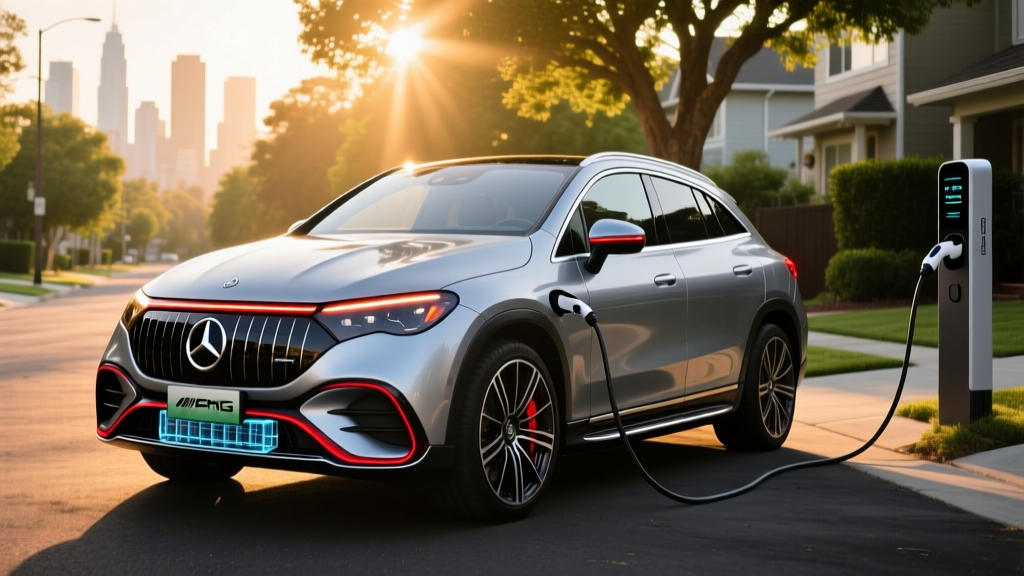
The 2026 Mercedes-AMG EQE SUV is a dual-motor electric luxury crossover that trades maximum range for serious performance and AMG-tuned driving dynamics. Built on Mercedes' EVA2 platform alongside the standard EQE SUV, the AMG variant adds aggressive power outputs, adaptive air suspension, and a stiffer chassis — but its 90.6 kWh usable battery delivers a modest 230 to 279 miles of EPA-estimated range depending on trim. That's a meaningful trade-off in a segment where the BMW iX M60 reaches 288 miles and the Tesla Model X Plaid manages 311 miles.
For buyers who prioritize driving engagement, interior craftsmanship, and Mercedes' latest MBUX Hyperscreen tech over road-trip efficiency, the AMG EQE SUV delivers. But if you regularly drive 300+ miles between charging stops, competitors offer more margin. Here's everything you need to know before putting down a deposit.
Range, Battery, and Efficiency
The AMG EQE 53 4MATIC+ posts an EPA-estimated 230 miles on its 21-inch AMG wheels. Step down to the standard EQE 350+ (RWD, 20-inch wheels) and you'll see up to 279 miles. On a 70°F highway cruise at 75 mph, expect the AMG 53 to deliver roughly 200–215 real-world miles. In winter conditions (25°F or below with cabin heat running), plan for 170–190 miles before needing a charger. The large battery helps, but the AMG's performance-oriented motors, wider tires, and heavier curb weight (~5,600 lbs) all work against efficiency.
The EQE SUV lineup uses a 90.6 kWh usable lithium-ion battery pack with NMC (nickel-manganese-cobalt) chemistry. Unlike Tesla's Model Y RWD or the base Model 3, Mercedes has not adopted LFP (lithium iron phosphate) for this platform — NMC offers higher energy density, which matters when packaging a large pack into a mid-size crossover floor.
| Spec | AMG EQE 53 4MATIC+ | AMG EQE 43 4MATIC |
|---|---|---|
| EPA Range | 230 mi | 269 mi |
| Battery (usable) | 90.6 kWh, NMC | 90.6 kWh, NMC |
| Drivetrain | Dual-motor AWD | Dual-motor AWD |
| Horsepower | 617 hp (677 hp w/ RACE START) | 476 hp |
| 0-60 mph | 3.4 sec (3.3 w/ RACE START) | 4.2 sec |
| MPGe (combined) | 74 MPGe | 82 MPGe |
| kWh/100 mi | 45 kWh | 41 kWh |
| Cargo (rear seats up) | 14.0 cu ft | 14.0 cu ft |
| Cargo (rear seats folded) | 55.0 cu ft | 55.0 cu ft |
| Base MSRP | $108,550 | $96,550 |
Efficiency is the AMG's weak point. At 45 kWh per 100 miles (74 MPGe combined), the EQE 53 consumes significantly more energy than a Tesla Model X (38 kWh/100mi, 102 MPGe) or even the non-AMG EQE 350+ SUV (36 kWh/100mi, 93 MPGe). This directly impacts both your real-world range and your cost per mile when charging on expensive public DC networks.
Source: fueleconomy.gov — U.S. Department of Energy efficiency and range data.
Charging: DC Fast Charging and Home Level 2
The EQE SUV uses a CCS1 connector for DC fast charging (J1772 for AC Level 2). Mercedes quotes a peak DC charge rate of 170 kW, which translates to a 10–80% charge time of approximately 32 minutes under ideal conditions. That's competitive but not class-leading — the Hyundai Ioniq 5 peaks at 240 kW and hits 10–80% in about 18 minutes, while the Tesla Model X leverages the Supercharger network at up to 250 kW.
| Charge Level | Power | Estimated Speed | Notes |
|---|---|---|---|
| Level 1 (120V) | 1.4 kW | ~3 mi/hr | Emergency/trickle only; 30+ hrs for full charge |
| Level 2 (240V, 48A) | 11.5 kW | ~29 mi/hr | Full charge in ~9.5 hours; standard home setup |
| Level 2 (240V, 32A) | 7.7 kW | ~20 mi/hr | Common portable charger; ~13 hours full charge |
| DC Fast (peak) | 170 kW | ~190 mi/hr at peak | 10–80% in ~32 min; tapers significantly above 80% |
At home on a properly installed 48-amp Level 2 charger (requiring a 60-amp circuit), you'll add roughly 29 miles of range per hour. Overnight charging from 20% to 80% takes about 5–6 hours, which is standard for a pack this size.
A critical note on the charging curve: the 170 kW peak is only sustained at low states of charge (roughly 10–35% SoC). Above 50%, the rate tapers to around 100–120 kW, and above 80% it drops to under 50 kW. This is normal battery-protection behavior, but it means a 20–90% session on a road trip will take closer to 45 minutes, not 32. Always plan charging stops around the 10–80% window for maximum efficiency.
The EQE SUV supports battery preconditioning — when you navigate to a DC fast charger in the MBUX system, the car warms or cools the pack to optimize charge speed upon arrival. Use this feature every time; skipping preconditioning in cold weather can add 10+ minutes to your charge session.
Performance, Driving Dynamics, and Drivetrain
The AMG EQE 53 4MATIC+ puts out 617 horsepower standard and 677 hp with RACE START (launch control) engaged. That's enough to launch this 5,600-pound SUV to 60 mph in 3.4 seconds — or 3.3 seconds with RACE START. The EQE 43 makes 476 hp and hits 60 in 4.2 seconds. Both use a dual-motor all-wheel-drive setup with torque vectoring between the axles.
What separates the AMG from the standard EQE SUV isn't just straight-line speed. Mercedes-AMG retuned the air suspension with stiffer damping, added rear-axle steering (up to 10 degrees for a tighter turning radius at low speeds and more stability at highway speeds), and fitted larger brakes with six-piston front calipers. The result is a heavy EV that handles its weight surprisingly well through corners, with body roll that's well-controlled for a crossover.
The AMG-specific drive modes — Slippery, Comfort, Sport, Sport+, and Individual — adjust throttle mapping, suspension firmness, steering weight, and regen intensity. Sport+ firms up the ride noticeably; you'll feel expansion joints and rough pavement more than in Comfort mode, which is the daily-driver default.
Regenerative braking offers multiple levels selectable via steering-wheel paddles: D+ (coasting, no regen), D (mild), D- (moderate,接近 one-pedal in city traffic), and D Auto (uses radar and cameras to adjust regen based on traffic ahead). D Auto is the most practical for mixed driving — it coasts on open roads and applies regen when you approach a slower vehicle.
Interior, Tech, and Cargo Space
The EQE SUV's cabin is where Mercedes justifies its premium pricing. The available MBUX Hyperscreen stretches 56 inches across the dashboard, integrating a 12.3-inch driver display, a 17.7-inch central touchscreen, and a 12.3-inch passenger screen into a single curved glass panel. The OLED displays are crisp, responsive, and generate minimal glare. The passenger screen includes a "distraction-free" filter that prevents the driver from viewing video content while the vehicle is in motion.
Standard tech includes wireless Apple CarPlay and Android Auto, a Burmester 3D surround-sound system (15 speakers on the AMG), a head-up display with augmented-reality navigation overlays, and Mercedes' MBUX voice assistant ("Hey Mercedes"). The voice system handles navigation, climate, media, and vehicle settings with natural-language input that's among the best in the industry.
Driver assistance comes via Mercedes' Driver Assistance Package, which bundles adaptive cruise control with stop-and-go, active lane-keeping, blind-spot monitoring, and active emergency braking. This is an SAE Level 2 system — it assists with steering and speed, but the driver must remain fully engaged at all times. Mercedes also offers its DRIVE PILOT system in select markets, which provides conditional Level 3 autonomy in heavy highway traffic at speeds under 40 mph, but availability remains limited to specific mapped highways in Nevada and California.
Cargo space is the EQE SUV's most practical compromise. With rear seats upright, you get 14.0 cubic feet — tight for a vehicle of this size and well behind the Tesla Model X (37.1 cu ft) and BMW iX (35.5 cu ft). Fold the rear seats and capacity opens to 55.0 cu ft, which is more usable but still not class-leading. There is no front trunk (frunk); the space under the hood houses electronics and the HVAC system. Rear-seat legroom is generous at 39.5 inches, and headroom is adequate despite the coupe-like roofline.
Pricing, Trims, and Federal Tax Credit Eligibility
The 2026 Mercedes-AMG EQE SUV starts at $96,550 for the EQE 43 4MATIC and $108,550 for the EQE 53 4MATIC+, including the $1,150 destination charge. Options can push the EQE 53 well past $125,000 with packages like the AMG Night Package, Pinnacle Trim (ventilated/massage seats, upgraded leather), and the Driver Assistance Package Plus.
| Trim | Base MSRP | As-Tested (Typical) | §30D Federal Credit |
|---|---|---|---|
| AMG EQE 43 4MATIC | $96,550 | $102,000–$108,000 | Not eligible (MSRP exceeds $80,000 SUV cap) |
| AMG EQE 53 4MATIC+ | $108,550 | $118,000–$130,000 | Not eligible (MSRP exceeds $80,000 SUV cap) |
Without the federal credit, the AMG EQE SUV's effective cost is the sticker price minus any applicable state or local incentives. Some states (California, Colorado, Massachusetts, among others) offer their own EV rebates that may apply regardless of MSRP caps — check your state energy office for current programs.
Warranty and Battery Coverage
Mercedes covers the EQE SUV with a 4-year/50,000-mile limited warranty and a dedicated high-voltage battery warranty of 8 years or 100,000 miles, whichever comes first. The battery warranty guarantees that the pack will retain at least 70% of its original capacity during the coverage period — if degradation drops below that threshold, Mercedes will repair or replace the battery at no cost.
Based on NMC chemistry degradation data from similar Mercedes EVA2-platform vehicles (the EQS sedan has been on the road since 2022), owners typically see 5–8% capacity loss over the first 50,000 miles, with the rate of degradation slowing afterward. The 70% retention guarantee at 100,000 miles provides a comfortable buffer. Routine maintenance costs are low compared to internal-combustion AMG models — no oil changes, no transmission fluid, and regenerative braking significantly extends brake pad life.
Competition: How the AMG EQE SUV Stacks Up
The AMG EQE SUV competes in a niche but growing segment of performance electric luxury crossovers. Here's how it compares to its most direct rivals:
| Attribute | Mercedes-AMG EQE 53 | BMW iX M60 | Tesla Model X Plaid | Porsche Cayenne EV Turbo |
|---|---|---|---|---|
| EPA Range | 230 mi | 288 mi | 311 mi | 275 mi (est.) |
| 0-60 mph | 3.4 sec | 3.6 sec | 2.5 sec | 3.3 sec (est.) |
| Horsepower | 677 hp (launch) | 610 hp | 1,020 hp | ~730 hp (est.) |
| Peak DC Charge | 170 kW | 195 kW | 250 kW | ~270 kW (est.) |
| Cargo (seats up) | 14.0 cu ft | 35.5 cu ft | 37.1 cu ft | ~22 cu ft (est.) |
| Base MSRP | $108,550 | $111,500 | $94,990 | ~$115,000 (est.) |
| Federal Credit | No (MSRP cap) | No (MSRP cap) | No (MSRP cap) | No (MSRP cap) |
The BMW iX M60 offers significantly more range and cargo space at a similar price, though it lacks the AMG's chassis tuning and brand cachet. The Tesla Model X Plaid demolishes the AMG in straight-line speed and range but can't match the Mercedes interior quality or ride refinement. The Porsche Cayenne EV (new for 2026) targets the same performance-luxury buyer with likely superior charging speed, though real-world data is still emerging.
Choose the AMG EQE 53 if: You want AMG driving dynamics, the MBUX Hyperscreen, and a luxury interior that no Tesla can match — and your typical drives stay under 200 miles or you have reliable home charging.
Choose the BMW iX M60 instead if: You need more cargo space (35.5 vs 14.0 cu ft), longer real-world range (~260+ mi highway), and faster DC charging (195 kW peak).
Choose the Tesla Model X Plaid if: Straight-line speed (2.5 sec 0-60), Supercharger network access, and maximum range (311 mi EPA) are your top priorities — and you can tolerate Tesla's minimalist interior.
Look at the standard EQE 350+ SUV if: You want the Mercedes EV platform and interior at a lower price ($75,050) with better range (279 mi EPA) and don't need AMG performance.
Pros and Cons
- AMG-tuned air suspension and rear-axle steering deliver handling that defies the 5,600-lb curb weight
- MBUX Hyperscreen is one of the most impressive EV infotainment systems available
- Quiet, well-isolated cabin with premium materials throughout
- RACE START provides genuine supercar-rivaling acceleration (3.3 sec 0-60)
- 8-year/100,000-mile battery warranty with 70% capacity retention guarantee
- Generous rear-seat legroom (39.5 inches) for passengers
- EPA range of 230 miles (EQE 53) is the lowest in its competitive set
- Cargo space (14.0 cu ft seats up) is severely limited for a mid-size luxury SUV
- Peak DC charging at 170 kW is slower than rivals (BMW iX: 195 kW, Tesla: 250 kW)
- Base price of $108,550 disqualifies it from the §30D federal tax credit
- No frunk for additional storage
- Energy consumption of 45 kWh/100mi makes public charging expensive
Frequently Asked Questions
What is the real-world range of the Mercedes-AMG EQE SUV?
The AMG EQE 53 has an EPA-estimated range of 230 miles. In real-world highway driving at 75 mph in moderate temperatures, expect approximately 200–215 miles. In cold weather (below 30°F), range drops to roughly 170–190 miles due to cabin heating demands and reduced battery efficiency. The EQE 43, with its lower power output, achieves 269 miles EPA and roughly 235–250 miles in real-world mixed driving.
How fast does the AMG EQE SUV charge at home and on the road?
On a 48-amp Level 2 home charger, the EQE SUV adds about 29 miles of range per hour, with a full charge taking approximately 9.5 hours. On a DC fast charger, it peaks at 170 kW and charges from 10–80% in about 32 minutes under ideal conditions. Real-world 20–90% road-trip sessions typically take 40–45 minutes due to charge-curve tapering above 80%.
Does the Mercedes-AMG EQE SUV qualify for the $7,500 federal EV tax credit?
No. Under current IRS §30D rules, SUVs must have an MSRP at or below $80,000 to qualify. Both AMG EQE SUV trims exceed this cap at base price ($96,550 and $108,550). Additionally, the credit has buyer income limits and battery-sourcing requirements. Check IRS.gov for the latest rules and consult a tax professional.
Is the AMG EQE SUV worth buying over the BMW iX or Tesla Model X?
It depends on your priorities. The AMG EQE SUV wins on interior luxury, ride quality, and chassis refinement. The BMW iX M60 is better for cargo space and range. The Tesla Model X Plaid wins on raw speed, range, and charging infrastructure. If interior quality and Mercedes brand prestige matter most, the AMG EQE is compelling — but go in with eyes open about the 230-mile range limitation.
What is the battery replacement cost for the EQE SUV?
Mercedes has not published an official out-of-warranty replacement price for the EQE SUV's 90.6 kWh pack. Based on comparable NMC battery replacement costs for the EQS and industry averages, expect a range of $20,000–$30,000 for a full pack replacement if needed outside the 8-year/100,000-mile warranty. However, NMC degradation data suggests most packs will retain 80–90% capacity at 100,000 miles under normal use.
Can the AMG EQE SUV tow?
Yes. The EQE SUV is rated to tow up to 4,000 pounds when properly equipped with the factory towing package. Towing will significantly reduce range — expect a 30–50% reduction depending on trailer weight and aerodynamics, bringing the EQE 53's effective range to approximately 115–160 miles under heavy tow conditions.
Sources: fueleconomy.gov, IRS §30D Clean Vehicle Credits, Mercedes-Benz USA official specifications.