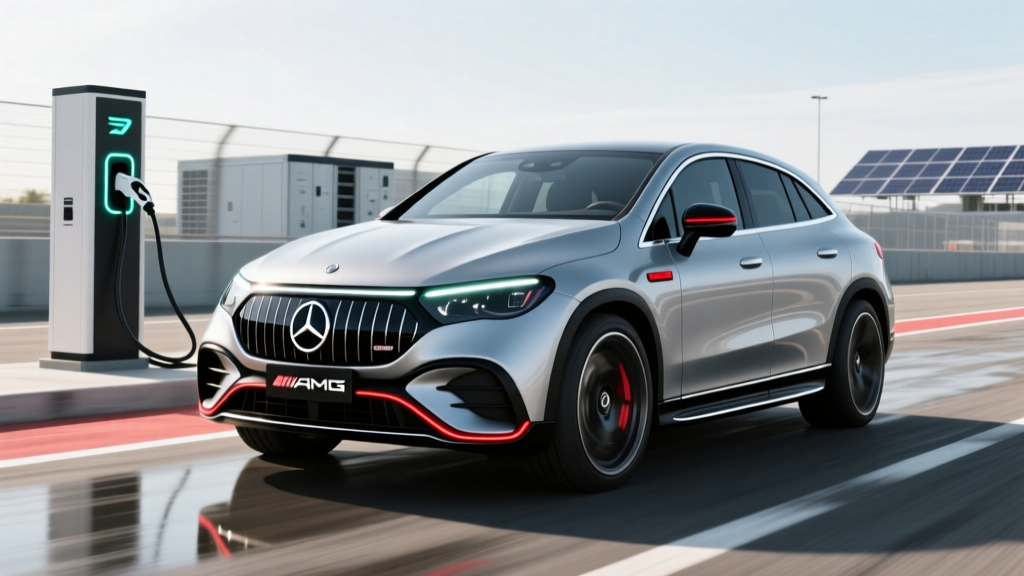
Quick Verdict: The AMG EQE Is a Luxury Sprinter, Not a Range King
The 2026 Mercedes-AMG EQE sedan targets a very specific buyer: someone who wants the effortless thrust of a dual-motor AMG powertrain, the cabin isolation of a flagship Mercedes, and the ability to charge at home overnight. It delivers on performance and luxury, but its EPA range of 230 miles and curb weight north of 5,500 pounds mean it trades efficiency for acceleration. If you're searching for the AMG EQE 0-60 time and wondering whether the rest of the package holds up, this review breaks down every number that matters.
| Spec | EQE 43 4MATIC | EQE 53 4MATIC+ |
|---|---|---|
| EPA Range | 230 mi | 230 mi |
| Usable Battery | 90.6 kWh (NMC) | 90.6 kWh (NMC) |
| Horsepower | 469 hp | 617 hp (677 w/ RACE START) |
| Torque | 633 lb-ft | 701 lb-ft (738 w/ RACE START) |
| 0-60 mph | 4.0 sec | 3.2 sec |
| Drivetrain | Dual-motor AWD | Dual-motor AWD |
| Max DC Charge Rate | 170 kW | 170 kW |
| 10-80% DC Time | ~32 min | ~32 min |
| Level 2 Rate | 9.6 kW (~22 mi/hr) | 9.6 kW (~22 mi/hr) |
| MPGe (combined) | 74 MPGe | 73 MPGe |
| Base MSRP | $106,900 | $117,900 |
| Battery Warranty | 8 yr / 100,000 mi | 8 yr / 100,000 mi |
AMG EQE 0-60 and Performance: The Numbers Behind the Thrust
The headline number for the EQE 53 4MATIC+ is a 3.2-second 0-60 mph sprint, achieved with RACE START (launch control) engaged. That puts it in the company of the Porsche Taycan 4S and the Tesla Model S Dual Motor, though neither of those rivals carries the same cabin appointment level at this price point. The EQE 43 4MATIC manages 4.0 seconds to 60 — quick by any sedan standard, but the 53's extra 148 horsepower and AMG-tuned torque vectoring make the upgrade feel substantial in real-world passing maneuvers.
Both trims use a dual-motor all-wheel-drive layout with permanent-magnet synchronous motors on each axle. The rear motor handles the bulk of cruising duty for efficiency, while the front motor engages under hard acceleration or low-traction conditions. AMG-specific tuning includes stiffer adaptive dampers, rear-axle steering (up to 3.6 degrees for tighter low-speed turns), and an AMG Performance brake system with larger rotors.
The tradeoff for this performance is mass. At approximately 5,555 pounds, the AMG EQE is heavy even by EV standards. You feel it in cornering transitions and in the energy consumption — this is not a car that rewards aggressive driving with efficiency.
Real-World Range: What 230 EPA Miles Actually Means
Real-World Highway (70 mph, mild weather): ~195–210 miles
Real-World City (mixed stop-and-go with regen): ~215–230 miles
Cold Weather (below 32°F, highway): ~165–185 miles
Note: The AMG EQE's 74 MPGe combined translates to roughly 45 kWh/100mi — among the least efficient luxury EVs in its class. Aggressive driving and RACE START usage will reduce range further.
The 90.6 kWh usable battery is an NMC (nickel-manganese-cobalt) pack, chosen for its higher energy density compared to LFP chemistry. Mercedes does not publish the gross capacity, but the usable figure is what determines your real driving range. At an observed efficiency of 2.2–2.5 miles per kWh on the highway, a full charge realistically delivers 200 miles before you'll want to find a charger.
Cold weather compounds the issue. The AMG EQE does include a heat pump for cabin heating, which helps, but battery preconditioning and cabin demands in sub-freezing temperatures can cut range by 20-25%. If your daily commute is 60 miles round-trip in a cold climate, you'll still have comfortable margin — but a 200-mile winter road trip will require a charging stop.
Charging Speed: DC Fast Charging and Home Level 2
The AMG EQE supports a peak DC fast-charge rate of 170 kW via its CCS1 connector (or NACS with adapter on 2025+ models equipped with the updated charge port). At a capable 350 kW Electrify America or Tesla Supercharger (with adapter) station, the charge curve looks approximately like this:
| Charge Level | Power / Rate | Speed | Notes |
|---|---|---|---|
| Level 1 (120V) | ~1.4 kW | ~3 mi/hr | Emergency/trickle only; not practical for daily use |
| Level 2 (240V, 40A) | 9.6 kW | ~22 mi/hr | Full charge in ~9.5 hours; ideal overnight home charging |
| DC Fast (peak) | 170 kW | ~180 mi/hr (peak) | 10-80% in ~32 min; tapers significantly above 80% |
The 170 kW peak is competitive but not class-leading. The Hyundai Ioniq 5 and Kia EV6 accept up to 240+ kW, and the Lucid Air can pull over 300 kW at compatible stations. Where the AMG EQE's charge curve matters most is the 10-80% window: roughly 32 minutes at a station delivering full power. In practice, expect 35-38 minutes accounting for connector handshake time, battery temperature, and taper above 80%.
For home charging, the onboard 9.6 kW charger means a full 0-100% charge takes about 9.5 hours on a 40-amp Level 2 circuit (hardwired, 50-amp breaker recommended). This is adequate for overnight replenishment. If your daily driving is under 100 miles, you'll rarely need a full charge — plugging in each evening at 80% state of charge is sufficient and better for long-term battery health.
Preconditioning tip: Always use the Mercedes me app or navigation-based preconditioning before arriving at a DC fast charger. The battery management system will warm the pack to optimal temperature, which can shave 5-8 minutes off your 10-80% time in cool weather. Without preconditioning, peak charge rates may be limited to 100-120 kW until the pack warms.
Pricing, Trims, and Federal Tax Credit Eligibility
The 2026 AMG EQE lineup starts at $106,900 for the EQE 43 4MATIC and climbs to $117,900 for the EQE 53 4MATIC+. Options packages — including the AMG Night Package, Executive Rear Seat Package, and Burmester 4D surround sound — can push an as-tested EQE 53 past $135,000.
| Trim | Base MSRP | §30D Credit Eligible? | Effective Price (if eligible) |
|---|---|---|---|
| EQE 43 4MATIC | $106,900 | No (exceeds $55,000 sedan cap) | $106,900 |
| EQE 53 4MATIC+ | $117,900 | No (exceeds $55,000 sedan cap) | $117,900 |
Does the AMG EQE qualify for the federal EV tax credit? No. Under current IRS §30D rules, the federal Clean Vehicle Credit applies a $55,000 MSRP cap for sedans (and $80,000 for SUVs, vans, and trucks). Both AMG EQE trims exceed the sedan cap significantly, making them ineligible regardless of buyer income or battery sourcing. This is a hard exclusion — there is no workaround via the point-of-sale transfer mechanism either.
Buyers should also be aware of the §30D income caps ($150,000 single / $300,000 joint filer AGI) and the critical-mineral and battery-component sourcing requirements, though these are moot for the AMG EQE given the MSRP disqualification. Some states offer their own purchase incentives that are not MSRP-capped — check your state's energy office or DMV for details.
Interior, Cargo, and Technology
The AMG EQE cabin is where Mercedes justifies its six-figure pricing. The standard MBUX Hyperscreen stretches 56 inches across the dashboard, combining a 12.3-inch instrument cluster, a 17.7-inch central OLED touchscreen, and a 12.3-inch passenger display under a single glass panel. It's visually impressive, though the touch-capacitive surfaces attract fingerprints and require deliberate presses while driving.
Front passengers get 41.1 inches of legroom and well-bolstered AMG sport seats with standard heating, ventilation, and massage. Rear legroom measures 38.2 inches — generous for a performance sedan, though the sloping roofline reduces headroom for taller passengers. Cargo volume is 15.0 cubic feet in the trunk, which is competitive with the BMW i5 but less than the Tesla Model S (25 cu ft with the rear hatch). There is no front trunk (frunk); the space under the hood houses drivetrain and HVAC components.
On the driver-assistance front, the AMG EQE comes equipped with Mercedes' latest Driver Assistance Package, which includes:
- Active Distance Assist DISTRONIC (adaptive cruise with stop-and-go)
- Active Steering Assist (lane centering)
- Active Lane Change Assist
- Active Emergency Stop Assist
- Pre-Safe Plus (rear-collision preparation)
The AMG EQE's driver-assistance suite is a Level 2 system per SAE J3016 classification. This means the vehicle can simultaneously control steering and speed under certain conditions, but the driver must remain fully attentive, keep hands on or near the wheel, and be prepared to take over at any moment. It is not self-driving. Mercedes does offer its Level 3 DRIVE PILOT system in select markets (currently limited to specific highways in Nevada and California at speeds up to 40 mph), but availability on the AMG EQE is restricted and requires separate subscription.
Standout tech includes MBUX's augmented-reality navigation overlay on the instrument cluster, wireless Apple CarPlay and Android Auto, a fingerprint reader for driver profile authentication, and over-the-air update capability for powertrain and infotainment software.
Ownership Costs, Warranty, and Efficiency Breakdown
Mercedes backs the AMG EQE's battery pack and electric powertrain with an 8-year/100,000-mile warranty, covering defects and capacity loss below 70% of original capacity. The limited vehicle warranty is 4 years/50,000 miles, which is standard for the luxury German segment but trails Hyundai/Genesis at 5 years/60,000 miles.
Efficiency is the AMG EQE's weakest ownership metric. At 74 MPGe combined (EPA), this sedan consumes more electricity per mile than nearly every competitor. For context:
- BMW i5 M60: 79 MPGe combined
- Porsche Taycan 4S: 78 MPGe combined
- Tesla Model S Plaid: 116 MPGe combined
- Lucid Air Grand Touring: 131 MPGe combined
At the national average electricity rate of $0.17/kWh (per EIA data), charging the AMG EQE from empty to full costs approximately $15.40. A 12,000-mile driving year at this efficiency runs roughly $910 in electricity. Compare that to a gas sedan averaging 25 MPG at $3.50/gallon: $1,680/year. The EV still wins on energy cost, but the gap is narrower than with more efficient EVs.
Insurance premiums for the AMG EQE tend to run 15-25% higher than the non-AMG EQE 350 due to the performance classification and repair costs. Expect annual premiums in the $3,200–$4,500 range depending on your profile and state, based on industry estimates. Always get a quote before purchasing.
Pros and Cons: The Honest AMG EQE Scorecard
Pros
- 3.2-second 0-60 (EQE 53) with composed, linear power delivery
- Exceptional cabin quietness and ride quality for a performance sedan
- MBUX Hyperscreen is visually stunning and functionally dense
- Rear-axle steering improves both low-speed maneuverability and high-speed stability
- Heat pump standard (helps cold-weather efficiency)
- 8-year/100,000-mile battery warranty
Cons
- 230-mile EPA range is below par for a $100K+ EV in 2026
- 74 MPGe efficiency trails every major competitor
- No frunk; cargo space limited to 15 cu ft trunk
- 170 kW peak DC charge rate is mid-pack; 32 min 10-80%
- No federal tax credit eligibility (exceeds §30D sedan MSRP cap)
- Heavy curb weight (~5,555 lbs) impacts handling agility and tire wear
- Touch-sensitive controls on steering wheel and hyperscreen can frustrate while driving
Who Should Buy the AMG EQE — And Who Should Look Elsewhere
- You prioritize cabin luxury and straight-line acceleration over range efficiency
- Your daily driving is under 120 miles and you can charge at home every night
- You value Mercedes brand cachet and MBUX technology integration
- You want AMG performance without stepping to the $200K+ AMG EQS
- You need 300+ miles of range for frequent road trips (consider the Lucid Air or Tesla Model S)
- Efficiency and low operating costs are priorities (the BMW i5 M60 or Porsche Taycan are more efficient)
- You want the fastest-charging EV in the segment (Hyundai Ioniq 5 N, Kia EV6 GT, or Lucid Air)
- Federal tax credit eligibility is a deal factor (no luxury sedan above $55K qualifies)
The AMG EQE occupies a narrow lane: luxury performance sedan buyers who commute mostly in urban and suburban settings, have reliable home charging, and don't regularly drive more than 180 miles between stops. For road-trip-heavy owners or those in charging-desert regions, the range limitation is a genuine friction point that no amount of horsepower can overcome.
Frequently Asked Questions
What is the real-world range of the Mercedes-AMG EQE?
The EPA rates the AMG EQE at 230 miles combined. In real-world highway driving at 70 mph in mild temperatures, expect 195-210 miles. City driving with regenerative braking can stretch this to 215-230 miles. In cold weather (below 32°F), highway range drops to approximately 165-185 miles. The AMG EQE's heavy curb weight and performance-tuned motors work against efficiency.
How fast does the AMG EQE charge at home and on the road?
On a Level 2 home charger (240V, 9.6 kW), the AMG EQE adds roughly 22 miles of range per hour, with a full 0-100% charge taking about 9.5 hours. At a DC fast charger, the peak rate is 170 kW, and a 10-80% charge takes approximately 32 minutes under ideal conditions. Always precondition the battery via the Mercedes me app or navigation for optimal charge speeds.
Does the AMG EQE qualify for the $7,500 federal EV tax credit?
No. The IRS §30D Clean Vehicle Credit caps eligible sedans at $55,000 MSRP. Both AMG EQE trims ($106,900 and $117,900) exceed this cap and are ineligible regardless of buyer income or battery sourcing. See the IRS Clean Vehicle Credit page for full eligibility rules.
How does the AMG EQE 0-60 compare to competitors?
The EQE 53's 3.2-second 0-60 mph time is competitive with the Porsche Taycan 4S (3.8 sec) and BMW i5 M60 (3.7 sec), but trails the Tesla Model S Dual Motor (3.1 sec) and Lucid Air Grand Touring (3.0 sec). The EQE 43's 4.0-second time slots behind most performance EVs in this price range. However, the AMG EQE's cabin refinement and ride comfort exceed most of these rivals.
Is the AMG EQE worth buying in 2026?
It depends on your priorities. If luxury, cabin technology, and effortless AMG acceleration matter more than range and efficiency, the AMG EQE delivers a compelling package. If you need road-trip capability, class-leading efficiency, or the fastest charging speeds, competitors like the Lucid Air, Tesla Model S, or BMW i5 M60 offer stronger overall value. The lack of federal tax credit eligibility is a given at this price point — no luxury sedan above $55K qualifies.
What is the battery warranty on the AMG EQE?
Mercedes-Benz covers the high-voltage battery and electric powertrain for 8 years or 100,000 miles, whichever comes first. The warranty covers defects and capacity degradation below 70% of the original usable capacity. The standard vehicle limited warranty is 4 years/50,000 miles.
Does the AMG EQE have a frunk (front trunk)?
No. The space under the hood is occupied by the front electric motor, power electronics, and HVAC components. All cargo must go in the 15.0-cubic-foot rear trunk. This is a notable omission compared to the Tesla Model S (which offers a frunk plus a hatchback rear) but is common among Mercedes EVs built on adapted platforms.
Sources: EPA fuel economy data via fueleconomy.gov; Mercedes-Benz USA EQE specifications; IRS §30D Clean Vehicle Credit rules via irs.gov.