Why the Tesla Austin Expansion Matters for EV Buyers
The Tesla Austin expansion — the ongoing multi-billion-dollar scaling of Gigafactory Texas — has moved from headline to hardware. By early 2026, the facility has ramped to become Tesla's primary North American hub for the Model Y and the exclusive global production site for the Cybertruck. For prospective buyers, this isn't just a corporate story: it directly affects vehicle availability, delivery timelines, trim configurations, and pricing leverage.
This review examines what the Austin expansion means on the ground, then dives into detailed specs for the two vehicles most affected: the 2026 Tesla Model Y Long Range AWD and the 2026 Tesla Cybertruck Dual Motor AWD. We cover real-world range, charging curves, tax credit eligibility under current IRS §30D rules, and whether either vehicle earns your money versus key competitors.
Gigafactory Texas at a Glance: Production Capacity and Buyer Impact
Tesla's Austin campus spans over 10 million square feet of factory floor. The expansion phases completed through 2025 and into 2026 have pushed estimated combined output capacity for Model Y and Cybertruck well past 500,000 units annually. Key buyer-facing consequences include:
- Shorter delivery windows: Model Y orders now typically fulfill within 2–4 weeks for standard configurations, down from 6–10 weeks in prior years.
- Structural battery pack integration: Austin-built Model Y vehicles use Tesla's 4680-cell structural battery pack, which alters weight distribution, range, and repair considerations versus the earlier 2170-cell packs built in Fremont.
- Cybertruck volume scaling: The Cybertruck has moved from constrained launch allocation to broader availability, with dual-motor and tri-motor trims now orderable without multi-quarter waitlists.
- Pricing pressure: Higher throughput has given Tesla room to adjust MSRPs downward incrementally throughout 2025, a trend continuing into 2026.
The Austin expansion also means Tesla has consolidated its NACS (North American Charging Standard) connector as the default on all vehicles — no adapter needed at Tesla Superchargers, and an increasing number of third-party networks now natively support NACS.
2026 Tesla Model Y Long Range AWD: Full Specs and Real-World Performance
The Model Y remains Tesla's volume leader, and the Austin-built 2026 Long Range AWD variant is the configuration most buyers should target. Below is the complete spec breakdown.
| Specification | Value |
|---|---|
| EPA Estimated Range | 320 miles |
| Battery Capacity (usable) | ~78 kWh (4680 structural pack, NMC chemistry) |
| Drivetrain | Dual Motor AWD |
| Horsepower | 384 hp (combined) |
| 0–60 mph | 4.8 seconds |
| Efficiency | 122 MPGe combined / 28 kWh/100 mi |
| Max DC Fast Charge Rate | 250 kW (peak) |
| 10–80% DC Fast Charge Time | ~25 minutes |
| Level 2 Home Charge Rate | 11.5 kW (~44 mi/hr) |
| Cargo Volume (rear seats up) | 30.2 cu ft |
| Cargo Volume (rear seats folded) | 72.0 cu ft |
| Rear Legroom | 37.4 inches |
| Battery/Drive Unit Warranty | 8 years / 120,000 miles (70% capacity retention minimum) |
| Base MSRP | $44,990 |
Real-World Range: What to Actually Expect
The EPA rates the 2026 Model Y Long Range AWD at 320 miles. In practice, expect 275–295 miles on mixed highway driving at 70–75 mph, and roughly 240–260 miles in freezing temperatures (below 32°F) where cabin heating and battery resistance take a toll. The 4680 structural pack shows slightly better cold-weather thermal management than the older 2170 pack, but the physics of lithium-ion chemistry still apply. City driving with heavy regenerative braking can push range to 310+ miles in mild weather.
Charging Deep Dive: Curve Behavior Matters
The Model Y Long Range peaks at 250 kW on a V3 Supercharger or equivalent DC fast charger, but — as with all EVs — peak rate is not sustained rate. The charge curve tapers meaningfully above 50% state of charge (SoC), and drops sharply above 80%. A typical 10–80% session takes roughly 25 minutes under ideal conditions (battery preconditioned via navigation to a Supercharger). If you arrive without preconditioning — for example, at a non-Tesla charger without triggering the thermal prep routine — add 5–8 minutes to that figure.
At home on a Level 2 wall connector (11.5 kW / 48A circuit), you'll recover approximately 44 miles of range per hour of charging, meaning a full overnight session (8–10 hours) easily replenishes a depleted battery.
Interior, Tech, and Driver Assistance
The refreshed Model Y interior features a 15.4-inch center touchscreen, ventilated front seats, ambient lighting, and a rear-seat entertainment screen. Tesla's infotainment remains best-in-class for responsiveness and over-the-air update cadence. Autopilot (basic lane-keeping and adaptive cruise) is standard; Full Self-Driving (Supervised) remains an $8,000 option or $99/month subscription.
2026 Tesla Cybertruck Dual Motor AWD: Full Specs
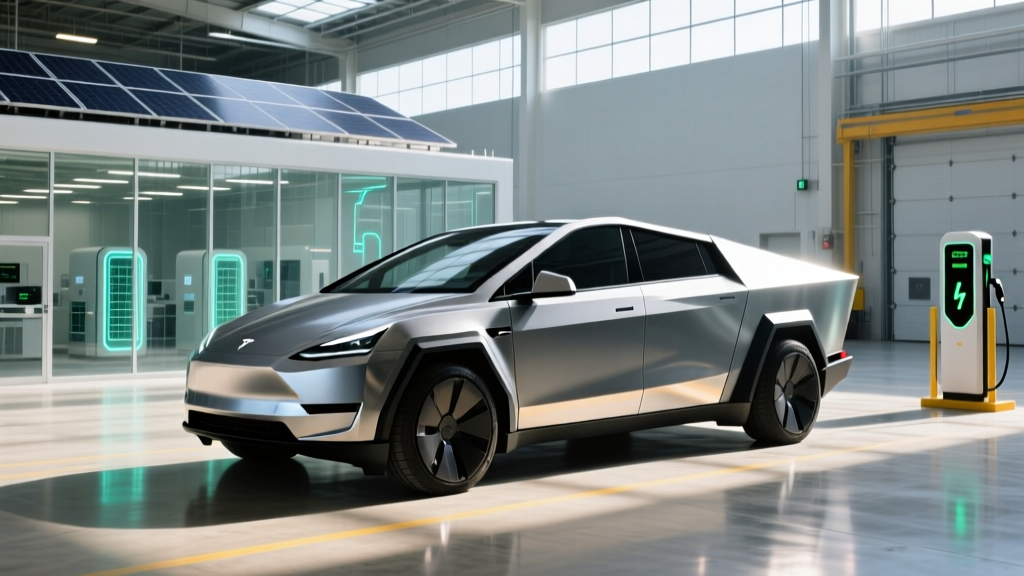
The Cybertruck is built exclusively at Gigafactory Texas, making it the most direct product of the Austin expansion. The Dual Motor AWD is the volume trim; the tri-motor Cyberbeast sits above it for performance seekers.
| Specification | Value |
|---|---|
| EPA Estimated Range | 318 miles (with range extender: est. 340+ mi) |
| Battery Capacity (usable) | ~123 kWh (4680 cells, NMC chemistry) |
| Drivetrain | Dual Motor AWD |
| Horsepower | 600 hp (combined) |
| 0–60 mph | 3.9 seconds |
| Efficiency | 76 MPGe combined / 45 kWh/100 mi (est.) |
| Max DC Fast Charge Rate | 350 kW (peak, architecture-capable) |
| 10–80% DC Fast Charge Time | ~22 minutes (preconditioned) |
| Level 2 Home Charge Rate | 11.5 kW (~30 mi/hr) |
| Bed Length | 72 inches (6 ft) |
| Cargo Volume (bed + vault) | ~74 cu ft total |
| Towing Capacity | 7,500 lbs |
| Battery/Drive Unit Warranty | 8 years / 150,000 miles |
| Base MSRP | $79,990 |
Real-World Range: The Cybertruck Reality
The EPA's 318-mile estimate for the Dual Motor assumes moderate driving. The Cybertruck's stainless-steel exoskeleton is aerodynamically penalized — expect 250–275 miles at sustained highway speeds of 70–80 mph, and significantly less (potentially 200–220 miles) when towing near its 7,500-lb capacity. Cold weather compounds this further. The optional bed-mounted range extender (a gasoline generator) adds estimated 20+ miles but negates the zero-tailpipe-emission benefit. Buyers prioritizing range should look carefully at this trade-off.
Federal Tax Credit Eligibility: What the IRS §30D Rules Mean in 2026
Tax credit eligibility under IRS §30D is one of the most consequential — and most misunderstood — factors in EV purchasing. Here's how the 2026 Model Y and Cybertruck stack up:
| Requirement | Model Y Long Range | Cybertruck Dual Motor |
|---|---|---|
| MSRP Cap (SUVs/Trucks: $80,000) | $44,990 ✓ Passes | $79,990 ✓ Passes (narrowly) |
| Buyer Income Cap (Joint: $300k / Single: $150k AGI) | Buyer-dependent | Buyer-dependent |
| Battery Component Manufacturing (N. America) | Austin-built ✓ Likely qualifies | Austin-built ✓ Likely qualifies |
| Critical Minerals Sourcing | Subject to annual threshold updates | Subject to annual threshold updates |
| Max Potential Credit | $7,500 | $7,500 |
| Point-of-Sale Transfer Available | Yes (dealer/manufacturer must participate) | Yes (Tesla direct sale) |
Critical caveats: The $7,500 credit splits into two $3,750 halves — one for battery component North American manufacturing, one for critical minerals sourcing from FTA-partner countries. The critical-minerals threshold tightens annually, and eligibility can change mid-year. Always verify current status at fueleconomy.gov before purchasing. Income caps are strict: modified AGI above $300,000 (joint) or $150,000 (single) disqualifies the buyer entirely. Consult a tax professional for your specific situation.
How the Austin Expansion Changes the Competitive Landscape
The Austin expansion hasn't happened in a vacuum. Here's how the Model Y and Cybertruck stack up against their most relevant 2026 competitors:
Model Y vs. the Compact Electric SUV Field
The Model Y Long Range at ~$44,990 (potentially ~$37,490 after the full $7,500 credit) competes against the Hyundai Ioniq 5 ($42,900 base), Ford Mustang Mach-E Extended Range ($45,995), and the refreshed Chevrolet Equinox EV ($33,000 base, lower range). The Model Y wins on Supercharger network access (still the most reliable DC fast-charging ecosystem), cargo versatility, and software maturity. It loses to the Ioniq 5 on 800V charging architecture (Ioniq 5 can sustain higher charge rates longer) and to the Equinox EV on base pricing.
Cybertruck vs. Electric Pickup Rivals
At $79,990, the Cybertruck Dual Motor sits in a sparse field. The Ford F-150 Lightning Lariat (~$69,995) undercuts it on price and offers a more conventional truck experience with a larger front trunk (frunk). The Rivian R1T Dual Motor (~$75,900) offers superior off-road capability and a more refined interior. The Cybertruck's advantages are its polarizing design cachet, 4680 battery architecture, and Tesla's Supercharger network for towing-oriented road trips — though range loss while towing remains a serious practical limitation for all electric pickups.
Model Y Long Range — Pros
- Best-in-class Supercharger network access
- Excellent cargo space (72 cu ft max)
- Strong efficiency (122 MPGe)
- Over-the-air updates keep software current
- Austin production = shorter delivery waits
Model Y Long Range — Cons
- No 800V architecture (charge taper above 50% SoC)
- Minimalist interior isn't for everyone
- FSD subscription cost adds up
- Insurance premiums above segment average
- Ride quality firm on rough pavement
Cybertruck Dual Motor — Pros
- 600 hp with 3.9-second 0–60
- 7,500-lb towing capacity
- Stainless steel body resists dents and corrosion
- 350 kW peak DC charging architecture
- Exclusive Austin-built, high production availability
Cybertruck Dual Motor — Cons
- Real-world range significantly below EPA, especially towing
- $79,990 MSRP is steep for a truck
- Polarizing design limits resale predictability
- Large footprint challenging in tight urban spaces
- Bed access via tonneau can be cumbersome
Who Should Buy — and Who Should Look Elsewhere
Choose the Model Y Long Range if:
- You want a versatile electric family SUV with 300+ mile range and road-trip-ready charging
- Supercharger network reliability is a priority for your driving patterns
- You value cargo space and efficiency equally
- Your household income qualifies for the §30D credit, bringing effective price below $38,000
Choose the Cybertruck Dual Motor if:
- You need a genuine work-capable electric truck with 7,500-lb towing
- You want the 4680 battery architecture and are willing to accept range trade-offs for the form factor
- Design exclusivity and performance are non-negotiable
- You have home Level 2 charging and primarily drive within ~200 miles of home
Look elsewhere if:
- You need maximum highway range — consider the Lucid Gravity or Hyundai Ioniq 5 Long Range
- You tow frequently over long distances — current EV pickups lose 30–50% range while towing
- You prefer a traditional interior with physical buttons — the Chevrolet Equinox EV or Ford Mach-E may suit better
Frequently Asked Questions
What is the real-world range of the 2026 Tesla Model Y?
The EPA estimates 320 miles for the Long Range AWD. Real-world highway driving at 70–75 mph typically yields 275–295 miles. In freezing temperatures, expect 240–260 miles. City driving with regenerative braking in mild weather can approach or slightly exceed the EPA figure.
How fast does the Model Y charge at home and on the road?
On a DC fast charger, the Model Y peaks at 250 kW and charges from 10–80% in approximately 25 minutes when preconditioned. At home on a Level 2 Tesla Wall Connector (11.5 kW), it recovers about 44 miles of range per hour — a full charge takes roughly 8 hours overnight.
Does the Cybertruck qualify for the $7,500 federal EV tax credit?
The Cybertruck Dual Motor at $79,990 passes the $80,000 MSRP cap for trucks/SUVs. However, full credit eligibility depends on the buyer's income (under $300,000 joint / $150,000 single AGI) and current-year battery sourcing requirements under IRS §30D rules. The critical-minerals sourcing threshold tightens annually — verify at fueleconomy.gov before ordering.
Is the Model Y still worth buying versus the Hyundai Ioniq 5 or Ford Mach-E?
The Model Y wins on Supercharger access, cargo versatility, and software. The Ioniq 5 has a superior 800V charging architecture (faster sustained DC charging) and a more distinctive interior. The Mach-E offers a more traditional driving feel. If you road-trip frequently, the Supercharger advantage remains significant. If you primarily charge at home and want faster public charging sessions, the Ioniq 5 is a strong alternative.
What are the biggest drawbacks of the Cybertruck?
Real-world range falls well short of the EPA estimate, especially at highway speeds and while towing. The $79,990 starting price is steep. The angular design creates wind noise at speed and limits rear visibility. The polarizing aesthetic also makes long-term resale value harder to predict compared to conventional trucks.
Does the Tesla Austin expansion affect vehicle quality?
Early Austin-built Model Y units (2022–2023) had fit-and-finish inconsistencies typical of new production lines. By 2026, panel gaps, paint quality, and interior assembly have improved substantially based on owner reports and third-party quality surveys. The Cybertruck's stainless-steel body panels, while dent-resistant, can show fingerprint smudges and require specific cleaning products.
How long will the Tesla battery last?
Tesla warrants the Model Y battery for 8 years or 120,000 miles (whichever comes first) with a minimum 70% capacity retention. The Cybertruck warranty extends to 8 years / 150,000 miles. Real-world degradation data from Tesla's fleet suggests NMC packs lose roughly 10–12% capacity over the first 100,000 miles, then degrade more slowly. The 4680 cells in Austin-built vehicles are newer and long-term data is still accumulating, but early indicators show comparable or slightly improved longevity versus 2170 cells.
Final Assessment
The Tesla Austin expansion has done what it set out to do: make the Model Y more available and the Cybertruck more than a low-volume halo product. For the Model Y Long Range AWD buyer, the result is a mature, efficient, well-supported electric SUV at a competitive effective price — especially after the federal tax credit. For the Cybertruck buyer, it's a capable, fast, and genuinely functional electric truck, provided you accept its range compromises and premium price.
Neither vehicle is the right choice for every buyer. But for the use cases they target, the Austin-built 2026 lineup is more accessible, more refined, and more competitively priced than at any point in Tesla's history. Verify your tax credit eligibility, test drive both, and make your decision on data — not headlines.