Quick Verdict: The MX-30 Is an Honest City EV — Nothing More
The Mazda MX-30 has always been the EV that apologizes for itself before you even turn the key. For 2026, Mazda continues to sell the MX-30 exclusively in California and a handful of ZEV-mandate states, and the formula hasn't changed: a 35.5 kWh battery, roughly 100 miles of EPA-estimated range, and a starting price that undercuts nearly every crossover in the segment. If you're a two-car household looking for a stylish, well-built grocery getter that charges overnight on a standard outlet, the MX-30 has a narrow but defensible niche. If you need highway range, fast road-trip charging, or all-wheel drive, keep shopping.
This review covers the 2026 Mazda MX-30 in detail — real-world range, DC fast-charging behavior, home charging economics, tax-credit eligibility under current IRS §30D rules, and a head-to-head look at the competitors that make this one of the toughest recommendations in the EV market.
Range and Efficiency: 100 Miles on Paper, Less in Practice
Real-World Expectation: 75–90 miles on the highway at 70 mph; 85–100 miles in mixed city/suburban driving. In freezing weather (below 32°F), expect 60–75 miles without preconditioning.
Efficiency: 108 MPGe combined (31 kWh/100 mi) per fueleconomy.gov.
The 100-mile EPA figure has been the MX-30's albatross since the 2022 U.S. launch, and for 2026 it remains unchanged. Mazda has not upgraded the battery pack. The 35.5 kWh gross capacity (approximately 32 kWh usable) uses NMC (nickel-manganese-cobalt) lithium-ion cells supplied by Panasonic. Mazda deliberately chose a small pack to keep weight, cost, and lifecycle carbon emissions low — a philosophy that makes environmental sense but practical sense only for specific buyers.
In real-world testing, the MX-30's efficiency is respectable for a small crossover: around 3.0–3.3 mi/kWh in moderate temperatures on surface streets. Highway driving at 70+ mph drops that to roughly 2.5–2.7 mi/kWh, which is where the 100-mile sticker starts to feel optimistic. Cold weather compounds the issue — the MX-30 uses a resistive heater rather than a heat pump, so cabin warmth draws directly from an already small battery. Plan on 20–25% range loss in sub-freezing conditions unless you precondition the cabin while still plugged in.
For a 30-mile round-trip commute with home charging, the range is sufficient. For anything beyond that, you'll be watching the state-of-charge meter with increasing urgency.
Charging Speed: Where the Small Battery Both Helps and Hurts
| Charging Level | Power | Time / Rate | Connector |
|---|---|---|---|
| Level 1 (120V household) | ~1.2 kW | ~24–28 hours (0–100%); ~3–4 mi/hr | J1772 |
| Level 2 (240V home/public) | 7.2 kW (max onboard) | ~4.5 hours (0–100%); ~22 mi/hr | J1772 |
| DC Fast Charge | 50 kW peak | ~36 min (10–80%); ~1.2 mi/min | CCS1 |
The MX-30's 50 kW DC fast-charge peak is the lowest in its class. Most 2026 competitors accept 150–250 kW. The small battery does mean the absolute charging time isn't catastrophic — 36 minutes from 10–80% is tolerable for an occasional highway stop — but the taper curve is aggressive. You'll see close to 50 kW only between roughly 10–40% state of charge; above 60%, the rate drops below 30 kW, and above 80% it slows to single digits. This is standard lithium-ion charge-curve physics, but it's more noticeable on a pack this small because you need every electron.
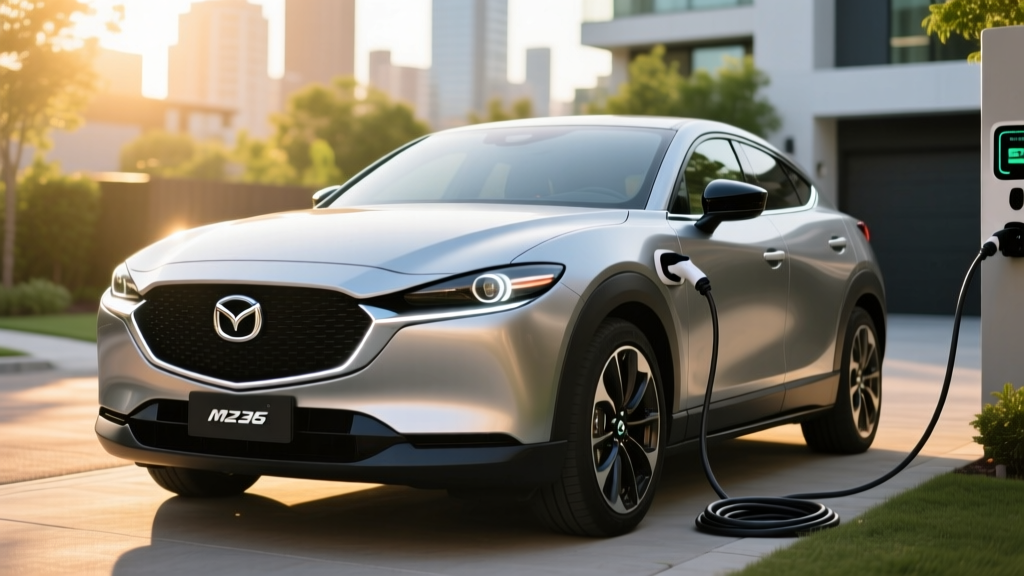
Level 2 home charging at 7.2 kW is the MX-30's sweet spot. A full charge takes about 4.5 hours, meaning you can plug in after work and wake up to a full battery every morning. The 7.2 kW onboard charger means there's no benefit to installing a 48-amp (11.5 kW) hardwired wallbox — a 32-amp circuit on a 40-amp breaker is the practical maximum, which simplifies and reduces installation cost. Most licensed electricians can install a 240V/40A circuit for $500–$1,200 depending on panel proximity and conduit runs.
Level 1 trickle charging from a standard 120V outlet adds about 3–4 miles of range per hour. That's enough to fully replenish the MX-30 overnight if your daily drive is under 30 miles — a scenario where the MX-30 actually works without any dedicated charging infrastructure.
Performance and Drivetrain: Adequate, Not Athletic
| Specification | 2026 Mazda MX-30 |
|---|---|
| Drivetrain | FWD (single motor) |
| Horsepower | 143 hp |
| Torque | 200 lb-ft |
| 0–60 mph | ~8.7 seconds |
| Battery (gross / usable) | 35.5 kWh / ~32 kWh |
| Battery Chemistry | NMC (nickel-manganese-cobalt) |
| EPA Range | 100 miles |
| MPGe (city / hwy / combined) | 116 / 99 / 108 |
| Curb Weight | ~3,835 lbs |
| Towing Capacity | Not rated |
The MX-30's 143-hp e-SKYACTIV motor and front-wheel-drive layout produce adequate around-town acceleration. The 8.7-second 0–60 time feels leisurely compared to the Hyundai Kona Electric (6.9 seconds) or the Nissan LEAF (6.9 seconds with the larger pack), but the instant torque delivery makes stoplight-to-stoplight city driving feel peppy enough. Highway merging requires planning — this is not a car that surges past 80 mph with confidence.
Mazda tuned the regenerative braking to offer adjustable levels via steering-wheel paddles, but the maximum regen isn't strong enough for true one-pedal driving. You'll still use the friction brake pedal regularly. The ride quality, however, is a Mazda hallmark — well-damped, composed over rough pavement, and quieter than most sub-$35,000 EVs. The steering is precise if numb. It's the best-driving EV in its price bracket, even if it's not the quickest.
Interior, Tech, and Cargo: Premium Touches, Tight Quarters
The MX-30's cabin is where Mazda's "right-sized EV" philosophy shines and falters simultaneously. The floating center console, cork-trimmed door panels (a nod to Mazda's origins as a cork manufacturer), and vegan leather upholstery feel a class above the price. The 8.8-inch infotainment display uses a rotary dial controller rather than a touchscreen — a love-it-or-hate-it choice that keeps your eyes higher on the dash but frustrates anyone accustomed to pinch-to-zoom map navigation.
Standard driver-assistance features include Mazda's i-Activsense suite: adaptive cruise control with stop-and-go, lane-keep assist, blind-spot monitoring, and rear cross-traffic alert. This is a solid SAE Level 1 system — it assists with steering and speed but requires full driver engagement at all times. There is no hands-free driving mode, and Mazda does not offer an Autopilot-style lane-centering subscription.
Where the MX-30 suffers is space. Rear-seat legroom is 33.1 inches — tight for adults on anything beyond a short ride. Cargo volume behind the rear seats is just 21.0 cubic feet, shrinking to roughly 35 cubic feet with the rear seats folded. Compare that to the Hyundai Kona Electric at 25.8 cu ft (cargo) or the Chevrolet Equinox EV at 26.4 cu ft, and the MX-30's crossover credentials look more like a tall hatchback.
The rear-hinged "freestyle" rear doors (similar to the old BMW i3) look dramatic but create an awkward entry sequence — you must open the front door first, then the rear half-door. It's a conversation starter at the grocery store and a daily annoyance in tight parking spots.
Pricing, Trims, and Federal Tax Credit Eligibility
| Trim | Base MSRP | Est. After §30D Credit* | Key Additions |
|---|---|---|---|
| Base | ~$32,550 | ~$25,050 | 8.8" display, i-Activsense, heated seats, 18" wheels |
| Premium Plus | ~$37,550 | ~$30,050 | Bose 12-speaker audio, sunroof, power seat, surround camera |
*Tax credit estimates assume full eligibility under IRS §30D rules. Actual credit depends on battery-sourcing compliance, buyer income limits, and MSRP caps. Consult a tax professional.
The 2026 MX-30's pricing has remained relatively stable. The Base trim at approximately $32,550 (including destination) is one of the most affordable new EVs available in the U.S. market. The Premium Plus trim at roughly $37,550 adds genuinely nice-to-have features but pushes the price into territory where competitors offer significantly more range.
- MSRP Cap: The MX-30 qualifies — it's an SUV/crossover under the $80,000 cap.
- Buyer Income Cap: AGI must not exceed $150,000 (single), $225,000 (head of household), or $300,000 (joint filers).
- Battery Sourcing: The MX-30's Panasonic NMC cells and critical-mineral supply chain must meet 2026 thresholds for North American or FTA-partner sourcing. Mazda has historically qualified for the full $7,500, but annual sourcing requirements tighten. Verify current-year eligibility at IRS.gov before purchase.
- Point-of-Sale Transfer: Buyers can transfer the credit to the dealer at purchase, reducing the out-of-pocket price directly rather than waiting for a tax refund.
At $25,050 after the full credit, the Base MX-30 is remarkably affordable — cheaper than many gasoline subcompacts after incentives. But the value proposition only holds if the range fits your life.
Warranty and Long-Term Battery Outlook
Mazda provides a 3-year/36,000-mile limited vehicle warranty and a 5-year/60,000-mile powertrain warranty. The high-voltage battery is covered for 8 years/100,000 miles against defects and excessive capacity loss (typically defined as dropping below 70% state of health). This is the industry-standard federal minimum for emissions-related components and aligns with competitors like Hyundai (which offers 10yr/100,000mi) and Nissan.
The 35.5 kWh NMC pack is small, which means fewer cells and potentially lower replacement cost if a failure occurs outside warranty. Industry estimates place a full MX-30 battery replacement in the $6,000–$9,000 range, though actual out-of-warranty replacements have been rare given the vehicle's limited U.S. sales volume. NMC chemistry typically degrades 1.5–2.5% per year under normal use — expect roughly 85–90% capacity retention after 8 years, which on a 100-mile-range car means 85–90 miles of practical range.
Competitor Comparison: How the MX-30 Stacks Up
| Spec | 2026 Mazda MX-30 | 2026 Hyundai Kona Electric | 2026 Nissan LEAF SV Plus |
|---|---|---|---|
| EPA Range | 100 mi | 261 mi | 212 mi |
| Battery (usable) | ~32 kWh | ~64 kWh | ~59 kWh |
| DC Fast Charge Peak | 50 kW | 100+ kW | 100 kW (CHAdeMO) |
| 0–60 mph | 8.7 sec | 6.9 sec | 6.9 sec |
| Horsepower | 143 hp | 201 hp | 214 hp |
| Base MSRP | ~$32,550 | ~$34,000 | ~$37,000 |
| Cargo Volume | 21.0 cu ft | 25.8 cu ft | 23.6 cu ft |
| Drivetrain | FWD | FWD | FWD |
The comparison is stark. For $1,500 more before incentives, the Kona Electric delivers 2.6× the range and double the DC fast-charge speed. The LEAF, despite its aging CHAdeMO connector (an increasing liability as CCS and NACS dominate public charging), still offers 212 miles. The MX-30's only advantages are its slightly lower base price, its premium interior materials, and its lower curb weight.
If your priority is range-per-dollar, the MX-30 loses this comparison decisively. If your priority is build quality, design, and city-driving refinement in a package you'll rarely drive beyond 40 miles, the MX-30 makes a more emotional case.
Pros, Cons, and Who Should Buy the MX-30
- Lowest entry price in the new-EV market (especially after §30D credit)
- Premium interior materials and build quality
- Composed ride and handling for the segment
- Small battery charges fully overnight on Level 1 (120V) for short commutes
- Comprehensive i-Activsense driver-assist suite standard
- Distinctive design — rear freestyle doors and cork accents
- 100-mile EPA range is the lowest of any new EV sold in the U.S.
- 50 kW DC fast-charging is painfully slow for road trips
- Tight rear-seat legroom and below-average cargo space
- No heat pump — cold-weather range loss is significant
- Non-touchscreen infotainment frustrates some users
- Limited availability — sold only in select states
- You have reliable home charging (Level 1 or Level 2)
- Your daily driving is under 40 miles round-trip
- You're a two-car household and this is the "around-town" vehicle
- You value interior quality and driving dynamics over range
- You qualify for the full $7,500 federal tax credit
- You need 200+ miles of range for highway commuting or road trips
- You live in an apartment without charging access
- You regularly carry rear-seat passengers
- You live in a cold climate and can't precondition at home
- This is your only car
Frequently Asked Questions
What is the real-world range of the 2026 Mazda MX-30?
The EPA rates the MX-30 at 100 miles. In real-world mixed driving at moderate temperatures, expect 85–100 miles. Highway driving at 70+ mph reduces that to roughly 75–90 miles. In freezing weather without preconditioning, plan for 60–75 miles. The small battery leaves very little buffer for detours or climate-control demand.
How fast does the MX-30 charge at home and on DC fast chargers?
On a 240V Level 2 home charger, the MX-30 charges at up to 7.2 kW, reaching a full charge in about 4.5 hours. On DC fast chargers, it peaks at 50 kW — a 10–80% session takes approximately 36 minutes. This is the slowest DC charging in the current EV market; most competitors charge 2–4× faster.
Does the 2026 Mazda MX-30 qualify for the $7,500 federal EV tax credit?
The MX-30 has historically qualified for the full $7,500 under IRS §30D, but eligibility depends on current-year battery-sourcing requirements, buyer income (AGI caps of $150K/$225K/$300K), and the $80,000 MSRP cap for SUVs. The credit can be transferred to the dealer at point of sale. Always verify eligibility on IRS.gov and with your tax professional before purchasing.
Is the Mazda MX-30 worth buying over the Hyundai Kona Electric or Nissan LEAF?
For most buyers, no. The Kona Electric costs only ~$1,500 more before incentives and delivers 261 miles of range with faster DC charging. The MX-30 makes sense only if your daily driving is short, you prioritize interior quality and driving refinement, and you want the lowest possible purchase price after tax credits. It's a niche car for a niche use case.
What are the biggest drawbacks of owning the MX-30?
Range is the dominant concern — 100 miles EPA means range planning is a daily reality, not an occasional inconvenience. The 50 kW DC fast-charging speed makes road trips impractical. Rear-seat space is cramped. The lack of a heat pump means significant winter range loss. And availability is limited to California and a few ZEV-mandate states.
Can I charge the MX-30 on a regular 120V outlet?
Yes. At roughly 3–4 miles of range per hour on Level 1, a 12-hour overnight charge adds 36–48 miles — enough for many commuters. The MX-30's small battery is actually an advantage here: it's one of the few EVs that can realistically be maintained on a standard household outlet if your daily mileage is low.