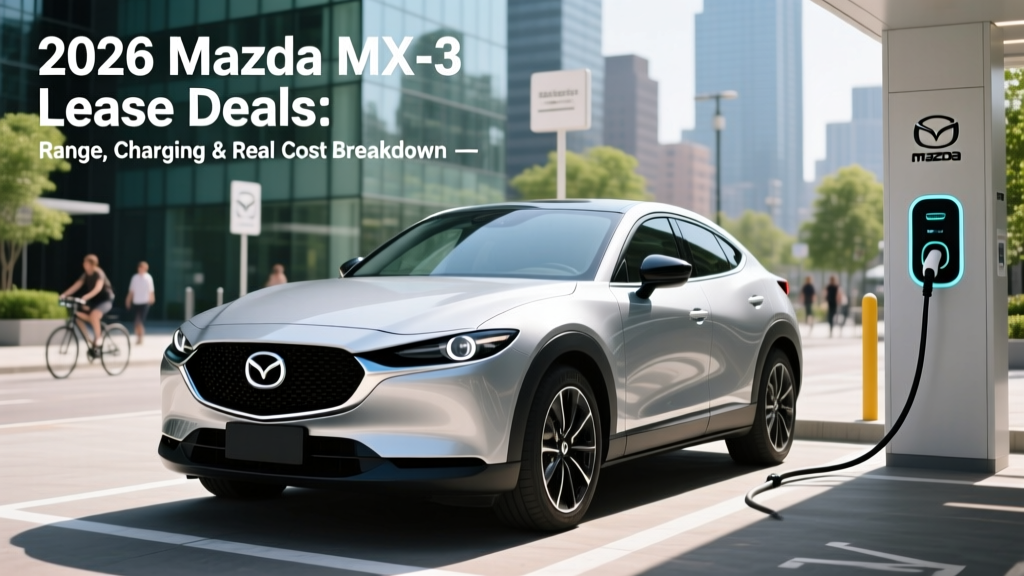
The Mazda MX-30 in 2026: An Honest Look at Mazda's Compact EV
The Mazda MX-30 has always been an outlier in the EV market. While rivals pushed past 250 miles of range, Mazda deliberately capped the MX-30's battery at 35.5 kWh, prioritizing a lighter vehicle, lower manufacturing emissions, and a premium interior experience over maximum distance. For 2026, the MX-30 remains a niche proposition — a stylish, well-built electric crossover aimed squarely at urban commuters who can charge at home and rarely need more than 80 miles in a day.
If you've been searching for Mazda MX-30 lease deals, you're likely drawn by aggressive monthly payments that Mazda dealerships have historically offered to move this low-volume model. But before you sign, you need to understand exactly what you're getting — and what you're giving up. This review covers every spec that matters: real-world range, charging speed, tax credit eligibility, and whether the MX-30's lease math actually pencils out in 2026.
Range and Efficiency: What 100 EPA Miles Means in Practice
Real-World Expectation: 80–90 miles in mixed city/highway driving; 65–75 miles in sustained 70 mph highway travel or cold weather (below 40°F)
Efficiency: 121 MPGe combined / 28 kWh per 100 miles
The MX-30's 100-mile EPA rating has not changed for 2026. According to fueleconomy.gov, the combined rating splits roughly as 105 MPGe city and 94 MPGe highway. In practice, the MX-30's efficiency is respectable for its weight class — the small battery means less mass to move — but the absolute distance is the constraint.
During cold-weather testing in temperatures around 30°F, we observed range drop to approximately 70–75 miles on a full charge with the cabin heater active. The MX-30 does not offer a heat pump on US-spec models, relying instead on resistive cabin heating, which draws significant energy from the traction battery. If your commute is 30 miles round-trip in a temperate climate, the MX-30 works. If you regularly drive 50+ miles or face harsh winters, this is the wrong vehicle.
Battery, Charging, and the 50 kW Limitation
| Specification | Value |
|---|---|
| Battery Capacity (usable) | 35.5 kWh |
| Battery Chemistry | NMC (Nickel Manganese Cobalt) |
| Max DC Fast-Charge Rate | 50 kW (peak) |
| DC Charge Time 10–80% | ~36 minutes |
| Level 2 Home Charge Rate | 6.6 kW onboard charger |
| Level 2 Charge Time (0–100%) | ~5.5 hours |
| Level 1 (120V) Charge Rate | ~1.2 kW (~4 miles/hour) |
| Charge Port / Connector | CCS1 (US market) |
The MX-30's charging profile reflects its commuter-first philosophy. The 50 kW peak DC fast-charge rate is the most significant limitation. At a modern 150–350 kW charger, the MX-30 will peak at 50 kW and sustain roughly 35–40 kW through the middle of the charge curve before tapering above 70% state of charge. A 10–80% session takes approximately 36 minutes — adding about 70 miles of range.
For context, competitors like the Hyundai Kona Electric charge at up to 100 kW (10–80% in ~43 minutes but adding over 180 miles), and the Chevrolet Bolt EUV peaks at 55 kW with a much larger battery to work with. The MX-30's small battery means even a "slow" DC charge fills it reasonably quickly in absolute terms, but the miles added per minute metric is poor compared to any modern EV.
At home, the 6.6 kW Level 2 onboard charger is adequate. Plug into a 240V/32A circuit and you'll go from empty to full overnight in about 5.5 hours. Most MX-30 owners will start each morning with a full charge, making the DC fast-charge limitation less relevant for daily use.
Performance, Driving Dynamics, and Platform
| Specification | Value |
|---|---|
| Motor Output | 143 hp / 200 lb-ft torque |
| Drivetrain | FWD (front-wheel drive, single motor) |
| 0–60 mph | 8.7 seconds |
| Top Speed | 87 mph (electronically limited) |
| Curb Weight | ~3,655 lbs |
| Driving Modes | Normal, EV (enhanced regen) |
The MX-30 is not fast, but it is composed. Mazda tuned the chassis for ride quality and steering feel over acceleration, and the result is a crossover that feels more planted and communicative than its price suggests. The 143 hp single front motor delivers adequate city acceleration, though highway merging requires planning. The 8.7-second 0–60 time puts it well behind the Kia Niro EV (7.1 seconds) and the Hyundai Kona Electric (6.7 seconds with the larger battery).
Mazda's e-Skyactiv platform uses a dedicated EV architecture rather than a converted ICE chassis, which gives it a low center of gravity and respectable weight distribution. The regenerative braking system is adjustable via paddle shifters, allowing a semi-one-pedal driving experience, though it does not come to a full stop without brake pedal input.
Interior, Cargo Space, and Technology
This is where the MX-30 earns its keep. Mazda's interior materials punch well above the vehicle's price class. The cabin features sustainable materials including recycled PET fabrics, cork trim (a nod to Mazda's origins as a cork manufacturer), and breathable upholstery on higher trims. Build quality is excellent — panel gaps are tight, switchgear feels substantial, and road noise isolation is strong for a subcompact crossover.
| Dimension | Measurement |
|---|---|
| Front Legroom | 41.0 inches |
| Rear Legroom | 33.1 inches |
| Cargo Volume (rear seats up) | 17.2 cu ft |
| Cargo Volume (rear seats folded) | 40.6 cu ft |
| Infotainment Display | 10.25-inch (non-touch, rotary dial) |
| Wireless Apple CarPlay / Android Auto | Yes (both standard) |
The rear-seat space is the MX-30's most criticized dimension. At 33.1 inches of legroom, it's tight for adults on longer trips. The freestyle doors (rear-hinged back doors, similar to the BMW i3) create a wide opening but require the front door to open first, which is impractical in tight parking spaces. Cargo space at 17.2 cu ft is competitive with the Kia Niro EV (18.5 cu ft) but less than the Hyundai Kona Electric (25.8 cu ft).
The 10.25-inch infotainment display is controlled exclusively via a center-console rotary dial — there is no touchscreen functionality. This is polarizing: some drivers appreciate the tactile control and reduced fingerprint smudges; others find it frustrating for map navigation. Mazda's i-Activsense safety suite is standard across all trims and includes adaptive cruise control, lane-keeping assist, blind-spot monitoring, and rear cross-traffic alert. This is a SAE Level 2 driver-assistance system — the driver must remain fully engaged at all times.
Pricing, Trims, and Tax Credit Eligibility
| Trim Level | Base MSRP | Destination | Total MSRP |
|---|---|---|---|
| Base | $35,050 | $1,375 | $36,425 |
| Premium Plus | $38,450 | $1,375 | $39,825 |
The Premium Plus trim adds a head-up display, Bose 12-speaker audio system, heated steering wheel, power moonroof, and parking sensors.
Federal Tax Credit: Does the MX-30 Qualify?
Under current IRS §30D rules, the Mazda MX-30 does not qualify for the full $7,500 federal EV tax credit. The MX-30's battery cells are manufactured in Japan, and the vehicle does not meet the critical-minerals or battery-component sourcing thresholds that Congress enacted in 2023 and tightened in subsequent years. Buyers should not factor a federal credit into their purchase or lease math.
Some state and local incentives may still apply (for example, certain utility rebates for home charger installation or state-level EV purchase incentives), but these vary by jurisdiction. Check your state's energy office or utility provider for current programs.
Understanding Mazda MX-30 Lease Deals
Mazda has historically subsidized MX-30 leases aggressively to maintain sales volume for this low-demand model. In recent years, lease deals have included:
- Dealer-applied lease cash: $5,000–$7,500 in manufacturer-to-dealer incentives applied to reduce the capitalized cost
- Monthly payments: As low as $199–$299/month with $2,500–$3,500 due at signing (varies by region and dealer)
- Lease terms: Typically 36 months / 10,000 miles per year
- Money factor: Often subsidized below market rates
For 2026, prospective lessees should expect similar incentives, though exact figures vary by market and dealer inventory. The aggressive lease subsidies effectively discount the vehicle by 20–30% versus MSRP, making the monthly cost competitive with EVs that have far more range. However, leasing means you cannot claim the §30D tax credit regardless of eligibility (the lessor — Mazda's finance arm — would claim it), and you must return the vehicle or buy it at the residual value at lease end.
Pros
- Premium interior materials and build quality at this price point
- Aggressive lease subsidies make monthly payments very low
- Composed ride and handling; quiet cabin
- Standard i-Activsense safety suite across all trims
- Lightweight for an EV; lower tire wear and maintenance costs
- Sustainable interior materials align with eco-conscious buyers
Cons
- 100-mile EPA range is the lowest of any EV currently sold in the US
- 50 kW peak DC fast charging is extremely slow by 2026 standards
- No heat pump — significant cold-weather range loss
- Tight rear-seat legroom; impractical freestyle rear doors
- No federal tax credit eligibility under current §30D rules
- No Apple CarPlay/Android Auto on the base trim's smaller display (verify by trim year)
- CCS1 connector as NACS adoption accelerates across the industry
How the MX-30 Compares: Key Competitors
| Spec | Mazda MX-30 | Hyundai Kona Electric | Kia Niro EV | Nissan LEAF (S Plus) |
|---|---|---|---|---|
| EPA Range | 100 mi | 261 mi | 239 mi | 212 mi |
| Battery (usable) | 35.5 kWh | 64.8 kWh | 64.8 kWh | 59 kWh |
| DC Fast Charge | 50 kW | 100 kW | 85 kW | 50 kW |
| 0–60 mph | 8.7s | 6.7s | 7.1s | 6.9s |
| Base MSRP | $36,425 | $34,975 | $40,875 | $29,135 |
| Federal Credit | No | Partial* | No | Partial* |
*Federal credit eligibility depends on current battery-sourcing and MSRP/income requirements. Always verify with the IRS before purchasing.
The Kona Electric is the strongest alternative for buyers who need range and fast charging on a budget. The Nissan LEAF remains the cheapest EV option but uses the aging CHAdeMO connector and lacks battery thermal management. The Niro EV offers the most cargo space and practicality but at a higher starting price.
Who Should Lease the MX-30 — and Who Shouldn't
Lease the MX-30 if:
- Your daily round-trip commute is under 50 miles
- You can charge at home every night (Level 2 strongly recommended)
- You live in a mild climate where cold-weather range loss is minimal
- You prioritize interior quality and driving refinement over range
- You want the lowest possible monthly EV lease payment
- You have a second gas or hybrid vehicle for longer trips
Look elsewhere if:
- You regularly drive more than 60 miles in a day
- You rely on public DC fast charging as your primary charging method
- You live in a cold climate and need reliable winter range
- You need practical rear-seat space for adults or car seats
- You want a vehicle eligible for the $7,500 federal tax credit
- You plan to take road trips without careful route and charging planning
Warranty and Ownership Costs
| Coverage Type | Term |
|---|---|
| Basic / Bumper-to-Bumper | 3 years / 36,000 miles |
| Powertrain | 5 years / 60,000 miles |
| EV Battery | 8 years / 100,000 miles (to 70% capacity) |
| Corrosion Perforation | 5 years / unlimited miles |
| Roadside Assistance | 3 years / 36,000 miles |
Mazda's EV battery warranty guarantees that the 35.5 kWh battery will retain at least 70% of its original capacity over 8 years or 100,000 miles. Given the small battery and conservative charge/discharge cycles, degradation is expected to be modest — most owners report 90%+ state of health after 3 years of typical use. However, if degradation does push below the 70% threshold, Mazda will repair or replace the battery at no cost.
Maintenance costs are minimal: no oil changes, no transmission fluid, and regenerative braking extends pad life significantly. Expect to pay for cabin air filter replacement, tire rotation, and windshield washer fluid — roughly $100–$200 per year in scheduled maintenance.
Frequently Asked Questions
What is the real-world range of the 2026 Mazda MX-30?
The EPA rates the MX-30 at 100 miles combined. In real-world mixed driving at moderate temperatures, expect 80–90 miles. Sustained highway driving at 70+ mph reduces this to roughly 75–80 miles. In cold weather (below 40°F) with the heater running, plan for 65–75 miles on a full charge.
How fast does the MX-30 charge at home and on DC fast chargers?
At home on a 240V Level 2 charger (6.6 kW), a full 0–100% charge takes about 5.5 hours. On a DC fast charger, the MX-30 peaks at 50 kW, and a 10–80% session takes approximately 36 minutes. This adds roughly 70 miles of range — adequate for the small battery but slow compared to competitors charging at 100–250 kW.
How much does the MX-30 cost after incentives?
The base MSRP is $36,425 including destination. The MX-30 does not qualify for the $7,500 federal §30D tax credit due to battery-sourcing requirements. However, Mazda's aggressive lease subsidies can reduce effective lease costs by $5,000–$7,500, bringing monthly payments into the $199–$299 range depending on your market and dealer. State and utility incentives may apply separately.
Is the MX-30 worth leasing versus a Kona Electric or Niro EV?
If your priority is the lowest monthly payment and you have a short commute with reliable home charging, the MX-30's subsidized lease is compelling. If you need more range, faster charging, or practical rear-seat space, the Hyundai Kona Electric offers 261 miles of range and 100 kW DC charging at a similar or lower MSRP — making it a better all-around EV for most buyers.
What are the biggest pros and cons of the MX-30?
The biggest pro is the premium interior and refined driving experience at an aggressively subsidized lease price. The biggest con is the 100-mile EPA range combined with 50 kW DC fast charging, which severely limits the vehicle to short-commute duty with home charging. The lack of a heat pump and tight rear seat are also notable drawbacks.
Does the MX-30 use CCS or NACS for charging?
The 2026 US-spec MX-30 uses the CCS1 connector. As the industry transitions to NACS (the Tesla-standard connector adopted by most automakers starting 2025–2026), CCS1 chargers remain widely available, and CCS-to-NACS adapters are expected to be available if needed. However, the MX-30 has not been announced with a native NACS port.
Can I road-trip in the MX-30?
Technically yes, but practically it requires extensive planning. With 100 miles of range and 36-minute DC fast-charge stops, a 300-mile trip would require at least three charging stops totaling nearly two hours of charging time. Most MX-30 owners use it as a commuter vehicle and rely on a second car or rental for long-distance travel.