The Bottom Line on the Mazda MX-30 Electric Vehicle
The Mazda MX-30 EV offers 100 miles of EPA-estimated range from a 35.5 kWh battery, starts around $35,580, and peaks at 50 kW DC fast charging. It qualifies for up to $7,500 in federal tax credits (subject to IRS §30D sourcing and income rules), bringing effective cost near $28,000. However, its short range and slow charging make it viable only as a dedicated city commuter with reliable home charging and a daily round-trip under 50 miles. If that describes your driving, the MX-30 is a refined, affordable urban EV. If you need highway road-trip capability or live in extreme cold, look elsewhere.
Range and Efficiency: The 100-Mile Reality
The Mazda MX-30 electric vehicle carries a compact 35.5 kWh usable battery pack using NMC (nickel-manganese-cobalt) lithium-ion chemistry. The EPA rates it at 100 miles of combined range and 124 MPGe combined (124 city / 104 highway), according to fueleconomy.gov. That efficiency figure is competitive, but the small battery caps how far you can go.
Real-World Range Expectations
| Condition | Estimated Range |
|---|---|
| EPA Combined (sticker) | 100 miles |
| City driving, mild weather | 95–110 miles |
| Highway (70 mph, mild weather) | 75–85 miles |
| Cold weather (below 32°F) | 65–80 miles |
| Cold weather + highway | 55–70 miles |
Lithium-ion batteries lose 15–30% of usable capacity in freezing temperatures because electrochemical reactions slow and cabin heating draws significant power. The MX-30 lacks a heat pump on most trims, relying on resistive heating — a notable efficiency penalty in winter climates. Plan for roughly 70 miles of realistic cold-weather range if you live in the northern U.S.
Charging Speeds: 50 kW Peak and What That Means
Understanding the difference between kW (power — how fast energy flows) and kWh (energy — how much the battery stores) is essential. The MX-30 stores 35.5 kWh and accepts a maximum DC fast-charge rate of 50 kW.
| Charging Level | Power | Time (10–80% SoC) | Miles Added per Hour |
|---|---|---|---|
| Level 1 (120V household) | ~1.2 kW | ~22+ hours (full charge) | ~3–4 mi/hr |
| Level 2 (240V, 32A) | ~7.2 kW | ~4 hours (full charge) | ~22 mi/hr |
| DC Fast Charge (50 kW peak) | 50 kW max | ~36 minutes (10–80%) | ~110 mi/hr (at peak) |
The 50 kW peak rate is modest by 2026 standards — rivals like the Hyundai Kona Electric accept up to 100 kW, and the Chevrolet Bolt EUV managed 55 kW. The MX-30's charge curve tapers significantly above 60% SoC, so the advertised 36-minute 10–80% time assumes ideal battery preconditioning and a compatible 50+ kW charger. Expect closer to 40–45 minutes in practice.
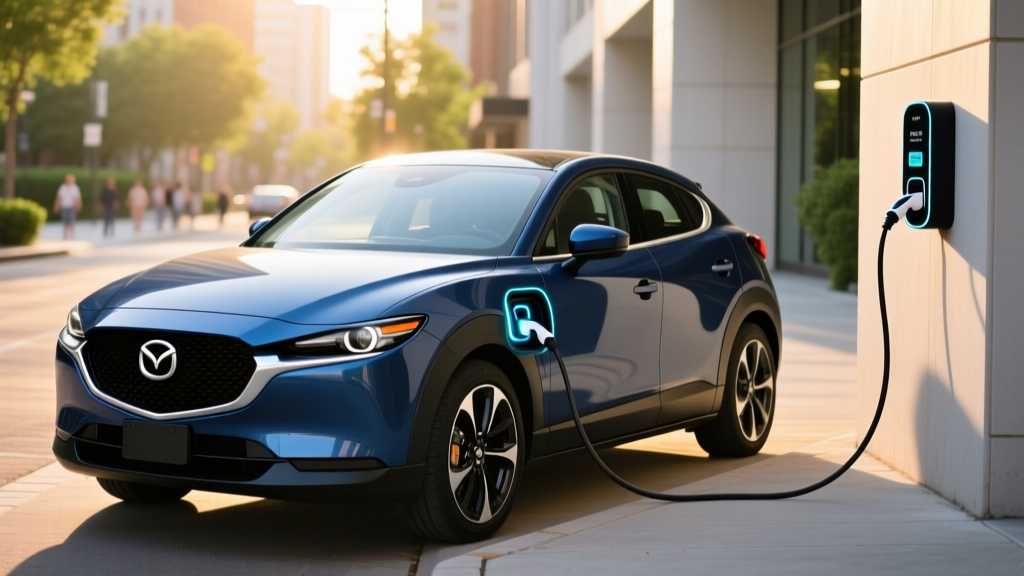
The MX-30 uses the CCS1 connector for DC fast charging (with NACS adapter availability expanding through partnerships). For home Level 2 charging, a standard 240V/32A wall connector will replenish the battery overnight easily — the small battery is actually an advantage here, since a full charge requires relatively little electricity.
Pricing, Tax Credits, and Total Cost of Ownership
For the 2025–2026 model years, the Mazda MX-30 EV starts at approximately $35,580 (including destination) for the base Select trim, with the Premium Plus trim at roughly $39,000. Mazda has limited availability primarily to California and select ZEV-mandate states.
IRS §30D Federal Tax Credit Eligibility
- Credit amount: Up to $7,500 ($3,750 for critical minerals + $3,750 for battery component sourcing)
- MSRP cap: Vehicle must be under $55,000 (sedans/hatchbacks) — MX-30 qualifies
- Buyer income cap: AGI ≤ $150,000 (single) / $300,000 (joint) per IRS guidelines
- Battery sourcing: Critical minerals and component requirements tighten annually; confirm current-year compliance on the IRS qualified vehicles list
- Point-of-sale transfer: Eligible buyers can transfer the credit to the dealer at purchase for an immediate price reduction
Tax credit rules change frequently. Consult a tax professional and verify eligibility at the time of purchase.
| Cost Factor | Mazda MX-30 EV | Mazda CX-30 (Gas AWD) |
|---|---|---|
| Base MSRP | $35,580 | $27,100 |
| Federal tax credit (if eligible) | –$7,500 | $0 |
| Effective purchase price | ~$28,080 | $27,100 |
| Fuel/energy cost (15,000 mi/yr) | ~$540 (electricity) | ~$1,650 (gasoline) |
| Annual maintenance | ~$300 | ~$650 |
| 5-year fuel/energy total | ~$2,700 | ~$8,250 |
| 5-year maintenance total | ~$1,500 | ~$3,250 |
| 5-year total operating cost | ~$4,200 | ~$11,500 |
At $0.14/kWh (national average residential rate) and the MX-30's consumption of roughly 27 kWh/100 mi, annual electricity cost for 15,000 miles of driving is approximately $570. A comparable gas vehicle at 28 MPG combined and $3.10/gallon costs roughly $1,660 per year. Over five years, the MX-30 saves approximately $7,300 in operating costs, largely offsetting any initial price premium — especially when the tax credit applies.
Insurance premiums for the MX-30 tend to run 10–20% higher than comparable gas Mazda models due to EV-specific repair costs and battery replacement considerations. Budget roughly $1,400–$1,800 annually depending on your state and driving record.
Performance, Interior, and Daily Driving
The MX-30's front-mounted electric motor produces 143 horsepower and 200 lb-ft of torque, delivering a 0–60 mph time of approximately 9.0 seconds. That's leisurely by EV standards — the Kona Electric hits 60 in roughly 6.5 seconds — but adequate for city merging and stoplight acceleration. The instant torque delivery makes it feel quicker than the numbers suggest around town.
Inside, Mazda's signature attention to materials stands out: cork-trimmed center console (a nod to Mazda's origins as a cork manufacturer), vegan leather upholstery, and a floating center console design. The 8.8-inch infotainment display uses a rotary dial controller rather than a touchscreen, which some drivers prefer for reduced distraction. Cargo space is modest at approximately 21.0 cubic feet behind the rear seats — comparable to a subcompact crossover.
The rear-hinged "freestyle" rear doors (similar to the old BMW i3) give the MX-30 a distinctive look but limit rear-seat accessibility. This is strictly a four-passenger vehicle, and the rear seats are best suited for children or occasional adult use on short trips.
Battery Longevity and Warranty Coverage
Mazda provides an 8-year / 100,000-mile high-voltage battery warranty (10 years / 150,000 miles in California and CARB-adopting states). The warranty covers battery capacity loss below 70% of original capacity — consistent with industry norms.
With a 35.5 kWh pack, 70% retention means roughly 24.9 kWh of usable capacity, translating to approximately 70 miles of range. For a commuter doing 30–40 miles daily, even a degraded MX-30 battery remains functional for its intended use case years down the line.
Replacement battery costs for the MX-30 are estimated at $8,000–$12,000 out of warranty, though real-world failures within the warranty period are rare. NMC chemistry has demonstrated reliable cycle life when kept between 20–80% SoC for daily use. The MX-30's smaller battery actually experiences shallower depth-of-discharge cycles for typical commutes, which is favorable for long-term health.
Decision Framework: Is the MX-30 Right for You?
Choose the Mazda MX-30 EV If:
- Your daily round-trip commute is under 50 miles
- You have reliable Level 2 home charging (garage or driveway)
- You live in a mild climate or rarely drive in extreme cold
- You want a distinctive, well-built urban EV under $30,000 after credits
- You have a second gas or hybrid vehicle for longer trips
- You prioritize interior quality and design over maximum range
Look Elsewhere If:
- Your daily driving regularly exceeds 60 miles
- You rely exclusively on public DC fast charging (50 kW is slow)
- You live in a region with harsh winters and no garage parking
- You need seating for five or significant cargo space
- You want to take road trips longer than 80 miles one-way
- You live outside California or ZEV-mandate states where the MX-30 is sold
| Common Misconception | Fact |
|---|---|
| "100 miles of range isn't usable" | The average American drives ~37 miles per day (FHWA data). 100 miles covers 90%+ of daily trips with room to spare. |
| "Small batteries degrade faster" | Degradation correlates more with charge habits, temperature, and C-rate than absolute capacity. Shallow daily cycles on a small battery can be gentler than deep cycles on a large one. |
| "The MX-30 qualifies for the full $7,500 credit automatically" | Credit eligibility depends on battery sourcing requirements, buyer income, and current-year IRS rules. Verify on the IRS qualified vehicle list before purchasing. |
| "You can't drive an EV in winter" | You can, but expect 20–30% range loss. With 100 miles EPA, winter range drops to ~70 miles — still viable for short commutes with planning. |
Frequently Asked Questions
Can I use the Mazda MX-30 as my only car?
It depends entirely on your driving patterns. If every trip you make in a typical week is under 50 miles round-trip and you charge at home nightly, yes. But if you regularly drive 80+ miles in a day, take road trips, or lack home charging, the MX-30 should be a second vehicle paired with a gas or hybrid car for longer journeys.
How long does it take to charge the MX-30 at home?
On a Level 2 home charger (240V, 32A delivering ~7.2 kW), a full charge from empty takes roughly 4 hours. Since most owners plug in nightly and rarely deplete the battery fully, expect 2–3 hours to replenish a typical day's 40–50 miles of driving. Level 1 (120V) adds only ~3–4 miles per hour — not practical as a primary charging method unless your daily driving is under 20 miles.
Is the Mazda MX-30 available nationwide?
No. Mazda has restricted the MX-30 EV primarily to California and states that follow California's Zero Emission Vehicle (ZEV) mandate, including Oregon, Washington, New York, New Jersey, Connecticut, and Massachusetts. Availability at dealerships outside these states is extremely limited or nonexistent.
How does the MX-30 compare to the Mazda MX-30 R-EV (range extender)?
Mazda offers a plug-in hybrid range-extender variant (MX-30 R-EV) in some markets with a small rotary engine acting as a generator, extending total range to approximately 370 miles. However, as of 2026, the R-EV is not available in the U.S. market. American buyers can choose only the fully electric version.
What happens if the battery fails out of warranty?
Out-of-warranty battery replacement is estimated at $8,000–$12,000 including parts and labor. However, lithium-ion battery failures are statistically uncommon; most batteries experience gradual capacity loss rather than sudden failure. At the 70% capacity threshold covered by warranty, you'd still have ~70 miles of range — enough for basic commuting. Consider an extended warranty or factor replacement cost into your long-term ownership plan if you plan to keep the vehicle past 100,000 miles.
Does the MX-30 support V2L (vehicle-to-load) to power devices?
No, the Mazda MX-30 does not offer vehicle-to-load (V2L) or vehicle-to-home (V2H) capabilities. You cannot use the traction battery to power external devices or home circuits, unlike competitors such as the Hyundai Ioniq 5 or Ford F-150 Lightning.