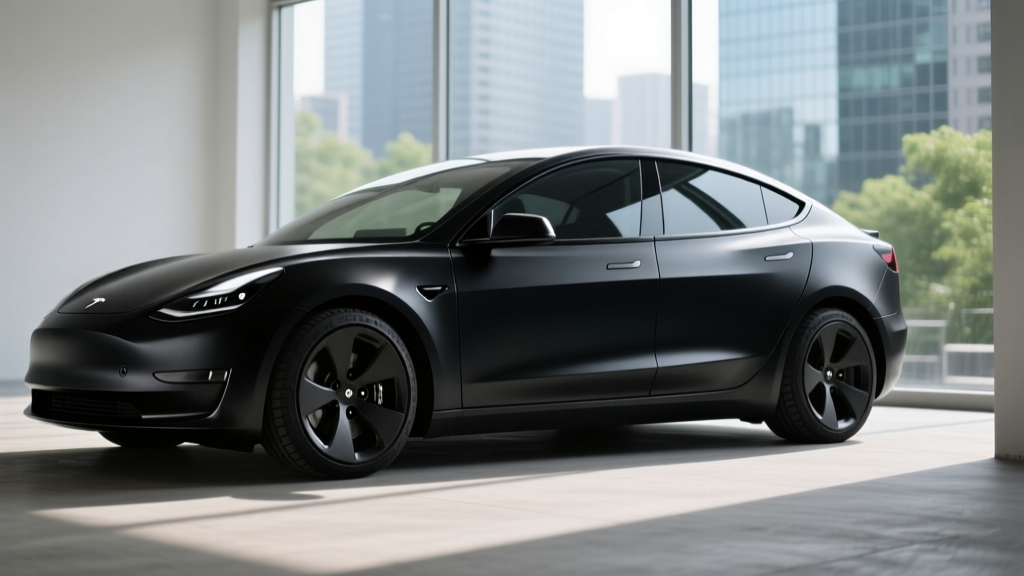
The matt black Tesla has become one of the most searched aesthetics in the EV world — and for good reason. A matte or satin-black finish transforms the already-sculpted lines of a Model 3 or Model Y into something that looks far more aggressive and exclusive than anything rolling off the Fremont or Austin assembly lines. But a wrap is a significant investment on top of an already premium vehicle, and the underlying car still has to deliver as a daily driver.
This guide covers what it actually costs to go matt black in 2026, which Tesla model makes the best canvas, and the hard performance, range, and charging numbers you need before pulling the trigger. We focus on the two most popular platforms: the refreshed Model 3 (Highland and its 2026 updates) and the Model Y Juniper refresh.
Why Matt Black Is the Dominant Tesla Wrap in 2026
Matte and satin finishes have overtaken gloss and color-shift wraps among Tesla owners for three practical reasons. First, Tesla's factory paint — particularly Solid Black and Midnight Silver — is notoriously thin and prone to swirl marks, making a protective wrap almost mandatory for owners who care about long-term paint condition. Second, the cybertruck-influenced design language of the 2024-2026 Model 3 Highland and Model Y Juniper lends itself to the flat, de-chromed aesthetic that a matt black wrap delivers. Third, resale data from platforms like Carvana and AutoTrader consistently shows that well-maintained wrapped Teslas command a $1,500–$3,000 premium over equivalent unwrapped examples, provided the wrap is documented and removable.
The two most popular finishes in the matt black family are Satin Black (low-gloss, 30-50% reflectivity, the most common choice) and True Matte Black (zero reflectivity, more dramatic but harder to maintain). Most installers in 2026 recommend satin black for daily drivers because it hides micro-scratches and water spots far better than true matte.
Wrap Cost Breakdown: What You Will Actually Pay
| Component | Model 3 | Model Y | Notes |
|---|---|---|---|
| Full-body satin/matte wrap (3M 2080 or Avery Dennison Supreme) | $3,800 – $5,200 | $4,400 – $6,000 | Varies by shop, region, and panel complexity |
| Chrome delete (window trim, badges, handles) | $400 – $700 | $500 – $800 | Almost universally paired with matt black |
| PPF over wrap (optional, high-impact zones) | $1,200 – $2,000 | $1,400 – $2,400 | Hood, fenders, mirrors, bumper |
| Wheel powder-coat (gloss or satin black) | $600 – $900 | $600 – $900 | Completes the stealth look |
| Total typical build | $6,000 – $8,800 | $6,900 – $10,100 | Full stealth aesthetic, no PPF |
A quality wrap using 3M 2080 or Avery Dennison Supreme Wrapping Film should last 5–7 years with proper care. Avoid shops quoting under $3,000 for a full Model 3 — they are almost certainly using calendared vinyl (not cast), which shrinks, lifts at edges, and can damage paint upon removal. Always ask for cast film and a written warranty from the installer.
The Best Tesla Canvas: Model 3 vs Model Y Specs
Most matt black builds in 2026 use either the Model 3 Long Range AWD or the Model Y Long Range AWD. Here is how the underlying vehicles compare on the metrics that matter most to daily drivers and road-trippers.
| Specification | Model 3 LR AWD | Model Y LR AWD |
|---|---|---|
| EPA Range | 341 miles | 320 miles |
| Battery (usable) | ~79 kWh, NMC | ~79 kWh, NMC |
| Max DC Fast Charge | 250 kW (peak) | 250 kW (peak) |
| 10–80% DCFC Time | ~27 minutes | ~27 minutes |
| Level 2 Home Charge (11.5 kW) | ~44 mi/hr | ~41 mi/hr |
| 0–60 mph | 4.2 seconds | 4.8 seconds |
| Horsepower | ~384 hp | ~384 hp |
| Drivetrain | Dual-motor AWD | Dual-motor AWD |
| MPGe (combined) | 132 MPGe | 122 MPGe |
| Efficiency | 25 kWh/100 mi | 27 kWh/100 mi |
| Cargo Volume | 23 cu ft (rear) + 3.1 cu ft (frunk) | 76 cu ft (rear folded) + 4.1 cu ft (frunk) |
| Rear Legroom | 35.2 in | 40.5 in |
| Base MSRP | $47,740 | $49,630 |
| Battery Warranty | 8 yr / 120,000 mi | 8 yr / 120,000 mi |
| Basic Vehicle Warranty | 4 yr / 50,000 mi | 4 yr / 50,000 mi |
Sources: fueleconomy.gov (EPA), Tesla specifications.
The EPA estimates 341 miles for the Model 3 LR and 320 miles for the Model Y LR. In real-world highway driving at 70–75 mph with climate control on, expect 270–300 miles from the Model 3 and 255–285 miles from the Model Y. In sub-30°F winter conditions, plan for a 20–30% reduction — that drops the Model 3 to roughly 220–250 miles of usable range. Always precondition the battery via the Tesla app before departing in cold weather to recover 5–10% of that loss.
Charging Speed: DC Fast Charge and Home Level 2
Both the Model 3 and Model Y Long Range use NMC (nickel manganese cobalt) chemistry in their ~79 kWh usable packs. They peak at 250 kW on a V3 or V4 Tesla Supercharger, but — and this is critical — that peak is only sustained between roughly 10% and 35% state of charge. The charge curve tapers significantly:
| Charging Method | Power | Speed | Notes |
|---|---|---|---|
| Tesla V3/V4 Supercharger (DCFC) | Peak 250 kW | 10–80% in ~27 min | Tapers above 50%; 80–100% adds ~25 min |
| CCS adapter + Electrify America / EVgo | Up to 250 kW | Similar to Supercharger | Tesla includes CCS adapter; speeds vary by station |
| Home Level 2 (Tesla Wall Connector, 48A) | 11.5 kW | ~44 mi/hr (Model 3) | Full charge in ~7 hours; requires 60A circuit |
| Home Level 2 (generic J1772, 32A) | 7.7 kW | ~30 mi/hr | Full charge in ~10 hours; works on 40A circuit |
| Level 1 (120V outlet) | ~1.4 kW | ~3–4 mi/hr | Emergency/trickle only; 4+ days for full charge |
For daily ownership, a home Level 2 setup is essential. A Tesla Wall Connector on a dedicated 60-amp circuit delivers 11.5 kW and adds roughly 44 miles of range per hour of charging — enough to fully replenish overnight. Installation typically runs $800–$2,000 depending on panel proximity and whether your electrical panel needs an upgrade to 200 amps. Always hire a licensed electrician and pull a permit; unpermitted work can void home insurance claims.
Federal Tax Credit: Does a Matt Black Tesla Qualify?
The IRS §30D Clean Vehicle Credit offers up to $7,500 for qualifying new EVs. Here is where the Model 3 and Model Y stand for the 2026 tax year:
- MSRP Cap: SUVs (Model Y) must be under $80,000; sedans (Model 3) must be under $55,000. Both the Model 3 LR ($47,740) and Model Y LR ($49,630) clear these caps at base MSRP — but adding Full Self-Driving ($8,000) or certain wheel/upholstery upgrades can push the Model 3 over $55,000.
- Buyer Income Cap: Modified adjusted gross income must not exceed $150,000 (single), $225,000 (head of household), or $300,000 (joint filing).
- Battery Sourcing: At least 60% of critical minerals and 75% of battery components must be sourced from the US or free-trade-agreement countries (2026 thresholds). Tesla's US-built vehicles with Panasonic cells have generally met these requirements, but sourcing rules tighten annually — verify at the point of sale.
- Point-of-Sale Transfer: Since 2024, the credit can be transferred to the dealer at purchase, reducing your out-of-pocket cost immediately rather than waiting for a tax refund.
- Wrap Cost: The aftermarket wrap is NOT part of the vehicle MSRP and does not affect tax credit eligibility.
| Configuration | MSRP | After $7,500 Credit | Notes |
|---|---|---|---|
| Model 3 LR AWD (base) | $47,740 | $40,240 | Qualifies at base MSRP |
| Model 3 LR AWD + FSD | $55,740 | Not eligible | Exceeds $55,000 sedan cap |
| Model Y LR AWD (base) | $49,630 | $42,130 | Qualifies; SUV cap is $80,000 |
| Model Y LR AWD + FSD + 21" wheels | $59,630 | $52,130 | Still under $80,000 SUV cap |
Always confirm eligibility with your tax professional and check the latest rules at irs.gov. State incentives (California, Colorado, etc.) may stack on top but vary by jurisdiction.
Performance, Tech, and the Ownership Experience
The dual-motor AWD powertrain in both models delivers 384 horsepower and instant torque. The Model 3 LR hits 0–60 in 4.2 seconds — genuinely quick for a daily commuter — while the Model Y LR does it in 4.8 seconds. Regenerative braking is strong enough for one-pedal driving in most conditions, though Tesla removed the adjustable regen setting years ago; the default strength is fixed and non-negotiable.
Standout tech features:
- 15.4-inch center touchscreen (Model 3) / 15.4-inch center + 8-inch rear screen (Model Y Juniper)
- Tesla Autopilot (Level 2 SAE driver-assist): adaptive cruise, lane centering, auto lane change — requires active driver supervision at all times
- Full Self-Driving Supervised ($8,000): adds city-street navigation, traffic light/stop sign recognition, and autosteer on local roads — still Level 2, not autonomous
- Over-the-air updates that add features post-purchase (recent additions: adaptive headlights, dashcam improvements, UI refreshes)
- Sentry Mode dashcam recording, dog mode climate control, and phone-as-key via Bluetooth
Tesla Autopilot and Full Self-Driving (Supervised) are SAE Level 2 driver-assistance systems. The driver must remain attentive, keep hands on the wheel (or demonstrate engagement via the cabin camera), and be prepared to take over instantly. These systems are not self-driving. Only Level 4 services like Waymo operate without a human driver.
Notable drawbacks:
- No traditional instrument cluster — all information is on the center screen, which some drivers find distracting
- Turn signal stalks removed on Model 3 Highland and Model Y Juniper; signals are now on the steering wheel (controversial and takes weeks to adapt)
- Rear visibility in the Model 3 is compromised by the sloping roofline; the Model Y is significantly better
- Insurance premiums run 15–30% higher than comparable ICE sedans/SUVs, according to Insurance Information Institute data, due to higher repair costs and parts pricing
Who Should Build a Matt Black Tesla?
- You prioritize maximum range (341 EPA miles) and efficiency (132 MPGe)
- You commute solo or with one passenger most days
- You want the lowest cost of entry into a matt black Tesla build (~$46,000 all-in after credit + wrap)
- Highway driving is your primary use case
- You need rear-seat space for children, car seats, or adult passengers (40.5" legroom vs 35.2")
- Cargo capacity matters (76 cu ft with seats folded vs 23 cu ft)
- You want the higher SUV MSRP cap ($80,000) for more flexibility with add-ons while retaining tax credit eligibility
- You occasionally need to haul gear, bikes, or camping equipment
Pros, Cons, and Competitor Context
- Class-leading Supercharger network reliability (~98% uptime)
- Over-the-air updates add real value post-purchase
- Excellent real-world efficiency (25–27 kWh/100 mi)
- Strong resale value, especially with documented wrap
- Best-in-class DC fast charging curve at 250 kW peak
- Steering-wheel turn signals take significant adaptation
- No Apple CarPlay or Android Auto
- Insurance costs above segment average
- FSD remains a $8,000 upsell for Level 2 functionality
- Build quality inconsistency (panel gaps, paint) still surfaces occasionally
Key competitors to cross-shop: The Hyundai Ioniq 6 (361 EPA miles, $42,715 base) offers more range and a traditional cockpit layout. The BMW i4 eDrive40 ($57,975) delivers a more premium interior and conventional controls. The Ford Mustang Mach-E ($42,995) provides SUV practicality rivaling the Model Y. None, however, match Tesla's charging infrastructure advantage or OTA update cadence.
Matt Black Tesla FAQ
How long does a matt black wrap last on a Tesla?
A quality cast vinyl wrap (3M 2080, Avery Dennison Supreme) lasts 5–7 years with proper care. Hand-wash only — automatic car washes with brushes will damage the matte finish. Use wrap-specific soap (no wax-based products) and avoid pressure washers closer than 12 inches.
Does a wrap affect Tesla's sensors or cameras?
No, as long as the installer does not cover camera lenses, ultrasonic sensor ports, or the front radar (if equipped). Reputable Tesla-experienced shops mask these areas precisely. Always confirm sensor functionality before leaving the shop.
Can I wrap a leased Tesla?
Yes, and it is one of the most popular ways to wrap. The wrap protects the factory paint and can be removed before lease return. Keep the installer's receipt and documentation; some leasing companies require proof that the wrap was professionally installed and removed.
What is the real-world range of a matt black Tesla?
The wrap itself has negligible impact on range (perhaps 1–2 miles difference due to minor surface-texture drag). Real-world range depends on the underlying model: expect 270–300 highway miles from a Model 3 LR and 255–285 from a Model Y LR in moderate temperatures. Cold weather (below 30°F) reduces these figures by 20–30%.
Does a matt black wrap void the Tesla warranty?
No. A professionally installed, removable wrap does not void Tesla's 8-year/120,000-mile battery warranty or 4-year/50,000-mile basic warranty. However, if wrap adhesive damages paint during removal, that specific repair would not be covered.
Is it worth buying a matt black Tesla vs a competitor?
If charging infrastructure reliability, over-the-air updates, and the lowest per-mile energy cost are your top priorities, the Tesla platform remains the strongest foundation for a matt black build. If you prefer a traditional instrument cluster, Apple CarPlay, or a more premium interior, the Hyundai Ioniq 6 or BMW i4 are compelling alternatives — but you sacrifice Supercharger access (though NACS adoption is closing this gap in 2026).