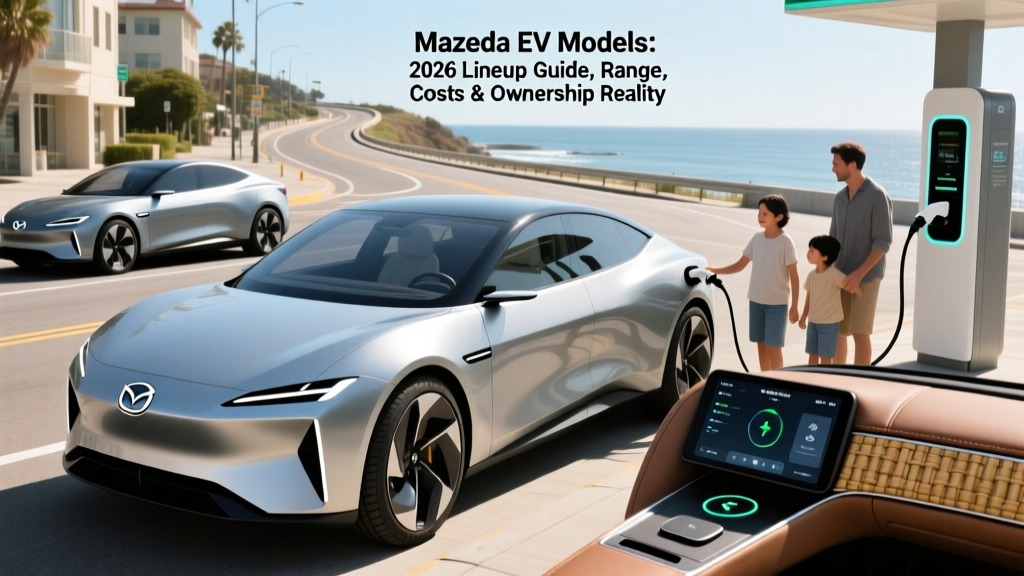
The short answer on Mazda EV models: As of the 2026 model year, Mazda sells one fully electric vehicle in the U.S. — the MX-30 EV — a subcompact crossover with an EPA-estimated 100 miles of range and a starting MSRP near $35,000. Mazda's broader electrified strategy leans heavily on plug-in hybrids (PHEVs), including the CX-70 PHEV and CX-90 PHEV, which offer 26–30 miles of electric-only driving before the gas engine engages. If you need a true long-range EV (250+ miles), Mazda does not currently offer one. The MX-30 works best as a city commuter with reliable home charging; everyone else should look at Mazda's PHEVs or competing long-range EVs.
The Current Mazda EV Lineup: MX-30 and What's Next
Mazda has been cautious about full electrification compared to rivals like Hyundai, Kia, and Tesla. The MX-30 launched in California only for 2022-2023 before Mazda expanded availability modestly. For 2026, it remains Mazda's sole battery-electric offering on U.S. soil, and it is a niche product by design — aimed at urban drivers who prioritize styling and interior quality over maximum range.
| Spec | Value |
|---|---|
| EPA Range | 100 miles |
| Battery (usable) | 35.5 kWh (NMC lithium-ion) |
| Motor Output | 143 hp / 200 lb-ft torque |
| 0–60 mph | ~8.7 seconds |
| DC Fast Charge (peak) | 50 kW (CCS1) |
| 10–80% DC Charge | ~36 minutes |
| Level 2 Charge Rate | 6.6 kW (~6 hours, 0–100%) |
| MPGe (combined) | 92 MPGe |
| Base MSRP | ~$35,000 (before incentives) |
| Battery Warranty | 8 years / 100,000 miles |
| Federal Tax Credit (§30D) | Up to $7,500 if sourcing/income/MSRP rules met |
Real-world range reality: The EPA sticker says 100 miles. In practice, expect 80–90 miles on the highway at 70 mph, and potentially 65–75 miles in freezing weather with cabin heat running. Cold temperatures reduce lithium-ion efficiency by 20–30%, and the MX-30's small battery offers very little buffer. This car is a 60-mile-round-trip commuter, not a road-trip vehicle.
Mazda has announced plans for additional EVs built on dedicated platforms, potentially including a three-row electric SUV for the U.S. market by 2027–2028. However, these remain announced/preliminary — no final specs, pricing, or EPA certifications are available yet. For now, the MX-30 is what you can actually buy.
Mazda PHEVs: The Practical Electrified Alternative
If the MX-30's range doesn't fit your life, Mazda's plug-in hybrids might. The CX-90 PHEV and CX-70 PHEV pair a 2.5-liter four-cylinder engine with a 17.8 kWh battery pack, delivering around 26 miles of electric-only driving before seamlessly switching to hybrid mode. That's enough for most daily errands and school runs on electricity alone, with the gas engine providing 400+ total miles of range for longer trips.
| Metric | MX-30 EV | CX-90 PHEV | CX-90 (Gas, I-6 Turbo) |
|---|---|---|---|
| EPA Electric Range | 100 mi | 26 mi (EV only) | N/A |
| Total Range | 100 mi | ~430 mi combined | ~460 mi |
| Combined Efficiency | 92 MPGe | 56 MPGe / 25 MPG (gas) | 24 MPG |
| Horsepower | 143 hp | 323 hp combined | 280–340 hp |
| 0–60 mph | ~8.7 sec | ~5.9 sec | ~6.5 sec |
| Starting MSRP | ~$35,000 | ~$51,000 | ~$45,000 |
| Home Charging Needed? | Essential | Recommended for EV miles | No |
| Road-Trip Ready? | No | Yes | Yes |
The PHEV math is compelling for a specific buyer: if you drive 25 miles or fewer per day and charge at home overnight, you may use almost no gasoline on weekdays. On a 300-mile weekend trip, the gas engine eliminates any charging hassle. Data from fueleconomy.gov confirms the CX-90 PHEV's 56 MPGe when operating in electric mode, dropping to 25 MPG once the battery is depleted — still competitive for a three-row SUV.
Real Ownership Costs: Buying, Charging, and Maintaining a Mazda EV
Let's run the actual numbers for owning a Mazda MX-30 EV versus the gas-powered CX-30 (its closest internal-combustion sibling) over five years and 75,000 miles.
| Cost Category | MX-30 EV | CX-30 (Gas, AWD) |
|---|---|---|
| Purchase Price (base MSRP) | $35,000 | $28,000 |
| Est. Federal Tax Credit (§30D) | −$3,750 to −$7,500* | $0 |
| Home Charger Install (Level 2) | $500–$2,000 | $0 |
| Fuel/Energy (75k mi) | $1,800–$2,700** | $6,200–$7,500*** |
| Maintenance (5 yr) | $1,200–$1,800 | $3,000–$4,000 |
| Insurance (5 yr avg.) | $7,500–$9,000 | $6,000–$7,500 |
| Est. 5-Year Total | $38,000–$47,000 | $43,200–$47,000 |
* §30D credit eligibility depends on battery critical-mineral sourcing, buyer income caps ($150k single / $300k joint), and MSRP limits ($55k for SUVs). The MX-30's battery sourcing has been inconsistent year-to-year — verify current eligibility at IRS.gov or through the dealer's point-of-sale transfer paperwork.
** Assumes $0.14/kWh average home electricity; higher if relying on public DC fast charging at $0.35–$0.50/kWh.
*** Assumes $3.50/gallon and 28 MPG combined.
The MX-30 can break even with the gas CX-30 over five years, but only if you qualify for a meaningful tax credit and charge primarily at home. Public-charging-only ownership pushes energy costs close to gasoline costs per mile — and with 100 miles of range, you'd be hunting for chargers constantly.
Charging the MX-30: What You Need to Know Before You Buy
The MX-30's charging profile is its most significant limitation for many buyers. Here's the breakdown by charging level:
| Level | Power (kW) | Miles Added per Hour | Typical Use Case |
|---|---|---|---|
| Level 1 (120V household) | ~1.2 kW | ~4 mi/hr | Emergency/overnight trickle (~25 hr for full) |
| Level 2 (240V home/public) | 6.6 kW | ~22 mi/hr | Daily home charging (~5 hr for full) |
| DC Fast Charge (CCS1) | 50 kW peak | ~150 mi/hr (peak) | Public charging; 10–80% in ~36 min |
A few critical realities:
- 50 kW DC fast charging is slow by 2026 standards. Competitors like the Hyundai Kona Electric accept 100+ kW, and the Tesla Model Y peaks near 250 kW. At 50 kW, the MX-30's charge curve tapers further above 80% State of Charge (SoC), meaning that last 20% takes disproportionately long.
- Level 1 charging is nearly unusable as a daily strategy. At ~4 miles of range per hour plugged into a standard outlet, you'd need to be plugged in for 25+ hours to fully replenish — impossible for most schedules.
- Home Level 2 installation is strongly recommended — practically mandatory. A 240V Level 2 charger adds ~22 miles of range per hour, meaning a nightly 5-hour session fully replenishes the battery. Expect to pay $500–$2,000 for a quality Level 2 unit plus electrician installation, depending on whether your electrical panel needs an upgrade (200-amp service is typically required).
- The MX-30 uses a CCS1 connector. This is the legacy standard being phased out in favor of NACS (Tesla's connector). Adapters are available, but verify compatibility with your preferred public charging network.
Mazda EV vs. the Competition: Where It Stands
The MX-30 occupies an unusual position: it's priced like a mainstream EV but delivers the range of an early-2010s compliance car. Here's how it compares to similarly priced alternatives:
| Spec | Mazda MX-30 | Hyundai Kona Electric | Nissan LEAF (SV Plus) | Chevy Bolt EV* |
|---|---|---|---|---|
| EPA Range | 100 mi | 261 mi | 212 mi | 259 mi |
| Battery (kWh) | 35.5 | 65.4 | 60 | 65 |
| DC Fast Charge (peak kW) | 50 | 100+ | 100 | 115 |
| 10–80% DC Time | ~36 min | ~43 min (larger battery) | ~40 min | ~30 min |
| Horsepower | 143 | 201 | 214 | 200 |
| Base MSRP | ~$35,000 | ~$34,000 | ~$37,000 | ~$28,000 (discontinued) |
* Chevy Bolt EV was discontinued after 2023; included for reference as a used-market alternative.
On pure range-per-dollar, the MX-30 is not competitive. A buyer prioritizing range should test-drive the Kona Electric or shop certified pre-owned Bolts. The MX-30's advantage is its interior — cork-trim accents, premium materials, and a distinctive design that feels more upscale than its price suggests.
Common Misconceptions About Mazda EVs
| Myth | Fact |
|---|---|
| "Mazda doesn't make electric cars." | The MX-30 EV is a fully battery-electric vehicle available in select U.S. markets. |
| "The MX-30 qualifies for the full $7,500 tax credit." | Eligibility depends on battery sourcing rules, buyer income, and MSRP caps under §30D. Credit has ranged from $3,750 to $7,500 depending on model year — always verify with the dealer and IRS guidelines. |
| "I can charge the MX-30 from a regular outlet overnight." | Level 1 (120V) adds only ~4 miles per hour. A depleted battery needs 25+ hours — overnight Level 1 is not viable as a primary strategy. |
| "Mazda's PHEVs are just gas cars with a small battery." | The CX-90 PHEV delivers 323 combined horsepower, 26 miles of real electric-only range, and 56 MPGe in EV mode — meaningfully reducing fuel use for short-trip drivers. |
| "EV batteries need replacing every few years." | Mazda warranties the MX-30 battery for 8 years/100,000 miles against capacity loss below a defined threshold. Industry data from sources like NHTSA and independent testing shows modern NMC packs retaining 85–90% capacity at 100,000 miles under normal use. |
Decision Framework: Is a Mazda Electrified Vehicle Right for You?
Choose the MX-30 EV if:
- Your daily round-trip commute is under 60 miles
- You have reliable Level 2 home charging (garage or driveway with 240V access)
- You rarely drive more than 80 miles in a single day
- You value distinctive interior design and are willing to trade range for it
- You live in a mild climate (extreme cold will shrink the already-short range by 25–30%)
Choose the CX-90 PHEV or CX-70 PHEV if:
- You want electric commuting but also need road-trip capability
- You need three rows of seating or more cargo space
- Your daily driving is under 25 miles and you can charge at home
- You want to reduce gas consumption without committing to a full EV
Look at competing EVs (Hyundai, Kia, Tesla, Chevy) if:
- You need 250+ miles of range for highway trips or long commutes
- You lack home charging and must rely on public infrastructure
- You want faster DC charging (100+ kW) for road-trip practicality
- You live in a region with harsh winters and need battery buffer
First-Time Mazda EV Buyer Checklist
If you're seriously considering the MX-30 or a Mazda PHEV, work through this before signing:
- Verify your home electrical capacity. Can your panel support a 240V/40-amp circuit for Level 2 charging? Get a quote from a licensed electrician — panel upgrades can add $1,500–$3,000.
- Measure your real commute. Use your car's trip meter for a week. If your daily miles exceed 70, the MX-30's 100-mile EPA range (lower in real-world conditions) will be stressful.
- Confirm §30D tax credit eligibility. Check current battery-sourcing requirements, your household income against IRS caps, and the MSRP limit. The point-of-sale transfer option lets you apply the credit at purchase, reducing your down payment.
- Check local utility rates. Time-of-use plans can drop overnight charging to $0.08–$0.10/kWh, making the MX-30 cost roughly $0.03/mile to "fuel." Without favorable rates, savings over gas narrow.
- Test the charge curve. If you'll use public DC charging, visit a CCS1-equipped station and time a 10–80% session. The MX-30's 50 kW peak is functional but not fast — plan accordingly.
- Get insurance quotes before buying. EVs often carry 15–25% higher premiums than equivalent gas vehicles due to repair complexity and battery replacement costs. This can erase fuel savings if not accounted for.
Frequently Asked Questions
Does Mazda have a long-range EV coming?
Mazda has announced plans for dedicated EV platforms with longer range, potentially arriving in U.S. showrooms by 2027–2028. These are currently in the announced/preliminary stage with no confirmed EPA range, pricing, or battery specs. If you need 250+ miles of range today, look at other brands.
Is the MX-30 available nationwide?
Initially limited to California, MX-30 availability has expanded to select additional states, but it is not sold in all 50 states. Check with your local Mazda dealer for current inventory and whether your state is included in the allocation.
How much does it cost to charge the MX-30 at home?
At the U.S. average residential rate of ~$0.14/kWh, fully charging the 35.5 kWh battery costs roughly $5.00, yielding 100 miles of EPA range — about $0.05 per mile. Compare that to a 30 MPG gas car at $3.50/gallon: $0.12 per mile. Home charging saves roughly $0.07/mile, or about $525 per year at 7,500 miles of annual driving.
Will the MX-30 battery need replacement?
Modern NMC lithium-ion packs are designed to last the life of the vehicle under normal use. Mazda's warranty covers the battery for 8 years/100,000 miles against degradation below a specified capacity threshold. If a replacement were needed out of warranty, costs for a 35.5 kWh pack would likely fall in the $8,000–$12,000 range (parts and labor) based on current market pricing for similar-capacity packs.
Can I use a Tesla Supercharger with the MX-30?
The MX-30 uses a CCS1 connector. Tesla's NACS connector is different. CCS-to-NACS adapters exist (such as those from third-party manufacturers), but you must verify compatibility with both your vehicle and the specific Supercharger generation. Tesla's Supercharger network has been opening to non-Tesla CCS vehicles at select locations — check the Tesla app for current availability in your area.
How does the MX-30 perform in cold weather?
Expect 20–30% range loss in freezing temperatures (below 32°F). The 100-mile EPA range could drop to 65–80 real-world miles in harsh winter conditions. The MX-30 does not come standard with a battery heat pump on all trims, which means preconditioning while plugged in is essential to preserve range. If you live in a cold climate, this short-range EV becomes significantly more limiting from November through March.