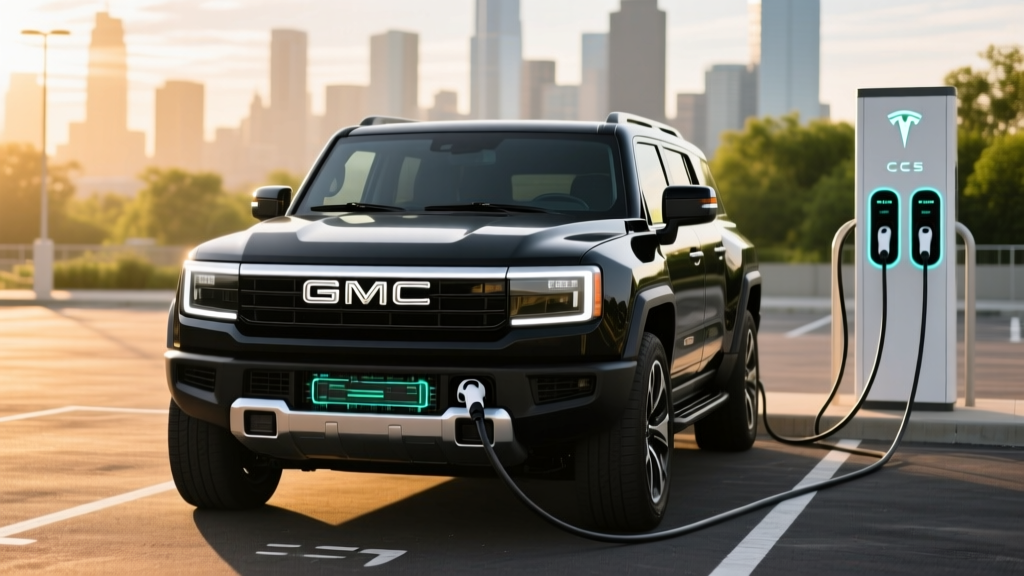
The 2026 GMC Hummer EV SUV is an exercise in excess — a 9,000-pound, three-row electric fortress that turns every parking lot into a spectacle and every off-road trail into a playground. Built on GM's Ultium platform and sharing its bones with the Hummer EV Pickup and the Chevrolet Silverado EV, this SUV trades efficiency for presence. If you're shopping for a commuter, look elsewhere. If you need a family hauler that can tow 7,500 pounds, wade through 32 inches of water, and still hit 60 mph in under four seconds, you've found your short list.
But excess comes with trade-offs. Range is modest for a battery this large, charging speeds lag behind Hyundai/Kia's 800-volt architecture, and the price pushes well into six figures before options. This review breaks down the 2026 Hummer EV SUV with the exact numbers that matter — EPA range, real-world expectations, charging curves, tax credit eligibility, and whether it actually makes sense against the Rivian R1S and Tesla Model X.
Range, Battery, and Efficiency: The Ultium Reality
The 2026 Hummer EV SUV carries a massive 212 kWh usable Ultium battery pack using NMC (nickel manganese cobalt) pouch cells manufactured at GM's Ultium Cells joint-venture plants. This is one of the largest battery packs in any production passenger vehicle, and it needs to be — the Hummer EV SUV's aerodynamics and weight demand enormous energy reserves.
Real-World Expectation: Expect 260–280 miles on a highway road trip at 70–75 mph. In cold weather (below 32°F), plan for 210–240 miles due to battery chemistry limitations and cabin heating demands on a pack this large. City driving with regenerative braking can push closer to the EPA sticker, around 300–310 miles.
| Spec | 3X (Standard) | 2X |
|---|---|---|
| EPA Range | 314 mi | 314 mi |
| Battery (usable) | 212 kWh NMC | 212 kWh NMC |
| MPGe (combined) | 47 MPGe | 47 MPGe |
| Efficiency | 72 kWh/100 mi | 72 kWh/100 mi |
| Drivetrain | Tri-motor AWD | Dual-motor AWD |
| Horsepower | 830 hp | 625 hp |
| 0-60 mph | ~3.5 sec (Watts to Freedom) | ~4.5 sec |
| Max DC Fast Charge | 350 kW (peak) | 350 kW (peak) |
| 10–80% DC Time | ~38 min | ~38 min |
| Level 2 Home Charge | 19.2 kW (~52 mi/hr) | 19.2 kW (~52 mi/hr) |
| Towing Capacity | 7,500 lbs | 7,500 lbs |
| Ground Clearance | 15.9 in (Extract Mode) | 15.9 in (Extract Mode) |
| Base MSRP | $106,495 | $99,795 |
Efficiency is predictably poor. At 47 MPGe combined (roughly 72 kWh per 100 miles), the Hummer EV SUV consumes nearly twice the energy per mile of a Tesla Model X or Rivian R1S. This is the physics of a 9,000-pound brick. For most owners with home Level 2 charging, the cost impact is manageable — roughly $7–$9 per 100 miles at a national average of $0.13/kWh. But on DC fast-charging road trips at $0.40–$0.50/kWh, you'll spend $28–$36 per 100 miles, rivaling or exceeding gas SUV fuel costs.
Charging Speed: 350 kW Peak, But Read the Curve
GMC quotes a 350 kW peak DC fast-charge rate on 800-volt-capable chargers, and the Ultium platform does support this architecture. However, peak is not sustained. The Hummer EV SUV's enormous 212 kWh battery means that even at a relatively modest C-rate, the absolute kW numbers look impressive — but the charge curve tapers significantly above 60% state of charge to protect cell longevity.
| Level | Power | Speed / Time | Notes |
|---|---|---|---|
| Level 1 (120V) | ~1.4 kW | ~3 mi/hr | Emergency only — full charge in ~6+ days |
| Level 2 (240V, 80A) | 19.2 kW | ~52 mi/hr | Full charge in ~11 hours; requires hardwired 100A circuit |
| Level 2 (240V, 48A) | 11.5 kW | ~31 mi/hr | Standard NEMA 14-50; full charge in ~18 hours |
| DC Fast (peak) | 350 kW | 10–80% in ~38 min | Sustained avg ~200 kW; tapers heavily above 80% |
| DC Fast (50 kW) | 50 kW | 10–80% in ~3.5 hrs | Typical older CHAdeMO/CCS station speed |
In real-world DC fast charging, expect a sustained average of roughly 180–220 kW from 10–60%, tapering to 80–120 kW from 60–80%. The 10–80% session takes approximately 35–42 minutes at a 350 kW-capable Electrify America or EVgo station. Above 80%, charging slows dramatically — plan for an additional 30+ minutes to reach 100% if needed. Always precondition the battery via the navigation system's built-in preconditioning routine before arriving at a DC charger; skipping this can add 10–15 minutes to your session in cold weather.
At home, the 19.2 kW onboard charger is a standout. If your electrician installs a hardwired 100-amp circuit (a $1,500–$3,000 upgrade depending on panel capacity), you'll add roughly 52 miles of range per hour — enough to fully replenish the pack overnight. Most owners will be fine with a 48-amp NEMA 14-50 setup, which delivers about 31 miles per hour and still covers daily needs. Consult a licensed electrician to assess your panel's headroom before committing to the 80-amp circuit.
Performance and Drivetrain: Watts to Freedom Mode
The 3X trim's tri-motor setup (one front, two rear) produces 830 horsepower and an estimated 1,200 lb-ft of torque. Engaging Watts to Freedom (WTF) mode — which lowers the air suspension, preconditions the battery for maximum discharge, and activates launch control — delivers a 0–60 mph time of approximately 3.5 seconds. For a vehicle that weighs as much as two Honda Civics, this is genuinely startling.
The dual-motor 2X trim delivers 625 hp with a 0–60 time around 4.5 seconds — still quick by any SUV standard. Both trims feature GM's torque-vectoring rear axle, which can send up to 100% of rear torque to either wheel, enabling tank turns (the rear wheels counter-rotate to spin the vehicle in place) and diagonal driving (CrabWalk). These aren't just party tricks; torque vectoring meaningfully improves trail traction and low-speed maneuverability.
Ride quality benefits from the standard adaptive air suspension, which offers a 5.8-inch range of travel. Extract Mode raises ground clearance to 15.9 inches for serious off-road obstacles, while highway mode lowers the vehicle for improved aerodynamics. The Hummer EV SUV is body-on-frame, and while it absorbs bumps with authority, it doesn't corner with the flatness of a unibody rival like the Model X or even the R1S. Drive it like a truck, and it rewards you; drive it like a sports sedan, and you'll feel every 9,000 pounds.
Interior, Cargo, and Technology
The cabin is dominated by a 13.4-inch infotainment touchscreen running GM's latest Ultifi-based software, paired with a 12.3-inch driver cluster. Wireless Apple CarPlay and Android Auto are standard. The interface is responsive, though GM's decision to bury some climate controls in the touchscreen draws criticism from owners who prefer physical knobs.
Seating is configured for five passengers (two rows) on the 2X and 3X trims. Front legroom is generous at 45.6 inches, with rear legroom at 38.9 inches — adequate but not class-leading given the vehicle's footprint. Headroom is excellent, aided by the standard Infinity Roof with removable sky panels (10 panels that stow in the frunk).
Cargo capacity measures 35.9 cubic feet behind the second row and 81.8 cubic feet with the second row folded. The front trunk (frunk) adds roughly 11.3 cubic feet of lockable storage, though much of that space is consumed by the stowed roof panels. For comparison, the Rivian R1S offers more usable third-row cargo in its three-row configuration, while the Model X provides 88 cubic feet max — slightly more, but without the Hummer's frunk utility.
Driver-assistance technology includes GM Super Cruise (SAE Level 2 hands-free driving on over 750,000 miles of mapped highways in the US and Canada). Super Cruise is excellent within its operational domain — the driver attention camera ensures you're watching the road, and the system handles lane-keeping, adaptive cruise, and automatic lane changes smoothly. However, this is not autonomous driving: you must remain engaged, and the system disengages on unmapped roads, in construction zones, and in severe weather.
Pricing, Trims, and Federal Tax Credit Eligibility
The 2026 GMC Hummer EV SUV starts at $99,795 for the dual-motor 2X trim (including the $1,995 destination charge). The tri-motor 3X starts at $106,495. The Edition 1 launch model is no longer offered. Popular option packages — including the Extreme Off-Road Package ($5,995 on 3X), tow package, and premium interior — can push a 3X to $115,000–$120,000 before incentives.
| Trim | Base MSRP | Federal §30D Credit | Effective Price |
|---|---|---|---|
| 2X (Dual-Motor) | $99,795 | Up to $7,500* | From ~$92,295* |
| 3X (Tri-Motor) | $106,495 | Up to $7,500* | From ~$98,995* |
*Federal tax credit eligibility (§30D) is not guaranteed. The Hummer EV SUV qualifies as an SUV under the IRS MSRP cap of $80,000 for SUVs — wait, the base 2X at $99,795 exceeds this cap. As of the 2026 tax year, the IRS §30D credit imposes an $80,000 MSRP cap for SUVs. Since all Hummer EV SUV trims exceed this threshold, the Hummer EV SUV does NOT qualify for the $7,500 federal new-vehicle EV tax credit. This is a critical factor that GMC's marketing materials often downplay.
- MSRP Cap (SUVs): $80,000 — Hummer EV SUV exceeds this ✗
- Buyer Income Cap: $150K single / $300K joint — may still qualify for other vehicles ✓
- Battery Sourcing: Critical minerals + battery components must meet phased thresholds — moot here
- Point-of-Sale Transfer: Available for qualifying vehicles — not applicable to Hummer EV SUV
- Used EV Credit (§25E): Up to $4,000 on a future used purchase if MSRP ≤ $25,000 (unlikely for this model)
Bottom line: budget the full MSRP. State-level incentives may apply (check AFDC's state incentive database), but do not factor the federal credit into your purchase decision for this vehicle. Consult a tax professional for your specific situation.
Pros, Cons, and Who Should Buy
Pros
- Unmatched presence and off-road capability (Extract Mode, CrabWalk, tank turns)
- 830 hp tri-motor performance is absurd in a vehicle this size
- 314-mile EPA range is adequate for most road trips
- Super Cruise is among the best Level 2 systems available
- 19.2 kW onboard Level 2 charging is fast for home replenishment
- Infinity Roof with removable panels is a genuinely unique feature
- 7,500-lb towing capacity with ProGrade trailering tech
Cons
- Does NOT qualify for the $7,500 federal tax credit (exceeds $80K MSRP cap)
- 47 MPGe is poor — high charging costs on road trips
- ~38-minute 10–80% DC charge is slower than Hyundai/Kia 800V rivals
- 9,000+ lb curb weight increases tire wear and energy consumption
- Five-seat only (no third row) limits family-hauler versatility vs. R1S
- Removable roof panels require frunk space and reinstallation effort
- Body-on-frame dynamics: noticeable body roll in corners
Who Is the 2026 Hummer EV SUV For?
Buy it if: You want a statement vehicle with genuine off-road chops, need 7,500-lb towing, value Super Cruise for highway commuting, and can charge at home. You accept the efficiency penalty and the lack of a federal tax credit as the cost of exclusivity.
Skip it if: You need a third row (consider the Rivian R1S), prioritize efficiency and road-trip charging speed (Tesla Model X or Hyundai Ioniq 9), or want to maximize federal incentives. If your daily commute is under 40 miles and you rarely tow or off-road, the Hummer's capabilities are wasted on your use case.
Competitor Comparison: Hummer EV SUV vs. Rivian R1S vs. Tesla Model X
| Spec | GMC Hummer EV 3X | Rivian R1S (Tri-Motor) | Tesla Model X Plaid |
|---|---|---|---|
| EPA Range | 314 mi | ~321 mi (Max Pack) | 326 mi |
| Battery | 212 kWh NMC | ~149 kWh NMC | ~100 kWh NMC |
| 0-60 mph | ~3.5 sec | ~3.5 sec | 2.5 sec |
| HP | 830 | 850 | 1,020 |
| Rows / Seats | 2 / 5 | 3 / 7 | 3 / 6-7 |
| Cargo (max) | 81.8 cu ft | 104.7 cu ft | 88.1 cu ft |
| DC Fast (peak) | 350 kW | ~220 kW | 250 kW |
| 10–80% Time | ~38 min | ~40 min | ~30 min |
| Towing | 7,500 lbs | 7,700 lbs | 5,000 lbs |
| Base MSRP | $106,495 | ~$100,900 | $109,990 |
| Federal Credit | No (MSRP cap) | Partial/No* | Partial/No* |
| ADAS | Super Cruise (L2) | Driver+ (L2) | Autopilot/FSD (L2) |
*Credit eligibility depends on battery sourcing and MSRP caps per IRS rules. Verify current-year status at irs.gov.
The Rivian R1S is the more practical family hauler: three rows, more cargo, competitive range, and a lower starting price. The Tesla Model X Plaid is faster and more efficient with access to the Supercharger network, though its interior quality and panel-gap reputation persist. The Hummer EV SUV wins on sheer presence, off-road capability, and the unique Infinity Roof experience — but it's the least practical of the three for daily family duty.
Battery Warranty and Long-Term Ownership
GM covers the Hummer EV SUV's battery and powertrain with an 8-year / 100,000-mile warranty, with a capacity retention threshold of 70% (consistent with federal mandate). If the battery degrades below 70% of its original 212 kWh capacity within that window, GM is obligated to repair or replace it. Real-world Ultium degradation data is still maturing — early Bolt EV and Cadillac Lyriq data suggests NMC pouch cells hold up well under normal use, but the Hummer's massive pack and high-discharge performance modes may accelerate wear over 150,000+ miles.
The bumper-to-bumper warranty is 3 years / 36,000 miles, which is industry-standard. Insurance costs are elevated: expect $3,500–$5,000 annually depending on your profile, driven by the vehicle's replacement cost, repair complexity, and performance classification. Always get an insurance quote before purchasing.
Tire costs are another ownership reality. The 35-inch Goodyear Wrangler Territory RT tires are specialized and expensive — budget $400–$550 per tire, and expect replacement every 25,000–35,000 miles given the vehicle's weight and torque delivery.
Frequently Asked Questions
What is the real-world range of the 2026 GMC Hummer EV SUV?
The EPA rates it at 314 miles, but real-world highway driving at 70–75 mph yields approximately 260–280 miles. In cold weather (below freezing), expect 210–240 miles. City driving with frequent regenerative braking can approach the EPA figure at 300–310 miles. Towing reduces range by 40–50%.
How fast does it charge at home and on the road?
At home with a hardwired 80-amp Level 2 station (19.2 kW), you'll add about 52 miles per hour — a full charge takes roughly 11 hours. On a 350 kW DC fast charger, expect 10–80% in about 38 minutes, though sustained speeds average 180–220 kW due to the charge curve taper. Always precondition the battery before DC charging.
Does the 2026 Hummer EV SUV qualify for the federal EV tax credit?
No. The IRS §30D credit imposes an $80,000 MSRP cap for SUVs, and all Hummer EV SUV trims start above $99,000. You will not receive the $7,500 federal credit for a new purchase. Check your state for local incentives, and consult a tax professional for your situation. Source: IRS §30D guidelines.
Is the Hummer EV SUV worth buying over the Rivian R1S or Tesla Model X?
It depends on your priorities. If you need a third row, more cargo space, or better efficiency, the R1S or Model X are stronger choices. If you want unmatched off-road capability, Super Cruise, the Infinity Roof, and a vehicle that turns heads everywhere, the Hummer is unique. Just accept the efficiency penalty, the lack of a federal tax credit, and the higher running costs.
Can the Hummer EV SUV tow, and how does towing affect range?
Yes — it's rated for 7,500 pounds with the available ProGrade trailering system. Towing at highway speeds will cut range by approximately 40–50%, reducing the 314-mile EPA figure to roughly 160–190 miles per charge. Plan your towing trips around DC fast-charging infrastructure accordingly.
Is GM Super Cruise self-driving?
No. Super Cruise is an SAE Level 2 driver-assistance system. It provides hands-free driving on mapped highways, but you must remain attentive and ready to take over at any time. The driver-monitoring camera will issue warnings and eventually bring the vehicle to a stop if it detects inattention. It does not operate on unmapped roads, in construction zones, or in severe weather.
The 2026 GMC Hummer EV SUV is not a rational purchase. It's too heavy, too inefficient, too expensive, and too large for most garages and most lives. But if you've read this far, you already know that rationality isn't the point. The Hummer EV SUV delivers a driving experience — and a presence — that nothing else on the road can match. Just go in with your eyes open about the real-world range, the charging realities, and the full price you'll pay at the dealership and at the charger.