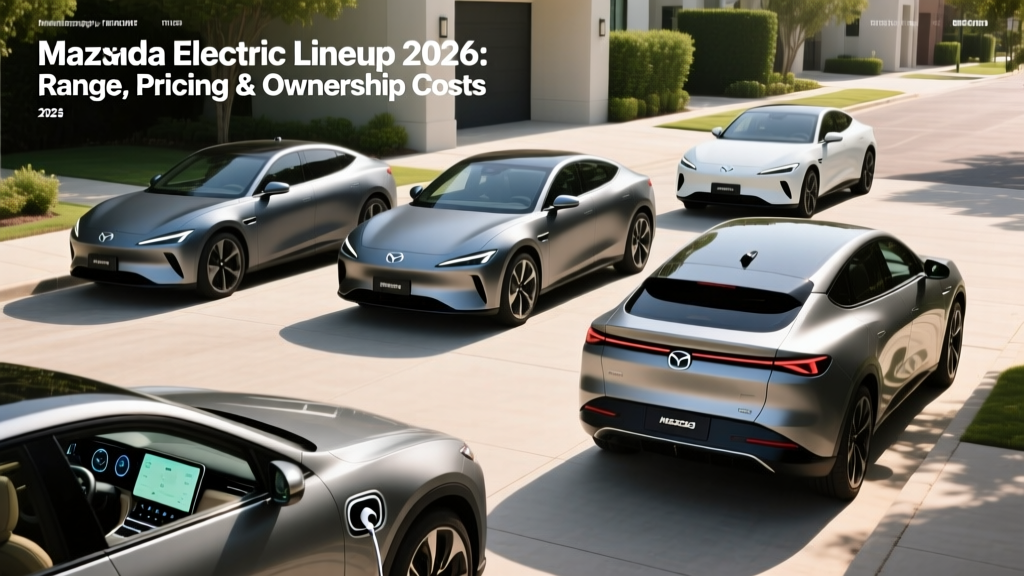
Mazda's Electric Options in 2026: What Buyers Need to Know
Quick Answer: Mazda's electrified lineup in 2026 centers on the CX-70 PHEV (plug-in hybrid) with 26 miles of electric-only range and 25 mpg combined, plus the MX-30 EV (California-only, 100-mile range). The CX-90 PHEV three-row SUV rounds out the options. None qualify for the full §30D federal tax credit due to battery sourcing requirements. For most buyers, the CX-70 PHEV offers the best balance of electric commuting and gas flexibility, while the MX-30 is a niche urban runabout best suited to households with a second car.
Mazda has taken a cautious approach to electrification compared to rivals like Hyundai and Tesla. Rather than going all-in on battery electric vehicles, the automaker has emphasized plug-in hybrids that let drivers commute on electricity while retaining a gas engine for longer trips. This strategy makes sense for buyers without reliable home charging or those in cold climates where EV range drops 20-30%.
As of 2026, Mazda sells three electrified vehicles in the U.S.: the CX-70 PHEV midsize SUV, the CX-90 PHEV three-row SUV, and the MX-30 EV subcompact crossover. Each serves a different use case, and understanding the real-world limitations is essential before signing a purchase agreement.
Current Mazda Electric and Plug-In Hybrid Models
| Model | Type | Electric Range | Battery | Combined MPG/MPGe | 0-60 mph | Base MSRP |
|---|---|---|---|---|---|---|
| CX-70 PHEV | Plug-in Hybrid | 26 miles | 17.8 kWh (NMC) | 25 mpg / 56 MPGe | 6.0 sec | $55,945 |
| CX-90 PHEV | Plug-in Hybrid | 26 miles | 17.8 kWh (NMC) | 25 mpg / 56 MPGe | 5.9 sec | $51,445 |
| MX-30 EV | Battery Electric | 100 miles (EPA) | 35.5 kWh (NMC) | 100 MPGe | 9.1 sec | $36,450 |
The CX-70 and CX-90 share the same powertrain: a 2.5-liter four-cylinder engine paired with an electric motor and 17.8 kWh battery pack. Both deliver 323 combined horsepower and can tow up to 3,500 pounds. The MX-30, by contrast, produces just 143 horsepower and is limited to front-wheel drive.
Real-World Range Reality: The MX-30's EPA-rated 100 miles drops to approximately 75-85 miles in highway driving at 70+ mph, and further to 60-70 miles in cold weather (below freezing). The CX-70/CX-90 PHEV's 26-mile electric range typically delivers 20-23 miles in mixed driving, less if you're aggressive with acceleration or driving in winter conditions.
Charging Times and Infrastructure Requirements
| Model | Level 1 (120V) | Level 2 (240V) | DC Fast Charge |
|---|---|---|---|
| CX-70/CX-90 PHEV | ~3 miles/hr | ~15 miles/hr (0-100% in 2.5 hrs) | Not available |
| MX-30 EV | ~3 miles/hr | ~18 miles/hr (0-100% in 5 hrs) | 50 kW peak (10-80% in ~36 min) |
The PHEVs charge exclusively via Level 1 or Level 2 AC charging—they lack DC fast charging capability entirely. This isn't unusual for plug-in hybrids, but it means you can't quickly top up on road trips. The MX-30 does support DC fast charging, but at just 50 kW peak, it's significantly slower than competitors like the Hyundai Ioniq 5 (240 kW) or Tesla Model Y (250 kW).
For home charging, you'll need a 240V Level 2 setup to make daily electric commuting practical. Installation costs typically run $500-$2,000 depending on your electrical panel capacity and the distance from panel to charging location. If your home has an older 100-amp panel, you may need a $1,500-$3,000 upgrade to support a 40-amp Level 2 charger alongside other major appliances.
Cost Comparison: Mazda Electrified vs. Gas Alternatives
| Cost Factor | CX-70 PHEV | CX-70 (Gas I6) | CX-5 (Gas) |
|---|---|---|---|
| Purchase Price (base) | $55,945 | $41,945 | $29,990 |
| Federal Tax Credit | $0* | $0 | $0 |
| Fuel/Energy (5 yrs, 15k mi/yr) | $4,200 | $8,500 | $7,800 |
| Maintenance (5 yrs) | $2,800 | $3,200 | $3,000 |
| Insurance (5 yrs avg) | $9,500 | $8,800 | $7,200 |
| 5-Year Total | $72,445 | $62,445 | $47,990 |
*As of 2026, Mazda's PHEVs do not qualify for the §30D federal tax credit due to battery component and critical mineral sourcing requirements. Always verify current eligibility at IRS.gov before purchasing.
The CX-70 PHEV's fuel savings are real but modest. If you drive 30 miles round-trip daily and charge at home, you'll use electricity for most weekday commuting, paying roughly $0.04-$0.06 per mile (depending on local electricity rates). On gas-only highway trips, expect 25 mpg combined. Over five years and 75,000 miles, the PHEV saves approximately $4,300 in fuel compared to the gas CX-70—but that's offset by a $14,000 higher purchase price.
The math improves if you have access to cheap workplace charging, live in a state with high gas prices (California, Hawaii), or qualify for state-level incentives. California's Clean Vehicle Rebate Project offers up to $2,000 for PHEVs, and some utilities offer time-of-use rates that make overnight charging extremely cheap.
Tax Credits and Incentives: What Mazda Buyers Actually Qualify For
§30D Federal Tax Credit Requirements (2026):
- Vehicle MSRP cap: $80,000 for SUVs, $55,000 for sedans
- Buyer income cap: $300,000 joint / $150,000 single
- Battery components: 100% manufactured or assembled in North America
- Critical minerals: 80% sourced from U.S. or free-trade-agreement countries
- Point-of-sale transfer available (reduces purchase price directly)
Here's the hard truth: Mazda's electrified vehicles do not meet the §30D battery sourcing requirements as of 2026. The battery cells and modules are sourced from suppliers that don't satisfy the North American manufacturing mandate. This means buyers pay full MSRP minus any state or utility incentives.
This puts Mazda at a significant disadvantage versus competitors like the Tesla Model Y, Ford Escape PHEV, and Chrysler Pacifica PHEV, which do qualify for the full $7,500 credit. For a buyer comparing the $55,945 CX-70 PHEV to a $47,000 Tesla Model Y (after credit), the effective price gap widens to nearly $16,000.
Some states offer their own incentives that partially close the gap. California, Colorado, and New York have rebate programs for PHEVs, typically $1,500-$3,000. Check your state's energy office or fueleconomy.gov for current programs.
Real-World Ownership: Who Should Buy a Mazda Electrified Vehicle?
Decision Framework: Is a Mazda Electrified Vehicle Right for You?
Choose the CX-70/CX-90 PHEV if:
- You have home Level 2 charging and a commute under 25 miles
- You need towing capacity (3,500 lbs) and three rows (CX-90)
- You want to reduce gas use without range anxiety on road trips
- You value Mazda's interior quality and driving dynamics over maximum efficiency
Choose the MX-30 EV if:
- You live in California and want an affordable EV for urban commuting
- You have a second gas car for longer trips
- Your daily driving is under 60 miles with home charging access
- You prioritize unique styling and sustainable interior materials over range
Look elsewhere if:
- You want maximum federal tax credit benefits (consider Tesla, Ford, Chrysler)
- You lack home charging and rely on public DC fast charging (MX-30 is too slow)
- You regularly drive 200+ miles in a day (MX-30's range won't work)
- You live in extreme cold climates where EV range loss is severe
The CX-70 and CX-90 PHEVs excel in a specific scenario: suburban households with Level 2 home charging, weekday commutes under 25 miles, and weekend road trips. You'll drive on electricity Monday through Friday, then use the gas engine for longer drives without planning charging stops. The transition between electric and gas is seamless, and the inline-six engine provides strong acceleration when needed.
The MX-30 is a harder sell. Its 100-mile EPA range (closer to 75 miles real-world) limits it to urban and near-suburban use. It works as a second car for a household that already owns a gas vehicle for road trips. Mazda's decision to limit sales to California reflects this reality—the state has the charging infrastructure and mild climate where a short-range EV can function.
Common Misconceptions About Mazda Electric Vehicles
| Myth | Fact |
|---|---|
| "The PHEVs are basically EVs with a backup engine." | PHEVs are primarily gas cars with a small electric assist. The 17.8 kWh battery provides only 26 miles of range—enough for short commutes, not all-day electric driving. |
| "I don't need to charge a PHEV at home." | Without regular charging, a PHEV operates as a heavy, less-efficient gas car. You'll pay more for the PHEV powertrain without capturing fuel savings. |
| "The MX-30 can handle road trips if I plan charging stops." | With 50 kW DC fast charging and 100-mile range, a 300-mile trip requires 3-4 stops of 35+ minutes each. It's impractical compared to gas or a 250+ kW EV. |
| "Mazda's warranty covers battery replacement if it degrades." | The 8-year/100,000-mile hybrid battery warranty covers defects and capacity loss below 70%, not normal degradation. Replacing a PHEV battery out of warranty costs $8,000-$12,000. |
Battery Longevity and Warranty Coverage
Mazda provides an 8-year/100,000-mile warranty on the hybrid battery pack (PHEVs) and 8-year/100,000-mile coverage on the MX-30's traction battery. The warranty guarantees the battery will retain at least 70% of its original capacity. If degradation drops below that threshold within the warranty period, Mazda will repair or replace the battery at no cost.
Real-world degradation data for Mazda's NMC (nickel-manganese-cobalt) batteries is limited due to the vehicles' recent introduction. However, industry data from similar NMC packs suggests 10-15% capacity loss over 8 years with normal use. This means a CX-70 PHEV's 26-mile electric range might decline to 22-23 miles after 8 years—a noticeable but manageable reduction.
To maximize battery life, avoid frequent DC fast charging on the MX-30 (the heat degrades cells faster), don't routinely charge to 100% or drain to 0%, and use preconditioning when possible. For PHEVs, the smaller battery experiences fewer full cycles, which typically extends longevity.
Insurance Costs: The Hidden Expense
Electrified Mazdas carry higher insurance premiums than their gas counterparts. Industry data shows PHEVs cost 15-25% more to insure than equivalent gas models due to higher repair costs, specialized parts, and the vehicle's higher MSRP. The CX-70 PHEV averages $1,900/year for full coverage versus $1,760/year for the gas CX-70—a $700 difference over five years.
The MX-30's insurance costs are more moderate given its lower MSRP, but still run 10-15% higher than a comparable gas subcompact SUV. Always get insurance quotes before purchasing—the premium difference can erase fuel savings.
Frequently Asked Questions
Does Mazda make a fully electric SUV?
Not yet for the U.S. market. The MX-30 is a subcompact crossover with just 100 miles of range, sold only in California. Mazda has announced plans for dedicated EV platforms arriving in 2027-2028, but no electric SUV is currently available nationwide.
Can I charge the CX-70 PHEV at a Tesla Supercharger?
No. The CX-70 PHEV uses a J1772 connector for Level 2 charging and has no DC fast charging capability. Tesla Superchargers are for DC fast charging only, and even if you had an adapter, the PHEV's onboard charger can't accept DC power.
How much does it cost to charge the MX-30 at home?
Filling the MX-30's 35.5 kWh battery from 10% to 90% requires about 28 kWh of electricity. At the national average of $0.16/kWh, that's $4.48 for roughly 85 miles of real-world range—about $0.053 per mile. Compare this to a 30 mpg gas car at $3.50/gallon: $0.117 per mile.
Is the CX-90 PHEV worth the premium over the gas CX-90?
Only if you have home charging and a short commute. The PHEV costs roughly $7,000 more than the gas CX-90 and doesn't qualify for federal tax credits. You'll save $800-$1,200/year in fuel if you charge daily, meaning a 6-9 year payback period. For most buyers, the gas CX-90 makes more financial sense unless you prioritize reducing emissions.
What happens if I don't charge my Mazda PHEV regularly?
The vehicle operates normally on gas, but you'll get worse fuel economy than a conventional hybrid due to the extra weight of the battery and electric motor. Expect 22-24 mpg combined instead of the EPA's 25 mpg rating. You'll also miss out on the electric-only acceleration smoothness and the fuel cost savings that justify the PHEV premium.
Sources: EPA Fuel Economy, Mazda USA, IRS Clean Vehicle Credits