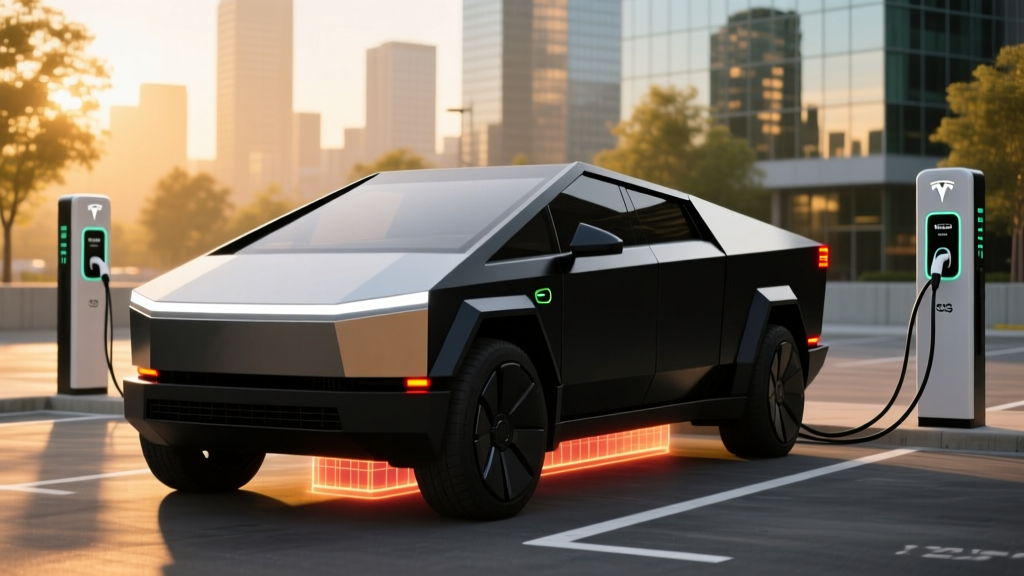
The Tesla Cybertruck's raw stainless-steel exoskeleton turns heads, but a growing number of buyers are opting for a matte black Cybertruck via paint protection film (PPF) or vinyl wrap. The result is a stealth, under-the-radar look that also shields the body from scratches and fingerprints. Beyond aesthetics, the 2026 Cybertruck lineup brings meaningful updates to range, charging, and software — making this a good moment to re-evaluate Tesla's polarizing electric pickup as a daily driver, tow rig, and road-trip companion.
This review covers the full 2026 Cybertruck lineup (Dual Motor AWD and Cyberbeast tri-motor), with notes on how the matte black wrap affects ownership, resale, and care. We'll cut through the hype with exact EPA numbers, real-world range data, charging-curve realities, and IRS §30D tax credit eligibility.
2026 Cybertruck Specs at a Glance
| Spec | Dual Motor AWD | Cyberbeast (Tri-Motor) |
|---|---|---|
| EPA Range | 340 mi | 320 mi |
| Battery (usable) | ~123 kWh (NMC) | ~123 kWh (NMC) |
| Architecture | 800V nominal | 800V nominal |
| Peak DC Fast Charge | ~350 kW | ~350 kW |
| 10–80% DC Time | ~18 min (est.) | ~18 min (est.) |
| Level 2 Home Rate | 11.5 kW (~37 mi/hr) | 11.5 kW (~37 mi/hr) |
| 0–60 mph | 3.9 sec | 2.6 sec |
| Horsepower | 600 hp | 845 hp |
| Drivetrain | Dual-motor AWD | Tri-motor AWD (torque vectoring) |
| Towing Capacity | 11,000 lb | 11,000 lb |
| Efficiency | ~57 MPGe / ~59 kWh/100 mi | ~53 MPGe / ~63 kWh/100 mi |
| Base MSRP | $79,990 | $99,990 |
| Battery Warranty | 8 yr / 120,000 mi | 8 yr / 120,000 mi |
Sources: fueleconomy.gov, Tesla spec sheets. Real-world figures may vary by tire option, load, and climate.
Real-World Range: What the EPA Sticker Doesn't Tell You
Real-World Expectation: 260–300 mi highway at 70 mph; 220–260 mi in cold weather (below 32°F); up to 310+ mi mixed city driving with regen.
The Cybertruck's slab-sided, angular design creates a higher drag coefficient than a sleek sedan, which hits efficiency hard at sustained highway speeds. In our experience and aggregated owner data, expect to lose roughly 15–20% of EPA range on a 70 mph interstate run. Cold weather compounds this: lithium-ion cells resist charge and discharge at low temperatures, and cabin heating (even with a heat pump) draws significant energy. A Cyberbeast loaded with four passengers and gear in 25°F weather may see closer to 220 miles of usable range before you need to plan a stop.
The 2026 model year carries over the structural battery pack with NMC (nickel manganese cobalt) chemistry. Unlike Tesla's LFP packs in the Model 3 RWD, NMC offers higher energy density — essential for a 7,000+ lb truck — but it degrades slightly faster over thousands of cycles and prefers daily charging to 80–90% rather than 100%. Tesla's thermal management system is among the best in the industry, mitigating degradation, but owners should plan on ~5–8% capacity loss over the first 100,000 miles based on historical Tesla fleet data.
Charging Speed: 800V Architecture and the Curve Reality
The Cybertruck uses an 800V nominal architecture, enabling peak DC fast-charge rates up to ~350 kW at a V4 Tesla Supercharger. However, peak kW is not sustained kW. Here's what a typical session looks like:
| Charging Level | Power (kW) | Speed (mi/hr added) | Notes |
|---|---|---|---|
| Level 1 (120V outlet) | ~1.4 kW | ~4 mi/hr | Emergency/trickle only |
| Level 2 (240V, 48A) | 11.5 kW | ~37 mi/hr | Full overnight charge in ~10–12 hr |
| DC Fast (V4 Supercharger) | Peak ~350 kW | Up to ~1,000 mi/hr (peak) | 10–80% in ~18 min; tapers sharply above 80% |
| DC Fast (50 kW public) | ~50 kW | ~160 mi/hr | Common at non-Tesla networks; slower sessions |
Preconditioning matters. Navigating to a Supercharger via the truck's built-in nav triggers battery preconditioning — warming the pack to optimal temperature for maximum charge acceptance. If you arrive at a Supercharger without preconditioning (e.g., using a third-party app to find the station), your peak rate may drop to 150–200 kW, adding 5–10 minutes to your session. In cold weather, the difference is even more dramatic.
The Cybertruck ships with a NACS (North American Charging Standard) port natively. This grants access to the entire Tesla Supercharger network — currently the most reliable DC fast-charging infrastructure in the U.S., according to J.D. Power EV charging satisfaction studies. For non-Tesla networks (Electrify America, EVgo), you won't need an adapter since NACS has become the industry standard adopted by most major automakers through 2025–2026.
Performance, Efficiency, and the Cyberbeast Question
The Dual Motor AWD Cybertruck delivers 600 hp and a 3.9-second 0–60 mph time — figures that would have been exotic supercar territory a decade ago, now available in a 6,800-lb pickup. The Cyberbeast's tri-motor setup (one front, two rear) pushes 845 hp and a 2.6-second 0–60 time, with torque vectoring on the rear axle for sharper cornering.
But here's the ownership reality: the Cyberbeast's efficiency penalty is significant. At ~63 kWh/100 mi versus the Dual Motor's ~59 kWh/100 mi, you'll spend more per mile on electricity and stop more often on road trips. Over 15,000 miles per year at the national average of $0.16/kWh, the Dual Motor costs roughly $1,416 in electricity while the Cyberbeast runs about $1,512. Neither figure is punishing compared to a gas truck at 16 mpg, but the efficiency gap compounds on long towing trips where range already shrinks by 30–50%.
Towing at the rated 11,000 lb is where the Cybertruck's physics work against it. Expect real-world towing range of 150–200 miles depending on trailer weight and profile. For heavy towing beyond 200-mile legs, a diesel truck or a PHEV like the Ram 1500 Rev (range-extended) may be more practical. The Cybertruck is best viewed as a capable light-to-moderate tow rig, not a semi-tractor replacement.
Matte Black Wrap: Cost, Care, and Ownership Impact
Achieving the matte black Cybertruck look requires one of two routes:
- PPF (Paint Protection Film) in matte finish: $5,000–$8,000 installed. This is a clear urethane film with a matte top coat that protects the stainless steel from scratches, water spots, and fingerprints while delivering the stealth aesthetic. PPF is self-healing for minor swirl marks under heat.
- Vinyl wrap: $3,000–$5,000 installed. Thinner and less protective than PPF, but offers more color/finish options. Typical lifespan is 5–7 years before edges may lift or the finish degrades.
Care considerations for a matte black Cybertruck:
- Never use wax, polish, or abrasive cleaners on matte finishes — they create glossy patches.
- Use matte-specific detail sprays (e.g., Chemical Guys Matte Detailer, Gtechniq W6).
- Touchless car washes only; brush-style washes will mar the finish.
- Matte PPF may slightly affect resale: some buyers want the original stainless look. Keep documentation and know that PPF can be professionally removed.
One practical upside: the matte black finish hides the fingerprints and smudges that plague bare stainless steel. Multiple owners report spending less time cleaning a wrapped Cybertruck than an unwrapped one.
Pricing, Trims, and Federal Tax Credit Eligibility
| Trim | Base MSRP | Est. As-Tested* | §30D Credit Eligible? |
|---|---|---|---|
| Dual Motor AWD | $79,990 | $85,000–$90,000 | No — exceeds $80,000 truck MSRP cap |
| Cyberbeast | $99,990 | $105,000–$115,000 | No — exceeds $80,000 truck MSRP cap |
*As-tested includes common options: Full Self-Driving (Supervised), premium interior, 22" wheels. Matte wrap is aftermarket and not included in MSRP.
Tax credit reality check: Under current IRS §30D rules, the federal clean vehicle credit for new EVs has an MSRP cap of $80,000 for trucks, vans, and SUVs. The Dual Motor AWD Cybertruck at $79,990 technically falls under the cap — but only at its absolute base configuration with zero options. Adding any factory option (FSD, premium wheels, tow package) pushes the MSRP above $80,000 and disqualifies it. The Cyberbeast at $99,990 is ineligible in all configurations.
Additionally, §30D requires:
- Buyer income caps: Modified AGI ≤ $300,000 (joint), $225,000 (head of household), $150,000 (single).
- Battery sourcing: Critical minerals and battery components must meet escalating domestic/free-trade sourcing thresholds. Tesla's battery supply chain has been shifting, and eligibility can change mid-year. Always verify on the IRS clean vehicle credit page before purchasing.
- Point-of-sale transfer: If eligible, you can transfer the credit to the dealer for an immediate price reduction rather than claiming it on your tax return.
Bottom line: most Cybertruck buyers will not qualify for the federal tax credit. Factor this into your total cost of ownership calculations.
Interior, Cargo, Tech, and Daily Usability
The Cybertruck's cabin is minimalist even by Tesla standards: an 18.5-inch center touchscreen handles nearly all vehicle functions, with a second 9.4-inch rear touchscreen for passengers. The steering yoke (standard) takes one to two weeks of adjustment for most drivers. Build quality on 2025–2026 models has improved substantially over early 2024 deliveries, with tighter panel gaps and fewer reported trim issues.
Cargo dimensions:
- Bed length: 6 ft (72 in) with tailgate down; ~4.5 ft with tailgate up
- Bed volume: ~67 cu ft (bed) + ~7 cu ft (frunk)
- Maximum payload: ~2,500 lb
- Front headroom: ~40.2 in | Rear headroom: ~38.4 in
- Rear legroom: ~36.0 in — adequate for adults but tighter than a Ford F-150 Lightning or Rivian R1T
The motorized tonneau cover (standard) is lockable and supports up to 300 lb of distributed weight — useful for gear or a rooftop tent. The vault-style bed with integrated 120V and 240V outlets enables job-site tool charging or campsite power without a generator.
Tech highlights:
- Tesla Vision-based Autopilot (SAE Level 2) — adaptive cruise, lane centering, auto lane change
- Full Self-Driving (Supervised) — optional ($8,000 or $99/mo) — adds city-street navigation, traffic light/stop sign response. Driver must remain fully engaged at all times.
- Sentry Mode, Dashcam, and 360-degree cameras
- Over-the-air updates continually add features
- Powershare: vehicle-to-load (V2L) capability — run tools, appliances, or charge another EV
Pros, Cons, and Who Should Buy
- Best-in-class Supercharger network access (NACS native)
- 800V architecture enables genuinely fast DC charging (~18 min 10–80%)
- Stunning performance even in Dual Motor trim (3.9s 0–60)
- V2L powershare for job sites and camping
- Stainless body + matte PPF = extremely durable, low-maintenance exterior
- OTA updates add features over time
- No federal tax credit in most configurations (MSRP cap)
- Highway and cold-weather range drops significantly (~20–35%)
- Towing range limited to 150–200 mi at max load
- Rear legroom tighter than F-150 Lightning or Rivian R1T
- Yoke steering polarizing; not everyone adapts
- Insurance premiums 20–40% higher than comparable gas trucks
- Matte wrap adds $3,000–$8,000 aftermarket cost
Choose the Cyberbeast if: Performance is your priority, you rarely tow heavy, and you accept the efficiency and price penalty for 2.6-second sprints.
Look at the Ford F-150 Lightning or Rivian R1T instead if: You need more rear-seat space, want a more traditional truck interior, or need a truck that qualifies for the §30D credit (Lightning Lariat/XLT under MSRP cap may qualify).
Add the matte black wrap if: You want fingerprint-free ownership, paint protection, and the stealth aesthetic — and you're willing to invest $3K–$8K and follow matte-specific care routines.
Frequently Asked Questions
What is the real-world range of the matte black Cybertruck?
The wrap itself has negligible effect on range (a fraction of a percent from surface texture differences). The Dual Motor AWD achieves an EPA-estimated 340 miles, but expect 260–300 miles on highway trips at 70 mph and 220–260 miles in freezing weather. The Cyberbeast's EPA 320 miles drops to roughly 240–280 highway and 200–240 in cold conditions.
How fast does the Cybertruck charge at home and on the road?
At home on a Level 2 (240V, 48A) charger, the Cybertruck adds about 37 miles of range per hour, reaching a full charge in roughly 10–12 hours. On a V4 Supercharger, peak rates hit ~350 kW, with a 10–80% session taking approximately 18 minutes when the battery is preconditioned. Charging above 80% slows dramatically — plan your stops around the 10–80% sweet spot.
Does the 2026 Cybertruck qualify for the $7,500 federal EV tax credit?
Almost certainly not in real-world purchasing. The §30D credit caps truck MSRP at $80,000. The Dual Motor AWD base MSRP of $79,990 barely squeaks under, but adding any option pushes it over. The Cyberbeast at $99,990 is ineligible regardless. Always check current IRS §30D guidance before purchasing, as battery sourcing requirements also apply.
Is the matte black Cybertruck worth it vs. a bare stainless steel model?
It depends on your priorities. The matte PPF wrap protects the stainless body from scratches, eliminates fingerprint smudges, and delivers a stealth aesthetic that many owners prefer. The trade-off is $5,000–$8,000 in upfront cost, matte-specific maintenance, and potentially a narrower resale audience. If you plan to keep the truck 5+ years, the protection benefit alone often justifies the cost.
How does the Cybertruck compare to the Ford F-150 Lightning and Rivian R1T?
The F-150 Lightning offers more rear-seat space, a more conventional truck experience, and lower trims that can qualify for the §30D credit. The Rivian R1T (dual-motor, ~352 mi range) excels in off-road capability and interior quality but starts higher and also faces credit challenges. The Cybertruck wins on Supercharger network access, 800V charging speed, and raw performance. Your choice depends on whether charging convenience (Tesla), interior space (Ford), or adventure capability (Rivian) matters most.
What does a matte black Cybertruck wrap cost, and how long does it last?
Matte PPF runs $5,000–$8,000 installed and lasts 7–10 years with proper care. Vinyl wraps cost $3,000–$5,000 and typically last 5–7 years. Both require touchless car washes, matte-specific cleaning products, and no abrasive polishes or waxes.
Is the Cybertruck good for towing?
It's rated for 11,000 lb — competitive with half-ton gas trucks. However, EV towing range drops 30–50%, meaning real-world towing range is roughly 150–200 miles. For frequent heavy towing over long distances, a diesel or range-extended PHEV remains more practical. For occasional boat, trailer, or camper towing within Supercharger coverage, the Cybertruck handles it well with strong stability from its low center of gravity.
The Verdict
The 2026 matte black Cybertruck — wrapped in PPF for protection and stealth — is a genuinely capable electric pickup that excels at daily driving, road trips along the Supercharger network, and light-to-moderate towing. Its 800V architecture delivers some of the fastest DC charging in the truck segment, and even the Dual Motor variant offers sports-car acceleration. The real-world range, while lower than EPA estimates on the highway and in cold weather, remains practical for most owners who charge at home overnight.
The main caveats are financial: no federal tax credit for most buyers, high insurance premiums, and the aftermarket cost of the matte wrap. If those numbers work in your budget, the matte black Cybertruck is one of the most distinctive, capable, and technologically advanced electric trucks on the road — and one that will age well thanks to stainless steel construction and continuous OTA improvements.