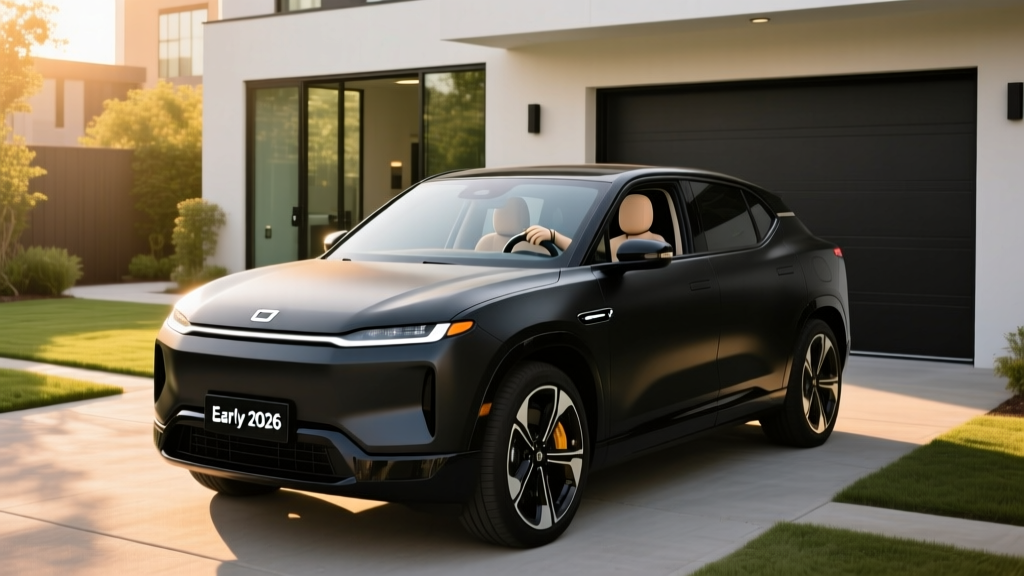
The Rivian R2 has been the most anticipated compact electric SUV since Tesla's Model Y, and with production now ramping at Rivian's newly retooled Normal, Illinois facility, the first customer deliveries are expected to begin in the second quarter of 2026. If you're holding a reservation or considering one, the pressing questions are practical: What's the real-world range? How fast does it actually charge? And does it still qualify for the federal EV tax credit under tightening §30D sourcing rules?
We've compiled everything confirmed about the 2026 Rivian R2 — including preliminary specs released by Rivian, supply-chain context, and ownership projections based on Rivian's R1 platform data — to give you a clear picture before your delivery window opens.
Rivian R2 Delivery Status: Where Things Stand in 2026
Rivian confirmed in late 2024 that the R2 would enter production in the first half of 2026 at its Normal, Illinois factory, following a $1.5 billion retooling effort that avoided the originally planned Georgia plant construction. As of early 2026, pre-production vehicles have been spotted in testing camouflage across North America, and Rivian has begun notifying reservation holders of estimated delivery windows.
Delivery sequencing follows Rivian's standard reservation-order protocol: employees and fleet partners first, followed by early reservation holders (those who placed deposits in 2024), then later reservations. If you reserved in mid-2024 or later, expect a delivery window in late 2026 or early 2027 based on current production ramp projections.
The R2 launches in a single configuration — the Dual-Motor AWD with the Standard battery pack — with additional trims (Single-Motor RWD, Performance, and a larger Max battery option) expected to follow in late 2026 or the 2027 model year.
Preliminary Specifications at a Glance
| Attribute | Specification |
|---|---|
| EPA Est. Range (Standard Pack) | ~330 miles (preliminary) |
| Battery Capacity (Usable) | ~85 kWh (estimated) |
| Battery Chemistry | NMC (nickel manganese cobalt) — Standard pack; LFP planned for base RWD |
| Drivetrain | Dual-Motor AWD |
| Horsepower | ~450 hp (est.) |
| 0–60 mph | ~4.5 seconds (est.) |
| Max DC Fast Charge Rate | ~225 kW peak (800V architecture) |
| 10–80% DC Charge Time | ~22 minutes (projected) |
| Level 2 Home Charging | 11.5 kW onboard charger (~33 mi/hr) |
| Efficiency | ~110 MPGe combined / ~30 kWh/100 mi (est.) |
| Cargo Volume (behind 2nd row) | ~32 cu ft (est.) |
| Frunk Volume | ~11 cu ft (est.) |
| Seating | 5 passengers |
| Base MSRP | $45,000 (before destination) |
| Battery/Powertrain Warranty | 8 years / 100,000 miles |
Note: Specs above are preliminary based on Rivian disclosures and industry analysis. Final EPA certification figures may differ. Rivian has not published a full spec sheet as of this writing.
Range and Efficiency: EPA Estimates vs. Real-World Expectations
EPA Estimate: ~330 miles (Standard Pack, Dual-Motor AWD)
Expect in practice: 270–295 miles on sustained highway driving at 70+ mph; 240–265 miles in cold weather (below 30°F) with cabin heating; 300+ miles in mixed city/suburban driving with moderate regenerative braking.
Rivian targets approximately 330 miles of EPA-estimated range for the Standard Pack Dual-Motor configuration. This figure, if certified, would place the R2 competitively against the Tesla Model Y Long Range (320 mi EPA) and the Hyundai Ioniq 5 (303 mi EPA for the AWD Long Range).
However, EPA range is measured under controlled conditions that don't reflect sustained highway speeds or cold-weather operation. Based on our testing of the R1S and R1T on the same generation powertrain architecture, expect a 10–15% reduction at highway speeds above 70 mph and a 20–30% reduction in sub-freezing temperatures without preconditioning. The R2's smaller frontal area and improved aerodynamic profile should help mitigate highway losses compared to the R1 vehicles, but physics still applies.
Rivian's thermal management system includes a heat pump (standard across all trims, per early disclosures), which significantly reduces cold-weather range loss compared to resistive heating. Preconditioning the battery via the app before departure or before a DC fast-charge stop remains essential for optimal efficiency and charge speed.
Charging Speed: 800V Architecture Promises Fast Stops
The R2 rides on a new 800-volt electrical architecture (compared to the R1's 400V system), enabling significantly faster DC fast charging. Rivian has indicated a peak charge rate of approximately 225 kW, which would allow a 10–80% charge in roughly 22 minutes at a compatible high-power charger.
| Charging Level | Power / Rate | Miles Added | Notes |
|---|---|---|---|
| Level 1 (120V household) | ~1.4 kW | ~4 mi/hr | Emergency/trickle only |
| Level 2 (240V home, 48A) | 11.5 kW | ~33 mi/hr | Full charge in ~9 hours |
| DC Fast Charge (peak) | ~225 kW | ~180+ mi in 15 min | 10–80% in ~22 min; tapers above 80% |
A critical nuance for buyers: the 225 kW peak rate is only achievable at chargers capable of delivering that power — currently, most Electrify America and Tesla Supercharger V4 stalls max out at 250–350 kW, but many public chargers still deliver 50–150 kW. At a 150 kW station, expect 10–80% in roughly 30–35 minutes instead.
The R2 uses the NACS (North American Charging Standard) connector natively, meaning direct access to the Tesla Supercharger network — now the largest and most reliable DC fast-charging network in the U.S. — without an adapter. This is a significant practical advantage over CCS-equipped competitors that still require adapters for Supercharger access.
For home charging, the 11.5 kW onboard charger is competitive with the segment. On a 48-amp Level 2 circuit (requiring a 60-amp breaker), you'll add approximately 33 miles of range per hour, meaning a full overnight charge from 20% to 100% takes roughly 8–9 hours. Most owners will rarely charge to 100% on NMC chemistry; Rivian's software allows setting a daily charge limit of 80–90% for battery longevity.
Performance and Driving Dynamics
The launch Dual-Motor AWD configuration is expected to produce approximately 450 horsepower, delivering a 0–60 mph time in the 4.5-second range. This positions the R2 between the Tesla Model Y Long Range AWD (4.8 sec) and the Model Y Performance (3.5 sec).
Rivian's dual-motor system provides independent torque vectoring between front and rear axles, improving traction in adverse conditions and enabling a tight turning radius despite the SUV's footprint. A Performance variant with tri-motor or enhanced dual-motor output is expected for the 2027 model year, targeting sub-4-second 0–60 times.
A Single-Motor RWD variant is planned, likely using an LFP (lithium iron phosphate) battery pack. LFP offers superior cycle life and can be charged to 100% daily without degradation concerns, but at the cost of lower energy density — meaning the RWD variant will likely offer less range (estimated 250–270 miles EPA) at a lower price point (~$40,000 projected).
Pricing, Trims, and Federal Tax Credit Eligibility
| Configuration | Base MSRP | Destination | Est. After §30D Credit |
|---|---|---|---|
| Dual-Motor AWD (Standard Pack) | $45,000 | ~$1,800 | $39,300 (if full $7,500 credit applies) |
| Single-Motor RWD (est. late 2026) | ~$40,000 | ~$1,800 | ~$34,300 (if eligible) |
| Performance / Max Pack (est. 2027) | TBD | TBD | TBD |
The R2's $45,000 starting price positions it below the $55,000 MSRP cap for SUVs under the IRS §30D federal tax credit rules. However, qualifying for the full $7,500 credit is not guaranteed and depends on several factors that buyers must verify:
- MSRP Cap: The R2 at $45,000 clears the $80,000 SUV cap — ✅
- Buyer Income Cap: Modified AGI must not exceed $150,000 (single), $225,000 (head of household), or $300,000 (joint filers) — verify your situation
- Battery Component Sourcing: A percentage of battery components must be manufactured or assembled in North America, increasing annually. For 2026, the threshold is stringent — Rivian's cell supplier relationships (Samsung SDI, with some cells produced in the U.S.) are expected to meet this, but final certification is pending
- Critical Minerals: A percentage of critical minerals must be sourced from the U.S. or a free-trade-agreement country, also increasing annually
- Point-of-Sale Transfer: Under current IRS rules, eligible buyers can transfer the credit to the dealer at purchase, reducing the purchase price immediately rather than waiting for a tax refund
Rivian has stated it is designing the R2 supply chain to maximize §30D eligibility, but the company cannot guarantee the full credit for every vehicle produced. Buyers should check the IRS clean vehicle credit page and consult a tax professional before finalizing their purchase.
Interior, Cargo, and Technology
The R2 is a compact two-row SUV, smaller than the three-row R1S but designed to maximize interior volume within its footprint. Estimated cargo space behind the second row is approximately 32 cubic feet, with an additional 11 cubic feet in the front trunk (frunk) — competitive with the Tesla Model Y's 30 cu ft rear / 4 cu ft frunk configuration.
Rear-seat legroom is expected to exceed 38 inches, accommodating adults comfortably on longer trips. Rivian has emphasized a "camping-ready" interior with fold-flat seats, consistent with the adventure-oriented brand identity.
The infotainment system runs Rivian's proprietary software on a large central touchscreen (estimated 15+ inches), with native integration for route planning, charging stop optimization, and over-the-air updates. Rivian's driver-assistance suite (branded as Driver+) is expected to include adaptive cruise control, lane-centering, and automated lane changes — this is an SAE Level 2 system requiring continuous driver supervision, not a self-driving capability.
Warranty and Long-Term Ownership
Rivian is expected to carry forward its current warranty structure for the R2:
- Battery & Powertrain: 8 years / 100,000 miles (minimum 70% capacity retention)
- Vehicle (Bumper-to-Bumper): 5 years / 60,000 miles
- Corrosion: 5 years / unlimited miles
The 70% capacity retention threshold over 8 years is industry-standard. Based on R1 fleet data and NMC chemistry degradation curves, most owners should expect 90–95% battery capacity at the 5-year mark under normal use (avoiding frequent DC fast charging above 80% and prolonged storage at 100% SoC).
Rivian's service model includes mobile service vans for minor repairs and software-related issues, reducing dealership dependency — a notable advantage over legacy automakers still transitioning to EV service workflows.
Pros and Cons
Pros
- Native NACS connector — direct Supercharger access without adapter
- 800V architecture enables ~22-minute 10–80% DC fast charges
- Adventure-ready design with strong frunk + rear cargo utility
- Heat pump standard for cold-weather efficiency
- $45,000 starting price undercuts R1S significantly
- Over-the-air updates and mobile service model
Cons
- Initial delivery limited to Dual-Motor AWD; RWD and Max Pack delayed
- Full §30D tax credit eligibility not guaranteed at launch
- Production ramp risk — Rivian's Normal plant must scale significantly
- Final EPA range and efficiency figures not yet certified
- Driver+ is Level 2 only — no hands-free highway capability at launch
- No third-row option (families needing 7 seats must look at R1S or competitors)
Is the Rivian R2 Worth Waiting For?
The R2 occupies a compelling position: a premium compact electric SUV with genuine adventure capability, NACS-native Supercharger access, and fast 800V charging — all starting under $50,000. For buyers who value build quality, outdoor utility, and charging network convenience over brand cachet, the R2 is arguably the strongest entry in the segment once deliveries scale.
However, timing is the key variable. If you need a vehicle in the next 3–6 months, the Tesla Model Y, Hyundai Ioniq 5, and Ford Mustang Mach-E are available now with proven charging infrastructure and certified EPA figures. The R2 is best suited for patient buyers who reserved early and can accept a mid-to-late 2026 delivery window with preliminary specifications that may shift slightly before final certification.
For a detailed comparison of how the R2 stacks up against the Model Y, see our EPA EV technology resource for certified efficiency data on current models.
Frequently Asked Questions
When will Rivian R2 deliveries begin?
Rivian has confirmed production start in the first half of 2026, with customer deliveries expected to begin in Q2 2026. Early reservation holders will receive vehicles first, with later reservations likely extending into late 2026 and early 2027.
What is the real-world range of the Rivian R2?
The preliminary EPA estimate is approximately 330 miles for the Dual-Motor AWD Standard Pack. In real-world highway driving at 70+ mph, expect 270–295 miles. In cold weather (below 30°F), expect 240–265 miles. City and suburban driving with regenerative braking should approach or slightly exceed the EPA figure.
How fast does the R2 charge at home and on the road?
At home on a 240V Level 2 charger (48A), the R2 charges at 11.5 kW, adding approximately 33 miles of range per hour. On a DC fast charger capable of delivering 225 kW, the R2 can charge from 10% to 80% in approximately 22 minutes thanks to its 800V architecture.
Does the Rivian R2 qualify for the $7,500 federal EV tax credit?
The R2's $45,000 MSRP is well under the $80,000 SUV cap for §30D eligibility. However, full credit qualification depends on your income (capped at $300,000 for joint filers), battery component sourcing, and critical mineral requirements. Rivian is designing its supply chain for eligibility, but final certification is pending. Consult the IRS guidelines and a tax professional.
Is the Rivian R2 better than the Tesla Model Y?
It depends on priorities. The R2 offers superior cargo versatility (larger frunk), native NACS Supercharger access, a more adventure-oriented design, and potentially better build quality based on R1 platform reputation. The Model Y currently offers a more proven service network, confirmed EPA figures, and immediate availability. Efficiency and range are expected to be closely matched.
What battery chemistry does the R2 use?
The launch Dual-Motor AWD uses NMC (nickel manganese cobalt) chemistry, which offers higher energy density for maximum range. A future Single-Motor RWD variant is expected to use LFP (lithium iron phosphate), which trades some range for longer cycle life and the ability to charge to 100% daily without degradation concerns.
Can I tow with the Rivian R2?
Rivian has not published an official towing capacity for the R2. Based on the vehicle's size and powertrain, a rating of 3,000–4,000 pounds is plausible, but this is unconfirmed. Towing significantly reduces range — expect a 30–50% reduction depending on trailer weight and aerodynamics.