The Maryland EV Incentive Landscape in 2026: What Actually Exists
Shoppers searching for a Maryland tax credit electric vehicle deal often hit a wall: Maryland's popular $3,000 state EV tax credit (HEV-EV-02) exhausted its annual funding allocation and has not been renewed for the 2026 tax year. Unlike states such as Colorado, Massachusetts, or New York that still offer active purchase rebates, Maryland buyers in 2026 must rely primarily on the federal IRS §30D Clean Vehicle Credit, utility-level rebates, and the state's HOV lane and emissions-test exemptions to offset costs.
This doesn't mean Maryland is a bad place to buy an EV — it just means the math has shifted. Between federal credits (up to $7,500 at point of sale), utility incentives from BGE, Pepco, and SMECO, and lower per-mile operating costs, the 5-year total cost of ownership for a well-chosen EV can still undercut a comparable gas car. But you have to run the real numbers, not the brochure numbers.
- Federal §30D Credit: Up to $7,500 (point-of-sale transfer available)
- Maryland State Purchase Credit: Currently unfunded / not available for 2026
- Utility Rebates: BGE up to $500 (EV + charger), Pepco up to $500, SMECO up to $500
- Maryland Excise Tax Exemption: EVs are exempt from the state's 6% titling excise tax (up to $2,500 savings on a $42,000 vehicle)
- HOV Lane Access: Qualifying EVs get permits for I-270, I-495, and US 50 HOV lanes
- Emissions Inspection: EVs are exempt from Maryland's VEIP emissions testing
Federal §30D Tax Credit: Eligibility Rules That Actually Matter
The federal Clean Vehicle Credit under IRS §30D remains the single largest incentive available to Maryland EV buyers in 2026, but qualification is far from automatic. The credit is split into two halves — $3,750 for critical minerals sourcing and $3,750 for battery component manufacturing — and vehicles must meet both to reach the full $7,500. Many popular models only qualify for $3,750 or nothing at all depending on the model year and battery supply chain.
- Income caps (MAGI): $150,000 single / $225,000 head of household / $300,000 joint
- MSRP caps: $80,000 for SUVs, pickups, vans; $55,000 for sedans and other body styles
- Battery sourcing: Critical minerals and battery components must meet escalating domestic/free-trade-agreement percentages (verify per model on fueleconomy.gov)
- Final assembly: Must occur in North America
- Transfer election: As of 2024+, you can transfer the credit to the dealer at point of sale for an immediate price reduction — you don't have to wait until tax filing
- One credit per person: Limited to one new EV credit and one used EV credit per 3-year period
For Maryland buyers eyeing popular models: the Tesla Model Y (Long Range, AWD) continues to qualify for the full $7,500 in most configurations. The Ford F-150 Lightning and Rivian R1S/R1T also qualify fully. The Hyundai IONIQ 5 (built in Georgia since late 2024) now qualifies for the full credit. However, several imported models — including some BMW and Volkswagen variants — may only qualify for partial or no credit depending on battery sourcing. Always verify your exact trim on the IRS qualified vehicles list before signing a purchase agreement.
5-Year Total Cost of Ownership: EV vs Gas in Maryland
To understand whether an EV makes financial sense in Maryland, we need to model a realistic 5-year/75,000-mile ownership cycle. Below, we compare a 2026 Tesla Model Y Long Range AWD ($46,630 MSRP before incentives) against a 2026 Toyota RAV4 XLE AWD ($33,425 MSRP) — two of the most-purchased vehicles in the state.
| Category | 2026 Tesla Model Y LR AWD | 2026 Toyota RAV4 XLE AWD |
|---|---|---|
| Purchase Price (MSRP) | $46,630 | $33,425 |
| Federal §30D Credit | −$7,500 | $0 |
| MD Excise Tax Exemption (6%) | −$2,348 | $0 |
| Effective Purchase Cost | $36,782 | $33,425 |
| Home Charger Install (Level 2, 240V/48A) | $1,200 | $0 |
| Fuel / Electricity (75k mi) | $4,125 | $9,938 |
| Maintenance (5 years) | $1,800 | $4,200 |
| Insurance (5 years, avg) | $11,250 | $8,500 |
| Depreciation (5-year) | $18,500 | $13,200 |
| 5-Year Total Cost | $73,657 | $69,263 |
The verdict: Over 5 years, the Model Y costs roughly $4,400 more than the RAV4 in this Maryland scenario. The gap is almost entirely driven by higher insurance premiums (+$2,750) and steeper depreciation (+$5,300). The Model Y saves substantially on fuel ($5,813 less) and maintenance ($2,400 less), and the federal credit + excise tax exemption close the purchase-price gap to just $3,357. For buyers who plan to keep the vehicle 8-10 years, the EV pulls ahead as depreciation flattens and fuel savings compound.
Charging vs Gas: The Real $/Mile Math in Maryland
Maryland's residential electricity rates average around $0.16/kWh as of early 2026 (BGE standard offer service), though this varies by utility and time-of-use plan. DC fast charging on networks like Electrify America or EVgo in Maryland typically runs $0.38–$0.52/kWh depending on the charger speed and time of day.
| Fueling Method | Cost per kWh / Gallon | Vehicle Efficiency | Cost per Mile |
|---|---|---|---|
| Home Level 2 (BGE, $0.16/kWh) | $0.16/kWh | 3.5 mi/kWh (Model Y) | $0.046 |
| Home Level 2 (TOU off-peak, $0.10/kWh) | $0.10/kWh | 3.5 mi/kWh | $0.029 |
| DC Fast Charging (avg $0.45/kWh) | $0.45/kWh | 3.5 mi/kWh | $0.129 |
| Gasoline (MD avg $3.45/gal, 28 MPG combined) | $3.45/gal | 28 MPG (RAV4 AWD) | $0.123 |
The insight: Home-charged EVs in Maryland cost 2.7 to 4.2 cents per mile — roughly 75-80% cheaper than gasoline at current prices. But here's the critical caveat: if you rely exclusively on DC fast charging (no home or workplace charging), your cost per mile actually exceeds gasoline at $0.129/mi. This is why home Level 2 charging is non-negotiable for EV economics. If you can't install a home charger, a plug-in hybrid (PHEV) may be the smarter financial play.
Maryland utilities also offer time-of-use (TOU) rate plans. BGE's Schedule EV program offers off-peak rates as low as $0.07–$0.10/kWh for overnight charging (typically 12 AM – 6 AM), which drops your fuel cost to under $0.03/mile. Enrolling in a TOU plan is one of the highest-ROI moves a Maryland EV owner can make.
Maintenance Savings: Where EVs Quietly Win
EVs eliminate a long list of routine maintenance items that gas-car owners pay for every 5,000–10,000 miles. Over a 5-year/75,000-mile ownership period, the maintenance gap becomes substantial.
| Service Item | EV Cost | Gas Car Cost |
|---|---|---|
| Oil Changes (15 services @ $55 avg) | $0 | $825 |
| Transmission Fluid | $0 | $200 |
| Brake Pads (regen extends life 2-3x) | $250 | $800 |
| Engine Air Filter / Cabin Filter | $150 | $350 |
| Coolant Flush / Spark Plugs | $0 | $450 |
| Tire Rotation + Replacement (EVs wear tires ~20% faster due to weight/torque) | $1,400 | $1,100 |
| 5-Year Maintenance Total | $1,800 | $3,725 |
Regenerative braking is the unsung hero here. Because regen handles the majority of deceleration, friction brake pads on EVs routinely last 80,000–120,000 miles — many owners never replace pads during their ownership. The one maintenance cost where EVs are more expensive is tires: the extra 500–1,000 lbs of battery mass plus instant torque accelerates tread wear. Budget for one extra tire set over 5 years compared to a gas equivalent.
Insurance Reality: The Cost EV Owners Don't See Coming
EV insurance premiums in Maryland run 15–30% higher than equivalent gas vehicles, and this is consistently the largest surprise cost for new EV owners. In our model, the Tesla Model Y averages $2,250/year for full coverage in Maryland (varies significantly by zip code, driving record, and insurer) compared to $1,700/year for the RAV4.
Why EVs cost more to insure:
- Higher repair costs: Battery packs, high-voltage components, and specialized body structures require certified technicians and OEM parts. A minor rear collision that totals a battery can push a claim to total-loss territory.
- Higher vehicle value: Insurers base premiums partly on replacement cost, and EVs still carry higher MSRPs than comparable gas vehicles.
- Limited repair network: Fewer body shops have EV high-voltage certification, which drives up labor rates and repair timelines.
- Tesla premium: Tesla vehicles specifically carry a brand-level insurance surcharge due to historically higher claim frequencies and repair costs, though Tesla's own insurance product (available in Maryland) can sometimes undercut traditional carriers for clean-record drivers.
How to reduce EV insurance costs in Maryland: Shop quotes from GEICO (HQ in Chevy Chase, often competitive on EVs), State Farm, Progressive, and Tesla Insurance. Bundling home+auto, maintaining a clean record for 3+ years, and choosing higher deductibles ($1,000 vs $500) can narrow the gap to 5–10% above gas equivalents.
Depreciation and Resale Value: The Moving Target
EV depreciation has been the most volatile ownership variable over the past three years. After aggressive price cuts by Tesla in 2023-2024 cascaded through the used market, EV resale values dropped significantly. As of early 2026, the market has stabilized, but EVs still depreciate faster than equivalent gas vehicles on average.
Typical 5-year depreciation for mainstream EVs: 45–55% of original transaction price. For comparison, a Toyota RAV4 holds roughly 60% of its value at 5 years (depreciating ~40%).
Factors working against EV resale value:
- Battery degradation uncertainty: Buyers of 5-year-old EVs worry about remaining range and potential $10,000–$20,000 battery replacement costs, even though most modern LFP and NMC packs retain 85–92% capacity at 100,000 miles.
- Rapid tech obsolescence: A 2021 EV with 250 miles of range and 50 kW charging looks dated next to a 2026 model with 350 miles and 250 kW charging. This tech churn depresses older model values.
- New-vehicle price competition: When new EV prices drop (as they have with increasing Chinese-manufactured competition and battery cost declines), used EV values fall in tandem.
Factors working in favor: Federal used-EV tax credit (§25E, up to $4,000 on vehicles priced under $25,000) supports demand in the secondary market. Battery warranties (typically 8 years/100,000 miles) transfer to second owners, providing a safety net.
Maryland Utility Rebates and Regional Incentives
While the state purchase credit is currently unfunded, Maryland's investor-owned utilities offer modest but stackable rebates that can offset home charging equipment costs:
- BGE (Baltimore Gas & Electric): Up to $300 for EV purchase/lease + up to $200 for Level 2 charger install. Enrollment in BGE's EV TOU rate program required.
- Pepco: Up to $500 rebate for residential Level 2 charger installation. Must enroll in Pepco EV Rider TOU rate.
- SMECO (Southern Maryland Electric): Up to $500 for Level 2 charger purchase and installation for residential customers.
- Potomac Edison (FirstEnergy): Limited-time rebates — check current availability as programs rotate.
Note: Utility rebate programs change frequently and are subject to funding availability. Verify current offerings directly with your utility before purchase.
Maryland also offers non-monetary incentives that have real value for commuters: qualifying EVs receive an HOV lane permit allowing single-occupant use of express lanes on I-270, I-495 (Capital Beltway), and US 50. For daily commuters in the DC-MD corridor, this time savings alone can be worth thousands in productivity over a year.
Frequently Asked Questions
Does Maryland offer a state tax credit for electric vehicles in 2026?
Maryland's $3,000 state EV tax credit (HEV-EV-02) is currently unfunded and not available for the 2026 tax year. The state legislature has discussed reinstating it, but no active program exists as of this writing. Maryland EV buyers should focus on the federal §30D credit (up to $7,500), the 6% excise tax exemption, utility rebates, and HOV lane access.
How much does it really cost to own an EV over 5 years in Maryland?
Based on our Model Y vs RAV4 comparison over 75,000 miles, a well-chosen EV costs approximately $70,000–$75,000 over 5 years including purchase (after incentives), electricity, maintenance, insurance, and depreciation. This is typically $3,000–$8,000 more than a comparable gas vehicle, with the gap driven primarily by higher insurance and depreciation. The EV breaks even or pulls ahead at 7-8+ years of ownership as fuel and maintenance savings compound.
Do I qualify for the federal EV tax credit?
You qualify for up to $7,500 under IRS §30D if: your modified adjusted gross income is under $150K (single) / $300K (joint), the vehicle MSRP is under $55K (sedans) or $80K (SUVs/trucks), the vehicle's battery meets critical mineral and component sourcing thresholds, and final assembly occurred in North America. Use the VIN lookup tool on fueleconomy.gov to verify your specific vehicle.
How much do I save on fuel and maintenance with an EV?
In Maryland, home-charged EVs cost approximately $0.03–$0.05 per mile to fuel, compared to $0.12–$0.14 per mile for a 28 MPG gas vehicle at $3.45/gallon. Over 75,000 miles, that's $5,500–$7,000 in fuel savings. Maintenance savings add another $1,500–$2,500 over 5 years from eliminated oil changes, reduced brake wear, and fewer fluid services. Combined operating savings typically total $7,000–$9,500 over 5 years.
Are EVs more expensive to insure in Maryland?
Yes. Expect to pay 15–30% more for full-coverage insurance on an EV compared to a similar gas vehicle. For a Tesla Model Y in Maryland, that translates to roughly $2,200–$2,500/year vs $1,600–$1,900/year for a RAV4. Higher repair costs, specialized parts, and elevated vehicle values drive the premium difference. Shopping multiple carriers and considering Tesla Insurance (for Tesla owners) can help narrow the gap.
How well do EVs hold their value?
EVs currently depreciate 45–55% over 5 years, compared to roughly 40% for mainstream gas vehicles. The gap is driven by battery degradation concerns, rapid technology advancement making older models feel dated, and new-vehicle price competition. Leasing is an effective strategy to avoid depreciation risk, and the federal used-EV credit (§25E) provides some demand support in the secondary market.
Can I charge at home in Maryland, and what does installation cost?
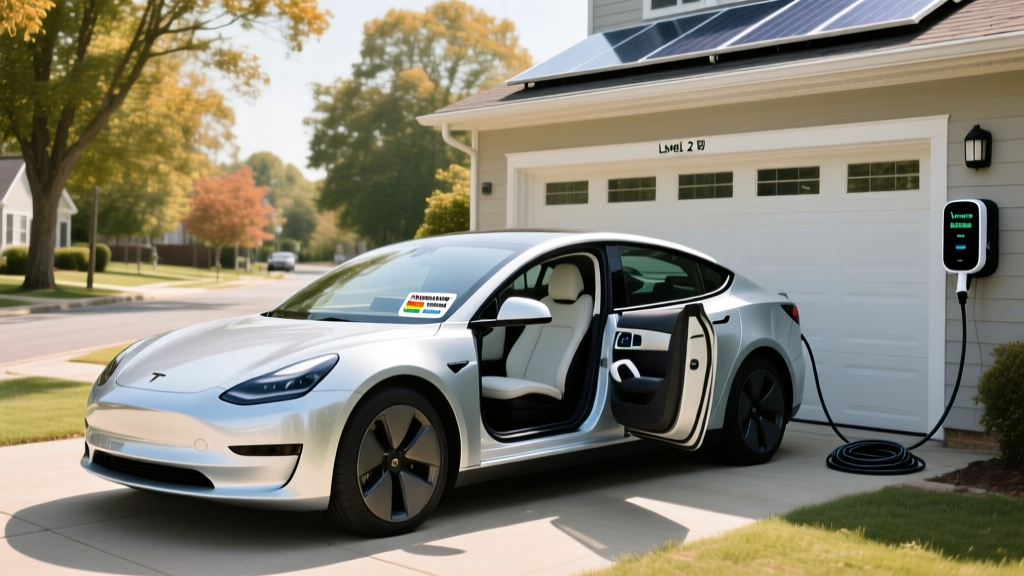
Most Maryland homeowners with a garage or dedicated parking space can install a Level 2 (240V) home charger. Expect to pay $600–$1,500 for a quality 48-amp charger (ChargePoint Home Flex, Tesla Wall Connector, or Emporia Level 2) plus $500–$2,000 for electrician installation depending on whether your electrical panel needs an upgrade. A 200-amp panel is typically sufficient; homes with older 100-amp panels may need a $1,500–$3,000 panel upgrade. Total install: $1,100–$3,500 in most cases.