Ford Mustang Mach-E Towing Capacity: What You Need to Know
The 2026 Ford Mustang Mach-E remains one of the most popular electric SUVs on the road, blending crossover practicality with sports-sedan performance. But for buyers eyeing a light trailer, bike rack, or small camper, the critical question isn't just about range or 0-60 times — it's about utility. Specifically: what is the Mach-E towing capacity, and how does pulling a load affect real-world range and efficiency?
Let's cut through the marketing and examine the hard numbers — from EPA range and battery specs to the actual cost of ownership after federal tax credits — so you can decide if the Mach-E fits your hauling needs.
Spec Table: 2026 Ford Mustang Mach-E at a Glance
| Spec | Select (RWD) | Premium (AWD) | GT (AWD) |
|---|---|---|---|
| EPA Range | 250 mi (Standard) / 320 mi (Extended) | 290 mi (Extended) | 280 mi (Extended) |
| Battery (usable) | 70 kWh / 91 kWh (NMC) | 91 kWh (NMC) | 91 kWh (NMC) |
| Horsepower | 266 hp | 346 hp | 480 hp (w/ Performance Upgrade) |
| 0-60 mph | 6.3 sec | 5.1 sec | 3.5 sec |
| Max DC Fast Charge | 150 kW | 150 kW | 150 kW |
| 10-80% DC Time | ~38 min | ~38 min | ~38 min |
| Level 2 Home Charge | 10.5 kW (~30 mi/hr) | 10.5 kW (~30 mi/hr) | 10.5 kW (~30 mi/hr) |
| MPGe (combined) | 101 MPGe | 97 MPGe | 84 MPGe |
| Towing Capacity | 1,500 lbs | 2,200 lbs (w/ factory tow pkg) | 2,200 lbs (w/ factory tow pkg) |
| Cargo (behind 2nd row) | 29.7 cu ft | 29.7 cu ft | 29.7 cu ft |
| Frunk | 4.7 cu ft (drainable) | 4.7 cu ft (drainable) | 4.7 cu ft (drainable) |
| Base MSRP | $42,995 | $48,995 | $59,995 |
Understanding the Mach-E Towing Capacity in Detail
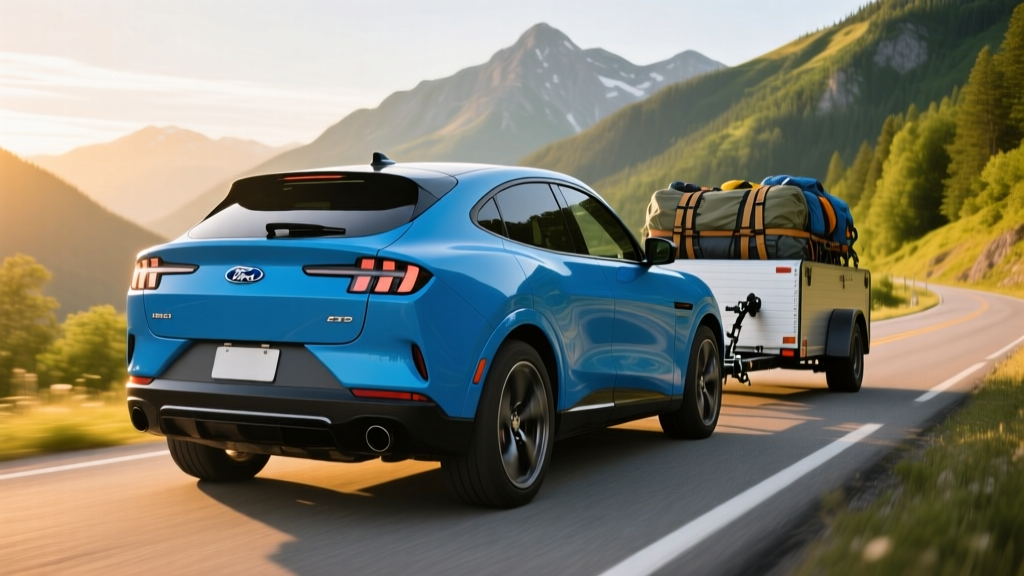
The 2026 Ford Mustang Mach-E carries a maximum towing capacity of 2,200 pounds when equipped with the factory tow package and all-wheel drive (AWD). This applies to the Premium AWD and GT AWD trims. The Select RWD trim is rated for 1,500 pounds. These figures are SAE J2807-tested — Ford's published numbers reflect a standardized protocol, not optimistic estimates.
What does 2,200 pounds actually let you tow? Here's a practical breakdown:
- Lightweight teardrop trailers: Most weigh 1,000–1,800 lbs loaded
- Small utility trailers: 5×8 or 5×10 foot open trailers with yard equipment
- Motorcycle/ATV trailers: Single-bike trailers typically 1,200–1,800 lbs
- Jet skis on a single-axle trailer: Generally 1,400–2,000 lbs
- Bicycle racks (hitch-mounted): 4-bike platform racks at ~150–250 lbs total
What it cannot tow: full-size travel trailers, most boat-and-trailer combos over 18 feet, horse trailers, or enclosed car haulers. If your regular hauling exceeds 2,200 lbs, you need to look at the Ford F-150 Lightning (rated up to 10,000 lbs) or the Rivian R1S (up to 7,700 lbs).
Real-World Range vs. EPA Estimates
EPA sticker (Premium AWD Extended Range): 290 miles
Real-world highway (70 mph, 72°F): ~245–260 miles
Real-world cold weather (30°F, highway): ~195–220 miles
While towing (near max capacity, 65 mph): ~130–175 miles
The Mach-E's 91 kWh usable battery (Extended Range) uses NMC (nickel manganese cobalt) chemistry, which offers higher energy density than LFP but is more sensitive to sustained high states of charge and extreme cold. Ford's thermal management system is robust — the liquid-cooled pack maintains consistent temperatures during fast charging and heavy loads.
In mixed driving (city and highway), owners typically report achieving 85–95% of the EPA figure in mild weather. Highway-heavy commutes at sustained 75+ mph speeds push consumption higher, and cold weather below freezing can reduce range by 20–30% due to cabin heating demands and reduced battery efficiency. The Mach-E does not currently offer a heat pump (a notable omission versus competitors like the Hyundai Ioniq 5 and Tesla Model Y), so resistance heating draws directly from the traction battery in winter.
According to fueleconomy.gov, the 2025–2026 Mach-E Premium AWD Extended Range achieves 97 MPGe combined (34 kWh/100 mi). When towing, expect consumption to rise to 55–70 kWh/100 mi depending on trailer weight and aerodynamics.
Charging Speed: DC Fast and Home Level 2
The Mach-E charges at a peak rate of 150 kW on DC fast chargers using the CCS1 connector (or NACS on 2025+ models equipped with the Tesla-style port, depending on build date and Ford's transition timeline). At 150 kW peak, the 10–80% charge takes approximately 38 minutes.
However, peak rate is not sustained rate. The Mach-E's charging curve tapers noticeably above 60% state of charge. Expect the following approximate progression:
| Charge Level | Speed | Time / Rate |
|---|---|---|
| Level 1 (120V household) | ~1.4 kW | ~3 mi/hr — emergency only |
| Level 2 (240V, 48A home charger) | 10.5 kW | ~30 mi/hr — full charge in ~9.5 hrs |
| DC Fast Charge (peak) | 150 kW | 10–80% in ~38 min |
| DC Fast Charge (towing scenario, 20–60%) | ~100–130 kW avg | ~45 min for usable highway range |
For towing trips, the 150 kW peak rate means planning a 30–40 minute charge stop every 130–160 miles when pulling a trailer. This is adequate for weekend getaways but adds significant time to longer hauls. Preconditioning the battery (using the built-in navigation routing to a charger) helps the pack reach optimal temperature for faster charging — always enable this feature before arriving at a DC station.
Home charging at 10.5 kW via a hardwired Level 2 station (such as the Ford Charge Station Pro or a third-party unit like the ChargePoint Home Flex) replenishes the Extended Range battery from empty to full in roughly 9.5 hours. This is sufficient for overnight charging for nearly all daily use cases, including post-towing replenishment.
Pricing, Trims, and Federal Tax Credit Eligibility
| Trim | Base MSRP | As-Tested (AWD + Tow Pkg) | §30D Credit Eligible? |
|---|---|---|---|
| Select (RWD Std Range) | $42,995 | N/A (RWD only) | Yes — up to $7,500* |
| Select (RWD Ext Range) | $47,995 | N/A (RWD only) | Yes — up to $7,500* |
| Premium (AWD Ext Range) | $48,995 | ~$51,495 | Yes — up to $7,500* |
| GT (AWD Ext Range) | $59,995 | ~$63,495 | Yes — up to $7,500* |
*Federal tax credit eligibility under IRS §30D is subject to multiple requirements. As of 2026, the Mach-E qualifies for up to $7,500 provided all conditions are met:
- MSRP cap: SUVs/crossovers must be under $80,000 — all Mach-E trims qualify
- Buyer income cap: AGI must not exceed $150,000 (single), $225,000 (head of household), or $300,000 (joint filing)
- Battery sourcing: Critical minerals and battery components must meet phased-in percentage thresholds from US or FTA-partner countries — verify current-year compliance on IRS.gov's qualified vehicle list
- Point-of-sale transfer: The credit can now be applied as an upfront price reduction at the dealer rather than waiting for tax filing
Always confirm the specific VIN's eligibility before purchase. Battery sourcing requirements tighten annually, and a model that qualifies in January may see changes mid-year. Your tax professional should verify your personal eligibility.
Interior, Cargo, and Daily Practicality
The Mach-E's cabin prioritizes digital integration over traditional luxury. A 15.5-inch portrait touchscreen running Ford's SYNC 4A system dominates the dash, with wireless Apple CarPlay and Android Auto as standard. The floating center console and minimalist design create an airy feel, though some owners note the absence of physical climate controls requires menu diving for temperature adjustments.
Passenger space is competitive for the segment:
- Front legroom: 43.3 inches
- Rear legroom: 38.9 inches
- Cargo behind 2nd row: 29.7 cu ft
- Cargo with rear seats folded: 59.7 cu ft
- Front trunk (frunk): 4.7 cu ft with a drainable Mega Power frunk — useful for wet gear, coolers, or charging cables
The factory tow package adds a Class II hitch receiver (1.25-inch), wiring harness with 4-pin connector, and trailer sway control integrated into the stability system. Ford's Pro Trailer Hitch Assist simplifies hookup by steering the vehicle toward the trailer coupler automatically.
Driver Assistance and Technology
The Mach-E comes standard with Ford Co-Pilot360 2.0, which includes automatic emergency braking, lane-keeping assist, blind-spot monitoring, and rear cross-traffic alert. The available BlueCruise system enables hands-free driving on over 130,000 miles of pre-mapped divided highways in the US and Canada.
BlueCruise works well for highway commuting and long-distance travel fatigue reduction, but it is not a substitute for an engaged driver. Subscription pricing is typically included for the first 90 days, then transitions to a paid plan (approximately $75/month or $800/year as of 2026).
Warranty and Long-Term Ownership
Ford backs the Mach-E with a competitive warranty structure:
- Bumper-to-bumper: 3 years / 36,000 miles
- Powertrain: 5 years / 60,000 miles
- Battery & electric components: 8 years / 100,000 miles (retains ≥70% capacity)
The 8-year/100,000-mile battery warranty is standard for the industry and federally mandated for EVs sold in the US. Ford's threshold of 70% capacity retention aligns with competitors like Tesla, Hyundai, and Volkswagen. Real-world degradation data from early 2021–2022 Mach-E owners suggests approximately 5–8% capacity loss over the first 60,000 miles — well within warranty limits. NMC chemistry in the Mach-E has proven stable under normal use, though frequent DC fast charging and regular 100% charge sessions can accelerate wear.
✅ Pros
- 2,200-lb tow rating (AWD) covers light trailers and racks
- Strong performance — GT hits 0-60 in 3.5 sec
- Spacious cabin with drainable frunk
- BlueCruise hands-free highway driving
- Federal §30D tax credit eligible (all trims under $80K MSRP cap)
- Over-the-air updates continuously improve the vehicle
❌ Cons
- No heat pump — cold-weather range loss is significant
- 150 kW peak charge rate trails 200+ kW competitors
- Towing cuts range by 30–50% — frequent charge stops required
- 15.5-inch touchscreen lacks physical climate buttons
- BlueCruise requires paid subscription after trial
- RWD Select trim limited to 1,500-lb tow rating
Who Should Buy the Mach-E for Towing?
Choose the Mach-E if:
- You need a daily-driver EV that can occasionally tow a teardrop trailer, small utility trailer, or bike rack on weekends
- Your towing trips are under 150 miles one-way, or you're willing to plan DC fast-charge stops
- You value sporty handling and strong acceleration in an electric crossover
- You qualify for the §30D federal tax credit and want a sub-$50K effective price on the Premium AWD
Look elsewhere if:
- You regularly tow over 2,200 lbs — consider the F-150 Lightning or Rivian R1S
- You live in a cold climate and tow frequently — the lack of a heat pump compounds range loss
- You need 300+ miles of towing range without stopping — no EV in this class delivers that today
Frequently Asked Questions
What is the maximum towing capacity of the 2026 Ford Mustang Mach-E?
The Mach-E can tow up to 2,200 pounds when equipped with the factory tow package and AWD (Premium and GT trims). The Select RWD trim is rated for 1,500 pounds. You must order the factory tow package — aftermarket hitches may not integrate with the vehicle's trailer sway control.
How much range do I lose when towing with the Mach-E?
Expect a 30–50% range reduction depending on trailer weight, aerodynamics, speed, and terrain. A Premium AWD with the Extended Range battery (EPA 290 mi) will realistically deliver 130–175 miles of range when towing near maximum capacity at highway speeds. Cold weather and hilly terrain push losses toward the higher end of that range.
Does the Mach-E qualify for the $7,500 federal tax credit?
Yes, the Mach-E appears on the IRS qualified vehicle list and is eligible for up to $7,500 under §30D, provided the buyer meets income caps ($150K single / $300K joint), the MSRP is under $80,000 (all trims qualify), and battery sourcing requirements are met for the specific build date. The credit can be transferred to the dealer at point of sale as an upfront price reduction. Verify on IRS.gov before purchasing.
How fast does the Mach-E charge at home and on the road?
At home on a 240V Level 2 charger (10.5 kW), the Mach-E adds approximately 30 miles of range per hour, fully charging the Extended Range battery in about 9.5 hours. On DC fast chargers, it peaks at 150 kW, reaching 10–80% in roughly 38 minutes. When towing, plan for 40–45 minute stops every 130–160 miles.
Is the Mach-E worth buying versus the Tesla Model Y or Hyundai Ioniq 5 for towing?
The Mach-E's 2,200-lb rating matches the Model Y (2,300 lbs) and slightly trails the Ioniq 5 (2,200 lbs with tow package). The Model Y has a more mature Supercharger network and slightly better efficiency, while the Ioniq 5 offers faster 350 kW peak charging and a heat pump. The Mach-E stands out for driving dynamics, interior space, and BlueCruise — but its 150 kW charge rate and lack of heat pump are real drawbacks for frequent towers in cold climates.
Does the Mach-E have a hitch included?
Only if you order the factory tow package, which adds a Class II 1.25-inch receiver, 4-pin wiring harness, and trailer sway control. The package typically costs around $1,000–$1,500 depending on trim. Without it, the Mach-E has no hitch and is not rated for towing.