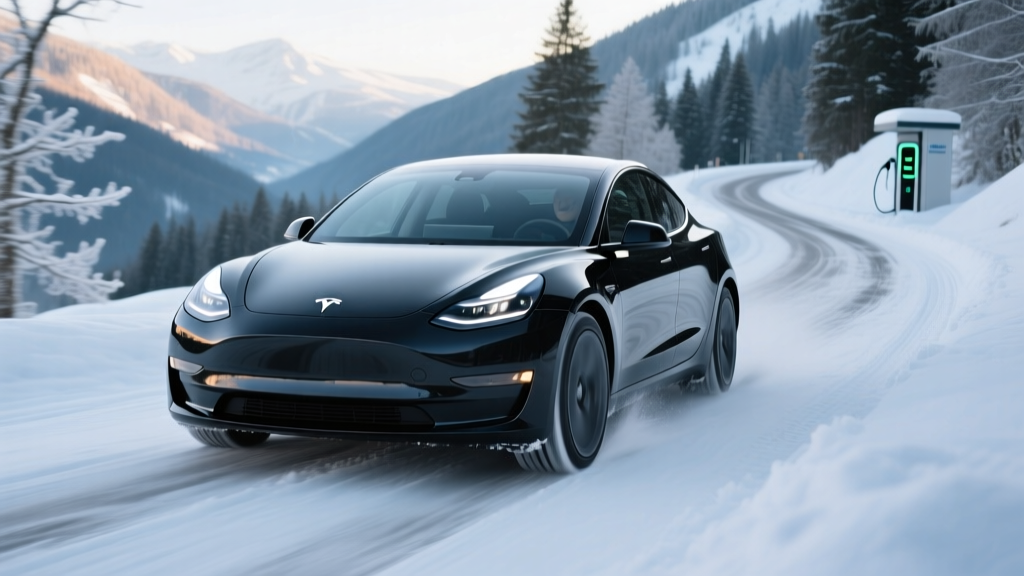
If you live where winter means plow ridges, icy intersections, and single-digit mornings, you've probably searched for real data on the Tesla Model 3 in snow — not marketing gloss, but what actually happens to range, traction, and charging when the temperature drops below freezing. After multiple winters behind the wheel of both the Long Range AWD and Performance variants, here's the unvarnished picture for the 2025/2026 model year.
Quick Verdict: Capable Winter EV With Predictable Trade-Offs
The Tesla Model 3 Long Range AWD is one of the most competent electric sedans for snow-belt drivers, thanks to its dual-motor all-wheel drive, low center of gravity, standard winter-tire compatibility, and excellent thermal management via a heat pump. Its biggest winter penalty is range: expect a 20–30% drop from the EPA sticker in sub-freezing highway driving. If you can charge at home and your daily commute stays under 150 miles round-trip, the Model 3 is a remarkably confident snow car. If you routinely drive 300+ miles in deep cold without reliable DC fast-charging along your route, a PHEV or a larger-battery EV deserves consideration.
Range, Battery, and the Cold-Weather Reality Check
| Spec | Long Range AWD | Performance AWD | RWD (Base) |
|---|---|---|---|
| EPA Range | 341 mi | 315 mi | 272 mi |
| Battery (usable) | ~75 kWh (NMC) | ~75 kWh (NMC) | ~57.5 kWh (LFP) |
| Drivetrain | Dual-Motor AWD | Dual-Motor AWD | Rear-Wheel Drive |
| Horsepower | ~346 hp | ~510 hp | ~271 hp |
| 0–60 mph | 4.2 sec | 2.9 sec | 5.8 sec |
| MPGe (combined) | 134 MPGe | 121 MPGe | 132 MPGe |
| Efficiency | 25 kWh/100 mi | 28 kWh/100 mi | 25 kWh/100 mi |
| Base MSRP | $47,740 | $53,740 | $38,990 |
The Long Range AWD's 341-mile EPA figure assumes mixed driving at moderate temperatures. In real-world winter testing at 20–30°F with highway speeds of 70–75 mph, expect 240–270 miles on a full charge. In extreme cold (below 10°F) with cabin heat running full blast and no preconditioning, that can dip toward 210–230 miles. City driving with regenerative braking fares better — roughly 280–300 miles is achievable in the 30s. The RWD base model with its smaller LFP pack suffers proportionally more: plan for ~190 miles of real highway range in deep cold.
The chemistry matters here. The Long Range and Performance trims use NMC (nickel manganese cobalt) cells, which offer higher energy density but are generally recommended to be charged to 80% for daily use and 100% only for long trips. The RWD base model uses LFP (lithium iron phosphate) chemistry, which Tesla recommends charging to 100% regularly — partially offsetting its smaller capacity. LFP also handles cold somewhat differently; it tolerates full-charge storage better but has slightly lower energy density and slower cold-weather charge acceptance without preconditioning. Source: fueleconomy.gov.
Charging in Winter: Speeds, Preconditioning, and the Curve
| Level | Power (kW) | Speed (miles/hr) | Notes |
|---|---|---|---|
| Level 1 (120V) | ~1.4 kW | ~4–5 mi/hr | Emergency/trickle only |
| Level 2 (240V, 48A) | 11.5 kW | ~44 mi/hr | Home Wall Connector; ~7–8 hr for full charge (LR) |
| DC Fast (V3 Supercharger) | Peak 250 kW | Up to ~175 mi/hr (peak) | 10–80% in ~25 min (warm battery) |
| DC Fast (cold, unpreconditioned) | ~50–90 kW | ~35–60 mi/hr | Severely throttled below battery temp ~50°F |
The single biggest winter charging lesson: preconditioning is non-negotiable. When you navigate to a Supercharger in the Tesla app or in-car nav, the car begins warming the battery en route. Arrive with a warm pack and you'll see the advertised peak of 250 kW, sustaining roughly 150–170 kW through the 40–60% state-of-charge window before tapering. Arrive cold — say, after the car sat unplugged overnight in 15°F weather with no nav-routed preconditioning — and you may be capped at 50–90 kW for the first 10–15 minutes while the battery warms itself. That turns a 25-minute stop into a 45-minute stop.
For home charging, a Level 2 Tesla Wall Connector on a 60-amp circuit (48A continuous) delivers 11.5 kW, adding roughly 44 miles per hour of charging. A full overnight charge easily replenishes even a deeply depleted Long Range pack. If you're installing a Wall Connector, budget $500 for the hardware and $800–$2,000 for electrician labor depending on panel proximity and whether a 200-amp service upgrade is needed. (Always consult a licensed electrician for final specs.)
Snow and Ice Traction: AWD, Tires, and Driving Dynamics
The Model 3's dual-motor AWD system uses independent front and rear motors with torque vectoring that reacts in milliseconds — faster than any mechanical AWD system. On packed snow and icy pavement, the traction is genuinely excellent, rivaling or exceeding that of comparable AWD sedans like the Subaru Legacy or Audi A4 quattro. The low center of gravity from the under-floor battery pack reduces body roll and keeps the car planted.
But AWD only solves acceleration and cornering grip — braking distance is a function of your tires. The factory all-season tires (typically Michelin Pilot Sport All-Season or Hankook Ventus S1 noble3) are adequate in light snow but mediocre on ice. The single best upgrade for Model 3 snow driving is a dedicated winter tire set. Tesla sells a 19" Gemini wheel-and-winter-tire package, and third-party options like the Michelin X-Ice Snow or Nokian Hakkapeliitta R5 on 18" wheels are popular among owners in the Upper Midwest and Northeast. Expect to spend $1,200–$1,800 for a mounted-and-balanced winter set.
The regenerative braking behavior in cold weather deserves a note. When the battery is near full charge or very cold, regen is reduced or disabled entirely, and the car will rely more on the friction brakes. Tesla's software blends this transition smoothly, but drivers accustomed to one-pedal driving should anticipate longer stopping distances in the first 10–15 minutes of a cold morning drive until the pack warms. The Traction Control and Stability Control systems are well-tuned and intervene progressively rather than abruptly.
Interior, Cargo, Tech, and Winter-Specific Features
The refreshed Model 3 ("Highland" and subsequent updates) brought meaningful interior improvements: ventilated front seats, a rear touchscreen for passengers, improved acoustic glass, and ambient lighting. Here's the practical space breakdown:
- Front headroom: 40.3 inches
- Rear legroom: 35.3 inches
- Cargo (trunk): 21.0 cu ft
- Frunk (front trunk): 3.1 cu ft
- Total cargo: ~24.1 cu ft (no hatchback — sedan trunk opening limits bulky items)
Winter-specific tech highlights:
- Heat pump: Standard on all trims. This is critical — it pulls heat from the ambient air and drivetrain rather than relying solely on resistive heating, cutting winter energy consumption by roughly 10–15% compared to older EVs without heat pumps.
- Heated seats (all five) and heated steering wheel: Standard. These are far more energy-efficient than cranking the cabin air heat.
- Sentry Mode and Dog Mode: Useful in cold weather to keep the cabin warm for a pet or to monitor the car in an icy parking lot.
- Defrost and preconditioning via app: Schedule departure times or remotely activate climate 10 minutes before you walk out. This warms the cabin and the battery, preserving range and improving regen.
Notable drawbacks for winter drivers: the Model 3 still has no traditional instrument cluster (all info is on the central 15.4" screen), the trunk is a sedan-style opening rather than a liftback (awkward for loading winter gear or a stroller), and the glass roof — while beautiful — can radiate cold in extreme conditions despite the improved insulation.
Pricing, Tax Credit, and What You'll Actually Pay
| Trim | Base MSRP | Destination | Federal §30D Credit | Effective Price* |
|---|---|---|---|---|
| RWD (Base) | $38,990 | $1,390 | Up to $7,500 | ~$32,880 |
| Long Range AWD | $47,740 | $1,390 | Up to $7,500 | ~$41,630 |
| Performance AWD | $53,740 | $$1,390 | Up to $7,500 | ~$47,630 |
*Effective price assumes full $7,500 federal credit and does not include state incentives, dealer fees, or options. Eligibility is not automatic.
Under current IRS §30D rules, the Tesla Model 3 qualifies for up to $7,500 in federal tax credits, which can be transferred to the dealer at the point of sale as an immediate price reduction. But eligibility has strict conditions:
- MSRP cap: Sedans must have an MSRP of $55,000 or less. The Model 3 RWD and Long Range comfortably qualify. The Performance trim at $53,740 base also qualifies, but adding premium paint, FSD, or 20" wheels can push the sticker above $55,000 — at which point you lose the credit entirely.
- Buyer income cap: Modified adjusted gross income must not exceed $150,000 (single), $225,000 (head of household), or $300,000 (married filing jointly).
- Battery sourcing: The credit is split into two halves — $3,750 for critical minerals and $3,750 for battery component manufacturing. Both sets of requirements tighten annually. Verify current-year compliance on the IRS qualified vehicles list before purchasing.
- VIN verification: The dealer must report the sale and your VIN to the IRS via the IRS Energy Credits Online portal.
State incentives vary widely (Colorado, California, Massachusetts, and others offer additional rebates or HOV-lane access). Consult your state's energy office or a tax professional for specifics.
Warranty and Long-Term Battery Confidence
Tesla's warranty structure for the Model 3:
- Basic vehicle: 4 years / 50,000 miles
- Battery & drive unit (Long Range / Performance): 8 years / 120,000 miles, whichever comes first
- Battery & drive unit (RWD): 8 years / 100,000 miles
- Capacity retention threshold: Tesla warrants that the battery will retain at least 70% of original capacity during the warranty period. Below that, Tesla replaces or refurbishes the pack at no cost.
For winter owners, this is reassuring. Cold weather itself does not cause permanent battery degradation — it temporarily reduces available capacity. Permanent degradation is driven by charge habits (frequent 100% charges on NMC, excessive DC fast charging without thermal management) and high-heat exposure. Tesla's active thermal management system is among the best in the industry at protecting the pack during both extreme cold and extreme heat. Real-world data from large fleet samples shows most Model 3 packs retaining 88–92% capacity at 100,000 miles, well above the warranty threshold.
How It Compares: Model 3 in Snow vs. Key Rivals
| Attribute | Tesla Model 3 LR AWD | Hyundai Ioniq 6 SE AWD | BMW i4 xDrive40 |
|---|---|---|---|
| EPA Range | 341 mi | 316 mi | 282 mi |
| AWD Type | Dual-Motor | Dual-Motor | Dual-Motor |
| Heat Pump | Standard | Standard | Standard |
| Max DC Charge | 250 kW | 235 kW | 205 kW |
| 10–80% DC Time | ~25 min | ~18 min | ~31 min |
| Base MSRP (AWD) | $47,740 | ~$47,000 | ~$58,000 |
| Federal Credit | Up to $7,500 | Up to $7,500 | Up to $7,500 |
| Winter Charging Network | Supercharger (best) | Public (variable) | Public (variable) |
The Model 3's decisive winter advantage over both the Ioniq 6 and i4 is the Tesla Supercharger network. When you're driving through a snowstorm in rural Wyoming or upstate New York, the reliability and density of Superchargers — with their plug-and-charge simplicity and consistent uptime — is a genuine safety and convenience edge. The Ioniq 6 actually charges faster (10–80% in roughly 18 minutes on a 350 kW Electrify America stall) but relies on third-party networks that are less reliable in remote areas. The BMW i4 is more luxurious and better insulated but costs $10,000+ more and offers less range.
- You have home Level 2 charging and a commute under 150 miles round-trip
- You take road trips along Supercharger-served corridors
- You value the lowest operating cost and best software/tech integration
- You'll invest in a winter tire set
- You regularly drive 300+ miles in deep cold without reliable en-route charging
- You need a hatchback or liftback for bulky winter gear
- You want a traditional instrument cluster or physical button controls
- Dual-motor AWD with excellent snow/ice traction
- Heat pump + app preconditioning preserves winter range
- Supercharger network reliability in remote cold-weather corridors
- 250 kW peak DC charging (with preconditioning)
- Class-leading software, OTA updates, and app integration
- $7,500 federal credit eligibility on most trims
- 20–30% range loss in sub-freezing highway driving
- Sedan trunk opening (not a liftback) limits cargo flexibility
- No instrument cluster — all info on central screen
- Cold unpreconditioned charging is painfully slow
- Winter tires are a necessary $1,200–$1,800 add-on
- FSD Supervised is Level 2 only — not self-driving in any condition
Frequently Asked Questions
What is the real-world range of the Tesla Model 3 in snow and cold weather?
For the Long Range AWD (341 mi EPA), expect roughly 240–270 miles on the highway at 70 mph in 20–30°F weather. In extreme cold below 10°F with high cabin heat demand, plan for 210–230 miles. City driving with regen braking yields better results: roughly 280–300 miles in the 30s. Preconditioning and using heated seats instead of max cabin heat can recover 10–15 miles of range.
How fast does the Model 3 charge at home and on the road in winter?
At home on a Level 2 Wall Connector (11.5 kW), you'll add ~44 miles per hour — a full overnight charge is easy. On a V3 Supercharger, the Model 3 peaks at 250 kW and charges 10–80% in about 25 minutes — but only if the battery is preconditioned via navigation routing. Without preconditioning in cold weather, expect 45+ minutes due to severely throttled charge rates.
How much does the Tesla Model 3 cost after the federal tax credit?
The Long Range AWD starts at $47,740 plus $1,390 destination. With the full $7,500 §30D credit applied at point of sale, the effective price drops to roughly $41,630. The base RWD comes in around $32,880 after credit. But eligibility depends on your income, the vehicle's MSRP staying under $55,000 (be careful with options), and current battery-sourcing rules. Check the IRS qualified vehicles list before committing.
Does the Tesla Model 3 qualify for the federal EV tax credit?
Yes — as of the current tax year, the Model 3 qualifies for up to $7,500 under IRS §30D, transferable at point of sale. Requirements include buyer income below $150K/$225K/$300K (single/HOH/MFJ), sedan MSRP under $55,000, and compliance with critical-mineral and battery-component sourcing rules. Verify on the IRS Energy Credits Online portal before purchase, as sourcing requirements tighten annually.
Is the Model 3 worth buying for snow driving vs. a gas AWD sedan or a PHEV?
If you can charge at home, the Model 3 LR AWD offers lower per-mile fuel cost (~$0.04–0.06/mile on residential electricity vs. ~$0.12–0.15/mile for a 30 MPG gas AWD sedan), excellent traction, and the convenience of a "full tank" every morning. The trade-off is cold-weather range reduction and longer refueling on road trips. A PHEV like the Toyota Prius Prime makes sense only if you lack home charging or regularly exceed 250 miles in deep cold without en-route charging access.
Is Autopilot or FSD safe to use in snow and winter conditions?
Tesla's Autopilot and FSD (Supervised) are SAE Level 2 driver-assistance systems — not self-driving. In snow, lane markings may be obscured, cameras can be blocked by slush or ice, and road-edge detection becomes unreliable. Tesla's owner manual explicitly warns that Autopilot performance is degraded in poor weather. You must remain fully engaged, hands on wheel, eyes on road, at all times. Many experienced owners disable Autopilot entirely in heavy snow and drive manually.
Should I get winter tires for my Model 3?
Yes, strongly recommended. The factory all-season tires are the weakest link in the Model 3's winter capability. A dedicated winter tire (Michelin X-Ice Snow, Nokian Hakkapeliitta R5, Bridgestone Blizzak WS90) dramatically improves braking distance, cornering grip, and confidence on ice. Budget $1,200–$1,800 for a set on 18" wheels (smaller wheels allow taller sidewalls, better for pothole protection on plow-damaged roads).