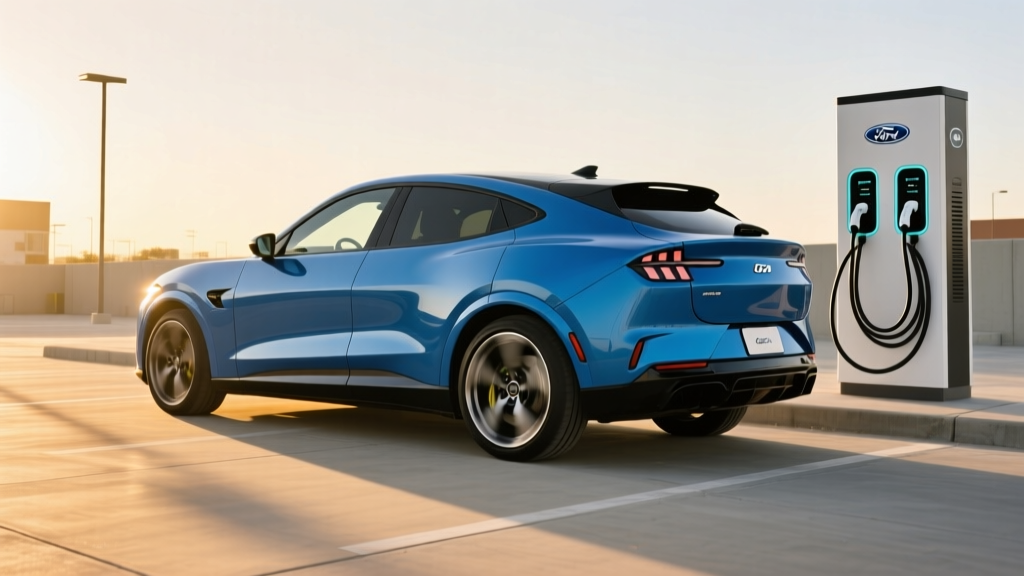
The Ford Mustang Mach-E Select is the entry point into Ford's electric SUV lineup, but "entry" no longer means "compromise." For 2026, the Select trim retains the extended-range battery that powers its higher trims, meaning the Mach-E Select 0-60 time and range figures punch above what most buyers expect from a base model. This review covers the real numbers — not just the sticker — including highway range reality, charging-curve behavior, and whether the §30D federal tax credit actually applies to your purchase.
Performance: Mach-E Select 0-60 and Drivetrain Breakdown
The 2026 Mustang Mach-E Select comes standard with rear-wheel drive (RWD) and a single permanent-magnet synchronous motor on the rear axle. Ford rates this motor at 266 horsepower and 317 lb-ft of torque, available from zero RPM as expected in a BEV.
| Metric | RWD (Standard) | eAWD (Optional) |
|---|---|---|
| 0-60 mph | 5.8 seconds | 5.2 seconds |
| Horsepower | 266 hp | 325 hp |
| Torque | 317 lb-ft | 500 lb-ft |
| Drivetrain | Rear-Wheel Drive | Dual-Motor eAWD |
| Top Speed | 112 mph (electronically limited) | 112 mph |
In real-world driving, the RWD Select's 5.8-second sprint is brisk enough for confident highway merging and passing. The instant torque delivery makes the car feel quicker than the stopwatch suggests around town. If you opt for the eAWD dual-motor package (approximately $3,000 on the Select), the 0-60 drops to roughly 5.2 seconds, with the front motor adding meaningful traction in rain and snow.
One note for enthusiasts: the Select trim does not offer the GT or Rally performance variants. If sub-4-second sprints matter, you'll need to look at the Mach-E GT (3.5 seconds, 480 hp) or consider a Tesla Model Y Performance. The Select is tuned for daily comfort, not track duty — and at this price point, that's the right call.
Range and Efficiency: EPA vs. Real-World Expectations
The 2026 Mach-E Select uses Ford's extended-range battery pack on both RWD and eAWD configurations. The pack is an NMC (nickel-manganese-cobalt) lithium-ion chemistry with a usable capacity of approximately 91 kWh (gross capacity ~98 kWh, with top and bottom buffer to preserve longevity).
EPA Range vs. What You'll Actually See
EPA Estimated Range: 250 miles (RWD) / 230 miles (eAWD)
Real-World Expectations:
- Mixed city/suburban driving (65°F): ~235–255 miles — the Mach-E excels in stop-and-go thanks to strong regenerative braking and no idling losses.
- Sustained highway driving (70–75 mph): ~200–220 miles — aerodynamic drag at speed cuts efficiency by 10–15%.
- Cold weather (below 32°F, highway): ~160–190 miles — NMC packs lose 20–30% range in freezing temps without consistent preconditioning. The Mach-E's heat pump (standard on 2026 models) mitigates some cabin-heating losses but cannot fully offset cell-level chemistry slowdown.
Efficiency lands at approximately 101 MPGe combined (RWD), which translates to roughly 33 kWh per 100 miles. This is competitive with the Hyundai Ioniq 5 (101–114 MPGe depending on trim) but trails the Tesla Model Y RWD (119 MPGe). The Mach-E's heavier curb weight (~4,700 lbs RWD) is the primary efficiency drag.
For context on what this means practically: if your daily commute is 40 miles round-trip, you'll charge at home every 4–5 days. A 300-mile road trip will require one DC fast-charge stop.
Charging Speed: DC Fast, Level 2, and the Curve Reality
Charging is where EV ownership is made or broken, and the Mach-E Select delivers adequate but not class-leading performance.
| Charging Level | Power / Rate | Time or Miles Added |
|---|---|---|
| Level 1 (120V household outlet) | ~1.4 kW | ~3–4 miles per hour of charging |
| Level 2 (240V home / public) | 10.5 kW (48A onboard charger) | ~28 miles per hour; 0–100% in ~10 hours |
| DC Fast Charge (CCS) | Peak 150 kW | 10–80% in approximately 41 minutes |
Understanding the charge curve: The Mach-E peaks near 150 kW only between roughly 10–30% state of charge (SoC). From 30–60%, it sustains around 100–120 kW, and above 80%, it tapers sharply to protect the NMC cells — often dropping below 40 kW. This means that 10–80% in 41 minutes is the realistic road-trip number, but if you're charging from 5–95%, expect closer to 65 minutes. Plan your stops accordingly.
The Mach-E uses the CCS1 connector natively. Ford now provides access to the Tesla Supercharger network via a included NACS adapter (starting with 2025+ models), which significantly expands available DC fast-charging infrastructure — particularly in rural corridors where Electrify America and EVgo coverage thins out.
For home charging, a Level 2 wallbox (such as the Ford Charge Station Pro or a third-party unit like the Emporia Vue or EnelX JuiceBox) connected to a 60A circuit will deliver the full 10.5 kW. Expect a home installation cost of $800–$2,000 depending on panel proximity and whether your electrical panel needs an upgrade. Always consult a licensed electrician for final specifications.
Pricing, Trims, and Federal Tax Credit Eligibility
The 2026 Mustang Mach-E Select starts at $42,995 (including destination charge) for the RWD model. Adding eAWD brings the base to approximately $45,995. Popular option packages — such as the BlueCruise hands-free driving prep and panoramic roof — can push an as-tested Select to $47,000–$49,000.
| Configuration | Base MSRP | Est. After §30D Credit* |
|---|---|---|
| Select RWD | $42,995 | ~$35,495 |
| Select eAWD | $45,995 | ~$38,495 |
| Select eAWD + Options (as tested) | $48,500 | ~$41,000 |
*Assumes full $7,500 §30D credit eligibility. See tax credit checklist below.
The Mach-E Select falls under the IRS §30D SUV MSRP cap of $80,000, so price is not the disqualifier. However, federal tax credit eligibility depends on several factors that change periodically:
- Buyer income caps: Modified AGI must not exceed $150,000 (single), $225,000 (head of household), or $300,000 (joint filers).
- Battery sourcing requirements: The percentage of critical minerals and battery components sourced from the U.S. or FTA-partner nations must meet annual thresholds. Ford has worked to localize Mach-E battery supply, but final eligibility can shift by model year and production batch. Verify the specific VIN on the IRS's qualified vehicle list before purchase.
- Point-of-sale transfer: Under current rules, you can transfer the credit to the dealer at purchase, reducing your out-of-pocket cost immediately rather than waiting for tax filing. The dealer must be IRS-registered.
Important: Consult a tax professional and check IRS.gov for the latest guidance. Credit rules are subject to legislative change and per-manufacturer phase-out thresholds no longer apply under the Inflation Reduction Act framework, but sourcing requirements tighten annually.
Interior, Cargo, and Technology
The Mach-E Select's cabin is a clear step above Ford's ICE compact SUVs, though it doesn't quite match the premium feel of a Tesla Model Y or Hyundai Ioniq 5 in material quality. The synthetic leather (ActiveX) seats are standard on Select — genuine leather is reserved for Premium and GT trims.
Passenger and Cargo Dimensions
- Front legroom: 43.3 inches
- Rear legroom: 38.9 inches — generous for a compact SUV; adults over 6' will be comfortable
- Cargo behind rear seats: 29.7 cubic feet
- Cargo with rear seats folded: 59.7 cubic feet
- Front trunk (frunk): 4.7 cubic feet — drainable, useful for wet gear or charging cables
The 15.5-inch portrait-oriented SYNC 4A touchscreen dominates the dashboard. It supports wireless Apple CarPlay and Android Auto, over-the-air (OTA) updates, and integrates Ford Co-Pilot360 driver-assistance features. The digital instrument cluster is a smaller 10.2-inch screen behind the steering wheel.
Driver-Assist and Smart Features
Standard on the Select is Ford Co-Pilot360 Assist 2.0, which includes:
- Adaptive cruise control with stop-and-go
- Lane centering assist
- Evasive steering assist
- Blind-spot monitoring with rear cross-traffic alert
- Automatic emergency braking with pedestrian detection
SAE Automation Level: The Mach-E's standard driver-assist features and available BlueCruise are SAE Level 2 systems. The driver must remain attentive, keep hands on or near the wheel (BlueCruise allows hands-off on pre-mapped divided highways but monitors eyes via an infrared camera). This is not autonomous driving — only Level 4 services like Waymo operate without a human driver.
BlueCruise (available as a subscription or included trial depending on model year) is one of the better hands-free highway systems on the market, covering over 130,000 miles of divided highways in North America. It handles lane-keeping and speed management smoothly, but does not perform automatic lane changes or navigate interchanges — you'll still manage those manually.
Warranty and Long-Term Ownership
Ford backs the 2026 Mach-E with competitive warranty coverage:
- Bumper-to-bumper: 3 years / 36,000 miles
- Powertrain (including electric motors): 5 years / 60,000 miles
- Battery pack: 8 years / 100,000 miles (retains ≥70% of original capacity)
The 70% capacity retention threshold over 8 years is industry-standard (Tesla uses the same benchmark). Based on fleet data from earlier Mach-E model years and broader NMC pack behavior, most owners see approximately 8–12% degradation over the first 100,000 miles with normal charging habits — meaning you'd likely retain 88–92% capacity well within the warranty window.
To maximize battery longevity, Ford's battery management system includes a buffer (you never truly charge to 100% or discharge to 0% at the cell level). For daily driving, setting your charge limit to 80–90% via the FordPass app will reduce stress on the NMC cells. Reserve 100% charges for road trips.
How the Mach-E Select Stacks Up Against Competitors
The compact electric SUV segment is crowded. Here's how the Select compares to its most direct rivals at a glance:
| Spec | Ford Mach-E Select | Tesla Model Y (Long Range RWD) | Hyundai Ioniq 5 SE |
|---|---|---|---|
| Base MSRP | $42,995 | $44,990 | $42,600 |
| EPA Range | 250 mi | 307 mi | 220 mi (Std Range) / 303 mi (LR) |
| 0-60 mph | 5.8s (RWD) | 5.8s (LR RWD) | 7.2s (Std Range RWD) |
| DC Fast Charge Peak | 150 kW | 250 kW | 240 kW (w/ preconditioning) |
| 10–80% DCFC Time | ~41 min | ~25 min | ~18 min |
| Battery (usable kWh) | 91 kWh (NMC) | 75 kWh (NMC) | 77.4 kWh (NMC) |
| Cargo (rear seats up) | 29.7 cu ft | 30.2 cu ft | 27.2 cu ft |
Where the Mach-E Select wins: Ride comfort and cabin quietness are class-leading. The suspension tuning absorbs road imperfections better than the firmer Model Y and Ioniq 5. Ford's dealership network provides easier service access than Tesla's direct model in many regions. The frunk is a practical bonus neither competitor matches in utility (the Ioniq 5 has no frunk; the Model Y frunk is smaller).
Where the Mach-E Select falls short: DC fast-charging speed is the clear weakness. At 150 kW peak, the Mach-E is notably slower than the Ioniq 5's 800V architecture (240 kW, 10–80% in ~18 minutes) and the Model Y (250 kW, ~25 minutes). For road-trip-heavy buyers, this matters — you'll spend roughly 15–20 extra minutes per charge stop compared to an Ioniq 5.
Pros
- Comfortable, quiet ride quality — best in segment for daily commuting
- Strong standard equipment at the Select trim level
- Access to Tesla Supercharger network via included NACS adapter
- Generous rear-seat legroom and practical drainable frunk
- BlueCruise is a polished hands-free highway system
- Competitive pricing before incentives
Cons
- DC fast-charging speed lags competitors (150 kW vs. 240–250 kW)
- EPA range trails the Model Y Long Range and Ioniq 5 Long Range
- No front trunk (frunk) power release — manual latch only on Select
- Efficiency (MPGe) below segment average due to weight
- Base infotainment, while functional, lacks the polish of Tesla's UI
Who Should Buy the Mach-E Select?
Choose the Mach-E Select if:
- Your daily driving is under 80 miles and you can charge at home nightly
- Ride comfort and cabin quietness matter more than outright performance or range
- You want a mainstream-brand EV with local dealership service support
- You take 2–3 road trips per year (not weekly) and can tolerate slightly longer charge stops
- You value the frunk and rear-seat space for family or gear hauling
Look elsewhere if:
- You regularly drive 200+ miles between charges — the Model Y Long Range or Ioniq 5 Long Range offer 50+ more miles of EPA range
- You road-trip monthly and want the fastest possible DC charging — the Ioniq 5's 18-minute 10–80% is hard to beat
- You want a sub-5-second 0-60 without paying for eAWD — the Model Y Long Range AWD hits 4.8 seconds at a similar price
Frequently Asked Questions
What is the real-world range of the 2026 Mach-E Select?
The EPA rates the RWD Select at 250 miles. In mixed real-world driving at moderate temperatures, expect 235–255 miles. Sustained highway driving at 70+ mph drops this to around 200–220 miles, and freezing temperatures can reduce range to 160–190 miles without diligent preconditioning.
How fast does the Mach-E Select charge at home and on the road?
At home on a Level 2 (240V, 48A) charger, the Mach-E adds about 28 miles per hour and charges fully in roughly 10 hours. On DC fast chargers, it peaks at 150 kW and takes about 41 minutes from 10–80%. Plan for longer stops than an Ioniq 5 or Model Y would require.
How much does the Mach-E Select cost after the federal tax credit?
If you qualify for the full $7,500 §30D credit, the RWD Select drops from $42,995 to approximately $35,495. Eligibility depends on your income, the vehicle's battery component and critical-mineral sourcing, and MSRP (the Select is well under the $80,000 SUV cap). Always verify with the IRS and a tax professional before relying on the credit.
Is the Mach-E Select worth buying over the Tesla Model Y or Hyundai Ioniq 5?
It depends on your priorities. The Mach-E Select offers the most comfortable ride and strongest dealer service network. The Model Y wins on range, efficiency, and charging speed. The Ioniq 5 dominates on DC fast-charging speed and has a more distinctive design. All three are compelling — test-drive each before deciding.
Does the 2026 Mach-E Select qualify for the $7,500 federal EV tax credit?
The Mach-E Select meets the MSRP cap ($80,000 for SUVs). Buyer income caps and battery-sourcing requirements determine your personal eligibility. Ford has been working to qualify the Mach-E under §30D's critical-mineral and battery-component rules, but eligibility can vary by production batch and model year. Check the VIN against the fueleconomy.gov qualified vehicle list and confirm with your tax advisor before purchase. The credit can be transferred to the dealer at point of sale if the dealer is IRS-registered.
What is the Mach-E Select's battery chemistry and expected lifespan?
The Select uses an NMC (nickel-manganese-cobalt) lithium-ion pack with 91 kWh usable capacity. NMC offers high energy density but is more sensitive to sustained 100% charges and extreme heat than LFP chemistry. Ford warranties the pack for 8 years / 100,000 miles at ≥70% capacity retention. Real-world data suggests most packs will retain 88–92% capacity at 100,000 miles with normal charging habits (80–90% daily limit).