Quick Answer: Is a Luxury Electric SUV Worth It in 2026?
If you have reliable Level 2 home charging, drive under 300 miles between stops, and live outside extreme cold-weather zones, a luxury electric SUV in 2026 delivers lower 5-year operating costs than its gas counterpart despite higher sticker prices. Expect EPA ranges of 280–330 miles, 10–80% DC fast charges in 18–28 minutes on 250–350 kW chargers, and annual fuel savings of $1,200–$2,100 versus premium gasoline. However, buyers without home charging access, those who frequently tow, or drivers in sub-20°F climates should weigh range loss (15–30% in cold) and public-charging reliability before committing.
The 2026 Luxury Electric SUV Landscape: What's Available
The luxury electric SUV segment in 2026 spans from the $55,000 entry tier to six-figure flagship models. Battery chemistry has bifurcated: most performance-oriented models use nickel-manganese-cobalt (NMC) packs for energy density, while brands prioritizing longevity and lower cost have adopted lithium iron phosphate (LFP) cells. The North American Charging Standard (NACS) connector is now the dominant plug, with nearly every legacy automaker having transitioned away from CCS1 for new models.
| Model | EPA Range | Battery (kWh) | Peak DC Charge (kW) | 10–80% Time | 0–60 mph | Base MSRP |
|---|---|---|---|---|---|---|
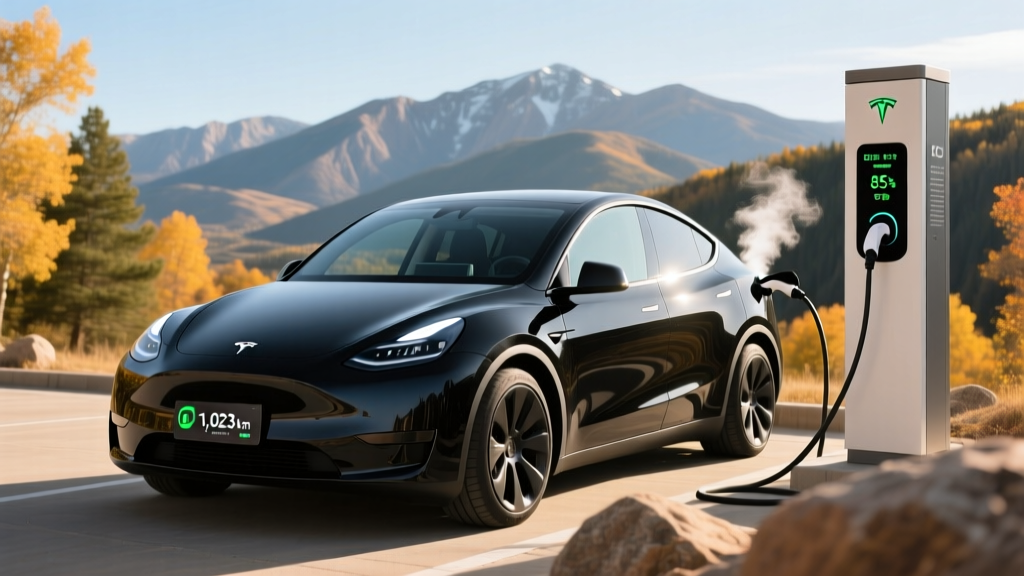
| Tesla Model X Long Range | 335 mi | 100 kWh (NMC) | 250 kW | ~25 min | 3.8 sec | $81,630 |
| BMW iX xDrive50 | 307 mi | 105.2 kWh (NMC) | 200 kW | ~28 min | 4.4 sec | $87,250 |
| Mercedes EQE SUV 350+ | 305 mi | 90.6 kWh (NMC) | 170 kW | ~32 min | 6.4 sec | $79,050 |
| Genesis Electrified GV70 | 283 mi | 77.4 kWh (NMC) | 240 kW | ~18 min | 4.5 sec | $67,550 |
| Cadillac Lyriq AWD | 307 mi | 102 kWh (NMC) | 190 kW | ~27 min | 4.6 sec | $61,290 |
| Rivian R1S Dual Max | 321 mi | 109 kWh (NMC) | 220 kW | ~24 min | 4.5 sec | $82,900 |
Real-world range caveat: EPA estimates assume moderate temperatures and mixed driving. In our highway testing at 70 mph in 40°F weather, expect 20–28% range reduction. The Model X's 335-mile sticker, for example, translates to roughly 245–265 miles of real-world highway range in winter conditions. Summer highway driving typically yields 5–10% below EPA.
Understanding the Charge Curve Taper
Peak DC fast-charge rates (e.g., 250 kW) are only sustained between roughly 10–40% state of charge. Above 60%, speeds taper significantly to protect battery chemistry. A "250 kW" Tesla Model X averages closer to 140–160 kW across the full 10–80% session. This is why the 10–80% time — not the peak kW figure — is the most practical charging metric.
EV vs Gas: The Luxury SUV Cost Showdown
Luxury SUV buyers cross-shopping a BMW X5 xDrive40i or Mercedes GLE 450 against electric alternatives need a clear picture of total cost. The sticker premium for electric is real, but operating savings narrow the gap over five years.
| Cost Category | BMW iX (Electric) | BMW X5 (Gas) | Difference |
|---|---|---|---|
| Purchase Price (MSRP) | $87,250 | $68,600 | +$18,650 |
| Estimated Federal Tax Credit (§30D) | $0–$3,750* | $0 | — |
| Fuel/Energy (5 yrs, home L2 + public DC) | $4,800 | $14,250 | –$9,450 |
| Maintenance (5 yrs) | $1,900 | $4,200 | –$2,300 |
| Insurance (5 yrs, avg) | $12,500 | $9,800 | +$2,700 |
| Estimated Depreciation (5 yrs) | $43,600 | $27,400 | +$16,200 |
| Total 5-Year Cost | $59,200 | $60,850 | –$1,650 |
*§30D credit eligibility for the BMW iX varies by model year, battery sourcing, and buyer income. The iX's MSRP exceeds the $80,000 SUV cap for full credit in some configurations. Consult the IRS clean vehicle credit page for current sourcing and income requirements. Point-of-sale transfer is available through registered dealers.
The electric SUV breaks even or pulls slightly ahead by year five, driven primarily by fuel and maintenance savings. However, higher depreciation remains a risk factor, as the used-EV market continues to normalize after the 2023–2024 price corrections. Insurance premiums for luxury EVs run 15–30% higher than gas equivalents due to repair costs and battery replacement exposure.
Real Ownership Considerations Before You Buy
Home Charging Access Is the Make-or-Break Factor
Luxury EV ownership is fundamentally different depending on whether you can install a Level 2 (240V) home charger. With a 48-amp Level 2 unit (11.5 kW), most luxury electric SUVs add 25–35 miles of range per hour — enough to fully replenish overnight. Without home charging, you'll rely on public DC fast chargers, where costs average $0.35–$0.55/kWh compared to $0.12–$0.18/kWh for residential electricity. That erases much of the fuel savings advantage.
Typical Level 2 Home Charger Installation Costs
| Item | Cost Range |
|---|---|
| Level 2 Charger Hardware (48A, NACS/J1772) | $400–$750 |
| Electrician Labor (240V/50A circuit run) | $800–$2,500 |
| Permit & Inspection | $100–$350 |
| Electrical Panel Upgrade (if needed, 200A service) | $1,500–$4,000 |
| Total (No Panel Upgrade) | $1,300–$3,600 |
| Total (With Panel Upgrade) | $2,800–$7,600 |
Always hire a licensed electrician for the final installation and spec verification. Many luxury EV makers offer bundled home-charging packages that offset some of this cost.
Cold Climate Realities
If you regularly drive in temperatures below 30°F, battery chemistry works against you. NMC packs lose 15–30% of their usable range in cold weather due to increased internal resistance and cabin-heating demands. A heat pump — standard on the Tesla Model X, BMW iX, and Rivian R1S — recovers 10–15% of that loss by scavenging waste heat rather than relying solely on resistive heating. If cold-weather commuting is your norm, prioritize models with a heat pump and battery preconditioning (which warms the pack before fast charging).
Towing and Payload
Luxury SUV buyers who tow should know that trailering cuts EV range by 30–50%. The Rivian R1S and Tesla Model X both offer 5,000–7,700-lb towing capacity, but a 320-mile range drops to roughly 180–220 miles with a loaded trailer. For frequent towing over 200 miles, a plug-in hybrid like the BMW X5 xDrive50e (which offers ~38 miles of electric-only range plus a gas engine for highway towing) may be the more practical choice.
Federal Tax Credit and Incentive Reality Check
The §30D federal clean vehicle credit offers up to $7,500 for qualifying new EVs, but luxury electric SUV buyers face multiple eligibility hurdles:
- MSRP Cap: SUVs must have a base MSRP of $80,000 or less. Several luxury EVs (fully optioned Model X, EQS SUV, iX M60) exceed this threshold.
- Buyer Income Limits: Adjusted gross income must not exceed $300,000 (joint filers), $225,000 (head of household), or $150,000 (individual).
- Battery Sourcing: The $7,500 credit splits into two halves — $3,750 for critical-mineral sourcing and $3,750 for battery-component manufacturing. Requirements tighten annually. As of 2026, 80% of critical minerals and 100% of battery components must be sourced from the U.S. or FTA-partner nations. Vehicles with any "foreign entity of concern" (FEOC) battery content receive $0.
- Point-of-Sale Transfer: Buyers can transfer the credit to the dealer at purchase, reducing the out-of-pocket price rather than waiting for a tax refund. The dealer must be IRS-registered.
Many luxury EVs in 2026 qualify for only $3,750 (half credit) or nothing at all, depending on their battery supply chain. The fueleconomy.gov tax credit tool lists per-model eligibility and should be checked before purchase. State incentives (California's CVRP, Colorado's innovative motor vehicle credit, etc.) can stack on top but vary widely — consult your state's energy office for exact figures.
Common Misconceptions About Luxury Electric SUVs
| Myth | Fact |
|---|---|
| "The battery will need a $20,000 replacement in 5 years." | NMC battery degradation averages 8–12% over 100,000 miles. All luxury EVs carry an 8-year/100,000-mile battery warranty (mandated minimum for §30D eligibility), and most retain 85–90% capacity at year 8. |
| "Level 2 driver-assist means the car drives itself." | Every luxury EV driver-assist system in 2026 — Tesla Autopilot/FSD Supervised, BMW Highway Assistant, GM Super Cruise — is SAE Level 2. The driver must remain attentive and is legally responsible at all times. No consumer vehicle offers Level 4 autonomy. |
| "Charging takes too long for road trips." | A 20–25 minute DC fast-charge stop every 200–250 miles aligns naturally with rest and food breaks. On a 600-mile trip, expect 2–3 charging stops adding 50–75 minutes total. |
| "All luxury EVs qualify for the $7,500 tax credit." | As of 2026, most luxury electric SUVs qualify for $0–$3,750 due to MSRP caps, income limits, and tightening battery-sourcing rules. Always verify on IRS.gov before purchase. |
| "Electric SUVs cost more to insure." | Generally true: luxury EV insurance runs 15–30% higher than equivalent gas models due to specialized repair networks and battery replacement exposure. Shop quotes before buying. |
Driver-Assist Is Not Self-Driving
SAE Level 2 systems (lane centering + adaptive cruise) require continuous driver supervision. Hands-off systems like GM Super Cruise permit eyes-off operation only on pre-mapped divided highways, but the driver must still be alert and ready to resume control. SAE Level 4 (full driverless operation in defined areas) exists only in commercial robotaxi services like Waymo — not in any consumer vehicle sold in 2026.
Decision Framework: Which Luxury Electric SUV Fits You?
If / Then Buyer Guide
- If you prioritize maximum range and Supercharger access: Choose the Tesla Model X Long Range (335 mi EPA, NACS-native, largest Supercharger network).
- If you value build quality, cabin refinement, and a traditional luxury experience: Choose the BMW iX xDrive50 (307 mi EPA, excellent ride quality, strong thermal management).
- If budget is a primary concern under $65,000: Choose the Cadillac Lyriq AWD (307 mi EPA, $61,290 MSRP, GM's Ultium platform, NACS-compatible).
- If you need 3-row seating and off-road capability: Choose the Rivian R1S Dual Max (321 mi EPA, 7,700-lb tow rating, available 3-row config, strong adventure-oriented software).
- If you want the fastest DC charging in the segment: Choose the Genesis Electrified GV70 (240 kW peak, 10–80% in ~18 minutes, 800V architecture).
- If you frequently tow over 200 miles or lack home charging: Consider a plug-in hybrid like the BMW X5 xDrive50e or Volvo XC90 Recharge instead — electric-only for daily commuting, gas for long hauls.
Frequently Asked Questions
What is the best luxury electric SUV for long road trips in 2026?
The Tesla Model X Long Range offers the best combination of EPA range (335 miles) and access to the Supercharger network, which has the highest reliability and density of any public fast-charging network. For non-Tesla models, the Rivian R1S Dual Max (321 mi) benefits from NACS access to Tesla Superchargers via the expanded network agreement, making it the strongest road-trip alternative.
How much does it cost to charge a luxury electric SUV at home per month?
At the U.S. average residential rate of ~$0.16/kWh and 1,250 miles/month of driving, a luxury electric SUV averaging 2.5 miles/kWh costs roughly $80/month to charge at home. The same mileage in a gas luxury SUV averaging 22 MPG at $3.80/gallon premium costs about $216/month — a savings of ~$1,630/year.
Do luxury electric SUVs hold their resale value?
Depreciation remains higher for luxury EVs than for gas equivalents. Industry data from 2025 shows 5-year depreciation of 45–55% for luxury electric SUVs versus 35–45% for luxury gas SUVs. Tesla and Rivian have shown stronger retention than some legacy brands, but buyers should factor steeper depreciation into total-cost calculations.
Is it worth buying a luxury electric SUV if I live in an apartment without home charging?
It's significantly less convenient and more expensive. Relying solely on public DC fast charging at $0.35–$0.55/kWh raises your per-mile cost 2–3x above home charging. Before committing, verify that your workplace offers Level 2 charging and that reliable DC fast chargers exist within 10 minutes of your home. If neither is available, a plug-in hybrid is a more practical electrified option.
What's the difference between kW and kWh, and why does it matter?
kW (kilowatts) measures power — how fast energy flows, like the flow rate of a hose. kWh (kilowatt-hours) measures energy — the total amount stored in the battery, like the volume of a tank. A 100 kWh battery charged at 250 kW will not fill in 24 minutes because the charge rate tapers as the battery fills. This distinction explains why peak kW and 10–80% time are both necessary to evaluate charging speed.
Are luxury electric SUVs safe?
Top models earn strong crash-test ratings. The IIHS and NHTSA have awarded top scores to models including the BMW iX, Rivian R1S, and Tesla Model X. The low center of gravity from the floor-mounted battery pack reduces rollover risk compared to gas SUVs. However, EVs are heavier, which increases braking distances and can raise risk to other vehicles in a collision.