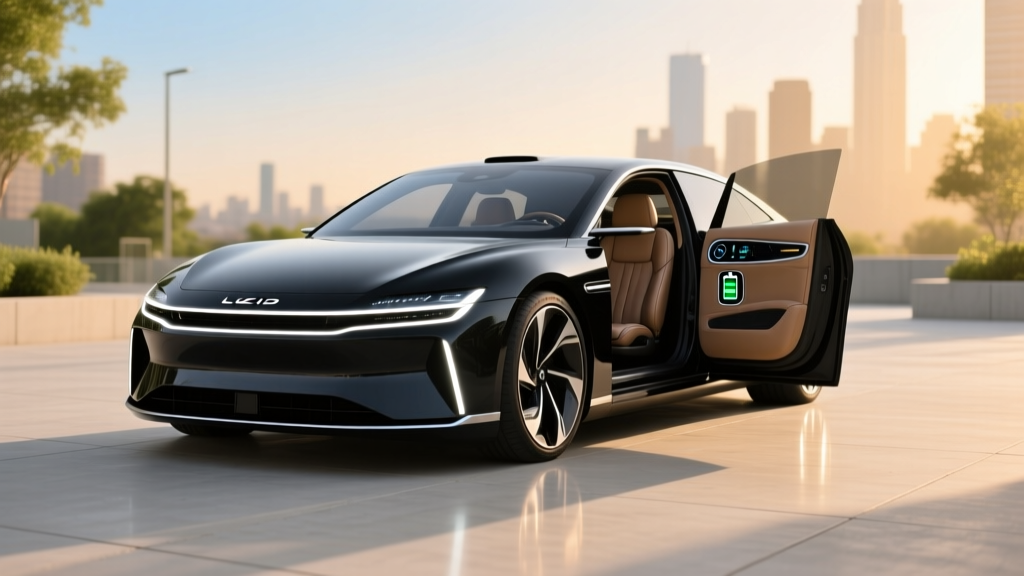
If you are researching a Lucid trade-in—whether you are looking to sell your current EV and upgrade to a Lucid Air, or you own one and are curious about its resale trajectory—you need more than marketing brochures. You need hard data on range retention, charging infrastructure compatibility, depreciation curves, and the total cost of ownership in 2026. This profile breaks down the Lucid Air lineup with the exact numbers buyers and sellers need to make an informed decision.
Lucid Air 2026 Lineup: Range, Battery, and Real-World Efficiency
The Lucid Air remains one of the most range-efficient luxury sedans on the market, thanks to its proprietary miniaturized drive units and 900V+ electrical architecture. For the 2026 model year, Lucid offers the Air in Pure, Touring, and Grand Touring trims (the limited Sapphire performance variant sits above these). Here is how the specs break down:
| Trim | EPA Range | Battery (kWh usable) | Chemistry | Drivetrain | 0-60 mph | Horsepower | MPGe (combined) |
|---|---|---|---|---|---|---|---|
| Air Pure | 419 mi | 88 kWh | NMC | RWD | 5.0 sec | 430 hp | 136 MPGe |
| Air Touring | 425 mi | 112 kWh | NMC | AWD (dual-motor) | 3.4 sec | 620 hp | 131 MPGe |
| Air Grand Touring | 516 mi | 112 kWh | NMC | AWD (dual-motor) | 3.0 sec | 819 hp | 131 MPGe |
Source: EPA fueleconomy.gov
EPA estimates are achieved under controlled lab conditions. In real-world highway driving at 70-75 mph, expect the Grand Touring to deliver approximately 400-440 miles in mild weather. In cold conditions (below 30°F), range can drop 15-25%, putting the Grand Touring closer to 340-380 miles. The Air's heat pump helps mitigate cabin-heating losses, but battery chemistry still loses efficiency in extreme cold. City driving with regenerative braking recovers energy and often exceeds EPA estimates.
Lucid uses NMC (nickel manganese cobalt) chemistry across the Air lineup rather than LFP (lithium iron phosphate). NMC offers higher energy density—critical for fitting 500+ miles of range into a sedan form factor—but it is slightly more sensitive to sustained high-state-of-charge storage. For daily use, Lucid recommends charging to 80-90% and only going to 100% before long trips, which preserves long-term battery health.
Charging Speed: DC Fast Charging and Home Level 2
Charging speed is where Lucid's 900V+ architecture pays dividends. The Air supports some of the fastest DC fast-charge rates in the luxury EV segment, but peak numbers only tell part of the story. The charge curve—how quickly the car sustains high power before tapering—matters more for real road trips.
| Charging Method | Power (kW) | Rate / Time | Notes |
|---|---|---|---|
| DC Fast Charge (peak) | Up to 300 kW | 10-80% in ~20 min (Grand Touring) | Requires 350 kW CCS or NACS station; preconditioning essential |
| DC Fast Charge (sustained avg.) | ~180-220 kW avg. | ~250 miles added in 15 min | Peak rate held to ~40% SoC, then tapers |
| Level 2 Home (48A / 11.5 kW) | 11.5 kW | ~37 miles per hour of charging | Full charge in ~10 hours (112 kWh battery) |
| Level 2 Home (80A / 19.2 kW) | 19.2 kW | ~62 miles per hour of charging | Requires 100A circuit; fastest home option |
| Level 1 (120V) | ~1.4 kW | ~4-5 miles per hour | Emergency/top-up only |
Key insight for trade-in buyers: The Air's onboard charger supports up to 19.2 kW AC, which is among the highest in the industry. Most competitors cap at 11.5 kW. If you have a high-capacity home electrical panel (200A service with available headroom), you can install an 80A hardwired charger and recover over 300 miles overnight in about 5 hours. However, many homes will need a panel upgrade to support an 80A circuit—budget $1,500-$3,000 for that electrical work, on top of $500-$800 for the charger unit and $500-$1,500 for standard installation.
For DC fast charging, Lucid uses the NACS (Tesla Supercharger-compatible) connector on 2025+ models, with a CCS adapter included for legacy networks. This gives Air owners access to Tesla's Supercharger network (over 25,000 stalls in North America) plus Electrify America, EVgo, and other CCS providers. Battery preconditioning activates automatically when a fast-charger is set as your navigation destination—skip this step and your peak charge rate may be cut in half, especially in cold weather.
Pricing, Tax Credits, and Lucid Trade-In Value
The 2026 Lucid Air starts at $69,900 for the Pure RWD and climbs to $125,500 for the Grand Touring (destination included). The Sapphire performance variant, when available, starts around $249,000. Here is the pricing ladder:
| Trim | Base MSRP | As-Tested (typical options) | §30D Federal Credit Eligible? | Effective Price (with credit) |
|---|---|---|---|---|
| Air Pure | $69,900 | $72,000-$75,000 | Potentially (see rules below) | ~$62,400-$67,500 |
| Air Touring | $87,400 | $92,000-$98,000 | No (exceeds MSRP cap) | $87,400-$98,000 |
| Air Grand Touring | $125,500 | $130,000-$140,000 | No (exceeds MSRP cap) | $125,500-$140,000 |
- MSRP cap for sedans: $55,000 — Only the Air Pure (at $69,900 base) falls close, but it still exceeds the $55,000 sedan cap. As of 2026, no new Lucid Air trim qualifies for the full $7,500 new-vehicle credit.
- Buyer income caps: AGI must not exceed $150,000 (single), $225,000 (head of household), or $300,000 (joint).
- Battery sourcing: Critical minerals and battery components must meet escalating domestic-content thresholds. Lucid sources from varied global suppliers; check the latest IRS eligible vehicle list before purchase.
- Used EV credit (§25E): If you are buying a pre-owned Lucid Air (model year 2023 or earlier in 2026), the used-EV credit offers up to $4,000 or 30% of sale price (whichever is lower), with lower income caps ($75k/$112.5k/$150k) and a $25,000 max sale price—which excludes most used Air models as well.
- Point-of-sale transfer: If eligible, the credit can be transferred to the dealer at purchase for an immediate price reduction rather than claimed at tax time.
Always verify current eligibility at IRS.gov and consult a tax professional. Rules change frequently.
What Does This Mean for Lucid Trade-In Values?
Luxury EVs depreciate faster than mainstream models, and the Lucid Air is no exception. Based on 2025-2026 market data, a 2-year-old Air Touring (originally ~$95,000) typically trades at $60,000-$70,000, representing 25-35% depreciation. The Grand Touring holds somewhat better in absolute dollars but similar percentages. Key depreciation drivers include:
- Luxury-segment buyer expectations for the latest tech
- Limited Lucid service-center footprint compared to Tesla or BMW
- EV market-wide price compression from new-model competition
- Battery health perception (though Lucid's 8-year/100,000-mile warranty mitigates this)
If you are trading in a Lucid Air, expect dealer offers 10-20% below private-party value. Platforms like Carvana, CarMax, and Lucid's own trade-in program (when available) provide competitive quotes. A well-maintained 2023 Air Grand Touring with under 30,000 miles might fetch $80,000-$90,000 privately versus $70,000-$78,000 from a dealer trade-in.
Performance, Interior, and Daily Livability
The Lucid Air is engineered as a performance luxury sedan first. Even the base Pure delivers 430 hp and a 5.0-second 0-60 time—quicker than most V8 sport sedans from five years ago. The Grand Touring's 3.0-second 0-60 puts it in supercar territory, with all-wheel-drive grip and torque-vectoring that makes the power accessible in rain and on twisty roads.
Interior dimensions and cargo:
- Front legroom: 41.3 inches
- Rear legroom: 37.6 inches (generous for a sedan; comparable to a Mercedes S-Class)
- Trunk: 32 cu ft (including the rear frunk/trunk combination)
- Frunk: ~7 cu ft (front trunk, good for charging cables and a carry-on)
- Seating: 5-passenger capacity; available executive rear seating with recline
The cabin uses a minimalist design anchored by a 34-inch curved glass cockpit display and a secondary lower touchscreen for climate and secondary controls. Lucid's infotainment system (Lucid UX) supports wireless Apple CarPlay and Android Auto, over-the-air updates, and a native app store. The available Surreal Sound Pro audio system (21 speakers) is one of the best in any vehicle at any price point.
Driver assistance: Lucid's DreamDrive Pro system uses lidar (a roof-mounted unit), cameras, and radar for adaptive cruise control, lane-keeping, automatic emergency braking, and lane-change assist. This is an SAE Level 2 system—the driver must remain fully engaged with hands on the wheel and eyes on the road. It is not autonomous driving and should not be confused with Level 4 robotaxi services like Waymo.
Lucid DreamDrive Pro is an SAE Level 2 driver-assistance system. It does NOT make the Air a self-driving vehicle. The driver is legally and operationally responsible at all times. Hands-off operation is not supported, and the system will issue escalating warnings (audible, haptic, then braking) if driver engagement is not detected. Performance degrades in heavy rain, construction zones, poorly marked roads, and low-visibility conditions.
Warranty, Reliability, and Ownership Costs
Lucid provides competitive warranty coverage for the luxury EV segment:
- Basic vehicle warranty: 4 years / 50,000 miles
- Battery and powertrain warranty: 8 years / 100,000 miles (covers battery capacity below 70% of original)
- Roadside assistance: 4 years / 50,000 miles
The 70% capacity-retention threshold is standard for the industry (Tesla uses the same). Real-world battery degradation data from early 2022-2023 Air owners suggests approximately 3-5% capacity loss in the first 50,000 miles, which is consistent with well-managed NMC packs using active liquid thermal management. Long-term projections (150,000+ miles) remain to be fully validated given the Air's relatively short market history.
Ownership cost considerations for trade-in evaluation:
- Insurance: Expect $2,500-$4,000/year depending on trim, location, and driving record—higher than a comparable BMW 5 Series due to repair costs and limited body-shop familiarity.
- Maintenance: Minimal—no oil changes, no transmission fluid. Cabin air filter, brake fluid check, tire rotation, and wiper fluid are the primary items. Budget ~$300-$500/year.
- Tires: The Air's weight (4,800-5,200 lbs depending on trim) and instant torque accelerate tire wear. Expect replacement every 25,000-35,000 miles at $1,200-$1,800 for a set of EV-rated tires.
- Charging cost: At a national average of $0.16/kWh for home charging, a full 112 kWh charge costs about $18, yielding roughly $0.04-$0.05 per mile—versus $0.12-$0.15 per mile for a gas sedan at 30 MPG and $3.50/gallon.
Lucid Air vs. Key Competitors: Trade-In Comparison
If you are weighing a Lucid trade-in against competing luxury EVs, here is how the Air stacks up against its primary rivals:
| Spec | Lucid Air Grand Touring | Tesla Model S Long Range | BMW i7 xDrive50 | Mercedes EQS 580 |
|---|---|---|---|---|
| EPA Range | 516 mi | 402 mi | 318 mi | 345 mi |
| Battery (kWh) | 112 | ~100 | 101.7 | 108.4 |
| 0-60 mph | 3.0 sec | 3.1 sec | 4.5 sec | 4.1 sec |
| DC Fast Charge (peak kW) | 300 kW | 250 kW | 195 kW | 200 kW |
| Base MSRP | $125,500 | $84,990 | $120,295 | $127,350 |
| Efficiency (MPGe) | 131 | 120 | 82 | 97 |
The Air Grand Touring's range and efficiency advantage is substantial—often 100+ miles more than competitors on a single charge. The trade-off is a smaller service network (Lucid has roughly 30 service centers and mobile service vans nationwide versus Tesla's 300+ locations) and a younger brand with less long-term reliability data. For trade-in value, Tesla and BMW tend to hold value slightly better due to brand recognition and service infrastructure, but Lucid's range dominance keeps it competitive among informed buyers.
Pros, Cons, and Who Should Buy (or Trade In) a Lucid Air
- Best-in-class EPA range (516 mi Grand Touring)
- Exceptional efficiency (kWh/100mi) reduces charging costs
- Spacious rear seat and generous cargo for a sedan
- Up to 19.2 kW home AC charging (fastest in class)
- NACS + CCS compatibility for broad public charging access
- Quiet, refined ride quality rivaling S-Class comfort
- Strong performance across all trims (430-819 hp)
- No trim qualifies for the $7,500 federal new-EV tax credit
- Limited service-center network; mobile service can have wait times
- Infotainment learning curve; no physical knobs for climate/audio
- Higher insurance premiums than legacy luxury brands
- Depreciation steeper than Tesla Model S in first 2 years
- Brand recognition still low outside EV-enthusiast circles
- Choose the Air Pure if: You want maximum range-per-dollar in a luxury sedan, commute long distances, and can charge at home. At ~$70K, it is the entry point to 400+ miles of range.
- Choose the Air Touring if: You need all-wheel drive for snow/rain climates, want dual-motor performance (3.4 sec 0-60), and value the larger 112 kWh battery for road trips.
- Choose the Air Grand Touring if: Range is your top priority, you regularly drive 300+ mile routes, and you want supercar acceleration without sacrificing comfort.
- Look elsewhere if: You need a robust dealer/service network in rural areas, you want the maximum federal tax credit, or you prioritize brand cachet and resale certainty over range.
Lucid Trade-In FAQ
What is the real-world range of a Lucid Air?
The EPA rates the Grand Touring at 516 miles, the Touring at 425 miles, and the Pure at 419 miles. In real-world highway driving at 70-75 mph, expect 400-440 miles from the Grand Touring, 340-370 from the Touring, and 330-360 from the Pure. Cold weather (below 30°F) reduces these figures by 15-25%. City driving with regenerative braking can match or slightly exceed EPA estimates.
How fast does the Lucid Air charge?
On a 350 kW DC fast charger with battery preconditioning, the Air Grand Touring peaks at 300 kW and charges from 10-80% in approximately 20 minutes, adding about 250 miles of range in 15 minutes. At home on a 48A Level 2 charger (11.5 kW), you gain roughly 37 miles per hour. With an 80A circuit (19.2 kW), that jumps to about 62 miles per hour—the fastest home AC charging in the luxury EV segment.
Does the Lucid Air qualify for the federal EV tax credit?
As of 2026, no new Lucid Air trim qualifies for the full $7,500 §30D federal tax credit. The sedan MSRP cap is $55,000, and even the base Air Pure starts at $69,900. The used-EV credit (§25E, up to $4,000) has a $25,000 sale-price cap, which also excludes most pre-owned Air models. Always verify current eligibility at IRS.gov before purchasing.
Is a Lucid Air worth buying versus a Tesla Model S or BMW i7?
If range and efficiency are your top priorities, the Air is the clear winner—its 516-mile EPA rating dwarfs the Model S (402 mi) and i7 (318 mi). However, Tesla offers a far larger Supercharger and service network, and BMW provides traditional dealership service infrastructure. The Air is best for buyers who value range above all else and have reliable home charging. If service accessibility or brand cachet matters more, the Model S or i7 may be a better trade-in target.
How much does a Lucid Air cost to own over 5 years?
For an Air Touring at ~$90,000, expect approximately: $15,000 in insurance over 5 years, $2,000 in maintenance, $4,500 in home electricity (at 12,000 miles/year and $0.16/kWh), and $3,000 in tire replacement. Depreciation is the largest cost—plan for 35-45% value loss over 5 years (~$35,000-$40,000). Total estimated 5-year cost of ownership: approximately $60,000-$65,000, heavily depreciation-driven. Compare this to a Model S Long Range at roughly $55,000-$60,000 over the same period (lower depreciation, similar operating costs).
What should I check before trading in or buying a used Lucid Air?
Request a battery State of Health (SoH) report from Lucid or a certified pre-owned inspection. Verify remaining warranty coverage (8 years/100,000 miles from original in-service date). Check for outstanding OTA (over-the-air) update completion, recall status at NHTSA.gov, and service history. Inspect tire wear (heavy EVs wear tires faster), and confirm the NACS/CCS adapter is included. A pre-purchase inspection at a Lucid service center ($200-$300) is strongly recommended before committing to a trade-in purchase.