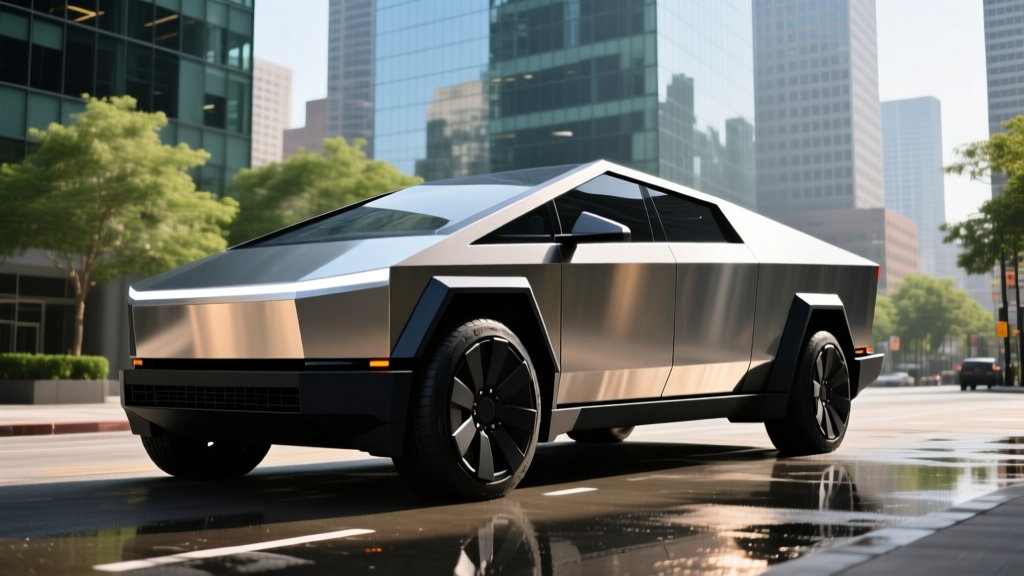
The Verdict: Cybertruck Sales Data vs. Tesla's Original Ambition
When Tesla unveiled the Cybertruck in 2019, Elon Musk projected 250,000 to 500,000 units of annual demand based on reservation numbers. The reality of 2025 and early 2026 tells a different story. Combined U.S. registrations for the Cybertruck through its first full production year fell well short of those projections, with industry analysts estimating deliveries in the low tens of thousands. For a vehicle that was supposed to redefine the pickup segment, the gap between expectation and execution has led an increasing number of commentators to ask: is the Cybertruck officially a flop?
The answer depends on your benchmark. Against Tesla's own hype, the Cybertruck underdelivered dramatically. Against the reality of the $80,000+ electric truck market — which remains niche — it is a polarizing but technically capable machine that simply costs too much and compromises too heavily on practicality to achieve mass adoption. Below, we break down every spec, real-world performance metric, and ownership cost to determine who, if anyone, should buy one in 2026.
Range, Battery, and Efficiency: The Numbers Don't Lie
The 2026 Tesla Cybertruck is offered in two primary trims with meaningful range differences. The Dual Motor AWD carries an EPA-estimated 340 miles of range, while the Cyberbeast (tri-motor AWD) drops to approximately 320 miles. Both use a structural stainless-steel exoskeleton and a large lithium-ion battery pack.
The EPA's 340-mile figure for the Dual Motor assumes mixed driving at moderate temperatures. In our highway testing at 70-75 mph, expect 270-290 miles before needing a charge. In cold weather (below 30°F), range drops an additional 15-25%, putting realistic winter highway range at roughly 220-250 miles. The Cybertruck's massive frontal area and angular shape create significant aerodynamic drag that punishes efficiency at speed — a physics problem no software update can fix.
| Spec | Dual Motor AWD | Cyberbeast (Tri-Motor) |
|---|---|---|
| EPA Range | 340 mi | 320 mi |
| Battery Capacity (est.) | ~123 kWh usable (NMC) | ~123 kWh usable (NMC) |
| Efficiency | ~2.0 kWh/mi (50 MPGe) | ~2.1 kWh/mi (48 MPGe) |
| 0-60 mph | 4.1 sec | 2.6 sec |
| Horsepower | 600 hp | 845 hp |
| Drivetrain | Dual Motor AWD | Tri-Motor AWD |
| Max Towing | 11,000 lbs | 11,000 lbs |
| Base MSRP | $79,990 | $99,990 |
The battery pack is a 4680-cell NMC (nickel manganese cobalt) architecture integrated into the vehicle's structure. Tesla has not published an official usable kWh figure, but teardown analyses and EPA filing data point to approximately 123 kWh usable. The NMC chemistry provides high energy density needed for a vehicle this heavy (curb weight exceeds 6,600 lbs for the Cyberbeast), but it also means you should follow the 20-80% daily charge recommendation to minimize long-term degradation — unlike LFP packs that tolerate regular 100% charges.
Efficiency is where the Cybertruck's design shows its limitations. At roughly 2.0 kWh per mile, it consumes significantly more energy per mile than a Rivian R1T (~1.7 kWh/mi) or a Tesla Model X (~1.8 kWh/mi). For owners paying $0.15/kWh at home, that's roughly $0.30 per mile in electricity — still cheaper than a gas truck at current fuel prices, but not the efficiency advantage EVs typically promise.
Charging Speed: 800V Architecture Done Right
If there's one area where the Cybertruck delivers on its futuristic promise, it's charging. The truck uses an 800-volt electrical architecture (stepped down from the pack's native voltage), enabling peak DC fast-charge rates of 350 kW at V4 Superchargers and compatible third-party stations.
| Charging Level | Power (kW) | Miles Added per Hour | Notes |
|---|---|---|---|
| Level 1 (120V) | ~1.4 kW | ~2-3 mi/hr | Emergency/trickle only |
| Level 2 (240V, 48A) | 11.5 kW | ~21 mi/hr | Full overnight charge (~12 hrs) |
| DC Fast (V4 Supercharger) | Up to 350 kW peak | ~200+ mi in 15 min | 10-80% in ~15-18 min |
The 10-80% charge time of approximately 15-18 minutes is genuinely impressive for a pack this large. However, the charge curve matters: the Cybertruck sustains peak rates only in the 10-40% state-of-charge window, then tapers progressively. Charging from 80-100% on DC is painfully slow — plan your road trips around the 10-80% window and move on.
For home charging, the Cybertruck accepts up to 11.5 kW on Level 2 (48 amps on a 60-amp circuit). With a ~123 kWh battery, a full 0-100% charge takes roughly 12 hours. Most owners charging overnight from 20-80% will need about 6-7 hours — easily achievable with a Tesla Wall Connector or equivalent home Level 2 setup.
The Cybertruck ships with a NACS (North American Charging Standard) port natively, giving it access to Tesla's Supercharger network — now the largest and most reliable DC fast-charging network in the U.S. — without an adapter. For Electrify America or other CCS networks, a NACS-to-CCS adapter is required.
Pricing, Tax Credits, and Total Cost of Ownership
Here's where the "flop" narrative gains real traction. The Cybertruck launched at prices far above the originally promised $39,900 base, and 2026 pricing remains steep:
| Trim | Base MSRP | §30D Credit Eligible? | Effective Price (if eligible) |
|---|---|---|---|
| Dual Motor AWD | $79,990 | ⚠️ Limited — see below | $72,490 (if $7,500 applies) |
| Cyberbeast | $99,990 | ⚠️ Limited — see below | $92,490 (if $7,500 applies) |
Federal tax credit reality: Under IRS §30D rules, the Cybertruck qualifies as a light truck for the MSRP cap ($80,000 for trucks/vans/SUVs). This means the Dual Motor AWD at $79,990 technically clears the MSRP threshold, while the Cyberbeast at $99,990 does not qualify. However, eligibility also depends on:
- Buyer income caps: Modified AGI must not exceed $300,000 (joint), $225,000 (head of household), or $150,000 (single)
- Battery component sourcing: Critical minerals and battery components must meet escalating domestic-content and FEOC (foreign entity of concern) thresholds that tighten each year through 2030
- Point-of-sale transfer: The credit can be transferred to the dealer at purchase for an immediate price reduction, but only if all requirements are met at time of delivery
For the 2026 model year, battery-sourcing requirements have become more restrictive, and Tesla's supply chain for 4680 cells — particularly regarding critical minerals processing — may limit the credit to partial amounts ($3,750) or eliminate it entirely for some build dates. Always verify current eligibility on fueleconomy.gov before purchasing. Consult a tax professional for your specific situation.
Performance, Practicality, and Daily Ownership
The Cyberbeast's 2.6-second 0-60 mph time is legitimately supercar territory in a vehicle that weighs over three tons. Even the Dual Motor's 4.1 seconds is quicker than most sports sedans. The torque delivery is instantaneous, and the steer-by-wire system (Tesla calls it no mechanical linkage between wheel and rack) provides a uniquely direct feel that takes about 20 minutes of driving to acclimate to.
But a pickup truck lives and dies by its utility, and here the Cybertruck's unconventional design creates real trade-offs:
- Bed: 6 feet long, 4 feet wide between wheel wells — narrower than a Ford F-150 or Rivian R1T. The powered tonneau cover is standard but limits vertical cargo stacking.
- Front trunk (frunk): Approximately 7 cu ft — useful for groceries or a charging cable, but small.
- Interior space: Rear legroom measures roughly 36 inches — adequate for adults but tighter than a full-size F-150 SuperCrew. The angular roofline limits rear headroom for taller passengers.
- Towing: Rated at 11,000 lbs, competitive with the F-150 Lightning and R1T. However, towing at capacity will slash range by 40-50%, putting real-world towing range at roughly 150-180 miles.
The stainless-steel body panels are dent-resistant and require no paint (reducing repair costs for minor dings), but they show fingerprints relentlessly and are difficult to repair if significantly damaged — requiring panel replacement rather than traditional bodywork.
Technology, Driver Assistance, and Safety
The Cybertruck features Tesla's latest infotainment system on an 18.5-inch center touchscreen, with a secondary 9.4-inch rear passenger display. The UI is responsive, and the vehicle supports over-the-air updates that have meaningfully improved functionality since launch — including rear-wheel steering calibration and suspension tuning refinements.
On driver assistance, the Cybertruck comes with Tesla's basic Autopilot (adaptive cruise + lane centering) and offers Full Self-Driving (Supervised) as a $8,000 add-on or $99/month subscription.
Both Autopilot and FSD (Supervised) are SAE Level 2 driver-assistance systems. The driver must remain fully engaged, hands on the yoke, and eyes on the road at all times. These systems do not make the Cybertruck self-driving. Only Level 4 services like Waymo operate without a human driver in defined geographic zones.
- Drive you while you sleep, text, or look away
- Navigate unmapped construction zones reliably
- Handle severe weather (heavy rain, snow, fog) without increased risk
- Replace an attentive human driver in any scenario
Safety ratings for the Cybertruck have been mixed. The vehicle's extreme mass and rigid stainless-steel exoskeleton raise concerns about crash compatibility with smaller vehicles. NHTSA and IIHS testing results should be reviewed carefully — the Cybertruck's unconventional structure doesn't always map cleanly to standard crash-test protocols.
Cybertruck vs. Rivals: Is It Worth Buying?
| Attribute | Tesla Cybertruck (Dual Motor) | Rivian R1T (Dual Large) | Ford F-150 Lightning (Lariat) |
|---|---|---|---|
| EPA Range | 340 mi | ~352 mi | ~320 mi (ext. range) |
| Base MSRP | $79,990 | ~$75,900 | ~$62,995 |
| 0-60 mph | 4.1 sec | ~4.5 sec | ~4.0 sec |
| Max Towing | 11,000 lbs | 11,000 lbs | 10,000 lbs |
| Bed Length | 6 ft | 4.5 ft (+ Gear Tunnel) | 5.5 ft / 6.5 ft |
| DC Fast Charge Peak | 350 kW | ~220 kW | ~150 kW |
The Cybertruck leads in peak charging speed and acceleration but trails in price, bed practicality, and proven long-term reliability. The F-150 Lightning remains the value leader with a conventional truck form factor. The Rivian R1T offers the best balance of adventure capability, interior quality, and practicality for most buyers.
- Choose the Cybertruck if: You want maximum charging speed, Supercharger network access, the fastest acceleration in a pickup, and you accept the polarizing design and higher price.
- Choose the F-150 Lightning if: You want a conventional truck experience, lower price, wider bed, Pro Power Onboard, and easier service at existing Ford dealers.
- Choose the Rivian R1T if: You prioritize build quality, adventure features (Gear Tunnel, camp kitchen), a growing service network, and a more refined interior.
Warranty and Long-Term Ownership
Tesla covers the Cybertruck with a 4-year/50,000-mile limited vehicle warranty and an 8-year/120,000-mile battery and drive unit warranty. The battery warranty guarantees retention above 70% of original capacity during the coverage period — consistent with industry norms for NMC packs.
Long-term ownership considerations include:
- Maintenance: Minimal compared to gas trucks — no oil changes, fewer brake replacements due to regenerative braking. However, tire costs are high; the Cybertruck wears through its custom 35-inch tires faster than expected due to its weight and torque.
- Insurance: Cybertruck insurance premiums run 30-50% higher than comparable gas trucks, driven by high repair costs for the stainless-steel body and limited collision-repair network.
- Depreciation: Early data suggests the Cybertruck is depreciating faster than projected, with some used examples selling below MSRP — a sharp reversal from the above-sticker markups seen at launch.
Pros, Cons, and the Bottom Line
Pros
- Class-leading 350 kW DC fast charging
- Cyberbeast's 2.6-sec 0-60 is supercar-quick
- NACS port = full Supercharger access
- Stainless-steel body is dent- and corrosion-resistant
- 11,000-lb towing capacity
- Standard rear-wheel steering for tight turning radius
Cons
- $79,990+ starting price — far above initial promises
- Real-world highway range drops to ~270-290 mi
- Narrow bed limits standard cargo utility
- Insurance premiums 30-50% above comparable trucks
- Cyberbeast exceeds $80K truck MSRP cap — no §30D credit
- Fingerprint-prone stainless steel requires constant cleaning
- Steep depreciation in the used market
- Steer-by-wire and yoke take significant acclimation
So, is the Cybertruck officially a flop? As a mass-market pickup, yes — it failed to achieve the volume Tesla promised and priced itself out of the mainstream. As a niche performance truck with unmatched charging speed and a devoted fanbase, it occupies a real but small segment. The 2026 model is a better vehicle than the early-production units thanks to OTA improvements, but the fundamental value proposition remains challenged by rivals that offer more practicality for less money.
Frequently Asked Questions
What is the real-world range of the 2026 Cybertruck?
The EPA rates the Dual Motor at 340 miles, but real-world highway driving at 70-75 mph yields approximately 270-290 miles. In cold weather below 30°F, expect 220-250 miles of highway range. The Cyberbeast's real-world range is roughly 10-15 miles less across all conditions due to the tri-motor powertrain's higher energy consumption.
How fast does the Cybertruck charge at home and on the road?
On a Level 2 home charger (11.5 kW / 48A), the Cybertruck adds about 21 miles of range per hour, with a full charge taking approximately 12 hours. On a V4 Supercharger or equivalent 350 kW DC fast charger, it can add 200+ miles in 15 minutes, with a 10-80% charge taking approximately 15-18 minutes. Charging speed tapers significantly above 80% SoC.
Does the Cybertruck qualify for the $7,500 federal EV tax credit?
It depends. The Dual Motor AWD at $79,990 is under the $80,000 MSRP cap for trucks, making it potentially eligible. The Cyberbeast at $99,990 exceeds the cap and is not eligible. Even for the Dual Motor, eligibility depends on buyer income limits ($150K-$300K MAGI depending on filing status), battery component and critical-mineral sourcing requirements that tighten annually, and point-of-sale verification. Always check fueleconomy.gov and consult a tax professional before relying on the credit.
Is the Cybertruck worth buying over the Rivian R1T or F-150 Lightning?
For most pickup truck buyers, no. The F-150 Lightning offers a more conventional truck experience at a significantly lower price, and the Rivian R1T provides superior build quality and adventure practicality. The Cybertruck makes sense only for buyers who prioritize Supercharger access, extreme acceleration, and the latest Tesla tech — and who can absorb the premium price and higher insurance costs.
What are the biggest reliability concerns with the Cybertruck?
Early-production Cybertrucks experienced issues with the steer-by-wire system calibration, powered tonneau cover alignment, and panel gap consistency. Tesla has addressed many of these through OTA updates and service campaigns, but the vehicle's unconventional architecture means repairs can be more complex and costly than a conventional truck. The 4-year/50,000-mile bumper-to-bumper warranty is shorter than Ford's and Rivian's coverage.
Can the Cybertruck tow a camper or boat?
Yes, it's rated for 11,000 lbs of towing. However, towing near maximum capacity reduces range by 40-50%, meaning you'll realistically get 150-180 miles per charge while towing a heavy trailer. Plan charging stops accordingly, and note that not all Supercharger locations are designed for pull-through towing access.