If you're researching the Lucid Air in 2026, you've likely noticed a recurring theme in owner forums and reviews: Lucid software updates. Over-the-air (OTA) updates have reshaped the Air's capabilities since launch — altering range estimates, refining the DreamDrive ADAS suite, and adding features that weren't available at delivery. But what do these updates actually mean for a prospective buyer evaluating the Air today?
This profile breaks down the 2026 Lucid Air lineup with the latest software-driven improvements in mind, alongside the hard numbers — EPA range, battery chemistry, charging curves, pricing, and federal tax credit eligibility — that matter most when you're spending $70,000+ on a luxury electric sedan.
2026 Lucid Air: Core Specs at a Glance
| Spec | Air Pure | Air Touring | Air Grand Touring |
|---|---|---|---|
| EPA Range | 419 mi | 425 mi | 516 mi |
| Battery (usable) | 88 kWh (NMC) | 112 kWh (NMC) | 112 kWh (NMC) |
| Drivetrain | RWD, single motor | AWD, dual motor | AWD, dual motor |
| Horsepower | 430 hp | 620 hp | 819 hp |
| 0–60 mph | 5.0 sec | 3.4 sec | 3.0 sec |
| Max DC Fast Charge | 200 kW | 250 kW | 250 kW (300+ kW capable) |
| 10–80% DCFC Time | ~28 min | ~22 min | ~20 min |
| Level 2 Home Charging | 19.2 kW (up to ~75 mi/hr) | 19.2 kW (up to ~75 mi/hr) | 19.2 kW (up to ~75 mi/hr) |
| Efficiency (combined) | 146 MPGe / 23 kWh/100mi | 131 MPGe / 26 kWh/100mi | 131 MPGe / 26 kWh/100mi |
| Base MSRP | $69,900 | $77,900 | $125,600 |
| Battery/Powertrain Warranty | 8 yr / 100,000 mi | 8 yr / 100,000 mi | 8 yr / 100,000 mi |
Source: fueleconomy.gov and Lucid Motors official specifications, 2026 model year.
Range Reality: EPA Sticker vs. What You'll Actually Get
The Grand Touring's EPA rating of 516 miles is the highest of any production sedan sold in the U.S. However, in sustained 75-mph highway driving at 65°F, expect roughly 410–440 miles. In cold weather (below 32°F), range drops to approximately 340–380 miles due to battery resistance and cabin heating demands. The Touring trim delivers roughly 340–360 miles highway in moderate temps. The RWD Pure, despite its smaller pack, achieves an impressive 330–350 miles highway thanks to its lighter curb weight and single-motor efficiency.
Lucid's industry-leading efficiency — measured in kWh per 100 miles — is the Air's defining engineering achievement. The Pure's 23 kWh/100mi figure means it extracts more miles per unit of energy than virtually any competitor, including the Tesla Model S Long Range (~28 kWh/100mi). This efficiency advantage is largely hardware-driven (Lucid's miniaturized drive units, low-drag aero at 0.20 Cd), but recent Lucid software updates have refined thermal management preconditioning and regenerative braking algorithms to squeeze out marginal gains.
Charging Speed: How Lucid Software Updates Changed the Curve
Charging speed is where OTA updates have had the most tangible owner impact. Lucid's 2025 software releases improved DC fast-charge preconditioning logic — the car now begins warming the battery earlier and more aggressively when a fast charger is navigated to, resulting in faster initial charge rates upon plug-in.
| Charging Level | Power (kW) | Miles Added per Hour | Notes |
|---|---|---|---|
| Level 1 (120V household) | 1.4 kW | ~4–5 mi/hr | Emergency/trickle only |
| Level 2 (240V, 48A) | 11.5 kW | ~45 mi/hr | Standard home charger |
| Level 2 (240V, 80A) | 19.2 kW | ~75 mi/hr | Requires 100A circuit; Lucid Connected Home charger |
| DC Fast Charge (CCS) | Up to 250 kW (300+ kW on Grand Touring) | ~600–900 mi/hr equivalent | 10–80% in ~20 min (GT); tapers significantly above 80% |
Charge curve reality check: Like all EVs, the Air doesn't sustain peak kW for the entire session. The Grand Touring hits ~300 kW at low state-of-charge (under 20%) on a 350 kW charger, but tapers to ~150 kW by 50% and ~75 kW by 80%. The 10–80% time of ~20 minutes reflects this integrated curve, not a sustained peak. Recent Lucid software updates have slightly flattened the mid-range taper, shaving 1–2 minutes off the 10–80% session on compatible chargers.
The Air uses a CCS1 connector natively. With the industry's shift to NACS (Tesla's connector), Lucid provides a NACS adapter for Supercharger access — critical for road-trip charging coverage in regions where Electrify America and other CCS networks remain sparse.
Performance, Interior Space, and Daily Livability
The Air's performance envelope varies enormously by trim. The Pure's 430 hp and 5.0-second 0–60 time are more than adequate for any real-world merge or passing scenario. The Grand Touring's 819 hp and 3.0-second sprint put it in supercar territory, though few owners will ever use that capability.
Where the Air consistently impresses is interior volume. As a full-size luxury sedan built on a dedicated EV platform with a compact drivetrain, it offers:
- Front legroom: 41.1 inches
- Rear legroom: 37.4 inches (competitive with the Mercedes EQS, significantly more than the Tesla Model S)
- Trunk: 32.1 cu ft (rear cargo) + 10.1 cu ft frunk = 42.2 cu ft total
- Seating: 5 passengers standard; Executive Rear Seating package available on Grand Touring (reduces capacity to 4 but adds recline, massage, and fold-down tables)
The glass canopy roof creates an airy cabin but does increase solar heat load in summer — the 2026 software includes improved cabin pre-conditioning scheduling to mitigate this when the car is parked.
Standout Tech: Where Lucid Software Updates Matter Most
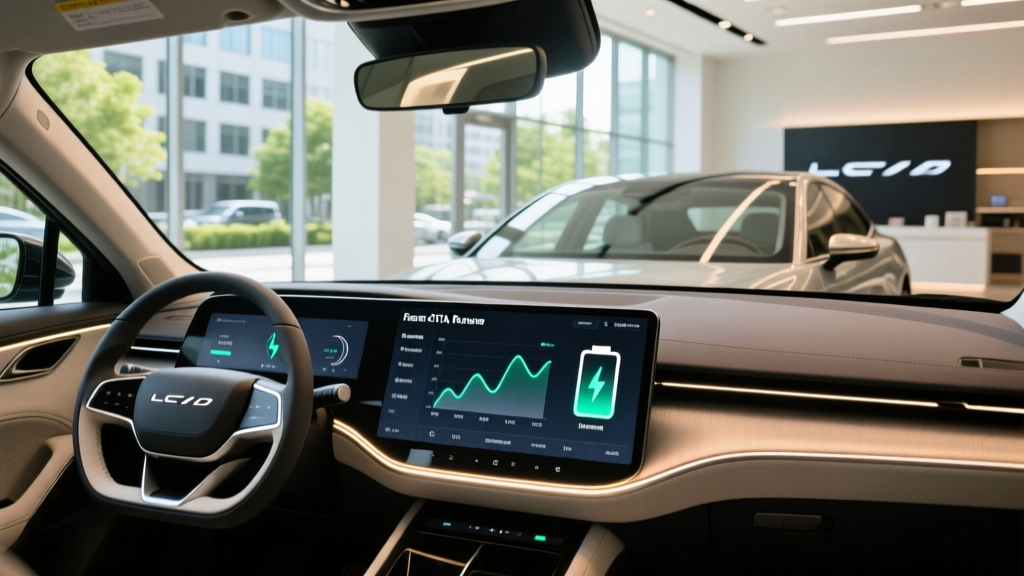
The Air runs Lucid's proprietary software stack on a 34-inch curved glass cockpit display. Key tech features include:
- DreamDrive Pro (ADAS): 32 sensors including LiDAR (standard on Touring and above). This is an SAE Level 2 driver-assistance system — the driver must remain engaged with hands on the wheel at all times. It is not self-driving.
- Wireless Apple CarPlay/Android Auto (added via OTA in late 2024)
- Native navigation with real-time charge planning — routes factor in elevation, temperature, and charger availability
- Proxy key and phone-as-key with improved BLE reliability in recent updates
- Sentry Mode-style dashcam recording (added via 2025 OTA)
DreamDrive Pro, despite its LiDAR hardware and sophisticated sensor suite, is an SAE Level 2 system. It does not permit hands-off or eyes-off driving. Lucid has not announced a Level 3 or Level 4 timeline. Competitors like GM's Super Cruise and Ford's BlueCruise offer hands-free driving on pre-mapped highways — DreamDrive requires steering wheel contact at all times.
The infotainment system remains a point of criticism. While the hardware is stunning, some owners report that the UI is less intuitive than Tesla's or BMW's iDrive. Lucid has addressed this incrementally through OTA updates — adding customizable shortcut tiles, improving voice recognition, and refining the climate control interface — but the system still trails the best in the segment for ease of use while driving.
Pricing, Trims, and Federal Tax Credit Eligibility
| Trim | Base MSRP | As-Tested (typical options) | §30D Federal Credit Eligible? |
|---|---|---|---|
| Air Pure | $69,900 | $72,000–$76,000 | Not eligible — MSRP exceeds $55,000 sedan cap |
| Air Touring | $77,900 | $82,000–$90,000 | Not eligible — MSRP exceeds $55,000 sedan cap |
| Air Grand Touring | $125,600 | $135,000–$155,000 | Not eligible — MSRP exceeds $55,000 sedan cap |
Critical tax credit note: Under IRS §30D rules, new clean vehicle credits are capped at $55,000 MSRP for sedans (the cap is $80,000 for SUVs, vans, and trucks). Because every Lucid Air trim is classified as a sedan and starts well above $55,000, no new Air qualifies for the $7,500 federal EV tax credit. Buyer income limits ($150K single / $300K joint) and battery-sourcing/critical-mineral requirements are moot here — the MSRP cap alone disqualifies the Air.
However, buyers may be eligible for the used EV credit (§25E) — up to $4,000 or 30% of the sale price (whichever is less) — when purchasing a pre-owned Air from a dealer, provided the used sale price is under $25,000. Given current Air resale values, this is unlikely to apply until the 2027+ timeframe for early 2022–2023 models.
Pros, Cons, and the Verdict
- Best-in-class EPA range (516 mi Grand Touring)
- Outstanding efficiency (23–26 kWh/100mi)
- Excellent rear-seat legroom for a luxury sedan
- 19.2 kW Level 2 charging — among the fastest available
- LiDAR-equipped ADAS hardware (future-proofing potential)
- Active OTA update program adding real features post-delivery
- No federal tax credit eligibility (sedan MSRP cap)
- Infotainment UI trails Tesla/BMW in usability
- CCS native; NACS requires adapter for Supercharger access
- Limited service center network vs. legacy luxury brands
- DreamDrive requires hands-on-wheel (no hands-free highway mode)
- Depreciation steeper than Tesla Model S in first 2 years
Who Should Buy the Lucid Air?
- You prioritize maximum range and efficiency above all else in a luxury sedan
- You frequently drive 300+ mile routes and want to minimize charging stops
- You value rear-seat comfort and cargo space for family use
- You can charge at home (Level 2) and want the fastest home replenishment available
- You want OTA-improving software that adds features over ownership
- You need the $7,500 federal tax credit to make the math work (consider the Hyundai Ioniq 6, BMW i5, or Tesla Model 3)
- Hands-free highway driving is a priority (GM Super Cruise or Ford BlueCruise vehicles)
- You rely exclusively on Tesla Superchargers and want native NACS (Tesla Model S)
- You need a large dealer/service network in rural areas
Frequently Asked Questions
What is the real-world range of the 2026 Lucid Air?
The EPA rates the Grand Touring at 516 miles, the Touring at 425 miles, and the Pure at 419 miles. In real-world highway driving at 70–75 mph in moderate temperatures, expect 80–85% of the EPA figure: roughly 410–440 miles for the Grand Touring, 340–360 for the Touring, and 330–350 for the Pure. Cold weather (below freezing) reduces range an additional 15–25%.
How fast does the Lucid Air charge at home and on the road?
On a 240V/80A Level 2 home charger, the Air accepts up to 19.2 kW, adding approximately 75 miles of range per hour — a full overnight charge from 10% to 100% takes about 10–12 hours. On DC fast chargers, the Grand Touring peaks above 300 kW and achieves 10–80% in roughly 20 minutes; the Touring and Pure peak at 250 kW and 200 kW respectively, taking 22–28 minutes for the same interval.
Does the Lucid Air qualify for the federal EV tax credit?
No. Under current IRS §30D rules, the new vehicle clean energy credit is capped at $55,000 MSRP for sedans. Every Air trim starts above $69,900, disqualifying it regardless of buyer income or battery sourcing. Some state-level incentives may still apply — check your state's energy office for current programs.
How do Lucid software updates compare to Tesla's OTA program?
Both Lucid and Tesla deliver meaningful feature additions via OTA — not just bug fixes. Lucid's updates have historically arrived less frequently (roughly 3–5 major releases per year vs. Tesla's more frequent cadence) but have added substantive capabilities: wireless CarPlay, dashcam recording, improved preconditioning, and UI overhauls. Lucid's smaller fleet means fewer crowdsourced driving data miles for ADAS training, which is reflected in DreamDrive's more conservative behavior vs. Tesla's Autopilot/FSD.
Is the Lucid Air worth buying vs. the Tesla Model S or BMW i7?
It depends on your priorities. The Air offers the longest range, best efficiency, and most rear-seat room of the three. The Model S wins on Supercharger network access, infotainment polish, and hands-free-style Autopilot capability (still Level 2, per NHTSA definitions). The BMW i7 offers the most traditional luxury experience, superior build quality, and dealer support but trails on range (318 mi EPA) and efficiency. If range and space are your top metrics, the Air is the segment leader.
What's the biggest risk of buying a Lucid in 2026?
Service network density. Lucid operates roughly 30+ service centers and mobile service vans nationwide — adequate for metro-area owners but thin for rural or intercity owners who may face long tow distances for hardware repairs. Software-related issues are often resolved remotely via OTA, but physical repairs require Lucid-specific facilities. Depreciation is also a factor: early Air models have lost 35–45% of value in the first two years, steeper than the Model S.