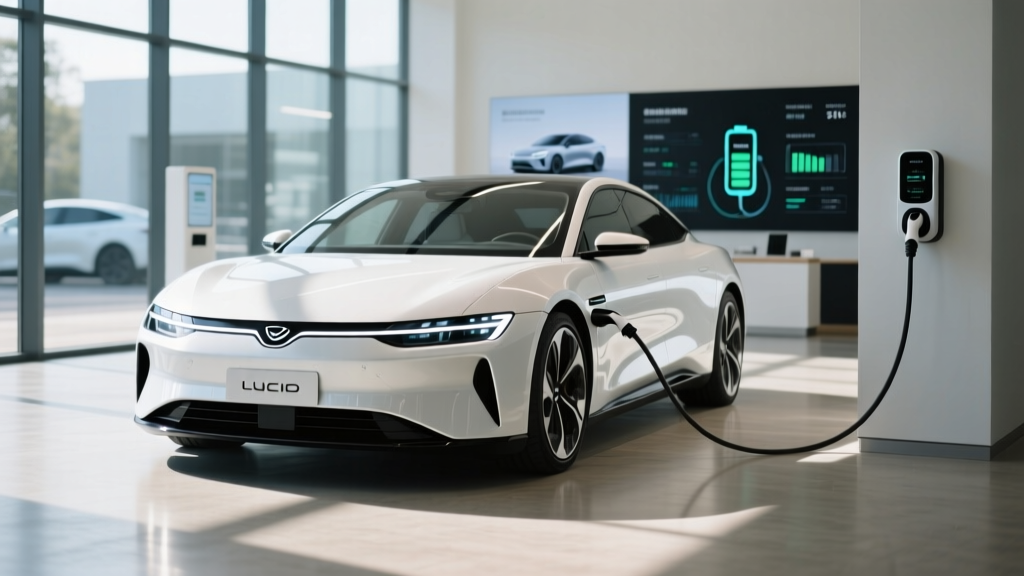
Luxury EV shoppers eyeing the Lucid Air have a unique calculus to run that Tesla or BMW buyers don't: the financial health of the automaker itself. Lucid's Q3 2025 financial results — released in early November 2025 — painted a picture of a company still burning significant cash while ramping production of the Air sedan and preparing for the Gravity SUV launch. For prospective buyers, those numbers matter far beyond Wall Street. They influence warranty support, service-center expansion, software-update cadence, and long-term resale confidence.
This review breaks down what Lucid's Q3 2025 earnings mean for anyone considering a 2026 Lucid Air purchase today, then dives deep into the car itself: real-world range, charging performance, pricing after federal tax credits, and how it stacks up against the Mercedes EQS, Tesla Model S, and BMW i7.
Why Lucid's Q3 2025 Financial Results Matter to Buyers
Lucid reported Q3 2025 revenue of approximately $240 million, with vehicle deliveries in the low thousands — a fraction of Tesla's volume but consistent with a low-volume luxury manufacturer still scaling. The company's net loss remained substantial, though its cash position was bolstered by continued backing from Saudi Arabia's Public Investment Fund (PIF), which holds a roughly 60% stake.
For buyers, three takeaways from the Lucid Q3 2025 earnings release are most relevant:
- Production continuity: PIF backing reduces near-term bankruptcy risk, meaning warranty and parts support should remain intact through the ownership period.
- Service network growth: Lucid has been expanding mobile service and studio locations, but coverage remains thin outside major metros — a real ownership friction point.
- Software investment: R&D spending continues, which matters for the Air's DreamDrive Pro ADAS and infotainment feature pipeline through 2026 and 2027.
Bottom line: buying a Lucid Air in 2026 is not the same risk as buying from a pre-revenue startup, but it's also not the same safety net as buying from BMW or Mercedes-Benz. If you're in a metro with a Lucid service center, the risk is manageable. If you're rural, think carefully.
2026 Lucid Air: Trims, Pricing, and Tax Credit Eligibility
The 2026 Lucid Air lineup carries over with four primary trims, ranging from the value-oriented Pure to the four-digit-horsepower Sapphire halo model. Pricing below reflects base MSRP before destination and before any federal or state incentives.
| Trim | Base MSRP | Drivetrain | Horsepower | EPA Range | §30D Credit Eligible? |
|---|---|---|---|---|---|
| Air Pure | $69,900 | RWD | 430 hp | 419 mi | Yes (meets MSRP cap) |
| Air Touring | $87,400 | AWD Dual-Motor | 620 hp | 406 mi | No (above $55K sedan cap) |
| Air Grand Touring | $125,600 | AWD Dual-Motor | 1,050 hp | 516 mi | No (above $55K sedan cap) |
| Air Sapphire | $249,000 | AWD Tri-Motor | 1,234 hp | 427 mi | No (above $55K sedan cap) |
Understanding §30D Federal Tax Credit Eligibility
Under current IRS §30D rules, new clean vehicle credits are capped at $7,500 and subject to multiple constraints:
- MSRP cap for sedans: $55,000 (this eliminates Touring, Grand Touring, and Sapphire)
- Buyer income caps: $150K single / $225K head of household / $300K joint (modified AGI)
- Battery sourcing: Critical minerals and battery component requirements phase in annually through 2026, with FEOC (foreign entity of concern) restrictions tightening
- Point-of-sale transfer: Eligible buyers can transfer the credit to the dealer at purchase for an immediate price reduction
For the Air Pure at $69,900 MSRP, the sedan MSRP cap of $55,000 technically disqualifies it unless Lucid restructures pricing or the buyer qualifies under a different provision. Always verify current-year eligibility with a tax professional before relying on the credit in your purchase math.
Range, Efficiency, and the Real-World Caveat
The Lucid Air Grand Touring's EPA-estimated 516 miles of range remains the highest of any production EV sold in the United States. But EPA stickers are laboratory estimates — here's what to expect on actual roads.
Real-World Range Expectations
| Trim | EPA Range | Real-World Highway (70 mph) | Cold Weather (20°F, highway) |
|---|---|---|---|
| Air Pure (RWD) | 419 mi | ~340–360 mi | ~280–310 mi |
| Air Touring (AWD) | 406 mi | ~330–350 mi | ~270–300 mi |
| Air Grand Touring (AWD) | 516 mi | ~420–450 mi | ~340–380 mi |
| Air Sapphire (AWD) | 427 mi | ~340–370 mi | ~280–310 mi |
Source: EPA estimates via fueleconomy.gov; real-world estimates based on independent EV range testing at sustained highway speeds. Cold-weather figures assume cabin heating and no preconditioning.
The Air's efficiency is genuinely class-leading. The Grand Touring achieves approximately 131 MPGe combined and consumes roughly 26 kWh per 100 miles — remarkable for a 5,200-pound luxury sedan. Lucid's proprietary miniaturized drive units and 900V+ architecture reduce energy waste in the powertrain, which is why the Air extracts more miles per kWh than competitors with similar battery sizes.
The battery pack in the Grand Touring is a 118 kWh usable (NMC lithium-ion) unit. The Pure and Touring use a smaller 88 kWh usable pack, also NMC chemistry. Lucid does not currently offer LFP (lithium iron phosphate) in any Air trim — meaning you should follow the 80% daily charge recommendation to preserve long-term battery health, unlike LFP packs that tolerate regular 100% charges.
Charging Speed: DC Fast Charging and Home Level 2
The Air's 900V electrical architecture is one of the highest-voltage platforms in production, enabling exceptionally fast DC charging — when you can find a compatible station.
| Charging Level | Power / Rate | Time / Speed | Connector |
|---|---|---|---|
| Level 1 (120V household) | ~1.4 kW | ~3–4 mi/hr | J1772 / NACS (with adapter) |
| Level 2 (240V home, 48A) | 11.5 kW | ~35–40 mi/hr (Grand Touring) ~28–32 mi/hr (Pure/Touring) |
J1772 / NACS |
| DC Fast Charge (peak) | 300 kW (GT) / 220 kW (Pure/Touring) | 10–80% in ~20 min (GT) 10–80% in ~25 min (Pure/Touring) |
CCS1 (NACS via adapter on newer builds) |
Charging curve reality: The Grand Touring's 300 kW peak is not sustained across the entire session. The Air holds above 250 kW from roughly 10–40% state of charge, then tapers progressively. From 80–100%, charging slows dramatically to protect the battery — expect that final 20% to take as long as the first 60%. Plan your road-trip stops around 10–80% charges for maximum efficiency.
On the Tesla Supercharger network, Lucid owners can access stalls using a NACS adapter (provided or available for purchase depending on model year). However, many Supercharger V2 stalls cap at 150 kW, which won't fully utilize the Air's capability. Seek out V3/V4 Superchargers or Electrify America 350 kW stations for best results.
Performance: 0–60 Times and Drivetrain Details
The Air's performance envelope spans from comfortable grand tourer to hypercar-adjacent, depending on trim:
- Air Pure (RWD, 430 hp): 0–60 mph in approximately 5.0 seconds. Smooth, effortless, and more than adequate for highway merging and daily driving.
- Air Touring (AWD, 620 hp): 0–60 mph in approximately 3.4 seconds. Dual-motor AWD provides all-weather traction and confident acceleration.
- Air Grand Touring (AWD, 1,050 hp): 0–60 mph in approximately 3.0 seconds. Relentless, linear acceleration that never feels peaky.
- Air Sapphire (Tri-Motor AWD, 1,234 hp): 0–60 mph in approximately 1.89 seconds. One of the quickest production cars ever made, with torque-vectoring rear motors enabling adjustable handling dynamics.
All trims feature adaptive dampers and air suspension (standard on Touring and above, optional on Pure). The ride quality in Comfort mode rivals the Mercedes S-Class; in Sport mode, body control tightens considerably without becoming harsh. Regenerative braking is adjustable but does not enable true one-pedal driving at very low speeds — you'll still use the brake pedal for final stops.
Interior, Cargo Space, and Technology
The Air's cabin uses a "post-luxury" design philosophy — minimalist but not spartan, with a curved 34-inch glass canopy display spanning the driver's instrument cluster and infotainment. Materials include Alcantara, Nappa leather (on higher trims), and sustainably sourced wood and aluminum trim.
Dimensions and Space
- Front legroom: 45.3 inches
- Rear legroom: 37.2 inches (generous for a sedan, though the sloping roofline limits headroom for 6-foot+ passengers)
- Trunk volume: 32.1 cu ft (rear trunk) + 7.1 cu ft (frunk) = 39.2 cu ft total
- Wheelbase: 116.5 inches — contributing to the limousine-like rear seat experience
Standout Tech Features
- DreamDrive Pro (ADAS): 32 sensors including LiDAR, cameras, and radar. Provides highway lane-centering, adaptive cruise, and automatic lane changes. This is SAE Level 2 — you must remain engaged and supervising at all times.
- Surreal Sound Pro: 21-speaker Dolby Atmos audio system (standard on Touring and above)
- Clearview Glass Roof: Electrochromic dimming with UV blocking — no shade needed
- OTA Updates: Regular over-the-air software improvements to powertrain mapping, infotainment, and ADAS
Notable Drawbacks
- Infotainment can lag behind Tesla and BMW in responsiveness and app ecosystem depth
- No Apple CarPlay or Android Auto — Lucid uses its own native interface exclusively
- Service center density remains limited; mobile service helps but can't handle major repairs
- Build quality on early 2024–2025 models had panel-gap inconsistencies; 2026 builds have improved but still trail German competitors
Lucid Air vs. Key Competitors: Is It Worth Buying?
Pros
- Class-leading efficiency and EPA range (516 mi Grand Touring)
- 900V architecture enables 300 kW DC fast charging
- Spacious cabin with best-in-class rear legroom for a sedan
- Sapphire trim offers hypercar performance at a fraction of the cost
- Distinctive, understated design stands out without shouting
Cons
- Limited service center network — risky for rural owners
- No wireless CarPlay/Android Auto
- Tax credit eligibility is unlikely for most trims due to MSRP caps
- Resale value uncertainty given Lucid's financial position
- Infotainment ecosystem less mature than Tesla or BMW iDrive
Choose the Lucid Air If:
- Maximum range per charge is your top priority for road trips
- You live near a Lucid service center or in a major metro
- You value efficiency and engineering substance over brand cachet
- You want a luxury sedan that isn't a Tesla, BMW, or Mercedes
Look Elsewhere If:
- You need a robust dealer/service network for peace of mind
- CarPlay integration is non-negotiable for your daily workflow
- You want the strongest resale value projection in the luxury EV segment
- You're buying primarily on federal tax credit savings
Warranty Coverage and Battery Longevity
Lucid provides the following warranty coverage for the 2026 Air:
- Basic vehicle warranty: 4 years / 50,000 miles
- Battery and drive unit warranty: 8 years / 100,000 miles (whichever comes first)
- Battery capacity retention threshold: Lucid warrants the battery will retain at least 70% of its original usable capacity during the warranty period
The 8-year/100,000-mile battery warranty is industry-standard and matches Tesla, BMW, and Mercedes. Based on NMC chemistry degradation data from similar high-voltage packs, expect approximately 10–15% capacity loss over 150,000 miles under normal use. Lucid's thermal management system is among the most sophisticated in the industry, which should help minimize degradation over time.
Frequently Asked Questions
What is the real-world range of the Lucid Air?
The EPA rates the Air Grand Touring at 516 miles and the Pure at 419 miles. In real-world highway driving at 70 mph, expect roughly 80–87% of the EPA figure — so about 420–450 miles for the Grand Touring and 340–360 miles for the Pure. Cold weather (below freezing) can reduce range by an additional 15–25% due to battery resistance and cabin heating demand.
How fast does the Lucid Air charge at home and on the road?
At home on a 240V Level 2 charger (48A), the Air adds approximately 35–40 miles of range per hour (Grand Touring) or 28–32 miles per hour (Pure/Touring), reaching a full charge overnight in 8–10 hours. On DC fast chargers, the Grand Touring peaks at 300 kW and can charge from 10–80% in about 20 minutes. The Pure and Touring peak at around 220 kW with a 10–80% time of approximately 25 minutes.
Does the Lucid Air qualify for the federal EV tax credit?
Under current IRS §30D rules, the new-vehicle credit of up to $7,500 has an MSRP cap of $55,000 for sedans. Since the least expensive 2026 Air Pure starts at $69,900, it does not meet this threshold. Higher trims are also ineligible. Buyers should consult a tax professional and check the latest IRS guidance, as rules can change annually. A used Air purchased from a dealer may qualify for the separate used-EV credit (up to $4,000) if the sale price is at or below $25,000.
How much does the Lucid Air cost after incentives?
Because the Air does not currently qualify for the federal new-vehicle credit due to the sedan MSRP cap, buyers should plan to pay full MSRP plus destination and applicable state fees. Some states offer additional rebates or HOV-lane access that can offset costs. Check your state's energy office for current programs.
Is the Lucid Air worth buying over the Tesla Model S or Mercedes EQS?
The Air wins on range and efficiency — no competitor matches 516 EPA miles or 131 MPGe. The Model S offers a more mature Supercharger network, faster infotainment, and stronger resale data. The EQS delivers a more traditional luxury experience with a denser dealer network. If range is your top metric and you have service-center access, the Air is a compelling choice. If infrastructure and long-term support are paramount, the Model S or EQS may be safer bets.
What happens to my warranty if Lucid's finances worsen?
PIF's majority ownership provides a significant financial backstop. However, no buyer should assume perpetual support from any automaker. The Air's 8-year/100,000-mile battery warranty is a contractual obligation, and in any restructuring scenario, warranty obligations are typically addressed. That said, buying from a low-volume manufacturer always carries more long-term support risk than buying from a legacy OEM.