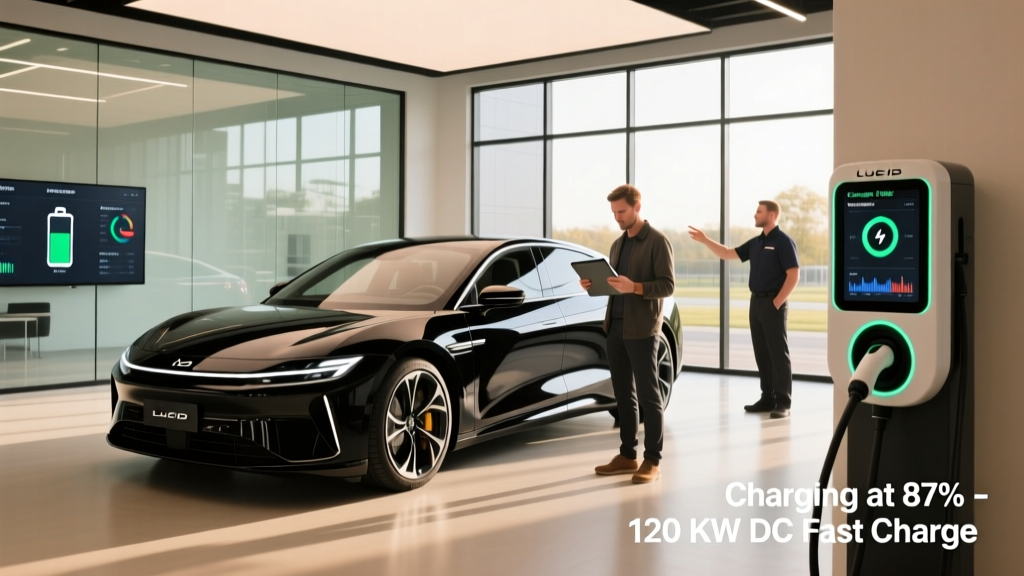
For New England EV shoppers, Lucid Natick has become a key touchpoint for experiencing the brand's luxury electric sedans and SUVs in person. Located at the Natick Mall in Massachusetts, this combined Service Center and Studio lets prospective buyers explore the Lucid Air lineup, schedule test drives, and access factory-trained service — all without traveling to a major metro hub. But the real question isn't where to find a Lucid; it's whether the Air or the new Gravity delivers enough range, charging speed, and real-world practicality to justify its premium price. This guide breaks down every spec, ownership cost, and consideration you need before walking through those doors.
Lucid's Current Lineup: What You'll Find at Natick
As of the 2026 model year, Lucid Motors offers two primary vehicles, both available for configuration and order through the Natick Studio:
- Lucid Air — A full-size luxury sedan competing with the Tesla Model S, BMW i7, and Mercedes EQS. Available in Pure, Touring, Grand Touring, and Sapphire trims.
- Lucid Gravity — A three-row luxury SUV (production began late 2024, now in full delivery mode) aimed at the Tesla Model X, BMW iX, and Rivian R1S buyer.
The Natick location functions as both a retail Studio and a Service Center, meaning you can handle everything from a first test drive to warranty repairs in one stop — a significant advantage over the mail-order-only approach some EV startups rely on.
Lucid Air: Range, Battery, and Real-World Efficiency
The Lucid Air's headline number has always been range, and the 2026 lineup continues to lead the luxury sedan segment. Here's how the trims stack up:
| Trim | Battery (kWh usable) | Chemistry | EPA Range | Drivetrain | HP | 0-60 mph | Base MSRP |
|---|---|---|---|---|---|---|---|
| Air Pure | 88 kWh | NMC | 419 mi | RWD | 430 | 5.0 sec | $69,900 |
| Air Touring | 112 kWh | NMC | 425 mi | AWD Dual-Motor | 620 | 3.4 sec | $87,400 |
| Air Grand Touring | 112 kWh | NMC | 516 mi | AWD Dual-Motor | 819 | 3.0 sec | $125,600 |
| Air Sapphire | 118 kWh | NMC | 427 mi | AWD Tri-Motor | 1,234 | 1.89 sec | $249,000 |
Efficiency figures from fueleconomy.gov show the Air Pure achieving approximately 146 MPGe combined (roughly 23 kWh/100 mi), making it one of the most efficient large luxury sedans on the market. The Grand Touring, despite its massive battery, still returns around 131 MPGe combined — a testament to Lucid's in-house motor and inverter technology, which achieves over 90% efficiency in the drivetrain.
Charging Speed: DC Fast Charging and Home Level 2
Lucid's 900V+ electrical architecture enables some of the fastest charging in the industry, but peak numbers don't tell the full story. Here's what to expect:
| Charging Level | Max Rate | Time / Miles Added | Notes |
|---|---|---|---|
| Level 1 (120V household) | ~1.4 kW | ~3-4 mi/hr | Emergency/trickle only |
| Level 2 (240V home, 48A) | 11.5 kW | ~37 mi/hr (full in ~10 hrs) | Recommended daily charging |
| Level 2 (240V, 80A) | 19.2 kW | ~62 mi/hr (full in ~6 hrs) | Requires 100A circuit; Lucid Connected Home charger |
| DC Fast Charge (CCS) | Up to 300 kW peak | 10-80% in ~20 min (Grand Touring) | Sustained rate tapers above 60% SoC |
| DC Fast Charge (NACS adapter) | Up to 250 kW (Tesla V3/V4) | 10-80% in ~25 min | Tesla Supercharger access via adapter |
Charging curve reality check: The Air Grand Touring can peak near 300 kW at a sufficiently powerful DC fast charger (350 kW+ station), but that peak is sustained only between roughly 10-40% State of Charge. By 60%, the rate drops to approximately 150 kW, and above 80% it slows significantly to protect battery longevity. This is normal lithium-ion behavior — not a Lucid limitation — but it means your actual road-trip stops will average closer to 180-200 kW over a 10-80% session.
For Natick-area owners, home Level 2 charging is the daily workhorse. A 48-amp Level 2 circuit (requiring a 60-amp breaker) adds roughly 37 miles per hour of charging, meaning an overnight session from 60% to 100% takes about 4-5 hours on the 112 kWh pack. If your electrical panel supports it, upgrading to an 80-amp circuit with Lucid's Connected Home charger cuts that significantly — but expect to pay a licensed electrician $1,500-$3,500 for installation depending on panel capacity and run distance.
Lucid Gravity: The SUV Option at Natick
The Lucid Gravity entered full production in late 2024 and is now a core part of the Natick Studio experience. For families who need three rows and cargo flexibility, it's the more practical Lucid:
| Trim | Battery (kWh) | EPA Range | Drivetrain | HP | 0-60 mph | Cargo (behind 3rd / 2nd / max) | Base MSRP |
|---|---|---|---|---|---|---|---|
| Gravity Pure | 112 kWh | 440 mi (est.) | AWD Dual-Motor | 600 | 3.8 sec | 22 / 62 / 112 cu ft | $79,900 |
| Gravity Grand Touring | 112 kWh | 450 mi (est.) | AWD Dual-Motor | 800+ | 3.2 sec | 22 / 62 / 112 cu ft | $99,900 |
The Gravity shares the Air's 900V architecture and efficiency-focused motor design, translating sedan-class efficiency into a 6,000+ lb SUV. Its max tow rating is approximately 6,000 lbs, though towing at capacity will cut range roughly in half — standard for all EVs.
Federal Tax Credit Eligibility (IRS §30D)
This is where Lucid buyers need to pay close attention. The IRS §30D clean vehicle credit offers up to $7,500, but eligibility hinges on three moving targets:
- MSRP cap: Sedans (Air) must be under $55,000; SUVs/vans/pickups (Gravity) under $80,000. The Air Pure at $69,900 exceeds the sedan cap and does not qualify. The Gravity Pure at $79,900 falls just under the SUV cap and may qualify if other requirements are met.
- Buyer income cap: Modified adjusted gross income (MAGI) must not exceed $300,000 (joint), $225,000 (head of household), or $150,000 (individual).
- Battery sourcing: Critical minerals and battery components must meet escalating percentage thresholds from qualifying trade partners. These requirements tighten annually, and Lucid's supply chain compliance may shift — always verify current eligibility on the IRS qualified vehicles list before purchase.
- Point-of-sale transfer: As of 2024+, buyers can transfer the credit to the dealer at purchase, reducing the upfront price rather than waiting for a tax refund.
Bottom line for Natick shoppers: The Air lineup currently does not qualify for the federal credit due to MSRP caps (even the Pure exceeds the $55K sedan threshold). The Gravity Pure, classified as an SUV, may qualify if battery sourcing rules are satisfied and your income falls within limits. Consult a tax professional and check the fueleconomy.gov tax credit tracker for the most current status before signing.
Interior, Tech, and Driver Assistance
Lucid's interior philosophy blends minimalism with a massive glass canopy display (34-inch curved glass cockpit on the Air). Notable tech and comfort features include:
- Infotainment: Lucid's proprietary operating system with native navigation, streaming apps, and over-the-air updates. No Apple CarPlay or Android Auto — a dealbreaker for some, though Lucid's native interface is responsive and well-designed.
- DreamDrive Pro (ADAS): Lucid's Level 2 driver-assistance suite includes adaptive cruise control, lane-centering, automated lane changes, and a 360-degree sensor array (lidar-equipped on Grand Touring and above). This is not autonomous driving — the driver must remain attentive and hands-on at all times.
- Glass roof: A full panoramic glass canopy creates an airy cabin but can increase solar heat gain in summer; tinting or a retractable shade is recommended for southern exposure parking.
- Cabin space: The Air offers 41.1 inches of rear legroom (class-leading for the segment) and a 32 cu ft trunk plus a small frunk. The Gravity adds three-row versatility with power-folding second and third rows.
- Audio: Surreal Sound by Lucid with 21 speakers, Dolby Atmos support on higher trims.
Warranty and Long-Term Ownership
Lucid provides competitive warranty coverage for the luxury EV segment:
- Basic vehicle warranty: 4 years / 50,000 miles
- Battery and powertrain warranty: 8 years / 100,000 miles (capacity retention guaranteed above 70% State of Health)
- Roadside assistance: 4 years / 50,000 miles
The 8-year/100,000-mile battery warranty is standard for the industry and aligns with Tesla, BMW, and Mercedes offerings. Lucid uses NMC (nickel-manganese-cobalt) chemistry across the Air and Gravity lineup, which offers higher energy density than LFP but requires more careful thermal management to minimize degradation. Best practices for longevity: avoid routinely charging to 100% (set daily limit to 80-90%), use preconditioning before DC fast charging, and minimize repeated 0% discharges.
Insurance costs for the Air tend to run 15-25% higher than comparable ICE luxury sedans due to repair complexity and parts pricing — budget $2,500-$4,000 annually depending on your profile and state.
Is Lucid Worth It vs. the Competition?
- Maximum range is your top priority (516 mi Grand Touring leads the segment)
- You value sedan efficiency and a quiet, spacious rear cabin
- You want 900V fast-charging architecture for road trips
- You don't need Apple CarPlay/Android Auto
- You want a more established service network outside major metros
- Apple CarPlay integration is non-negotiable (BMW, Mercedes)
- You need access to the largest proprietary fast-charging network (Tesla Superchargers, though Lucid now has adapter access)
- Budget is under $70K and you want AWD (the Air Pure is RWD only; Tesla Model S starts at ~$74,990 with AWD)
- You need three rows and SUV cargo space with 440+ miles of range
- You want to potentially qualify for the $7,500 federal credit (MSRP under $80K for Pure trim)
Pros
- Class-leading EPA range (516 mi Grand Touring)
- 900V architecture enables ultra-fast DC charging (~300 kW peak)
- Spacious rear cabin with 41.1" legroom
- Highly efficient drivetrain (131-146 MPGe)
- Gravity SUV offers 3-row utility with sedan-class range
- Natick Studio + Service Center for local support
Cons
- Air lineup does not qualify for federal $7,500 tax credit (MSRP cap)
- No Apple CarPlay or Android Auto
- Service network still limited vs. legacy luxury brands
- Insurance premiums run 15-25% above ICE equivalents
- Sapphire trim is $249K — ultra-niche pricing
- DreamDrive Pro is Level 2 only, not autonomous
Frequently Asked Questions
What is the real-world range of the Lucid Air?
The EPA-rated range spans from 419 miles (Pure RWD) to 516 miles (Grand Touring AWD). In real-world highway driving at 75 mph, expect roughly 10-15% less — so about 440-460 miles for the Grand Touring. In New England winter conditions (20-35°F), plan for 20-30% reduction, bringing the Touring to approximately 300-340 miles per charge.
How fast does the Lucid Air charge?
On a 350 kW DC fast charger, the Air Grand Touring peaks at approximately 300 kW and charges from 10-80% in about 20 minutes. On a Tesla V3 Supercharger (250 kW) using the NACS adapter, expect 10-80% in roughly 25 minutes. At home on a 48-amp Level 2 charger (11.5 kW), you'll add about 37 miles per hour — a full overnight charge is practical for daily use.
Does the Lucid Air qualify for the federal EV tax credit?
No. Under current IRS §30D rules, sedans must have an MSRP under $55,000 to qualify. The least expensive Air Pure starts at $69,900, well above the cap. The Lucid Gravity, classified as an SUV (cap: $80,000), may qualify in its Pure trim at $79,900 — subject to buyer income limits and battery-sourcing requirements. Always verify on IRS.gov before purchasing.
Is the Lucid Air worth buying over a Tesla Model S?
It depends on priorities. The Air Grand Touring offers substantially more EPA range (516 vs. ~402 miles), a more spacious rear seat, and a quieter cabin. The Model S has a more mature Supercharger network (though Lucid now has adapter access), a more established service footprint, and available Autopilot/FSD (also Level 2). If range and luxury refinement are paramount, the Air wins. If ecosystem and service density matter more, Tesla remains practical.
Can I get the Lucid serviced in Natick, MA?
Yes. Lucid Natick at the Natick Mall includes a factory-trained Service Center alongside the retail Studio. This handles warranty repairs, software-related diagnostics, tire service, and routine maintenance. For major collision repair, Lucid partners with certified body shops in the greater Boston area.
What battery chemistry does Lucid use?
Lucid uses NMC (nickel-manganese-cobalt) lithium-ion cells across the Air and Gravity lineup. NMC offers higher energy density than LFP (lithium iron phosphate), enabling the Air's class-leading range in a relatively compact battery pack. The trade-off is that NMC benefits from careful charging habits — avoid daily 100% charges and use the built-in charge-limit settings for longevity.