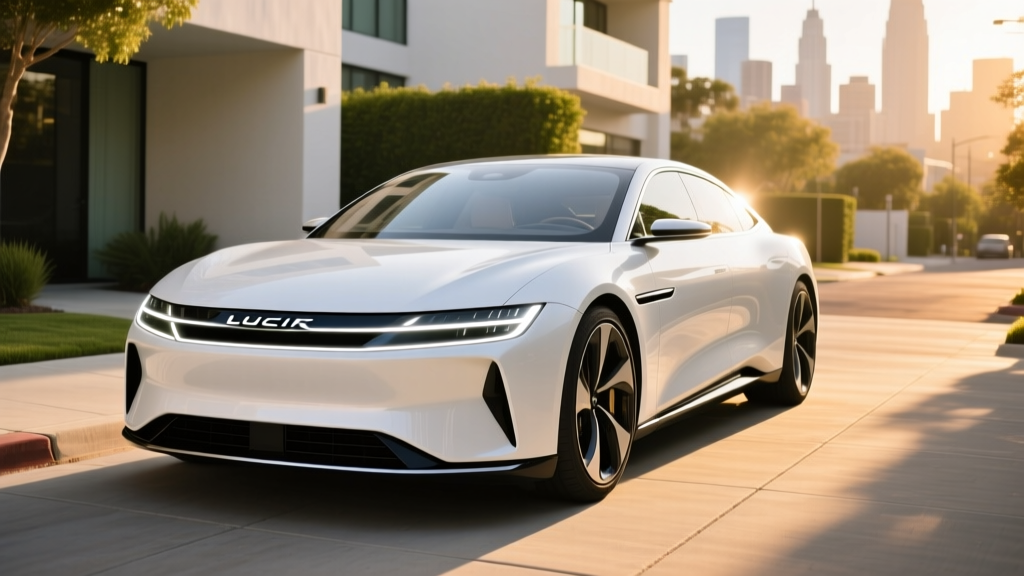
Recent headlines around Lucid Motors layoffs have spooked prospective buyers and current owners alike. When a startup trims headcount, the natural questions follow: Will parts remain available? Will software updates continue? Is the company stable enough to honor its warranty? Those are fair concerns, and we'll address them head-on. But first, the car itself deserves a clear-eyed evaluation — because the Lucid Air remains one of the most efficient, longest-range electric sedans on the market, regardless of the corporate noise.
This review covers the 2026 Lucid Air lineup — Pure, Touring, Grand Touring, and Sapphire — with exact specs, real-world range expectations, charging performance, and a frank look at whether buying into a company navigating financial turbulence makes sense for your garage.
Lucid Air Lineup: 2026 Specs at a Glance
| Spec | Air Pure | Air Touring | Air Grand Touring | Air Sapphire |
|---|---|---|---|---|
| Drivetrain | RWD (single motor) | AWD (dual motor) | AWD (dual motor) | AWD (tri-motor) |
| Horsepower | 430 hp | 620 hp | 819 hp | 1,234 hp |
| 0-60 mph | 5.0 sec | 3.4 sec | 3.0 sec | 1.89 sec |
| Battery (usable) | 88 kWh (NMC) | 112 kWh (NMC) | 112 kWh (NMC) | 118 kWh (NMC) |
| EPA Range | 419 mi | 425 mi | 516 mi | 427 mi |
| Efficiency | 146 MPGe | 131 MPGe | 131 MPGe | 105 MPGe |
| Max DC Charge | 200 kW | 300 kW | 300 kW | 300 kW |
| 10-80% DC Time | ~30 min | ~20 min | ~20 min | ~22 min |
| Level 2 Rate | 19.2 kW (~75 mi/hr) | 19.2 kW (~75 mi/hr) | 19.2 kW (~75 mi/hr) | 19.2 kW (~75 mi/hr) |
| Base MSRP | $69,900 | $77,900 | $125,600 | $249,000 |
Lucid uses nickel-manganese-cobalt (NMC) lithium-ion cells across the entire Air lineup, supplied primarily by Samsung SDI. The smaller 88 kWh pack in the Pure trim uses a subset of the full modular battery architecture, while Touring, Grand Touring, and Sapphire variants carry larger packs. There is no LFP option — Lucid prioritizes energy density to hit its class-leading range figures.
Real-World Range: Beyond the EPA Sticker
EPA Estimated: 516 miles
Real-World Highway (70-75 mph, mild weather): ~410-440 miles
Real-World Highway (cold weather, 30°F): ~340-380 miles
Mixed City/Suburban Driving: ~460-490 miles
The Lucid Air Grand Touring's 516-mile EPA figure is the highest of any production sedan sold in the U.S., verified via fueleconomy.gov. But EPA testing uses relatively low average speeds and includes significant city driving, where regenerative braking recovers energy.
In sustained highway driving at 70-75 mph in 65-75°F conditions, expect roughly 80-85% of the EPA sticker — so around 410-440 miles on a full charge for the Grand Touring. That's still exceptional. Drop the thermometer to 30°F and highway range contracts further to roughly 340-380 miles, as the battery's internal resistance increases and cabin heating draws additional power. The Air uses a resistive heater rather than a heat pump, which is a notable efficiency gap versus competitors like the Hyundai Ioniq 6 or Tesla Model S.
For city-heavy commuters, the Air's efficiency shines. Stop-and-go traffic maximizes regen recovery, and the Pure trim's 146 MPGe (roughly 23 kWh/100 mi) makes it one of the most efficient large luxury sedans ever built.
Charging Speed: DC Fast and Home Level 2
| Charging Level | Power / Rate | Miles Added per Hour | Notes |
|---|---|---|---|
| Level 1 (120V household) | ~1.4 kW | ~4-5 mi/hr | Emergency/trickle only |
| Level 2 (240V, 48A home charger) | 11.5 kW | ~45 mi/hr | Typical home installation |
| Level 2 (240V, 80A hardwired) | 19.2 kW | ~75 mi/hr | Requires 100A circuit; full overnight refill |
| DC Fast Charge (350 kW station) | Peak 300 kW | ~200 mi in 15 min (Touring/GT) | Curve tapers significantly above 80% |
| DC Fast Charge (150 kW station) | ~150 kW sustained | ~100 mi in 15 min | Common Electrify America tier |
The Touring, Grand Touring, and Sapphire support up to 300 kW peak DC fast charging on a 900V+ architecture — one of the highest voltage platforms in production. On a 350 kW Electrify America or IONITY station with preconditioned battery, the Air can add approximately 200 miles in 15 minutes during the 10-50% SoC window.
However, the charging curve tapers aggressively past 80%. The final 20% can take as long as the first 60%. For road trips, plan to charge from 10-80% (about 20 minutes on the Grand Touring) and move on. Sitting to 100% wastes time.
At home, the Air's onboard charger accepts up to 19.2 kW on Level 2 — but that requires an 80A hardwired EVSE on a dedicated 100A circuit. Most homes with a standard NEMA 14-50 outlet or a 48A wall connector will deliver 11.5 kW, adding roughly 45 miles per hour of charging. A full overnight charge (10 hours at 11.5 kW) replenishes about 450 miles — more than enough for daily use.
Performance, Interior, and Technology
The Air's performance spread is staggering. The Pure delivers 430 hp and a 5.0-second 0-60 — quick by any sedan standard. The Sapphire, with its tri-motor 1,234 hp setup, hits 60 mph in 1.89 seconds, making it one of the fastest accelerating production cars ever built, rivaling the Rimac Nevera at a fraction of the price (though still at $249,000).
Interior space is a genuine strength. The Air offers 110.8 cubic feet of total passenger volume, with 41.1 inches of front legroom and 37.6 inches rear — competitive with the Mercedes EQS and significantly more spacious than the Tesla Model S. Cargo volume is 32.1 cu ft combined (22.1 cu ft trunk + 10.0 cu ft frunk), enough for two large suitcases and a week's groceries.
The 34-inch curved glass cockpit display is visually striking and houses Lucid's custom infotainment OS. Wireless Apple CarPlay and Android Auto are standard. The DreamDrive Pro ADAS suite includes adaptive cruise, lane centering, and automated parking — all SAE Level 2 driver-assist features requiring active driver supervision. Lucid has been slower to roll out over-the-air feature expansions compared to Tesla, which is worth noting for buyers who prioritize software evolution.
Notable drawbacks: No heat pump (reduces cold-weather efficiency), no NACS port from the factory (CCS1 standard, though NACS adapters are available), and the rear visibility is compromised by the sloping roofline — a backup camera is essential.
Pricing, Tax Credits, and Ownership Cost
| Trim | Base MSRP | As-Tested (typical) | §30D Credit Eligible? | Est. After Credit |
|---|---|---|---|---|
| Air Pure | $69,900 | $72,500 | Partial — MSRP cap met; income/sourcing rules apply | ~$65,000-$69,900 |
| Air Touring | $77,900 | $82,000 | Exceeds $55,000 sedan MSRP cap — NOT eligible | $77,900+ |
| Air Grand Touring | $125,600 | $132,000 | Exceeds $55,000 sedan MSRP cap — NOT eligible | $125,600+ |
| Air Sapphire | $249,000 | $249,000 | Exceeds $55,000 sedan MSRP cap — NOT eligible | $249,000 |
Under current IRS §30D rules, the federal EV tax credit caps at $7,500 for new clean vehicles, but sedans must have an MSRP at or below $55,000 to qualify. Only the Air Pure approaches this threshold, and even then, its $69,900 base exceeds the sedan cap. This means no Lucid Air trim currently qualifies for the $7,500 federal new-vehicle credit.
Buyers should also be aware of the income caps ($150,000 single / $300,000 joint AGI) and the critical-minerals/battery-sourcing requirements that apply to any qualifying vehicle. Point-of-sale transfer is available for eligible vehicles, but again, the MSRP cap eliminates the Air from this benefit. Some state-level incentives (California's CVRP, for example) may offer partial rebates — check your local DMV or energy office for current programs.
Lucid's warranty covers the battery and powertrain for 8 years/100,000 miles, with a capacity retention threshold of 70%. The basic vehicle warranty is 4 years/50,000 miles. These terms are competitive with Tesla and Mercedes but fall short of Hyundai's 10-year/100,000-mile battery coverage.
Addressing the Layoffs: What Buyers Should Know
Lucid Motors has undergone multiple rounds of workforce reductions since late 2023, with further layoffs reported into 2025 and early 2026. The company has framed these cuts as efficiency measures to extend its cash runway while scaling production of the upcoming Gravity SUV and pursuing international partnerships (notably with Aston Martin for powertrain supply).
For prospective Air buyers, the practical implications are:
- Service network: Lucid operates roughly 20 service centers nationwide and offers mobile service in major metros. Coverage is thinner than Tesla's, and wait times for bodywork can stretch weeks in smaller markets.
- Parts availability: As of early 2026, parts supply for the Air remains adequate, but proprietary components (glass roof panels, specific suspension parts) may carry longer lead times than mainstream competitors.
- Software development: OTA updates continue, but the pace of new feature additions has been slower than Tesla's cadence. DreamDrive Pro remains capable but hasn't seen the rapid iteration some early adopters expected.
- Resale value: Financial uncertainty around any automaker depresses residual values. The Air already faces steeper depreciation than the Model S — factor this into total cost of ownership.
Lucid's backing by Saudi Arabia's Public Investment Fund (PIF), which holds a roughly 60% stake, provides a financial floor that most EV startups lack. But it doesn't eliminate risk entirely.
Lucid Air vs. Key Competitors
✅ Pros
- Class-leading 516-mile EPA range (Grand Touring)
- Outstanding efficiency: 146 MPGe on Pure trim
- Spacious rear seat and generous cargo/frunk space
- 300 kW peak DC fast charging (Touring/GT/Sapphire)
- Stunning glass cockpit display and premium materials
- PIF backing reduces bankruptcy risk vs. other startups
❌ Cons
- No federal tax credit eligibility (MSRP exceeds sedan cap)
- No heat pump — cold-weather range suffers more than rivals
- Limited service center network outside major metros
- Slower OTA/software update pace than Tesla
- CCS1 port only (NACS adapter required for Superchargers)
- Company financial uncertainty may impact resale value
Against the Tesla Model S (402 mi EPA, $74,990 base), the Air Grand Touring wins on range, interior space, and ride quality but loses on charging network access (Tesla Superchargers remain the gold standard for reliability) and software features. The Model S also benefits from a stronger resale market.
The Mercedes EQS 450+ (352 mi EPA, ~$104,400) offers a more established dealer/service network and a heat pump, but sacrifices over 160 miles of range versus the Air Grand Touring. The BMW i7 eDrive50 (318 mi EPA, ~$105,700) similarly trails on range but leads in build quality and dealer support.
Choose the Lucid Air if: Maximum range and efficiency are your top priorities, you have reliable home charging, and you live near a Lucid service center.
Choose the Tesla Model S if: Supercharger access, software features, and resale confidence matter more than 100 extra miles of range.
Choose the Mercedes EQS if: Dealer service network, brand prestige, and cold-weather efficiency (heat pump) outweigh range and price.
Frequently Asked Questions
What is the real-world range of the Lucid Air?
The Grand Touring achieves 516 miles EPA, but expect 410-440 miles on the highway in mild weather and 340-380 miles in freezing conditions. The Pure's 419-mile EPA rating translates to roughly 340-360 highway miles in moderate temperatures.
How fast does the Lucid Air charge at home and on the road?
On a 350 kW DC fast charger, the Touring and Grand Touring peak at 300 kW, adding ~200 miles in 15 minutes (10-50% SoC). At home on a 48A Level 2 charger, expect ~45 miles per hour of charging. A full 10-hour overnight session replenishes approximately 450 miles.
Does the Lucid Air qualify for the federal EV tax credit?
No. Under current IRS §30D rules, sedans must have an MSRP of $55,000 or less. Every Lucid Air trim exceeds this cap, making none eligible for the $7,500 credit. State incentives may still apply.
Is the Lucid Air worth buying given the company's layoffs?
The Air is an objectively excellent EV — class-leading range, strong efficiency, and a spacious interior. The risk is company stability: service access, parts lead times, and resale value could suffer if Lucid's financial position deteriorates further. PIF backing provides a safety net, but it's not a guarantee. Buyers who prioritize the product over the brand's long-term trajectory will be well-served; risk-averse buyers may prefer Tesla or Mercedes.
What are the biggest pros and cons of owning a Lucid Air?
Pros: unmatched range (516 mi GT), top-tier efficiency, fast 300 kW charging, roomy interior. Cons: no tax credit, no heat pump, thin service network, CCS1-only port, depreciation risk tied to company health.
How does the Lucid Air's warranty compare?
Lucid covers the battery and powertrain for 8 years/100,000 miles with a 70% capacity retention guarantee. The vehicle warranty is 4 years/50,000 miles. This matches Tesla but trails Hyundai/Kia's 10-year battery coverage.