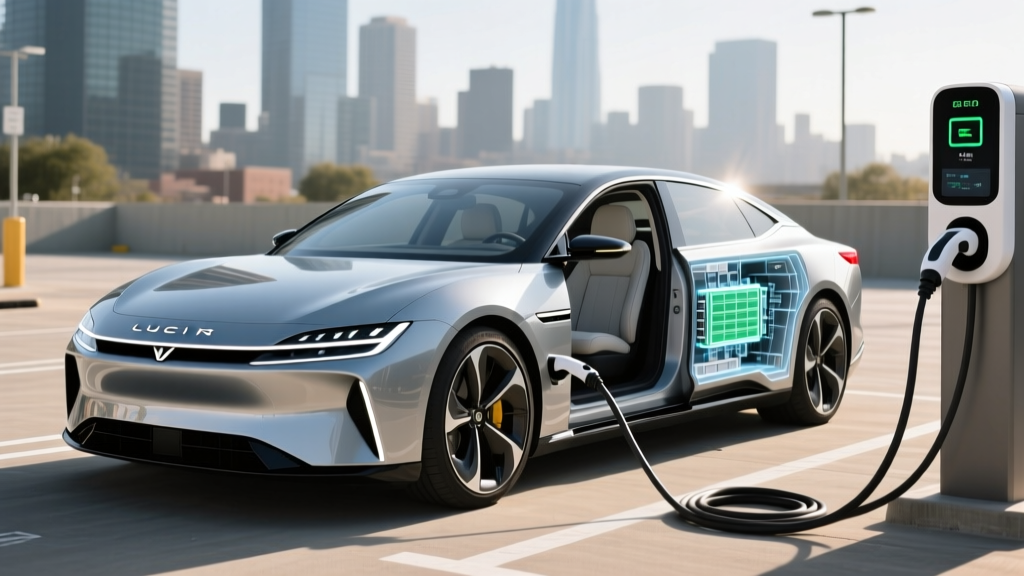
If you've been searching for Lucid Gravity who makes it, the answer is straightforward: the Gravity is designed, engineered, and manufactured by Lucid Group, Inc. — the same American EV company behind the acclaimed Lucid Air luxury sedan. Headquartered in Newark, California, Lucid assembles its vehicles at its purpose-built AMP-1 (Advanced Manufacturing Plant) in Casa Grande, Arizona. The company was originally founded in 2007 as Atieva, a battery technology firm, before pivoting to full vehicle production and rebranding as Lucid Motors. Saudi Arabia's Public Investment Fund (PIF) holds a majority stake, providing the capital backing that has allowed Lucid to bring the Gravity to market as its second production vehicle.
The 2026 Lucid Gravity is a three-row, seven-passenger electric SUV built on Lucid's proprietary LEAP (Lucid Electric Advanced Platform) architecture. It directly targets the Tesla Model X, Rivian R1S, and the upcoming wave of premium electric utility vehicles. But the Gravity's defining achievement is its efficiency: Lucid's miniaturized powertrain technology delivers class-leading range in a full-size SUV package. Here's everything buyers and owners need to know.
Lucid Gravity Specs at a Glance
| Spec | Value |
|---|---|
| EPA Range | 440 miles (Grand Touring); 390 miles (Touring) |
| Battery Capacity | ~120 kWh usable (Grand Touring); ~100 kWh usable (Touring) |
| Battery Chemistry | NMC (Nickel Manganese Cobalt) — 2170 cylindrical cells |
| Powertrain | Dual-motor AWD |
| Horsepower | 828 hp (Grand Touring); 600 hp (Touring) |
| 0–60 mph | 3.5 sec (Grand Touring); 4.5 sec (Touring) |
| Max DC Fast Charge | 300+ kW (900V architecture) |
| 10–80% DC Charge Time | ~20 minutes (under optimal conditions) |
| Level 2 Home Charge Rate | 19.2 kW (up to ~58 miles of range per hour) |
| EPA Efficiency | ~110 MPGe combined (estimated); ~30 kWh/100 mi |
| Towing Capacity | 6,000 lbs |
| Cargo Volume | ~120 cu ft (max, seats folded); frunk included |
| Seating | 7 passengers (3 rows) |
| Base MSRP | $79,900 (Touring); $94,900 (Grand Touring) |
| Battery/Powertrain Warranty | 8 years / 100,000 miles |
| Vehicle Warranty | 4 years / 50,000 miles |
Real-World Range: Beyond the EPA Sticker
EPA Estimated: 440 miles
Real-World Highway (70–80 mph, moderate temps): ~360–390 miles
Real-World Cold Weather (below 30°F, mixed driving): ~300–340 miles
Real-World City/Suburban: ~400–430 miles (regen-heavy routes favor efficiency)
Lucid's 440-mile EPA rating for the Grand Touring is extraordinary for a three-row SUV. For context, the Tesla Model X Long Range achieves roughly 335 miles EPA, and the Rivian R1S (Large Pack) lands around 352 miles. Lucid's advantage comes from its industry-leading efficiency — the same miniaturized motor and low-loss drivetrain engineering that gave the Air sedan a 520-mile EPA figure.
However, real-world physics still applies. At sustained highway speeds of 75–80 mph, aerodynamic drag increases exponentially, and you should expect roughly 360–390 miles before needing a charge. In freezing temperatures, lithium-ion battery chemistry becomes less efficient, cabin heating draws substantial power (the Gravity uses a heat pump, which mitigates some loss), and range can drop to 300–340 miles. City driving with frequent regenerative braking opportunities will get you closest to the EPA sticker — and potentially exceed it on flat terrain in mild weather.
The Touring trim, with its smaller battery pack, carries a 390-mile EPA rating. Expect roughly 320–350 miles in mixed real-world driving.
Charging Speed: 900V Architecture Explained
The Lucid Gravity uses a 900-volt electrical architecture — one of the highest in production EVs. Higher voltage allows the vehicle to accept more power (kW) at a given current, which translates to faster charging without requiring thicker, heavier cables. This is the same approach used by Porsche (Taycan), Hyundai/Kia (E-GMP platform), and now Lucid.
| Charging Level | Power | Speed (Approx.) | Use Case |
|---|---|---|---|
| Level 1 (120V) | ~1.4 kW | ~4 miles per hour | Emergency / trickle top-up |
| Level 2 (240V, 48A) | 11.5 kW | ~35 miles per hour | Standard home charging |
| Level 2 (240V, 80A) | 19.2 kW | ~58 miles per hour | High-power home (requires hardwired EVSE + 100A circuit) |
| DC Fast Charge | Up to 300+ kW | 10–80% in ~20 min | Road trips, public fast-charging |
Understanding the charge curve: The 300+ kW peak rate is not sustained for the entire session. Like all EVs, the Gravity's charging speed tapers as the battery's State of Charge (SoC) rises. You'll see peak speeds between roughly 10–40% SoC, after which the rate gradually decreases to protect the battery. The 10–80% time of ~20 minutes assumes a properly preconditioned battery and a charger capable of delivering 300+ kW (such as Electrify America's newest 350 kW stations or Tesla Superchargers with a NACS adapter).
Charging connector: The Gravity ships with a NACS (North American Charging Standard) port, giving it native access to Tesla's Supercharger network — the most extensive and reliable DC fast-charging infrastructure in the US. It also supports CCS1 charging via adapter for networks like Electrify America, EVgo, and ChargePoint.
For home charging, Lucid supports up to 19.2 kW Level 2 charging, which requires a hardwired wall connector on a dedicated 100-amp circuit. Most homeowners will install a 48-amp Level 2 charger (11.5 kW) on a 60-amp circuit, which adds roughly 35 miles of range per hour — enough to fully replenish the battery overnight for nearly all daily driving needs. Always consult a licensed electrician to assess your panel capacity before installation.
Performance and Driving Dynamics
The Grand Touring's dual-motor all-wheel-drive powertrain produces 828 horsepower, launching the Gravity from 0–60 mph in an estimated 3.5 seconds. That's supercar territory from a seven-passenger SUV weighing over 5,800 pounds. The Touring trim delivers 600 hp and a 4.5-second 0–60 time, which is more than adequate for daily driving and highway merging.
Lucid's motors are notably compact — each drive unit (motor, transmission, and inverter) is roughly the size of a carry-on suitcase. This packaging efficiency contributes to the Gravity's spacious interior and front trunk (frunk). The low center of gravity, inherent to skateboard-style EV platforms, keeps body roll controlled through corners despite the vehicle's height and mass.
Air suspension is standard, providing adjustable ride height for highway efficiency, rough-road comfort, and ground clearance. The Gravity also offers a 6,000-pound towing capacity, competitive with the Rivian R1S and sufficient for most boat trailers and mid-size campers. Note that towing will dramatically reduce range — expect roughly 50–60% of the EPA figure when pulling a heavy trailer at highway speeds.
Interior, Cargo, and Technology
The Gravity's cabin is designed around a massive 34-inch curved glass cockpit display that stretches across the dashboard, combining instrument cluster and infotainment into a single panoramic screen. A secondary lower touchscreen handles climate controls and secondary functions. Lucid's software platform supports over-the-air (OTA) updates, navigation, streaming apps, and smartphone integration.
Space and dimensions:
- Seating: Three rows, seven passengers standard. Second-row captain's chairs available for a six-passenger layout.
- Third-row usability: Unlike many three-row SUVs where the rearmost seats are punishment, the Gravity's third row offers genuine adult-sized legroom (~33 inches) for short trips, and ample space for children on longer drives.
- Cargo behind 3rd row: ~20 cu ft
- Cargo behind 2nd row: ~60 cu ft
- Max cargo (all rear seats folded): ~120 cu ft
- Frunk (front trunk): ~10 cu ft — large enough for charging cables, groceries, or a carry-on bag
Driver assistance: The Gravity ships with Lucid's DreamDrive Pro ADAS suite, which includes adaptive cruise control, lane-centering assist, automatic emergency braking, blind-spot monitoring, and surround-view cameras. DreamDrive Pro is a SAE Level 2 system — meaning the driver must remain fully engaged, with hands on the wheel and eyes on the road at all times. It is not a self-driving system. Lucid has signaled future hands-free highway driving capabilities via OTA updates, but as of the 2026 model year, active supervision is required.
Pricing, Trims, and Federal Tax Credit Eligibility
| Trim | Base MSRP | Key Features | §30D Tax Credit Eligible? |
|---|---|---|---|
| Touring | $79,900 | 600 hp, 390 mi range, AWD, air suspension, DreamDrive Pro | Unlikely — exceeds SUV MSRP cap (see below) |
| Grand Touring | $94,900 | 828 hp, 440 mi range, AWD, premium interior, full suite | No — exceeds MSRP cap |
| Range (upcoming) | ~$69,900 (announced) | RWD, 600+ hp, 440+ mi range, simplified feature set | Potentially — if MSRP stays under cap and sourcing rules are met |
Federal tax credit reality check: Under IRS §30D rules, new EVs must meet several criteria to qualify for up to $7,500 in federal tax credits. For SUVs, the MSRP cap is $80,000. The Gravity Touring at $79,900 sits just under this threshold, but destination fees and common options can push it over. The Grand Touring at $94,900 is definitively ineligible based on price alone.
Additionally, buyers must meet income caps (adjusted gross income ≤ $300,000 for joint filers, ≤ $150,000 for single filers), and the vehicle must satisfy critical-mineral and battery-component sourcing requirements that have tightened significantly since 2024. Lucid's battery supply chain is still scaling to meet these thresholds. Always verify current eligibility at IRS.gov's Clean Vehicle Credits page and consult a tax professional before assuming credit qualification.
The credit can be transferred to the dealer at the point of sale, effectively reducing the purchase price upfront — but only if the vehicle and buyer both qualify.
Pros and Cons
- Class-leading 440-mile EPA range (Grand Touring)
- 900V architecture enables 300+ kW DC fast charging
- NACS port = native Tesla Supercharger access
- Genuinely usable third row for adults
- 6,000-lb towing capacity
- Compact motors maximize interior and cargo space
- Heat pump standard for cold-weather efficiency
- Air suspension with adjustable ride height
- $79,900+ starting price — luxury-tier cost
- Likely ineligible for $7,500 federal tax credit (MSRP cap)
- Limited service center footprint vs. Tesla
- New model — long-term reliability unproven
- DreamDrive Pro is Level 2 only (no hands-free driving yet)
- Third-row access requires second-row fold/slide
- High insurance premiums expected (luxury EV class)
- Range trim (most affordable) not yet available
Lucid Gravity vs. Key Competitors
Here's how the Gravity stacks up against the most relevant three-row electric SUVs:
| Spec | Lucid Gravity GT | Tesla Model X LR | Rivian R1S (Dual Max) |
|---|---|---|---|
| EPA Range | 440 mi | ~335 mi | ~410 mi |
| 0–60 mph | 3.5 sec | 3.8 sec | 4.5 sec |
| Max DC Charge | 300+ kW | 250 kW | 220 kW |
| Base Price | $79,900 | ~$79,990 | ~$79,900 |
| 3rd Row | Yes (adult-capable) | Yes (tight for adults) | Yes (best-in-class space) |
| Towing | 6,000 lbs | 5,000 lbs | 7,700 lbs |
| Charging Network | NACS (Superchargers) + CCS | NACS (Superchargers only) | NACS adapter + CCS |
Choose the Lucid Gravity if: Maximum range and charging speed are your top priorities, you want native Supercharger access without adapters, and you value sedan-like efficiency in an SUV body.
Choose the Rivian R1S if: You need maximum towing capacity, off-road capability, or the most flexible adventure-oriented interior.
Choose the Tesla Model X if: You want the most mature Supercharger ecosystem, Falcon Wing doors for tight parking, and Tesla's software/FSD feature set (with the understanding that FSD Supervised remains SAE Level 2).
Who Is the Lucid Gravity Best For?
The Gravity is engineered for premium-family buyers who prioritize range and charging speed above all else. If your routine includes regular 300+ mile road trips, you want to minimize charging stops, and you need three rows for school runs and family travel, the Gravity occupies a unique niche. It's also well-suited for executive commuters who occasionally need passenger and cargo capacity but don't want the bulk and inefficiency of a traditional full-size SUV.
It's less ideal for budget-conscious buyers (the Touring starts near $80K with no tax credit), hardcore off-roaders (the Rivian R1S is more capable on trails), or those who need maximum towing (the R1S tows 7,700 lbs vs. the Gravity's 6,000).
Frequently Asked Questions
Who manufactures the Lucid Gravity?
The Lucid Gravity is manufactured by Lucid Group, Inc. at its AMP-1 factory in Casa Grande, Arizona. Lucid is an American company headquartered in Newark, California, with majority financial backing from Saudi Arabia's Public Investment Fund.
What is the real-world range of the Lucid Gravity?
The Grand Touring trim carries a 440-mile EPA rating. In real-world highway driving at 70–80 mph, expect roughly 360–390 miles. In freezing weather, range drops to approximately 300–340 miles. City driving with regenerative braking can approach or slightly exceed the EPA figure.
How fast does the Lucid Gravity charge?
On a 350 kW-capable DC fast charger with a preconditioned battery, the Gravity can accept over 300 kW peak, achieving a 10–80% charge in approximately 20 minutes. At home on a 48-amp Level 2 charger (11.5 kW), it adds about 35 miles of range per hour. A 19.2 kW hardwired Level 2 unit adds ~58 miles per hour.
Does the Lucid Gravity qualify for the federal EV tax credit?
Most likely not. Under current IRS §30D rules, SUVs must have an MSRP at or below $80,000. The Grand Touring ($94,900) is clearly ineligible. The Touring ($79,900) technically qualifies on price, but destination fees and options can push it over, and battery-sourcing requirements must also be met. Buyers should also verify their income falls within caps (≤$300K joint / ≤$150K single). Always confirm with a tax professional.
Is the Lucid Gravity worth buying over a Tesla Model X or Rivian R1S?
It depends on your priorities. The Gravity offers the longest range (440 mi EPA) and fastest charging (300+ kW) in the segment, making it ideal for road-trip-heavy families. The Model X offers a more established service network and Tesla's software ecosystem. The R1S leads in towing (7,700 lbs), off-road capability, and third-row space. Test-drive all three before deciding.
What is the Lucid Gravity's battery warranty?
Lucid covers the Gravity's battery pack and powertrain for 8 years or 100,000 miles, whichever comes first. This is standard for the EV industry. The bumper-to-bumper vehicle warranty is 4 years / 50,000 miles. Lucid's battery uses NMC chemistry, which typically retains 85–90% of original capacity after 100,000 miles based on industry data — though long-term Gravity-specific data is not yet available.
Does the Gravity have a NACS charging port?
Yes. The Lucid Gravity ships with a native NACS (Tesla-style) charging port, giving it direct access to Tesla Superchargers without an adapter. A CCS1 adapter is available for use with Electrify America, EVgo, and other non-Tesla DC fast-charging networks.
Sources: EPA Fuel Economy, Lucid Motors Official, IRS Clean Vehicle Credits