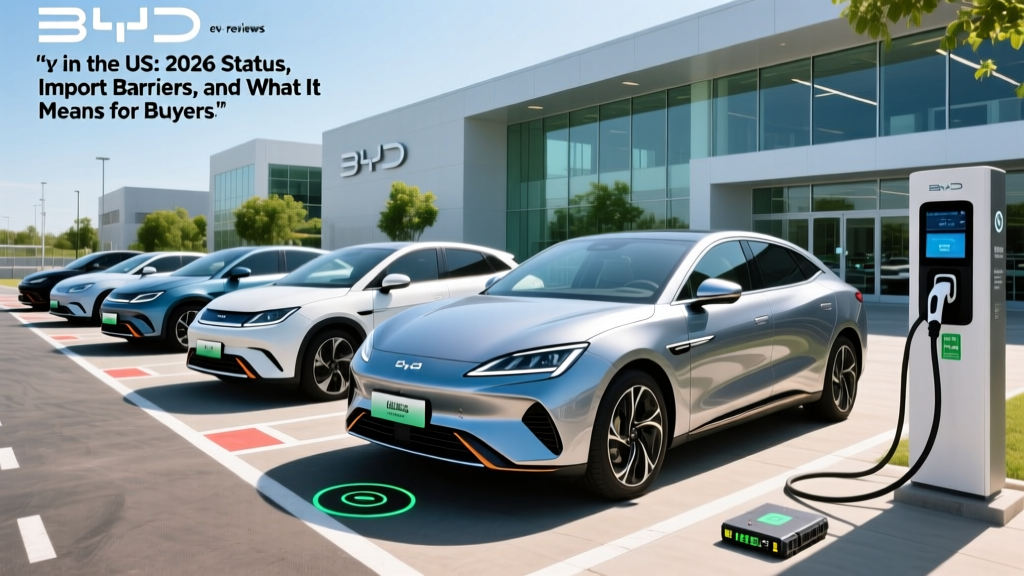
If you follow global EV sales, you already know BYD is a juggernaut. The Chinese automaker has been battling Tesla for the title of world's top-selling EV brand, with a massive lineup spanning affordable hatchbacks to luxury SUVs. But for American shoppers, the question remains frustratingly simple: Can you actually buy a BYD in the US?
The short answer for 2026: No, BYD does not sell passenger cars in the United States. But the longer answer — involving tariffs, geopolitical trade policy, and the ripple effects on the domestic EV market — matters enormously if you're shopping for an electric vehicle right now. This profile breaks down BYD's US status, the barriers keeping it out, the models Americans are missing, and what that means for your purchase decision.
BYD's US Status in 2026: Where Things Stand
As of early 2026, BYD has no official passenger vehicle presence in the United States. You cannot walk into a dealership, configure a vehicle on a US website, or register a BYD car in any state. This is not a matter of BYD choosing to delay a launch — it's the result of deliberate US trade policy.
Here's the regulatory landscape blocking BYD from American roads:
- 100% tariff on Chinese-made EVs: In mid-2024, the Biden administration raised the Section 301 tariff on Chinese-built electric vehicles from 25% to 100%, effectively doubling the import cost of any BYD vehicle. The Trump administration maintained and expanded these tariffs into 2025 and 2026.
- Additional legacy tariffs: Beyond the EV-specific tariff, Chinese autos face a 2.5% standard import duty, stacking the total tariff burden to over 102%.
- Connected vehicle ban: The US Department of Commerce finalized rules banning the sale of vehicles containing Chinese-made connected vehicle hardware and software, with compliance deadlines beginning in 2027 for hardware. This effectively targets BYD's vertically integrated tech stack.
- National security scrutiny: BYD's deep integration with Chinese supply chains — including battery minerals, semiconductors, and infotainment — makes regulatory compliance a moving target even if tariffs were reduced.
The result: BYD's global passenger car lineup, which includes vehicles priced as low as $10,000 in some markets, is functionally locked out of the US market through at least the end of the decade.
The BYD Models Americans Are Missing
BYD's global catalog is staggering. To understand what US buyers are missing — and why BYD's absence matters for competitive pricing — here's a snapshot of key models sold internationally:
| Model | Type | Global Price (approx.) | Battery (kWh) | WLTP Range |
|---|---|---|---|---|
| Dolphin | Compact hatchback | ~$22,000 | 60.4 (LFP Blade) | ~265 mi |
| Atto 3 (Yuan Plus) | Compact SUV | ~$28,000 | 60.5 (LFP Blade) | ~260 mi |
| Seal | Midsize sedan | ~$38,000 | 82.5 (LFP Blade) | ~355 mi |
| Seagull | Subcompact hatch | ~$10,000–$14,000 | 38.9 (LFP Blade) | ~190 mi |
| Tang EV | Midsize 3-row SUV | ~$45,000 | 108.8 (LFP Blade) | ~310 mi |
Note: Global prices vary by market and do not reflect US tariff adjustments. WLTP range estimates are typically 10–15% higher than EPA estimates for the same vehicle.
The pricing here is the headline. A BYD Seagull at $10,000–$14,000 in China would still cost roughly $22,000–$28,000 after a 100%+ tariff — competitive with a base Nissan Leaf or Chevrolet Bolt, but without the service infrastructure. The BYD Seal, positioned as a Tesla Model 3 competitor globally, would land near $76,000+ after tariffs, obliterating its value proposition.
BYD's Blade Battery: The Tech That Matters
Even if you can't buy a BYD car in America, BYD's battery technology influences the EVs you can buy. The company's Blade Battery — a lithium iron phosphate (LFP) cell in a long, thin form factor — has reshaped the industry's approach to battery safety and cost.
| Feature | BYD Blade (LFP) | Typical NMC Cell |
|---|---|---|
| Chemistry | Lithium Iron Phosphate | Nickel Manganese Cobalt |
| Energy Density | Lower (~150 Wh/kg cell) | Higher (~250 Wh/kg cell) |
| Thermal Runaway Risk | Very low (passes nail penetration test) | Moderate–high |
| Cycle Life | 3,000+ cycles | 1,000–2,000 cycles |
| Cold-Weather Performance | Weaker (15–25% range loss at 20°F) | Better (10–20% range loss at 20°F) |
| Cost | Lower (no cobalt/nickel) | Higher |
BYD's Blade Battery design has been so influential that it's now supplied to other automakers — including Tesla, which uses BYD LFP cells in some Model Y variants sold in Europe. For US buyers, this means BYD's battery tech is already on American roads indirectly, even if BYD-badged vehicles are not.
The LFP chemistry trade-off is straightforward: you sacrifice some energy density (meaning a heavier or physically larger pack for the same range) in exchange for dramatically better longevity, lower cost, and near-elimination of thermal runaway risk. For daily commuting and moderate-range use cases, LFP is increasingly the rational choice.
What BYD's Absence Means for US EV Pricing
BYD's global expansion has been aggressive — the company now sells in over 70 countries, with factories in Thailand, Brazil, Hungary, Indonesia, and Turkey. But the US market remains walled off. This has direct consequences for American EV buyers:
Less Price Competition at the Low End
The US market for sub-$35,000 EVs is thin. The Chevrolet Bolt EV/EUV was discontinued and relaunched with NACS, the Nissan Leaf is aging, and most affordable options are compact crossovers starting in the mid-$30,000s. A BYD Seagull or Dolphin, if tariff-free, would have pressured every automaker to compete on price.
Without BYD (and other Chinese brands like NIO, Xpeng, and Zeekr), legacy automakers face less urgency to push pricing below $30,000. The result: the cheapest new EVs in America hover around $28,000–$32,000 before incentives.
Fewer LFP Battery Options
BYD is the world's largest producer of LFP vehicle batteries. Its absence from the US market means American buyers have fewer vehicles leveraging LFP's longevity and cost advantages. Tesla's Standard Range models (which use LFP) are a notable exception, but selection remains limited compared to markets where BYD, MG, and other LFP-heavy brands compete.
Slower Feature Innovation Pressure
BYD's global models feature rotating infotainment screens, V2L (vehicle-to-load) capability across the lineup, and aggressive ADAS feature bundling at low price points. Without that competitive pressure, US-market EVs at similar price points often charge extra for features BYD includes standard.
Could BYD Enter the US Market? Scenarios and Timelines
While the current tariff and regulatory environment blocks BYD passenger vehicles, several scenarios could shift the landscape:
Scenario 1: US Manufacturing (Unlikely Before 2030)
BYD could theoretically build a US factory to bypass import tariffs — similar to how Toyota and Hyundai manufacture vehicles in American plants. However, the connected-vehicle ban and political opposition to Chinese-owned manufacturing make this extremely challenging. BYD's Lancaster, CA bus plant is a small-scale exception, but passenger car production at scale faces enormous headwinds.
Scenario 2: Tariff Reduction (Politically Unlikely)
A future administration could reduce Section 301 tariffs on Chinese EVs as part of broader trade negotiations. Given bipartisan consensus on restricting Chinese EV imports, this scenario is improbable through at least 2028.
Scenario 3: Third-Country Manufacturing Loophole (Regulatory Risk)
BYD's factories in Hungary, Brazil, and Turkey could theoretically export to the US at lower tariff rates. However, US trade authorities have already signaled intent to close this loophole with rules-of-origin requirements targeting Chinese-owned factories outside China.
The realistic bottom line: BYD passenger vehicles are not coming to the US before 2028 at the earliest, and likely not before 2030 in any meaningful volume.
What to Buy Instead: US Alternatives to Key BYD Models
If you were drawn to BYD's global lineup for its pricing or features, here are the closest US-market alternatives available today:
| BYD Model | US Alternative | EPA Range | Starting MSRP |
|---|---|---|---|
| Seagull (subcompact) | Chevrolet Bolt EV (2026 relaunch) | ~259 mi | ~$28,000 |
| Dolphin (compact hatch) | Hyundai Kona Electric | 261 mi | $32,975 |
| Atto 3 (compact SUV) | Kia EV6 / Hyundai Ioniq 5 | 232–310 mi | $42,600 / $42,600 |
| Seal (midsize sedan) | Tesla Model 3 / Hyundai Ioniq 6 | 272–363 mi / 361 mi | $38,990 / $38,650 |
| Tang EV (3-row SUV) | Kia EV9 / Tesla Model Y (3-row option) | 230–304 mi / 285–308 mi | $54,900 / $44,990 |
Sources: fueleconomy.gov for EPA range; manufacturer MSRP pages for pricing. All prices as of early 2026 model year, excluding destination fees.
None of these alternatives match BYD's global pricing, but they offer established dealer networks, US-spec safety certifications (NHTSA/IIHS), and access to the federal EV tax credit (up to $7,500, subject to MSRP caps of $55,000 for sedans and $80,000 for SUVs/trucks, buyer income limits of $150,000 single/$300,000 joint, and battery-sourcing requirements).
BYD's Indirect US Presence: Buses, Batteries, and Supply Chain
While you can't buy a BYD car, the company's footprint in America is real — just not in the consumer passenger segment:
- BYD Lancaster, CA: This factory builds battery-electric transit buses for US municipalities. It's BYD's only US manufacturing facility and employs several hundred workers. However, the 2020 National Defense Authorization Act banned federal transit funds from being used to purchase buses from Chinese-owned companies, severely limiting this operation's growth.
- Battery supply: BYD's LFP cells appear in Tesla Model Y vehicles sold in Europe and some energy storage products. As LFP adoption grows in US-market vehicles (Tesla Model 3 Standard Range, Ford Mustang Mach-E Select), BYD's battery technology indirectly reaches American drivers.
- Energy storage: BYD's stationary battery systems are used in utility-scale and commercial energy storage projects, though less prominently in the US than competitors like CATL.
FAQ: BYD in the US
Can I import a BYD from another country?
Technically, you could attempt a grey-market import, but the 100%+ tariff, EPA certification requirements, FMVSS safety compliance, and the connected-vehicle ban make this impractical and likely illegal for a current-model BYD. The cost would far exceed buying a US-market equivalent.
Will BYD ever sell cars in the US?
Not before 2028 at the earliest, and realistically not before 2030. The combination of 100% tariffs, connected-vehicle bans, and bipartisan political opposition creates a near-impenetrable barrier. BYD has publicly stated it is focused on markets where it can operate without prohibitive trade restrictions.
Does BYD's Blade Battery technology appear in any US-market cars?
Yes, indirectly. Tesla uses BYD-supplied LFP cells in some Model Y variants (primarily Europe). As LFP chemistry gains traction in US-market EVs — including Tesla Model 3 Standard Range and base Ford Mustang Mach-E — BYD's battery technology influences the sector even without branded vehicles.
What's the cheapest EV I can buy in the US in 2026?
The most affordable new EVs in the US for 2026 include the Chevrolet Bolt EV (relaunched, ~$28,000), Nissan Leaf (~$29,000), and Hyundai Kona Electric (~$33,000). All qualify for at least partial federal tax credits, which can be transferred to the dealer at point of sale for an immediate price reduction under current IRS §30D rules.
Is BYD's absence good or bad for US EV buyers?
It's a trade-off. BYD's absence means less price competition, keeping affordable EV options limited and prices higher than global averages. But it also means US buyers get vehicles that meet NHTSA/IIHS safety standards, have established dealer service networks, and comply with data-privacy regulations that Chinese-connected vehicles may not satisfy. The net effect depends on your priorities: maximum affordability or maximum regulatory protection.
Bottom Line: BYD in the US Is a Policy Story, Not a Product Story
BYD makes compelling, affordable electric vehicles with industry-leading LFP battery technology. That's not in dispute. But the US market is closed to Chinese passenger EVs through a combination of tariffs, connected-vehicle bans, and national security policy — and that closure is likely to persist through the remainder of the decade.
For American EV shoppers, the practical takeaway is this: focus on the vehicles available to you, leverage the federal tax credit where eligible, and recognize that the lack of BYD competition is one reason US EV pricing remains higher than in Europe or Asia. If affordable, compact EVs are your priority, the relaunched Chevrolet Bolt, Hyundai Kona Electric, and upcoming budget offerings from domestic automakers are your best options — imperfect substitutes, but ones you can actually buy, service, and insure.