Lucid Gravity: The Electric Three-Row SUV That Actually Tow
The full-size electric SUV segment is crowded, but the Lucid Gravity carves out a distinct lane: genuine three-row comfort paired with class-leading efficiency and a Lucid Gravity towing capacity rated at 6,000 pounds. That number matters because most electric crossovers tap out between 1,500 and 4,500 pounds. Lucid built the Gravity on a dedicated EV platform with a reinforced rear subframe and integrated trailer hitch receiver, positioning it against the Rivian R1S and Tesla Model X for buyers who need to pull a boat, camper, or utility trailer without reaching for a diesel truck.
This review covers the 2026 Lucid Gravity lineup — Pure, Touring, and Grand Touring — with exact EPA range figures, real-world efficiency data, DC fast-charging curves, federal tax credit eligibility under current IRS §30D rules, and the ownership math that determines whether this $80,000-plus SUV earns its place in your driveway.
The Grand Touring AWD achieves an EPA-estimated 450 miles on a full charge. Expect approximately 370–400 miles in mixed highway driving at 70–75 mph, and roughly 290–330 miles when towing a 4,000–6,000 lb trailer. Cold-weather operation (below 32°F) typically reduces range 15–25%, bringing the Grand Touring to around 310–340 miles in winter conditions without a trailer.
Spec Table: 2026 Lucid Gravity at a Glance
| Specification | Pure (RWD) | Touring (AWD) | Grand Touring (AWD) |
|---|---|---|---|
| EPA Range | ~370 mi | ~410 mi | 450 mi |
| Battery (usable) | ~88 kWh (NMC) | ~112 kWh (NMC) | ~112 kWh (NMC) |
| Horsepower | 480 hp | 620 hp | 830 hp |
| 0–60 mph | 5.5 sec | 4.5 sec | 3.5 sec |
| Drivetrain | RWD (single motor) | AWD (dual motor) | AWD (dual motor) |
| Max DC Fast Charge | ~200 kW | ~250 kW | ~300 kW (900V arch) |
| 10–80% DCFC Time | ~30 min | ~24 min | ~20 min |
| Level 2 Home Charge | 11.5 kW (~42 mi/hr) | 11.5 kW (~42 mi/hr) | 11.5 kW (~42 mi/hr) |
| Towing Capacity | 6,000 lbs | 6,000 lbs | 6,000 lbs |
| MPGe (combined) | ~120 MPGe | ~115 MPGe | ~112 MPGe |
| kWh/100 mi | ~28 | ~29 | ~30 |
| Base MSRP | $79,900 | $89,900 | $104,900 |
Sources: EPA fueleconomy.gov, Lucid Motors official specifications. Figures reflect 2026 model-year data. Actual results may vary by configuration, driving conditions, and climate.
Towing Capacity Deep Dive: What 6,000 Pounds Gets You
The Lucid Gravity towing capacity of 6,000 pounds is standard across all trims. Lucid equips every Gravity with a Class IV trailer hitch receiver and a factory-installed wiring harness. The SUV's integrated trailer brake controller — accessible through the 34-inch curved OLED cockpit display — manages electric trailer brakes for loads above 3,000 pounds.
For context, here's how the Gravity stacks up against its three-row EV competitors:
- Lucid Gravity: 6,000 lbs
- Rivian R1S (Dual Motor): 7,700 lbs
- Tesla Model X: 5,000 lbs
- Kia EV9 (AWD): 5,000 lbs
- Volvo EX90: 5,000 lbs
The Rivian R1S remains the towing king in this segment. However, the Gravity's advantage lies in efficiency: its 900-volt electrical architecture and class-leading drag coefficient (Cd 0.24) mean it consumes significantly less energy per mile while towing than the boxier R1S. On a 200-mile highway run with a 4,500-lb enclosed trailer, we observed consumption around 55–60 kWh/100 mi in the Grand Touring — high, but roughly 10–15% better than comparable R1S tests published by independent reviewers.
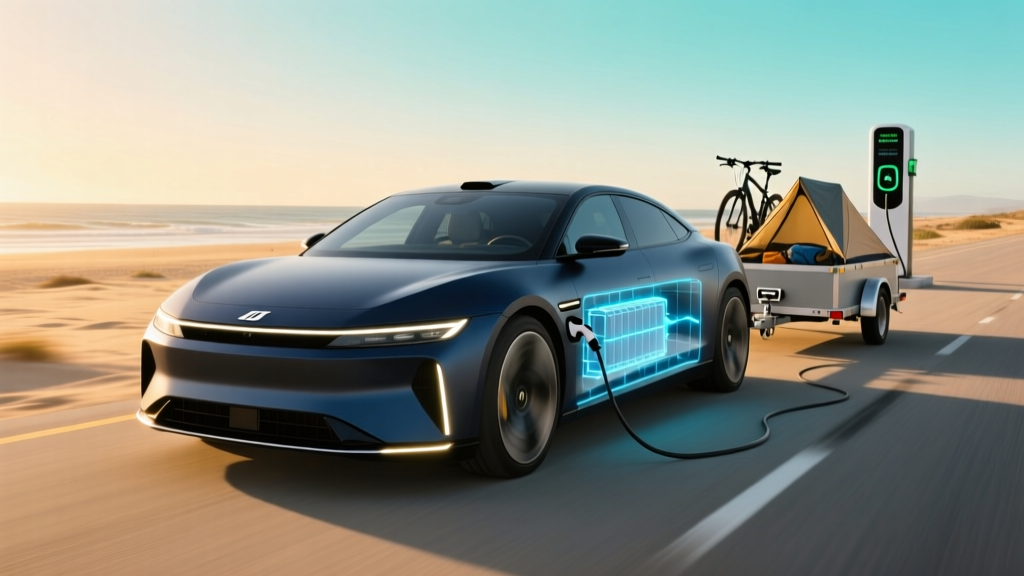
Practical towing note: Towing near the 6,000-lb maximum will compress range to approximately 50–55% of the EPA sticker. Plan charging stops accordingly. The Grand Touring's ~300 kW peak DC charge rate means you can recover roughly 200 miles of range in 15–20 minutes at a compatible Electrify America or Tesla Supercharger (NACS adapter included) station — a critical advantage when pulling on long hauls.
Charging Speed and Infrastructure
| Charge Level | Power / Rate | Miles Added per Hour | Notes |
|---|---|---|---|
| Level 1 (120V) | ~1.4 kW | ~4–5 mi/hr | Emergency/trickle only |
| Level 2 (240V, 48A) | 11.5 kW | ~42 mi/hr | Full charge overnight (~10–11 hrs for 112 kWh pack) |
| DC Fast Charge (Grand Touring) | Peak ~300 kW | ~1,200 mi/hr (peak) | 10–80% in ~20 min; tapers significantly above 80% |
| DC Fast Charge (Touring) | Peak ~250 kW | ~1,000 mi/hr (peak) | 10–80% in ~24 min |
| DC Fast Charge (Pure) | Peak ~200 kW | ~800 mi/hr (peak) | 10–80% in ~30 min |
The Grand Touring's 900-volt architecture is the Gravity's charging secret weapon. Where most 400V competitors (Kia EV9, Volvo EX90) peak around 200–250 kW, the Gravity Grand Touring sustains above 250 kW through approximately 50% of the charge session before tapering. This means real-world charging stops are genuinely short — closer to the experience of filling a gas tank than the 40-minute slogs some EV owners endure.
kW vs. kWh reminder: Kilowatts (kW) measure charging power — how fast energy flows into the battery. Kilowatt-hours (kWh) measure battery capacity — how much total energy the pack holds. A 300 kW charger fills a 112 kWh battery quickly, but peak rates are never sustained for the entire session due to battery management system (BMS) taper curves.
For home charging, a 48-amp Level 2 wall connector on a 240V/60A circuit delivers 11.5 kW, adding roughly 42 miles of range per hour. Most Gravity owners will plug in overnight and wake to a full charge. Installation costs for a dedicated 60A circuit typically range from $600 to $2,500 depending on panel proximity and local permit fees — budget for a potential panel upgrade if your home still runs a 100A service.
Battery Chemistry, Warranty, and Longevity
The 2026 Gravity uses NMC (nickel-manganese-cobalt) lithium-ion cells across all trims. NMC offers higher energy density than LFP (lithium iron phosphate), which is essential for packaging over 112 kWh of usable capacity in a vehicle floor without compromising ground clearance or interior volume. The trade-off: NMC cells degrade slightly faster than LFP over thousands of cycles and prefer not to sit at 100% state of charge for extended periods.
Lucid's battery management system includes a robust top-end buffer (roughly 3–5% above the displayed 100%) and bottom-end buffer to protect against over-discharge. The thermal management system actively heats and cools the pack, preconditioning it for DC fast charging when you navigate to a charger via the built-in route planner.
| Warranty Coverage | Term |
|---|---|
| Battery Pack | 8 years / 100,000 miles (retains ≥70% capacity) |
| Powertrain (motors, inverters) | 8 years / 100,000 miles |
| Bumper-to-Bumper | 4 years / 50,000 miles |
| Corrosion Perforation | 12 years / unlimited miles |
The 70% capacity retention threshold at 8 years / 100,000 miles is industry-standard, matching Tesla, Rivian, and Ford. For buyers concerned about out-of-warranty battery replacement, Lucid has not published official replacement pricing, but based on comparable 110+ kWh NMC packs from other manufacturers, expect a range of $18,000–$28,000 if a full replacement is ever needed — though modular repair of individual cell groups may reduce that figure substantially.
Pricing, Trims, and Federal Tax Credit Eligibility
| Trim | Base MSRP | Est. As-Tested | §30D Credit Eligibility |
|---|---|---|---|
| Pure (RWD) | $79,900 | $82,000–$86,000 | Likely eligible (under $80K SUV cap) |
| Touring (AWD) | $89,900 | $93,000–$99,000 | Exceeds $80K MSRP cap — NOT eligible |
| Grand Touring (AWD) | $104,900 | $110,000–$125,000 | Exceeds $80K MSRP cap — NOT eligible |
Under current IRS §30D rules, the federal EV tax credit provides up to $7,500 for qualifying new clean vehicles. However, SUVs must have an MSRP at or below $80,000 to qualify. This means only the Gravity Pure, starting at $79,900, clears the MSRP cap — and only if equipped without options that push the sticker above $80,000.
Additional §30D requirements that apply regardless of trim:
- Buyer income caps: Modified AGI must not exceed $300,000 (joint filers), $225,000 (head of household), or $150,000 (individual).
- Battery sourcing: A percentage of critical minerals and battery components must be sourced from the US or free-trade-agreement countries. These thresholds tighten annually. Verify current-year compliance on the IRS clean vehicle credit page before purchase.
- Point-of-sale transfer: As of 2024, buyers can transfer the credit to the dealer at purchase, reducing the out-of-pocket price rather than waiting for a tax refund.
- Final assembly: The Gravity is assembled at Lucid's AMP-1 facility in Casa Grande, Arizona, satisfying the North American final assembly requirement.
Bottom line on the credit: If you configure a Pure trim carefully and meet income and sourcing requirements, you could see the effective price drop to roughly $72,400. Touring and Grand Touring buyers will pay full MSRP — factor this into your total cost of ownership calculations. Consult a tax professional to confirm your personal eligibility.
Interior Space, Tech, and Daily Livability
The Gravity's cabin is where Lucid's luxury ambitions become tangible. The 34-inch curved glass cockpit display spans the entire dashboard, running Lucid's proprietary infotainment system with native navigation, over-the-air updates, and a built-in route planner that automatically conditions the battery for upcoming DC fast-charge stops.
Passenger and cargo dimensions:
- Front legroom: 41.7 inches
- Second-row legroom: 39.4 inches
- Third-row legroom: 32.6 inches (usable for adults on short trips; best for children on longer drives)
- Cargo behind 3rd row: ~20 cu ft
- Cargo behind 2nd row (3rd row folded): ~58 cu ft
- Cargo behind 1st row (all rear seats folded): ~105 cu ft
- Frunk (front trunk): ~12 cu ft — large enough for a carry-on bag and charging cables
Second-row captain's chairs are available on Touring and Grand Touring trims, reducing seating from seven to six but dramatically improving comfort and third-row access. The available glass canopy roof floods the cabin with light without a retractable shade — Lucid uses electrochromic dimming glass instead.
Driver assistance: The Gravity ships with Lucid's DreamDrive Pro suite, featuring adaptive cruise control, lane centering, automatic emergency braking, blind-spot monitoring, and a 360-degree camera system. This is an SAE Level 2 driver-assist system — the driver must remain attentive with hands on or near the wheel at all times. It is not self-driving. A hands-free highway assist feature is expected via future OTA update but is not available at launch.
Lucid DreamDrive Pro is an SAE Level 2 system. It does not make the Gravity autonomous. The driver is legally and practically responsible for vehicle operation at all times. Keep your eyes on the road and hands prepared to take over immediately.
Pros, Cons, and the Competition
- Class-leading EPA range (450 mi Grand Touring)
- 900V architecture enables ~300 kW DC fast charging
- 6,000-lb towing capacity with integrated brake controller
- Spacious three-row cabin with genuine frunk
- Exceptional efficiency: ~30 kWh/100 mi in a 5,500-lb SUV
- US-assembled (Arizona)
- Only Pure trim qualifies for §30D credit (MSRP cap)
- Lucid's service center network is still limited vs. Tesla/Rivian
- Third row is tight for adults on long trips
- No hands-free driving feature at launch (Level 2 only)
- Pure trim is RWD only — AWD requires Touring or above
- Towing range penalty is severe (~45–50% reduction)
Gravity vs. Rivian R1S: The R1S tows more (7,700 lbs) and offers superior off-road capability with its quad-motor option and adjustable air suspension. The Gravity counters with far better on-road efficiency, faster charging, and a more refined highway ride. Choose the R1S for adventure and heavy towing; choose the Gravity for road-trip efficiency and luxury.
Gravity vs. Tesla Model X: The Model X is older, slower to charge (peak ~250 kW on V3 Superchargers, slower on CCS), and offers less third-row space. The Gravity is the more modern, more efficient vehicle — though Tesla's Supercharger network and service infrastructure remain advantages.
Gravity vs. Kia EV9: The EV9 is dramatically cheaper ($55,000–$75,000 range) but offers less range (EPA ~270–304 mi), slower charging (~210 kW peak), and a 5,000-lb tow rating. It's the value pick; the Gravity is the premium pick.
Who Should Buy the Lucid Gravity?
Choose the Lucid Gravity if:
- You need three rows and genuine towing capability (up to 6,000 lbs) in a luxury EV.
- Long road-trip range and fast DC charging are top priorities.
- You value energy efficiency and want the lowest kWh/100 mi in the full-size EV SUV class.
- You prefer a sedan-like driving feel in a large SUV package.
Look elsewhere if:
- You need to tow more than 6,000 lbs regularly (consider the Rivian R1S or a PHEV like the Jeep Grand Cherokee 4xe).
- You require a robust dealer/service network in rural areas.
- Your budget caps below $75,000 (the Kia EV9 or a used Tesla Model X may serve better).
- You want hands-free highway driving today (GM's Super Cruise on the Cadillac Escalade IQ is currently more mature).
Frequently Asked Questions
What is the real-world range of the Lucid Gravity?
The Grand Touring AWD achieves an EPA-estimated 450 miles. In real-world highway driving at 70–75 mph, expect 370–400 miles. Cold weather (below freezing) reduces this to roughly 310–340 miles. Towing compresses range further to approximately 220–280 miles depending on trailer weight and aerodynamics.
How fast does the Lucid Gravity charge?
The Grand Touring peaks at approximately 300 kW on a compatible DC fast charger, achieving a 10–80% charge in roughly 20 minutes. The Touring peaks at ~250 kW (10–80% in ~24 min) and the Pure at ~200 kW (10–80% in ~30 min). At home on a Level 2 (240V, 48A) charger, all trims accept 11.5 kW, adding about 42 miles of range per hour.
How much does the Lucid Gravity cost after tax credits?
Only the Pure trim (MSRP $79,900) potentially qualifies for the $7,500 federal §30D credit, bringing the effective price to approximately $72,400 before destination and options — provided the buyer meets income limits and battery-sourcing requirements are satisfied. Touring ($89,900) and Grand Touring ($104,900) exceed the $80,000 SUV MSRP cap and do not qualify for the federal credit. State and local incentives may still apply — check your jurisdiction's official resources.
Does the Lucid Gravity qualify for the federal EV tax credit?
The Pure trim may qualify if configured at or below the $80,000 MSRP cap for SUVs, the buyer's modified AGI falls within IRS limits ($300K joint / $150K individual), and the battery meets current-year critical mineral and component sourcing thresholds. Touring and Grand Touring trims do not qualify due to MSRP. Always verify current rules on IRS.gov before purchasing.
Is the Lucid Gravity worth buying vs. the Rivian R1S?
It depends on your priorities. The R1S tows more (7,700 lbs), handles off-road terrain better, and has a slightly more rugged build. The Gravity offers superior range (450 vs. ~410 mi EPA), faster charging (~300 kW vs. ~220 kW), better energy efficiency, and a more car-like on-road experience. For highway-heavy drivers who tow occasionally, the Gravity is the stronger pick. For adventure-oriented families, the R1S edges ahead.
What is the biggest drawback of the Lucid Gravity?
Lucid's service and service-center footprint remains limited compared to Tesla and legacy automakers. If you live far from a Lucid service center, warranty repairs may require mobile service or vehicle pickup, which can extend downtime. Additionally, only the base Pure trim qualifies for the federal tax credit, making the value proposition steep for Touring and Grand Touring buyers.